

AI for Legal Contracts: How AI Is Changing Contract Review and Management

Legal contracts are part of almost every business activity. Companies create employment agreements, non-disclosure agreements (NDAs), partnership contracts, software licenses, and many other legal documents every day.
- AI for legal contracts helps legal teams review, summarize, organize, and analyze contracts much faster than manual methods.
- AI can identify important clauses, compare contract versions, highlight missing terms, and support legal contract review.
- Businesses are adopting AI because contract volumes continue to increase while legal teams are expected to work more efficiently.
- According to McKinsey, 78% of organizations already use AI in at least one business function, showing how quickly AI has become part of everyday operations.
As the number of contracts grows, reviewing and managing them manually becomes more difficult.
This is where AI for legal contracts is making a difference. Instead of reading hundreds of pages line by line, legal teams can use AI to review contracts.
Whether your organization manages dozens of contracts or hundreds each year, understanding how AI for legal contracts works can help improve contract review, organization, compliance, and decision-making.
What Is AI for Legal Contracts?
AI for legal contracts refers to the use of artificial intelligence to assist with creating, reviewing, organizing, analyzing, and managing legal agreements throughout their lifecycle.
Instead of manually reading every page, AI analyzes the contract to identify clauses, obligations, dates, payment terms, renewal conditions, compliance requirements, and potential legal risks.
For example, imagine a company receives a 60-page supplier agreement. A legal professional may spend hours reviewing every section before sending comments.
Stats: According to recent industry research, 83% of companies say AI is a top priority in their business plans, showing that organizations increasingly view AI as an important business capability rather than an experimental technology.
This is one of the most common questions discussed on legal forums and communities.
The short answer is no.
AI is designed to assist legal professionals, not replace them.
AI can quickly review documents, summarize agreements, identify clauses, and compare contracts. However, legal interpretation, negotiation, litigation strategy, and final legal advice still require qualified lawyers.
Think of AI as a research assistant that reads documents much faster than humans. It provides useful information, while lawyers decide what actions should be taken.
AI powered contract managment balance allows legal professionals to spend more time advising clients instead of manually reviewing hundreds of pages.
What Types of Contracts Can AI Review?
Most AI contract review platforms support many common business agreements, including.
- Non-Disclosure Agreements (NDAs) – Protect confidential business information.
- Vendor Agreements – Define terms between businesses and vendors.
- Supplier Contracts – Manage supplier obligations and deliveries.
- Employment Contracts – Outline employee roles, terms, and conditions.
- Service Agreements – Specify services, responsibilities, and payment terms.
- Sales Contracts – Govern the sale of products or services.
- Purchase Agreements – Set terms for buying goods or assets.
- Lease Agreements – Define rental terms for property or equipment.
- Licensing Agreements – Grant rights to use intellectual property.
- Partnership Agreements – Establish roles and responsibilities between partners.
- SaaS Contracts – Define software subscription and service terms.
The more standardized the contract language, the easier it is for AI to identify patterns and important legal terms.
How Does AI Work in Legal Contract Management?
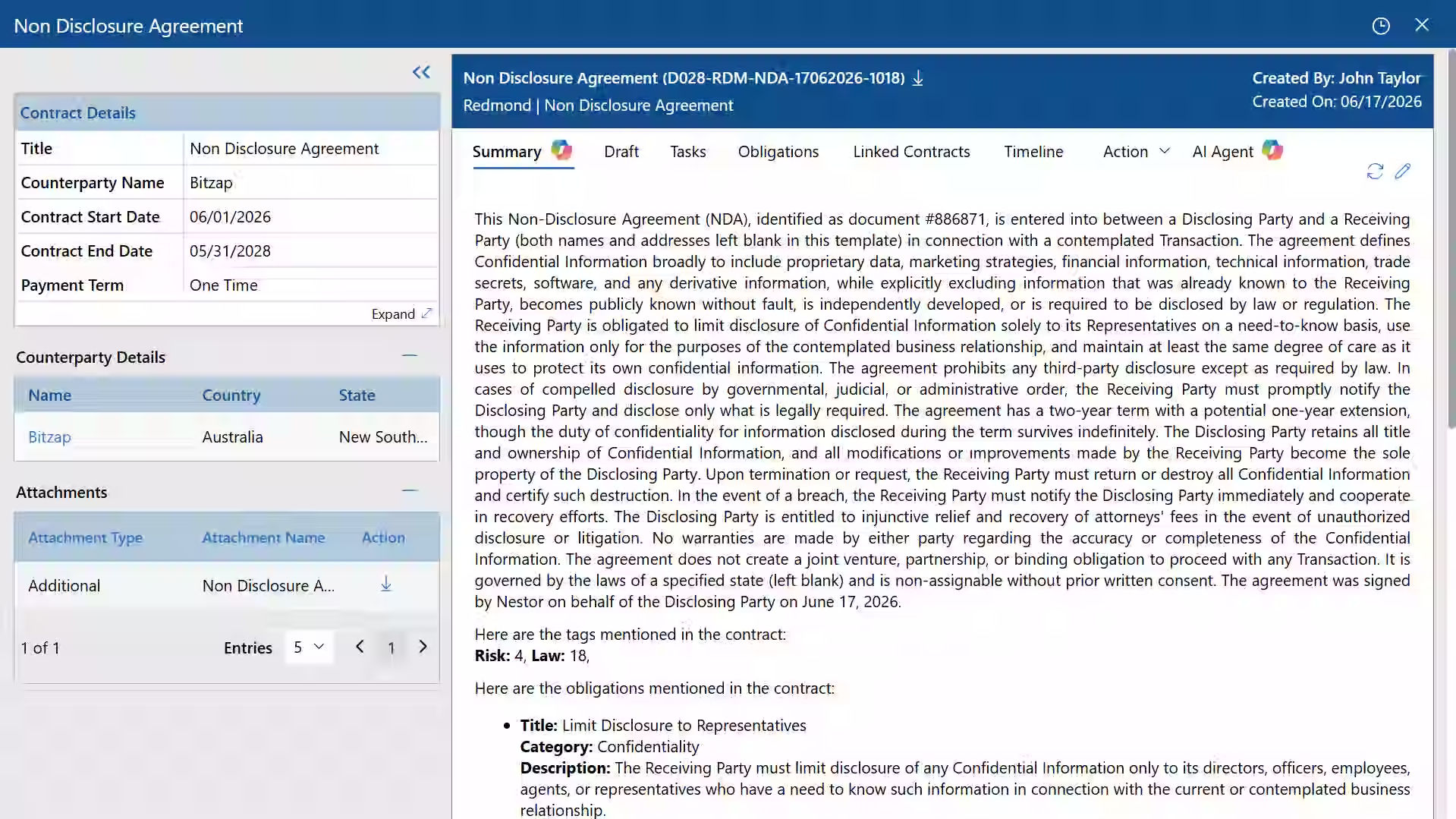
Understanding how AI for legal contracts works helps explain why businesses are increasingly adopting it. Although AI may appear complex, the overall process is straightforward.
The contract is uploaded into the AI powered contract managment as a Word document, PDF, or scanned file. Many modern solutions can also connect directly with document repositories like SharePoint, Microsoft Teams, or enterprise document management systems.
AI analyzes the contract clauses inside the document. Instead of only recognizing keywords, AI-powered contract lifecycle management understands how clauses relate to each other and identifies the purpose of different contract sections.
For example, AI can recognize:
- Confidentiality clauses
- Payment obligations
- Contract duration
- Notice periods
- Liability provisions
- Governing law
After reading the contract, AI automatically extracts key contract metadata from the document.
Example: Contract name, parties involved, effective date, expiration date, renewal terms, payment terms, and governing law.
Instead of manually entering this information into spreadsheets, AI captures it directly from the contract.
This is where AI for legal contract review becomes especially valuable. AI compares contract language against predefined legal policies or approved clause libraries.
It can identify:
- Missing clauses
- Non-standard wording
- Expired terms
- Risky provisions
- Inconsistent language
- Missing signatures
- Unusual payment conditions
- Different versions of similar agreements
Rather than replacing legal review, AI points legal teams toward the sections that deserve closer attention.
Long agreements can be difficult to review quickly. AI automatically generates summaries highlighting:
- Parties involved
- Main obligations
- Key dates
- Financial commitments
AI for legal contracts helps business users understand the agreement before reading the full document.
Spend less time reviewing contracts.
AI helps CLM 365 analyze lengthy agreements, summarize key clauses, and surface important obligations faster.
Why Businesses are Adopting AI for Legal Contracts?
Contract volumes continue to grow across industries. Procurement teams negotiate supplier agreements, HR manages employment contracts, sales teams finalize customer agreements, and legal departments review every stage of the process.
As this workload increases, organizations are looking for ways to improve how contracts are handled.
One major reason is the growing adoption of AI across businesses.
According to McKinsey’s latest research, 78% of organizations now use AI in at least one business function, reflecting how AI has moved from experimentation into everyday business operations.
Legal teams are following the same trend.
Research shows that 79% of law firm professionals already use AI tools in their daily work, while many corporate legal departments are adopting AI even more actively to review contracts, organize legal documents, and support legal research.
Businesses are also thinking ahead.
According to Gartner, by 2027, 50% of organizations will support supplier contract negotiations using AI-enabled contract risk analysis and editing tools.
These numbers reflect more than technology adoption, they show how organizations are preparing for larger contract volumes, faster business cycles, and increasing compliance expectations.
Common Challenges in Traditional Contract Management
Managing contracts manually becomes more difficult as a business grows. Finding the right document, tracking deadlines, and reviewing every clause manually takes time. Many businesses exploring AI for legal contracts are trying to solve these everyday challenges.
Business contracts often contain dozens of pages, making it time-consuming for legal teams to review contract terms, liability clauses, renewal conditions, and other important details manually.
Locating specific clauses such as renewal terms, termination rights, or notice periods can be challenging when contracts are stored across multiple systems and lengthy documents.
Managing multiple contract revisions increases the risk of reviewing outdated versions instead of the latest approved or signed agreement.
Tracking renewal dates, expiration dates, payment milestones, and notice periods manually becomes difficult as the number of contracts grows.
Legal professionals often review the same types of clauses across similar agreements, making contract reviews repetitive and time-intensive.
Key Features of AI for Legal Contracts
Today’s AI native contract management support much more than document storage they help legal teams review, organize, and analyze contracts throughout their lifecycle. Below are some of the most valuable features businesses look for.
AI reviews contracts before approval by analyzing the document and highlighting important clauses, missing provisions, tracks contract obligations automatically, unusual wording, and key legal terms. This helps legal professionals focus their attention on sections that require careful review instead of reading every page manually.
AI generates concise summaries that explain the contract’s purpose, the parties involved, key obligations, payment terms, important dates, renewal conditions, and termination rights. These summaries help business users understand the agreement quickly without reading the entire document.
AI automatically identifies and extracts important legal clauses from contracts, including confidentiality, limitation of liability, intellectual property, governing law, indemnity, payment terms, contract termination, and data privacy provisions. This makes it easier to organize, search, and analyze large volumes of contracts.
AI compares different versions of a contract and highlights changes in payment terms, contract duration, legal clauses, obligations, and other modified sections. This allows legal teams to quickly identify revisions and review only the changes instead of comparing documents line by line.
Contract intelligence search goes beyond simple keyword matching by understanding the context of legal language. Users can search contracts using natural language questions to quickly find agreements based on renewal dates, clause types, contract values, vendors, or other specific criteria.
AI helps identify contract language that may require additional legal review by flagging missing clauses, non-standard wording, high-risk provisions, unusual obligations, and incomplete information. Rather than replacing legal judgment, it directs reviewers to areas that deserve closer attention.
It identifies upcoming renewals, contract expiration dates, notice periods, and renewal deadlines. This gives organizations better visibility into important contract milestones and helps reduce the risk of missed renewal opportunities.
The repository stores agreements in a SharePoint environment, making it easier to organize, categorize, and retrieve contracts. Users can quickly search by vendor, customer, department, contract type, or status, improving accessibility and contract management across the organization.
Benefits of AI for Legal Contracts
Businesses invest in AI for legal contracts because it supports legal teams throughout the entire contract lifecycle. Here are some of the biggest benefits.
AI speeds up contract reviews by generating summaries and highlighting important clauses before legal professionals begin their detailed analysis. This reduces the time spent manually reading lengthy agreements and allows reviewers to focus on the most relevant sections.
AI organizes contract information into a searchable format, making it easier to find details such as contract values, renewal schedules, vendors, customers, departments, and expiration dates. This gives organizations greater visibility into their contracts and supports faster, more informed decision-making.
AI-generated summaries make legal agreements easier for business users to understand without requiring them to read the entire document. This reduces the number of routine questions directed to legal teams and improves collaboration across departments.
AI for legal contracts applies the same review criteria to every agreement, helping legal teams follow a more consistent contract review process. While legal professionals make the final decisions, AI provides a standardized starting point for reviewing contracts.
AI powered contract management automatically categorizes contracts using extracted metadata such as vendors, customers, agreement types, effective dates, renewal dates, and business units. This creates a well-organized contract repository where documents can be searched and filtered quickly.
How to Implement AI for Legal Contracts?
Adopting AI for legal contracts is not just about purchasing software. A successful implementation starts with understanding how your organization manages contracts today and identifying where AI can provide the most value.
- Step 1: Review Your Current Contract Process – Evaluate your existing workflow to identify where AI can reduce manual effort and improve efficiency.
- Step 2: Organize Your Contract Repository – Store contracts in a clean, centralized repository to improve AI-powered search and analysis.
- Step 3: Define Your Review Policies – Establish clear legal review rules, approval workflows, and compliance requirements for consistent contract analysis.
- Step 4: Start With High-Volume Contracts – Begin AI adoption with frequently reviewed agreements such as NDAs, vendor, and service contracts.
- Step 5: Train Your Legal and Business Teams – Educate users on how to interpret AI-generated insights while maintaining human oversight.
- Step 6: Validate AI Results – Review AI-generated summaries, extracted clauses, and flagged risks to confirm accuracy before making decisions.
- Step 7: Integrate AI Into Daily Workflows – Incorporate AI into existing contract review and approval processes to improve efficiency without disrupting operations.
- Step 8: Monitor and Improve Performance – Regularly evaluate AI performance and update review policies to improve accuracy and adapt to changing business needs.
Turn lengthy contracts into clear insights.
With AI-powered contract analysis, CLM 365 helps you understand key clauses, risks, obligations, and terms faster.
Best Practices for Using AI in Legal Contracts
Artificial intelligence continues to evolve, and legal contract management is expected to become more intelligent over the next few years.
- Review AI Results Before Taking Action – Always verify AI-generated summaries, extracted clauses, and recommendations before approving or signing a contract.
- Use Standard Contract Templates – Standardized templates improve review consistency and help AI analyze contracts more accurately.
- Keep Your Contract Repository Organized – Store, categorize, and maintain contracts in a centralized repository for faster search and better analysis.
- Update AI Review Rules Regularly – Keep AI review policies aligned with changing legal requirements, compliance standards, and business policies.
- Train Teams on AI Features – Ensure legal and business teams understand how to use AI tools effectively for contract review and management.
- Protect Sensitive Contract Data – Use secure AI solutions with role-based access, encryption, audit trails, and permission controls to safeguard confidential information.
Future of AI for Legal Contract Management
Artificial intelligence continues to evolve, and legal contract management is expected to become more intelligent over the next few years.
Instead of only reviewing documents, future AI solutions will help legal teams make faster, data-driven decisions throughout the contract lifecycle.
One indication of this shift comes from Gartner, which predicts that by 2027, 50% of organizations will support supplier contract negotiations using AI-enabled contract risk analysis and editing tools.
Here are some developments businesses can expect.
- More Intelligent Contract Review – AI for legal contracts will help better understand legal context, contract intent, and how different clauses relate to one another, providing deeper contract insights.
- Better Contract Risk Analysis – AI will identify risk patterns across large volumes of contracts, helping legal teams prioritize agreements that require closer review.
- Smarter Contract Search – AI-powered search will answer natural language questions, making it easier to find contracts and specific legal information without relying on keywords.
- More Automation Across the Contract Lifecycle – AI will support contract drafting, clause recommendations, metadata extraction, approvals, analytics, and renewal planning throughout the contract lifecycle.
- Greater Integration with Business Systems – AI will integrate more closely with platforms like Microsoft 365, CRM, ERP, and procurement systems to streamline contract management across the organization.
How CLM 365 Helps Manage Legal Contracts with AI?
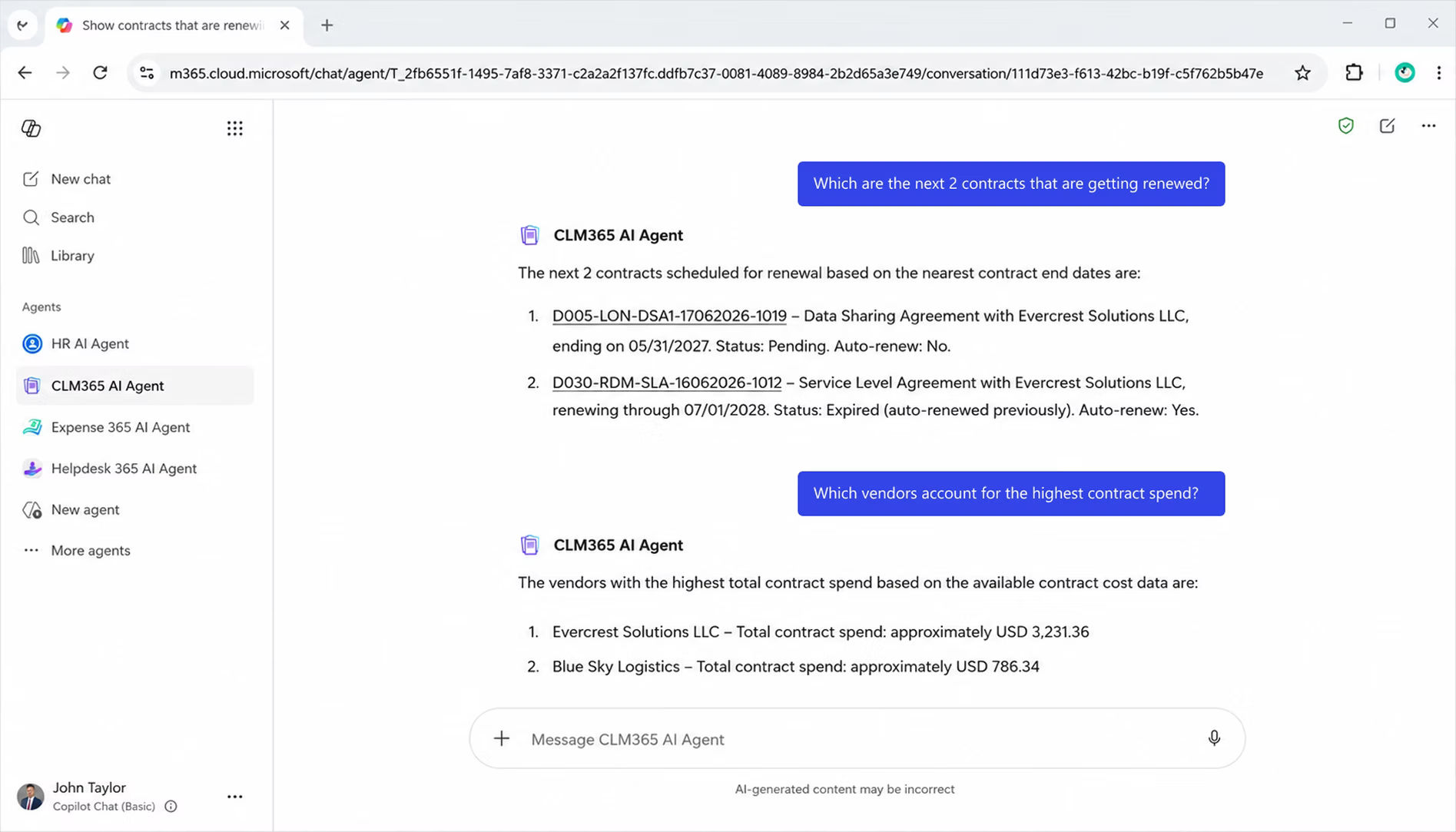
Managing contracts involves much more than storing documents. Legal teams need to review agreements, locate important clauses, track key dates, compare versions, and search thousands of contracts efficiently.
CLM 365 combines AI-powered contract management with Microsoft 365 to help organizations manage contracts throughout their lifecycle.
Some of its AI capabilities include
- Review contracts faster by identifying important clauses, obligations, key dates, and legal terms that require closer attention.
- Generate concise contract summaries that highlight the purpose, parties involved, payment terms, renewal conditions, and other key details.
- Automatically extract and organize important clauses such as confidentiality, termination, liability, governing law, and payment terms.
- Search contracts using natural language questions to quickly find agreements, clauses, vendors, customers, or renewal dates.
- Store contracts securely in a centralized Microsoft 365 repository for easier organization, version control, approvals, and document retrieval.
- Track the complete contract lifecycle from creation and approval to execution, renewal, and expiration with greater visibility into contract status.

Hear from Our Delighted Clients
CLM 365 has made contract reviews faster and more efficient with AI-powered contract summaries. It helps teams quickly understand key terms, obligations, and potential risks, reducing manual review and enabling faster, more informed decision-making.
Conclusion
Managing contracts involves more than simply storing documents. Legal teams need to review agreements, locate important clauses, track renewal dates, compare versions, and retrieve contract information quickly. CLM 365 combines AI-powered contract management with Microsoft 365 to help organizations streamline these tasks and manage contracts more efficiently throughout their lifecycle.
See AI-powered contract management in action. Learn how SharePoint contract management helps legal and business teams streamline contract reviews, improve visibility, and manage every stage of the contract lifecycle from a single platform.
Frequently Asked Questions
Can AI review legal contracts?
Yes. AI-powered contract management helps reviews legal contracts, analyze agreements, identify important clauses, generate summaries, extract contract information, and compare document versions. Final legal review should still be completed by qualified legal professionals.
Which contracts can AI review?
AI can review many types of business agreements, including:
- Non-disclosure agreements (NDAs)
- Employment contracts
- Vendor agreements
- Supplier contracts
- Service agreements
- Purchase agreements
- Sales contracts
- Licensing agreements
- Lease agreements
Is AI suitable for small businesses?
Yes. Small businesses can use AI to organize contracts, search documents, summarize agreements, and monitor important dates without building a large legal team.
How accurate is AI for legal contract review?
AI performs well when identifying clauses, extracting metadata, comparing versions, and summarizing documents. However, legal professionals should always review AI-generated findings before making legal decisions.
Can AI compare different contract versions?
Yes. AI can compare two or more versions of a contract and highlight additions, deletions, and modified clauses, helping reviewers focus on the changes.


_JiluXJRGNl.svg)























