

Every business runs on contracts. Vendor agreements, employment terms, client deals, partnership documents they shape how organizations operate, earn, and manage risk.
- Contract intelligence helps businesses quickly extract, analyse, and manage important contract data using AI and automation.
- It improves visibility into obligations, renewal dates, risks, and compliance requirements across agreements.
- AI-powered insights reduce manual review time and help teams make faster and more informed decisions.
- It improve collaboration between legal, sales, procurement, and business teams through centralized contract management.
Yet for decades, the way legal teams have handled contracts has barely changed: read, mark up, negotiate, sign, file. Repeat.
That is where contract intelligence comes in using AI to manage contracts, understand, extract, and act on contract data at a speed and scale no human team can match alone.
44% of current legal work tasks could be automated by AI, according to Goldman Sachs almost double the cross-industry average of 25%.
What is Contract Intelligence?
It is the use of AI and analytics to extract, analyse, and manage key information from contracts throughout their lifecycle.
AI contract management software helps businesses gain deeper visibility into terms, risks, obligations, and opportunities hidden within complex legal documents. By automating contract review and insights, it improves decision-making, reduces manual effort, and enhances overall efficiency.
- It helps businesses easily understand important details, opportunities, and responsibilities within contracts.
- Automated analysis saves time and makes contract handling faster and more organized.
- Smart insights help teams make confident decisions and improve overall productivity.
The Need for Contract Intelligence in the Modern Era
Before exploring what contract intelligence does, it helps to understand the problem it solves. Legal teams are overwhelmed not because they lack skill, but because the volume and complexity of contract work has grown far faster than headcount.
Lawyers spend between 40% and 60% of their billable hours on repetitive contract drafting and review work. Thomson Reuters
Think about what that figure means. If a lawyer bills 1,800 hours a year, up to 1,080 of those hours may be spent on work that follows a predictable pattern comparing clauses, checking terms, drafting standard language, flagging non-standard provisions. That is time that could go toward higher-value work: advising clients, building strategy, managing risk.
The challenge is not just the time. It is the consistency. When human reviewers process hundreds of contracts manually, small differences in attention lead to missed obligations, overlooked renewal dates, or non-standard contract clause that slip through. One unchecked clause in a supply chain agreement can expose a business to significant liability.
It does not replace lawyers. It removes the repetitive load so lawyers can focus on judgment calls that require legal expertise. That is a shift legal teams have been waiting for, and it is now practical and affordable to make it happen.
Data Security and Confidentiality in Contract Intelligence
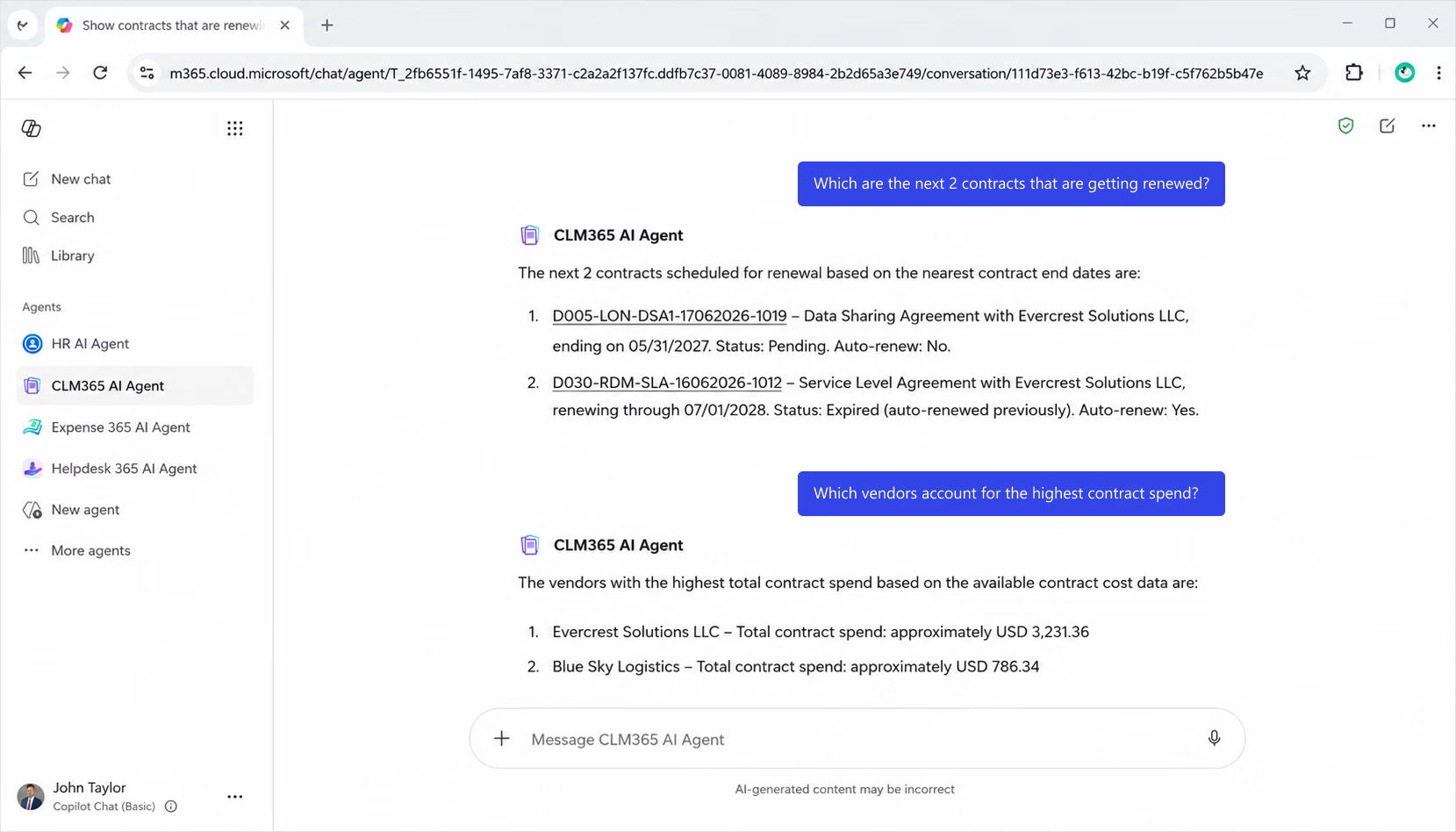
Take advantage of AI while keeping your contract data secure in your Microsoft 365 environment.
CLM 365 does not send your contract data to public AI services such as ChatGPT unless you explicitly configure an approved AI provider. You control which AI service is used, and all AI requests follow your organization’s security and governance policies. You decide which AI service to use, and every request follows your existing security, compliance, and governance policies.
This means your legal, financial, and business information remains protected by the same Microsoft security controls your organization already trusts, including permissions, audit logs, compliance settings, and access controls.
Whether you’re reviewing contracts for risks, extracting key clauses, tracking obligations, or summarizing agreements, AI works within your organization’s security boundaries not outside them.
For businesses with strict compliance, regulatory, or data residency requirements, CLM 365 provides the confidence to use AI while keeping full control over where contract data is stored and how it is handled. You get faster contract reviews and valuable AI insights without compromising security or governance.
Difference Between Contract Intelligence vs. Traditional Contract processes
To understand the full value of the system, it helps to see exactly where it differs from the traditional way of doing things. The table below breaks this down across five key dimensions.
Aspect | Traditional Process | Contract Intelligence |
Review Time | Hours to days per contract, depending on length and complexity. Teams often queue work, creating bottlenecks. | Seconds to minutes. AI reads and extracts key data from a contract the moment it is uploaded. |
Consistency | Varies by reviewer. Different lawyers may flag or miss different issues in the same document. | Uniform analysis every time. The same rules and risk thresholds apply to every contract in the repository. |
Clause management | Clauses are copy-pasted from previous contracts or sourced from shared drives. Version control is often informal. | Clause library with pre-approved, fallback, and non-negotiable options. |
Obligation tracking | Deadlines and deliverables are tracked in spreadsheets or calendars. Missed obligations are discovered reactively. | Obligations are extracted automatically and tracked with alerts. Teams see upcoming deadlines in a single dashboard. |
Risk identification | Risk depends on the reviewer’s experience and time available. | AI scans every clause against defined risk criteria and highlights deviations, unusual terms, or missing provisions automatically. |
The difference is not incremental it is structural. Traditional contract processes treat each document as a standalone task. It treats your entire contract portfolio as a connected, searchable, actionable dataset.
Give your contracts the visibility they deserve with CLM 365
CLM 365 brings contracts, key dates, responsibilities, and post-signature actions into one connected process.
How Contract Intelligence Works? (with example)
It combines natural language processing (NLP), machine learning, and large language models to read and interpret contracts the way a trained lawyer would at scale and without fatigue. Here is how the process typically unfolds:
A contract is uploaded as a PDF, Word document, or scanned image. The platform extracts and structures the text, even from poorly formatted legacy documents.
The AI identifies and labels individual clauses indemnification, termination, payment terms, confidentiality, governing law, and more. Each clause is tagged and stored against the contract record.
3. Risk Scoring
Clauses are compared against your organization’s pre-set standards. Anything outside the accepted range a liability cap that is too low, a missing indemnity carve-out is flagged with a severity level.
The AI produces a plain-language summary of the contract, like key parties, duration, obligations, payment terms, and notable risk items. This gives stakeholders a clear picture without reading the full document.
Dates, deliverables, and milestones are extracted and fed into a tracking system. Teams get alerts before deadlines, not after they are missed.
When a clause does not meet your standards, the platform suggests approved alternatives from the clause library so negotiators can push back quickly with pre-approved language.
A software vendor sends a 45-page SaaS agreement
A software vendor shares a 45-page SaaS agreement. Instead of spending hours reading and summarizing, the contract is quickly reviewed using AI in just a few minutes. It highlights important clauses like data terms, renewal conditions, and liability limits, and even suggests ready-to-use improvements.
The lawyer simply reviews these suggestions, makes quick edits, and sends the updated contract back the same day. What once took a full day is now done in under an hour faster, easier, and more efficient.
What Can Contract Intelligence Analyze?
The lawyer simply reviews these suggestions, makes quick edits, and sends the updated contract back the same day. What once took a full day is now done in under an hour faster, easier, and more efficient.
- Contract parties — Identifies the organizations and individuals involved.
- Contract value — Extracts financial values, pricing, and payment information.
- Key dates — Identifies effective, expiration, renewal, and termination dates.
- Renewal terms — Finds auto-renewal conditions, notice periods, and renewal requirements.
- Payment terms — Analyzes payment schedules, deadlines, and conditions.
- Contract clauses — Reviews liability, indemnification, termination, confidentiality, and data protection clauses.
- Service-level agreements — Identifies SLAs, performance requirements, and service commitments.
- Contract obligations — Surfaces responsibilities and commitments assigned to each party.
- Compliance requirements — Identifies contractual requirements related to regulations, policies, and standards.
- Non-standard clauses and deviations — Flags language that differs from approved templates, playbooks, or standard terms.
In short, contract analysis turns complex contract language into structured insights that teams can use to identify risks, track obligations, and make informed decisions.
Key Features of a Contract Intelligence Platform
Not all contract tools are equal. A capable contract management platform should cover the full contract lifecycle from drafting through execution and beyond. Here are the seven features that matter most.
1. AI Contract Summary
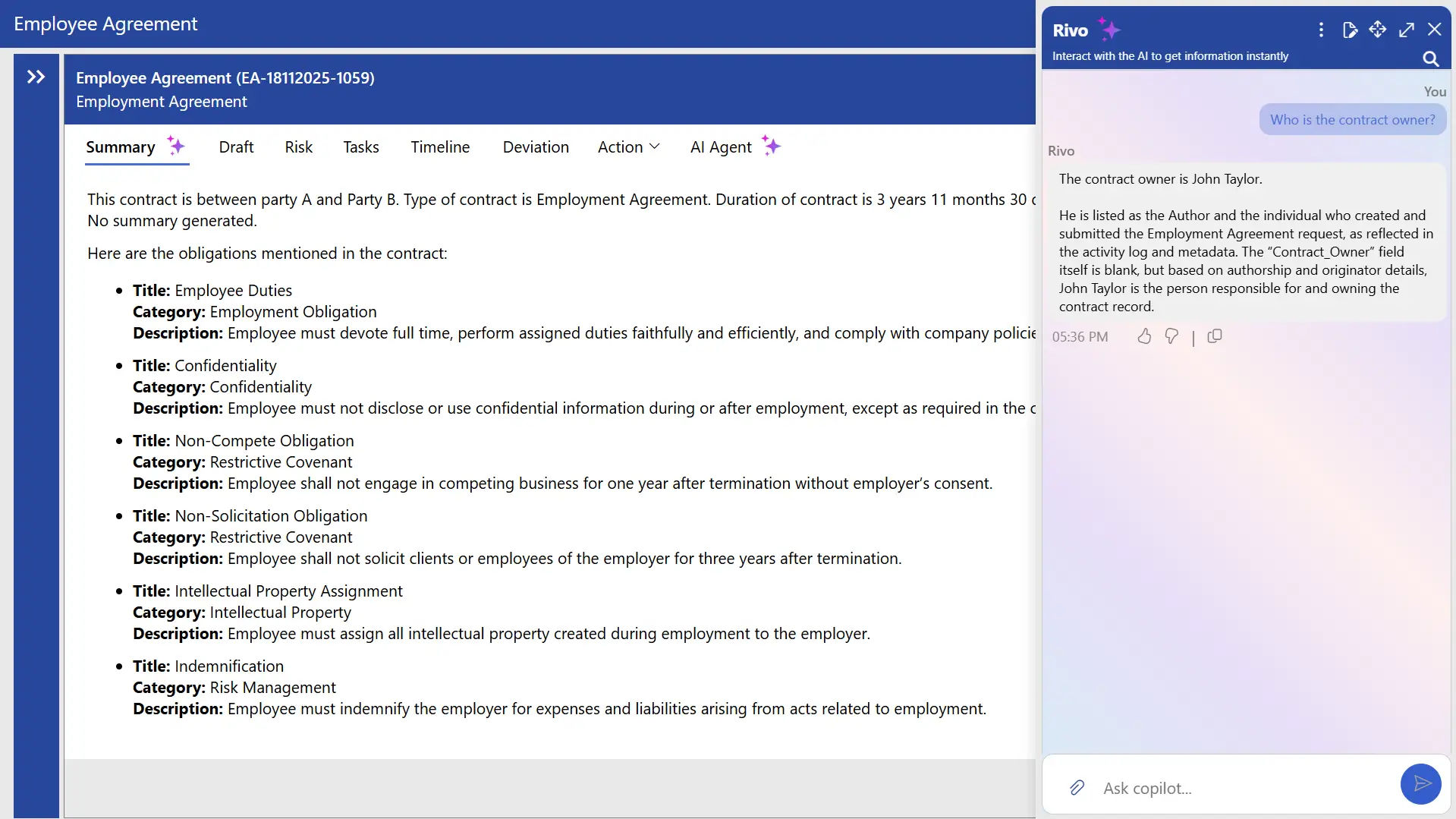
With AI contract summaries, long and complex agreements are instantly transformed into clear, easy-to-read summaries. It captures key details like parties involved, contract duration, responsibilities, payment terms, and important highlights in seconds.
2. Obligation Management
The system automatically identifies and manages all contract obligations, deadlines, and deliverables from each contract. Everything is tracked in one central place with smart reminders before important dates. This ensures teams stay proactive, meet commitments on time, and manage contracts with greater confidence and control.
3. Alternative Clause Suggestion
During negotiations, it helps by suggesting pre-approved and optimized clause alternatives instantly. Instead of delays, teams can quickly respond with the right language, ensuring consistency and faster deal closures while maintaining company standards.
4. AI Agent
The AI agent acts like a smart, always-available assistant for your contracts. Users can ask simple questions like “What are the payment terms?” or “When does this contract renew?” and receive instant, clear answers in plain language. It understands the full context of the document, making it easy to find specific details without scrolling through pages.
5. Clause Library
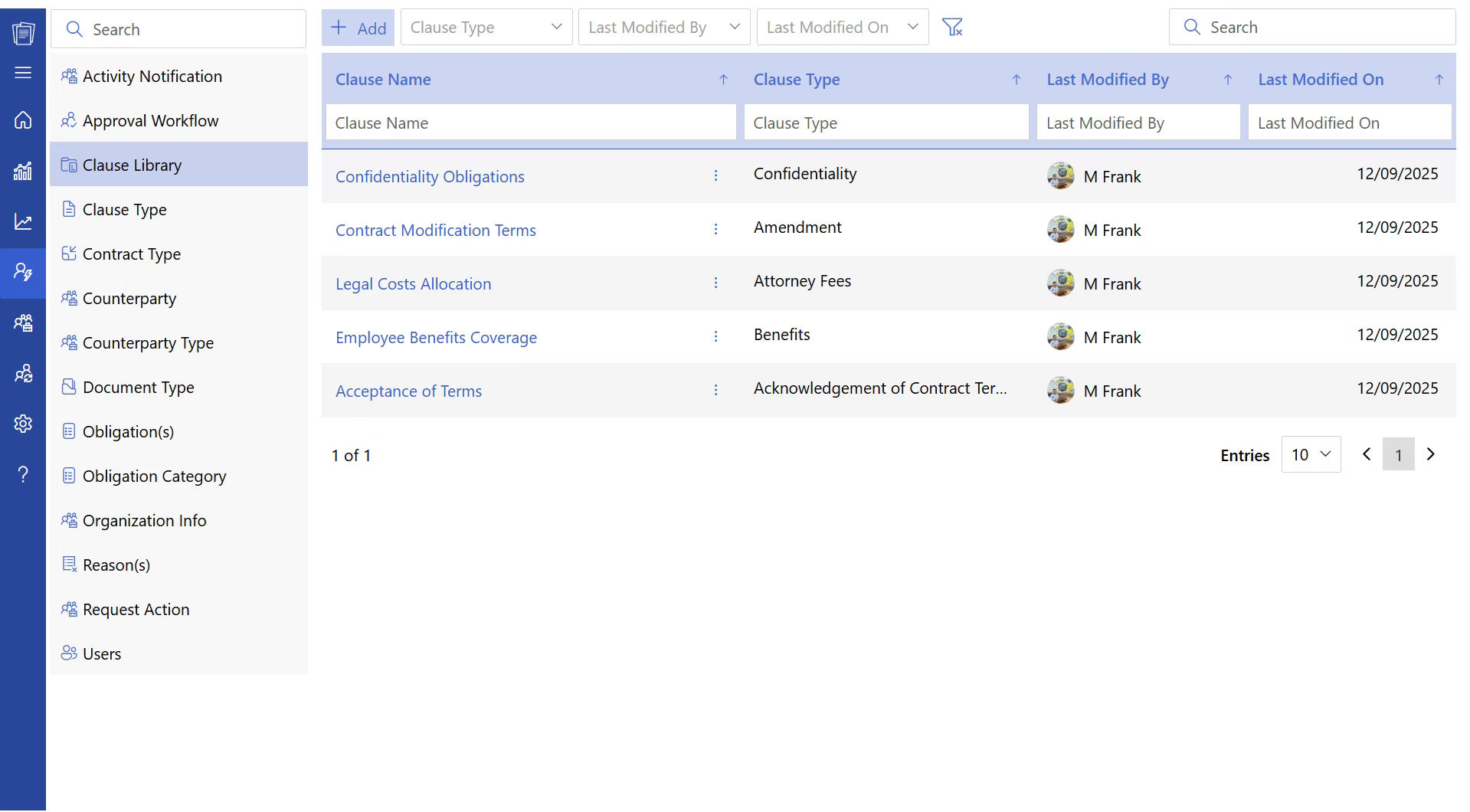
A strong contract management system software includes a well-structured clause library that stores pre-approved, fallback, and standard clauses in one place. A clause library template ensures every contract starts with reliable, compliant language while maintaining consistency across all agreements.
6. Analytics and Reporting
With the system users gain access to powerful yet simple dashboards that show contract performance and trends. Track timelines, understand patterns, and improve processes with clear data insights. This helps teams make smarter decisions and continuously optimize contract management.
Work smarter on contracts with Al
CLM 365 uses AI agents to review contracts, track obligations, and detect risks in seconds
Benefits of Using a Contract Intelligence Platform
The benefits of platform fall into four broad categories: speed, accuracy, cost, and organizational visibility. Together, they change how legal fits into the business from a function that slows things down to one that helps the company move faster.
AI handles the first review by extracting clauses, identifying key points, and generating summaries instantly. This reduces the contract review process, helping teams move from weeks to just a few days. It also brings consistency to every review with a more organized approach.
88% of organizations now use AI, up from 78% last year (McKinsey & Company). It captures every deadline, renewal date, and deliverable automatically. Teams receive timely reminders and alerts, making it easy to stay on track with all commitments. This keeps contract activities well-managed and clearly visible.
By reducing time spent on repetitive tasks, contract intelligence helps teams use their resources more effectively. Over time, this leads to strong cost savings, especially for organizations managing large volumes of contracts.
With contract intelligence, negotiators get instant access to approved clauses, past deal insights, and relevant context. This helps them respond quickly with the right language during discussions. As a result, deals move forward faster with stronger and more consistent outcomes.
The system makes contract data available across teams not just legal. Finance can review payment terms, procurement can track supplier commitments, and operations can monitor renewals. It brings greater contract visibility and control across the organization.
How Contract Intelligence Across Industries?
79% of law firm professionals now use AI tools in their daily work, with corporate legal teams adopting even faster. This highlights the rapid shift toward AI in legal operations, where contract intelligence is becoming essential across industries.
Legal department uses contract management software to review large volumes of contracts in less time, especially during due diligence, M&A transactions, and commercial work. This allows teams to handle more matters without increasing headcount. It improves productivity while maintaining high-quality output.
Fast-growing tech companies manage hundreds of agreements across customers, vendors, and partners. It helps legal and operations teams scale efficiently by handling contract reviews, tracking key terms, and supporting faster deal execution. It supports growth without adding extra workload.
Banks and financial institutions operate in highly regulated environments. The contract management tool highlights key clauses and tracks regulatory requirements across contracts. This helps teams stay aligned with policies while managing large contract portfolios with better visibility.
Contracts in healthcare, such as clinical trial agreements and licensing deals, require careful handling. Contract intelligence reviews documents and highlights important provisions, helping teams manage compliance requirements effectively. It supports accurate and well-structured contract management for healthcare.
Supplier agreements define timelines, quality standards, and responsibilities. It tracks these key details and provides timely alerts for important actions. This helps procurement teams stay updated and maintain strong supplier relationships.
Real estate contracts include lease agreements, construction deals, and property management terms. Contract analysis software extracts important details like rent changes, renewal dates, and maintenance terms automatically. This makes contract handling faster and more organized.
Best Practices for Implementing Contract Intelligence
The system delivers the most value when the implementation is planned thoughtfully. Organizations that get the most out of these tools share a few common habits.
- Start with high-volume contracts: Begin with NDAs, vendor agreements, or customer contracts before expanding to other types.
- Define risk levels: Set clear high-, medium-, and low-risk guidelines to help identify important contract issues.
- Build a clause library: Organize approved clauses and standard language to speed up drafting and maintain consistency.
- Involve key teams: Include legal, finance, procurement, sales, and operations to capture their contract information needs.
- Start with executed contracts: Use signed agreements to build a reliable data foundation and generate useful insights.
- Prioritize high-impact contracts: Focus on contracts tied to revenue, compliance, and critical business operations.
- Standardize key data: Keep fields such as contract value, dates, obligations, and renewals consistent for easier tracking and analysis.
Looking for a Smarter Way to Manage Clauses? Try CLM 365
CLM 365 brings contract intelligence directly into the Microsoft ecosystem, connecting with tools like Microsoft SharePoint, Microsoft Teams, Microsoft Outlook, Microsoft Copilot, Power BI, and Power Automate. This allows teams to work with contracts inside the tools they already use every day.
With built-in AI, CLM 365 makes contract processes faster and more effective. It supports smart approvals, tracks obligations automatically, and highlights important contract details in real time. Teams get clear insights without manual follow-ups, helping them stay organized and move work forward quickly.
The platform combines advanced intelligence with strong security and a simple interface. It is designed for both growing businesses and large enterprises, making contract management easy to adopt and manage at scale.
Hear from Our Delighted Clients
CLM 365 has made contract reviews faster and more efficient with AI-powered contract summaries. It helps teams quickly understand key terms, obligations, and potential risks, reducing manual review and enabling faster, more informed decision-making.
Conclusion
It is not a future technology. It is available, proven, and being used today by legal teams in every major industry. The question for most organizations is no longer whether to adopt it, but how quickly to do so and how to do it well.
Start with the highest-impact use case for your team, build the right foundation, and grow from there. The contracts are waiting and now, so is the intelligence to manage them properly.
Frequently Asked Questions
What does AI extract first from a contract?
AI quickly pulls key details like parties involved, effective date, contract duration, renewal terms, payment structure, and obligations. With contract intelligence, these fields are organized in a structured format, making it easy for teams to review and use the information without scanning the full document.
Can AI summarize contracts in simple language?
Yes, it converts complex legal text into short, easy-to-understand summaries. It presents the main points clearly, helping both legal and non-legal teams understand the contract faster and act where needed.
Can AI compare two contracts?
Yes, it highlights differences between versions and clearly shows what has changed. With contract intelligence, teams can quickly review edits, track revisions, and focus only on the updated sections instead of reading the entire document again.
Does AI help reduce contract cycle time?
Yes, it speeds up drafting, review, and approval stages by handling repetitive tasks and providing instant insights. It helps teams move contracts forward faster with better visibility into each stage of the process.
Can AI identify unusual terms?
Yes, it compares clauses against standard benchmarks and highlights terms It helps teams quickly spot important variations and review them with better context, improving overall contract quality.
Table of Contents

Trusted by the Best

_JiluXJRGNl.svg)























