

If you work in legal, sales, procurement, or HR, reading contracts can take a lot of time. Even after spending hours reviewing them, there is still a chance of missing important details.
If you work in legal, sales, procurement, or HR, reading contracts can take a lot of time. Even after spending hours reviewing them, there is still a chance of missing important details.
In this blog, we’ll understand what contract summary software is, how it works, the benefits of AI-powered contract summary tools, best practices businesses can follow, plus the role of CLM 365 in simplifying the contract summarization process.
This is where automated contract summary software help. Instead of reading every page manually, AI quickly scans the contract and gives a simple summary of the most important points including key terms, responsibilities, risks, renewal dates, and deadlines.
According to report by Thomson Reuters, 53% of organizations say they are already experiencing at least one benefit from adopting AI. Contract summarization is one of the most practical examples, helping teams reduce manual effort, improve accuracy, and focus on higher-value work rather than paperwork.
What Is Contract Summary Software
Contract summary software helps businesses quickly understand lengthy contracts by creating a short, easy-to-read overview of the most important details. Instead of spending hours reviewing every page, users can instantly identify key clauses, obligations, risks, payment conditions, renewal timelines, and termination terms.
Using AI technology, the software analyses the contract, extracts critical information, and presents it in simple language. Users can review specific sections, understand complex clauses faster, and gain better clarity on contracts without requiring deep legal knowledge.
Summarize contracts in minutes with CLM 365 AI Agent.
How Does Contract Summary Software Work?
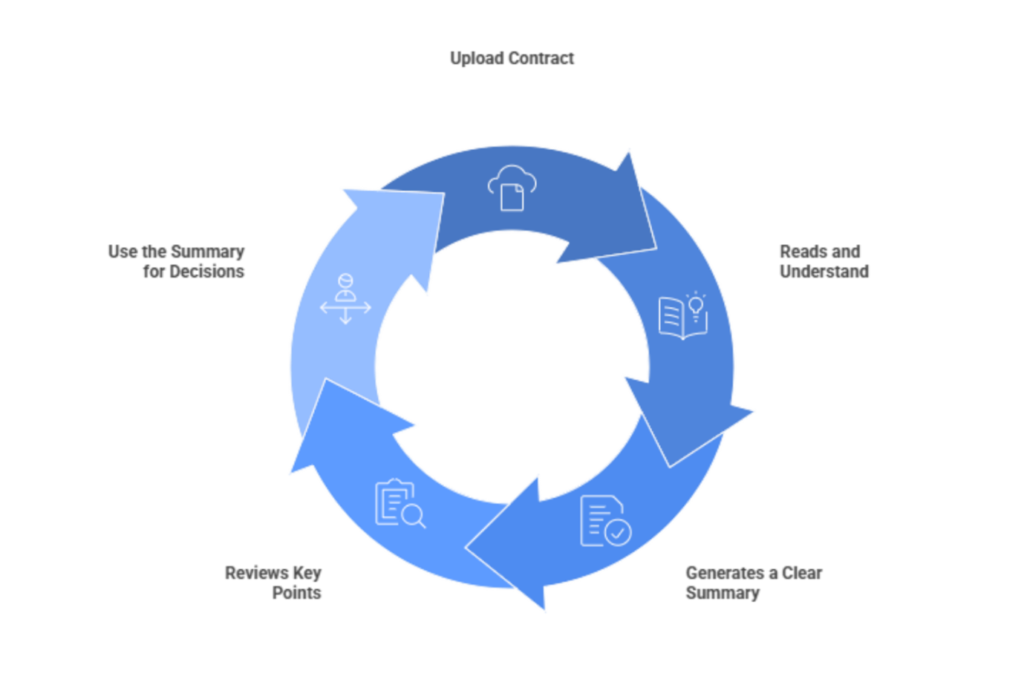
Contract summary software helps teams understand lengthy contracts faster by turning complex documents into short, simple summaries. Instead of manually checking every page, users can quickly access the most important contract details.
Step 1: Upload the Contract
Users upload the contract document, usually in PDF or Word format. The software securely scans the file while keeping the original document unchanged.
Step 2: Analyse the Contract Content
The software reviews the contract content to identify important information such as clauses, responsibilities, payment terms, deadlines, renewal dates, plus termination conditions.
Step 3: Generate a Simple Summary
The software creates a clear contract summary highlighting the key points of the agreement. Users can quickly understand the purpose of the contract, required actions, plus important dates.
Step 4: Check Important Clauses
Teams review the summary for better clarity. Users can open specific clauses to view simplified explanations of legal terms.
Step 5: Use the Summary for Faster Decisions
After review, teams can use the summary to approve contracts, negotiate terms, or manage agreements more efficiently without reading the full document again.
Key Features of Contract Summary Software
As businesses handle a growing number of agreements, reviewing contracts manually becomes time-consuming and difficult. Here are some key function of it.
1. Converts Complex Clauses into Simple Summaries
Contract summary software changes lengthy legal clauses into short, easy-to-read explanations. Users can quickly understand the purpose of each section, the responsibilities involved, plus the conditions mentioned in the agreement. This helps legal, HR, procurement, and sales teams save time during contract review process.
Summarize contracts instantly in 16+ languages with Agentic AI
2. Suggests Alternate Wording for Clauses
If a contract clause looks unclear, restrictive, or outdated, the software can recommend alternative wording options. These suggestions help businesses review contracts more confidently before approval or negotiation. Teams can compare different versions of a clause and choose language that better fits business requirements.
3. Up-to-Date Clauses Based on Industry Standards
The software matches the clauses of the contract with the frequently used language in other related industries. This assists the users to know whether the wording is in line with the current business practices. The teams can recognize the clauses that might require consideration as they are either outdated or rare.
3. Compares Clauses with Industry Standards
The software reviews contract language against commonly used industry contract clause and structures. This helps users identify unusual clauses, outdated wording, or terms that may need additional attention. Businesses can maintain more consistent contracts across departments and vendors.
4. Identifies Risks Early in the Review Process
One of the major advantages of contract summary software is its ability to detect potential risks early. The system can highlight payment conditions, penalties, liability terms, renewal clauses that may create business concerns. Early visibility helps teams make better decisions before signing agreements.
5. AI Agents Help Explain Clauses Clearly
Users can click on any clause and ask questions in simple language. The software explains what the clause means, why it matters, plus how it may affect the organization. According to Fynk, companies using AI have seen a 35% improvement in contract review accuracy. This feature makes contract review easier for non-legal teams who may not fully understand legal terminology.
6. Tracks Important Obligations and Deadlines
The software identifies key contractual obligations, deliverables, deadlines, plus renewal dates mentioned in the contract. Teams can stay informed about upcoming tasks and avoid missing important actions during the contract lifecycle. This improves contract management and reduces operational delays.
7. Integrates with Existing Business Tools
Contract summary software works smoothly with Microsoft 365. Teams can access contract summaries within their regular workflow without changing current processes. This creates a faster and more organized contract management experience across departments.
Benefits of Using AI-Based Contract Summary Software
According to a study by McKinsey, 78 percent of organizations already use AI in at least one business function. This shows how businesses are adopting AI tools to improve speed, accuracy, plus productivity in daily operations. Below are some of the major benefits.
1. Quick Understanding of Contract Details
The software scans the complete contract and extracts the most important information, including clauses, obligations, payment terms, timelines, renewal dates, plus termination conditions. Users can quickly understand the purpose of the agreement without reading every page manually.
Analyze lengthy contracts in minutes with CLM 365 Agentic AI
2. Faster Contract Review Process
Reviewing contracts manually often delays approvals and negotiations. AI-powered software creates summaries within seconds after the document is uploaded. Teams can access important contract terms, respond quickly, plus move contracts through the approval process more efficiently.
3. Better Visibility of Contract Risks
Contracts may contain hidden risks related to penalties, liabilities, pricing, renewals, or cancellation terms. The AI powered contract management software highlights these important areas early during the review process. This helps businesses identify concerns sooner and make informed decisions before signing agreements.
4. Improved Collaboration Across Teams
Contracts are often reviewed by multiple departments. Sharing lengthy legal documents can slow communication and create confusion. Contract summaries provide clear and structured information that helps teams discuss agreements with better understanding and faster alignment.
5. Easy for Non-Legal Teams to Understand
Legal terms can be difficult for employees outside the legal department. AI-based contract summary software explains contract content in simple language, making it easier for HR, sales, finance, plus operations teams to understand agreements without depending heavily on legal support.
How Contract Summary Software Helps Non-Legal Teams?
Contract summary software helps non-legal teams understand contracts more easily by converting long legal documents into short, clear summaries. Here is how it helps.
1. Simplifies Complex Contracts
Legal documents often contain difficult wording that can confuse non-legal users. Contract summary software explains important clauses in a simple and understandable format. Teams can quickly understand what the contract covers, the responsibilities involved, plus the important conditions without needing legal knowledge.
2. Reduces Dependence on Legal Departments
Not every contract requires full legal review. The software helps departments handle basic contract checks on their own by providing simplified summaries of key terms. Teams can identify common clauses, understand contract details faster, plus involve legal teams only when necessary.
3. Helps Teams Make Better Decisions
Clear contract summaries help departments review agreements with more confidence.
- Sales teams can review pricing, delivery terms, plus service scope
- HR teams can understand employee terms, policies, plus agreements
- Finance teams can check payment schedules, billing terms, plus penalties
- Procurement teams can review vendor obligations, renewals, plus contract conditions
This improves communication and helps teams make faster business decisions.
4. Keeps Teams Aware of Important Responsibilities
Contracts often include tasks, deadlines, plus deliverables that different teams must complete. Contract summary software identifies these important responsibilities clearly. Users can quickly see what actions are required and when they need to be completed without reviewing the entire document again.
5. Supports Better Contract Management
Contract summary software helps teams stay updated throughout the contract lifecycle process. Users can monitor important dates, review obligations, plus track key contract terms regularly. This allows teams to manage contracts proactively instead of reacting after issues arise.
Difference Between Contract Summary Software vs Manual Contract Review
Reviewing of contracts manually takes time, effort and specialization. Here is a short comparison.
Aspect | Manual Contract Review | Contract Summary Software |
Time Required | Hours or days to read full contracts | Key details available within minutes |
Cost Impact | High review effort for even simple agreements | Lower review effort and reduce cost |
Understanding | Requires legal expertise | Easy to understand for all roles |
Risk Visibility | Risks identified late in the process | Key risk areas highlighted early |
Team Dependency | Heavy reliance on legal teams | Supports independent review by business teams |
Best Practices for Using AI to Summarize Contracts
- Create a separate checklist from the contract summary to track responsibilities, approvals, payments, plus deadlines more easily.
- Highlight risky clauses early before internal meetings so teams can prepare better negotiation points in advance.
- Use summaries to explain contracts quickly to non-legal stakeholders without sharing the full legal document.
- Compare summaries from multiple vendor contracts to identify better pricing, terms, plus service conditions faster.
- Turn key obligations from the summary into reminders or workflow tasks to avoid missed actions later.
- Keep a library of past contract summaries to review previous agreements before signing new contracts.
- Use summaries during renewal discussions to quickly revisit commitments, performance terms, plus contract changes.
- Share only the relevant summary sections with different departments instead of sending lengthy contracts to everyone.
Getting Contracts Summarized with CLM 365
CLM 365 is built within the Microsoft ecosystem and connects smoothly with tools such as SharePoint, Microsoft Copilot, Microsoft Teams, Microsoft Word, Microsoft Power BI and Microsoft Power Automate. This allows teams to review, manage, plus collaborate on contracts directly within the business tools they already use every day.
CLM 365 also provides clear contract summaries that highlight important obligations, milestones, ownership details, plus critical dates. Teams can quickly understand key contract terms, review responsibilities, plus monitor upcoming actions without opening lengthy legal documents.
By bringing contract management into a single platform, CLM 365 helps departments stay aligned, improve visibility across contracts, plus respond to contract requirements more efficiently throughout the entire contract lifecycle.
Future of AI-Driven Contract Summarization
Future advancements will focus on generating more accurate summaries, identifying risks earlier, plus improving guidance throughout the entire contract lifecycle.
According to industry reports, businesses lose nearly 9.2% of annual revenue due to poor contract management practices. This is pushing organizations to invest in smarter contract management solutions that improve visibility, accountability, plus decision-making.
Contract summary software will continue to play an important role in helping businesses reduce risks, protect revenue, improve collaboration, plus manage contracts more efficiently across departments.
Conclusion
AI-powered contract summary software helps businesses convert lengthy and complex contracts into clear, easy-to-understand summaries. This helps teams save time, improve accuracy, plus understand important contract terms faster across customer, vendor, plus business agreements.
If your business handles multiple contracts every month, start a 14-day free trial of CLM 365 and discover a simpler way to review, manage, plus track contracts more efficiently.
Frequently Asked Questions
What types of contract risks can be identified using contract summary software? <
Contract summary software can highlight important risk areas such as penalties, auto-renewal clauses, liability conditions, unusual terms, plus payment-related obligations to support faster contract reviews.
Is contract summary software actually reliable for reviewing large contracts?
Yes, the software can process lengthy agreements quickly while extracting key obligations, deadlines, payment terms, plus important clauses in a structured summary.
Can AI explain legal clauses in simple English?
Yes, many AI-powered contract tools simplify complex legal wording into clear explanations that non-legal users can understand more easily. This helps business teams review contracts faster without depending entirely on legal departments for basic clause understanding.
Can contract summary software handle large agreements accurately?
Yes, modern contract summary software can process lengthy agreements quickly and extract important clauses, obligations, payment terms, deadlines, plus risks within seconds. This helps teams save significant time during contract reviews.
How are sales teams benefiting from AI contract summaries?
Sales teams use AI contract summaries to review pricing terms, service scope, delivery conditions, customer obligations, plus renewal details more efficiently. This helps speed up approvals, negotiations, plus customer communication workflows.


_JiluXJRGNl.svg)























