


Fixed vs variable cost comes down to one question: does the expense change when your sales or output change? Fixed costs, like rent, stay the same. Variable costs, like materials and sales commissions, rise and fall with activity.
Knowing which is which affects your pricing, your budget, and the sales you need to cover your bills. Two businesses with the same revenue can carry very different risk if one pays mostly fixed costs and the other pays mostly variable ones.
This guide covers the key differences, examples, and formulas. You’ll also find a worked monthly example, a checklist for classifying expenses, and tips for tracking them.
- Fixed costs stay the same each month, while variable costs rise and fall with sales or output
- Total cost equals total fixed cost plus total variable cost
- Mixed costs, like utilities, have both parts, so split them before you budget
- Classify expenses every quarter and compare actual spending against your budget
Fixed vs Variable Costs: Key Differences
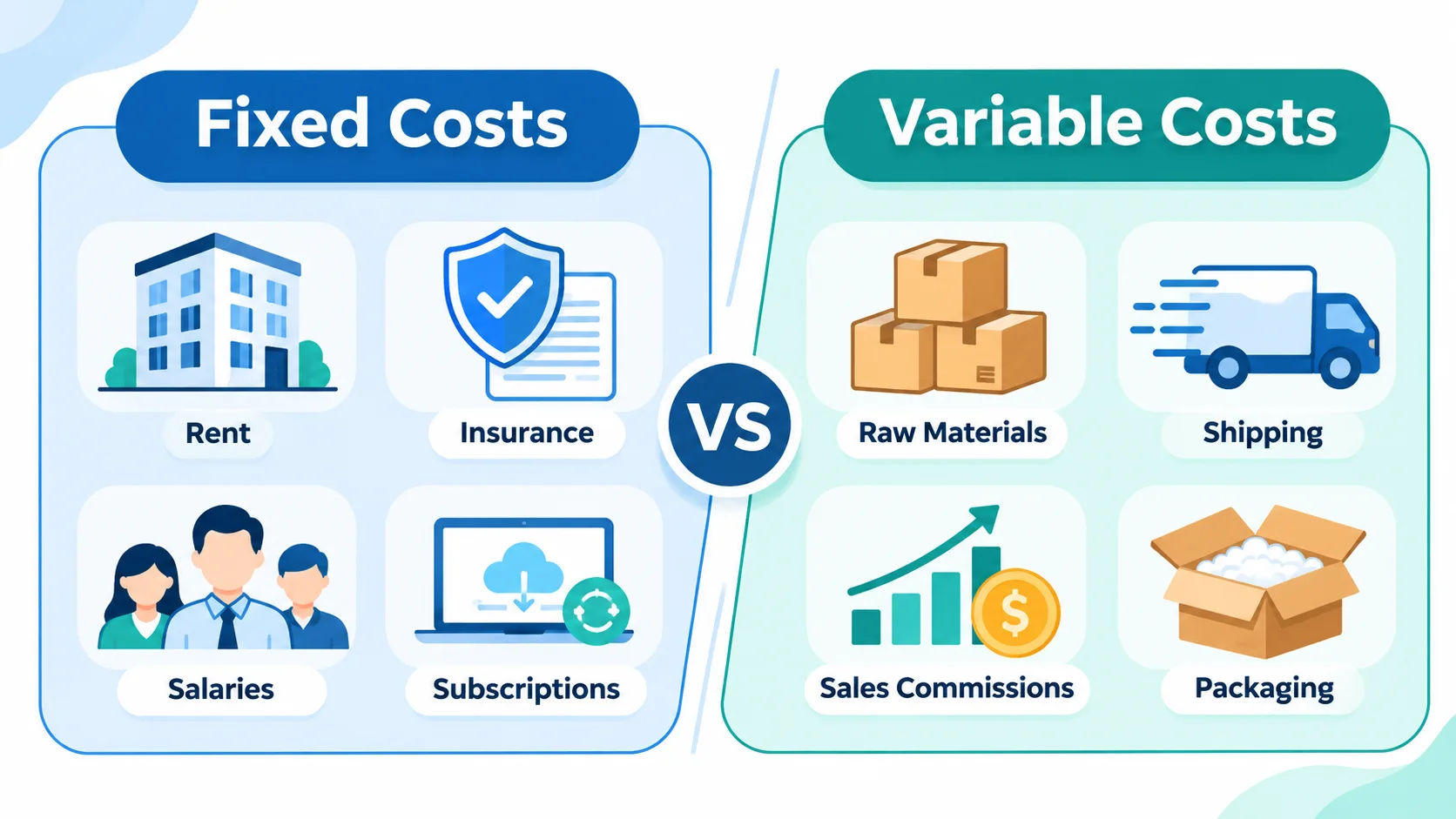
Fixed costs stay the same when activity changes, while variable costs move with it. Rent is the same whether you sell 10 units or 1,000. Materials aren’t. The table compares both across behavior, predictability, total cost, cost per unit, and examples.
Factor | Fixed costs | Variable costs |
Cost behavior | Stay the same within a normal activity range | Change as activity changes |
Predictability | High, since you know the amount in advance | Lower, since it depends on sales or output |
Total cost | Constant | Rises as volume rises |
Cost per unit | Falls as volume rises | Stays about the same |
Cost in a month with no sales | Still owed | Close to zero |
Common examples | Rent, insurance, salaries, equipment leases | Materials, packaging, commissions, transaction fees |
Here’s a quick test. If you’d still pay the bill in a month with no sales, it’s likely fixed. This difference between fixed and variable costs also explains why cost per unit drops as you sell more: the same rent gets spread across more units.
What Are Fixed Costs?
Fixed costs are business expenses that stay the same no matter how much you sell or produce. You owe them every period, even in a slow month. The amount can change over time, such as when a landlord raises rent, but it doesn’t change with output.
The U.S. Small Business Administration lists rent, salaries, property taxes, insurance, interest, and depreciation as typical fixed costs.
These fixed cost examples add up to $5,000 a month, the figure used in the calculations below:
- Rent or lease payments: a $2,000 office lease costs the same in busy and quiet months
- Insurance: a $400 monthly premium doesn’t change with order volume
- Salaried pay: a $2,000 monthly admin salary is owed whatever the sales volume
- Equipment leases: a $300 monthly lease on a printer or machine
- Fixed-fee software subscriptions: a $300 monthly plan with a flat price
A subscription priced per user can act as a mixed cost if your headcount changes often.
What Are Variable Costs?
Variable costs are expenses that change with sales volume or production output. If you make more, you pay more. If you make nothing, you pay close to nothing. Total variable cost rises with activity, while the cost per unit usually stays about the same. Materials, packaging, and sales commissions are typical examples.
Use these variable cost examples as a starting point:
- Materials: a bakery pays for flour and butter by the batch
- Packaging and shipping: each order needs a box and postage
- Sales commissions: a rep earns 5% of every deal closed
- Transaction fees: card processors take a percentage of each payment
- Activity-based labor: hourly or contract workers paid per job or shift
Bulk discounts can lower the cost per unit at higher volumes, so check supplier terms before you assume it’s constant.
How to Calculate Fixed and Variable Costs
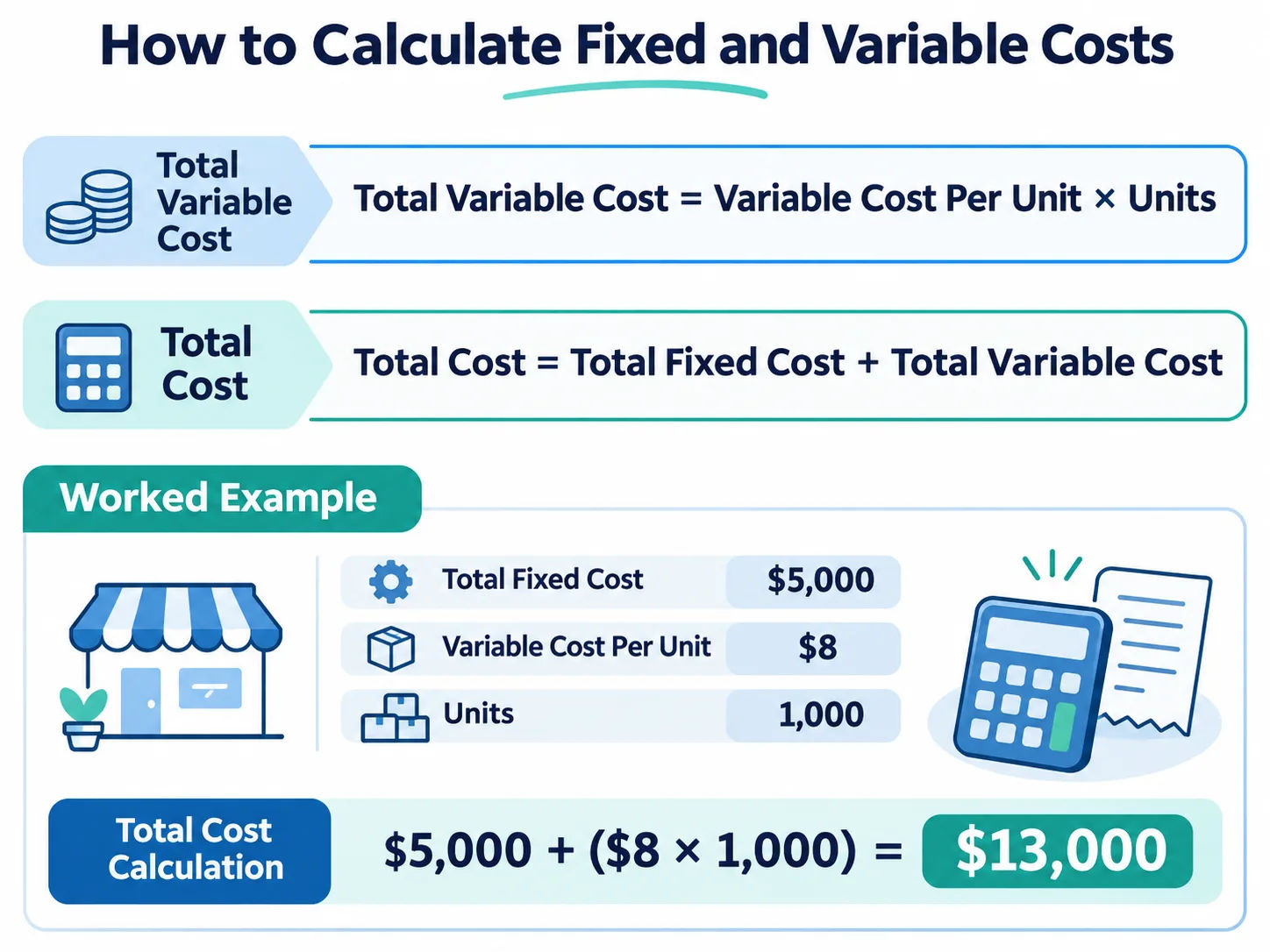
To find total cost, add total fixed cost to total variable cost. Total fixed cost is the sum of costs that don’t change with activity. Total variable cost is the variable cost per unit multiplied by the units produced or sold. The fixed and variable cost formula below uses one monthly example.
[Total fixed cost = rent + insurance + salaries + leases + other fixed expenses ]
Using the example: $2,000 + $400 + $2,000 + $300 + $300 = $5,000. Divide that by units sold to get fixed cost per unit.
[Total variable cost = variable cost per unit × units produced or sold]
If you pay $8 in materials, packaging, and fees per unit and sell 1,000 units, total variable cost is $8,000. Not sure of the unit figure? Here’s how to calculate variable cost per unit: divide total variable cost by the units produced.
[Total cost = total fixed cost + total variable cost]
The table applies it to four sales volumes. Fixed cost stays at $5,000 and variable cost is $8 per unit.
Units sold | Total fixed cost | Total variable cost | Total cost | Cost per unit |
500 | $5,000 | $4,000 | $9,000 | $18.00 |
1,000 | $5,000 | $8,000 | $13,000 | $13.00 |
1,500 | $5,000 | $12,000 | $17,000 | $11.33 |
2,000 | $5,000 | $16,000 | $21,000 | $10.50 |
Total cost rises with volume, but cost per unit falls from $18.00 to $10.50. The $5,000 is spread across more units. On a graph, fixed cost is a flat line, variable cost is a rising line, and total cost is the two added together.
What Are Mixed and Semi-Variable Costs?
Mixed costs, also called semi-variable costs, have a fixed part and a variable part. A phone plan with a $40 base fee plus usage charges is one example. You pay the base amount regardless, then more as usage grows. Split mixed costs into both parts before you build a budget.
Utilities, mobile plans, and tiered software subscriptions are common mixed costs. The SBA advises separating semi-variable costs into their fixed and variable parts so break-even analysis stays accurate. They sit between the fixed vs variable cost categories, so they need their own label.
Some costs jump in steps. A warehouse lease is fixed up to 5,000 orders a month. Beyond that, you need more space and the cost steps up. This is why classification depends on the activity driver, which is the measure that causes a cost to change, such as units made or orders shipped. It also depends on the relevant range, the band of activity where cost behavior holds true.
Why Are Fixed and Variable Costs Important?
Fixed and variable costs show how your spending reacts when sales change. That shapes your budget, your prices, and your break-even point. High fixed costs raise risk in slow months. High variable costs lower that risk but leave less profit on each sale.
Two numbers do most of the work. Contribution margin is the selling price minus the variable cost per unit. It’s the amount each sale adds toward fixed costs and profit. Break-even analysis uses it to find the sales volume where total revenue equals total cost.
Say you sell each unit for $20 and variable cost is $8. Contribution margin is $12. The SBA’s formula, fixed costs ÷ (price − variable cost) = break-even units, gives $5,000 ÷ $12 = 416.7, so you need 417 units to break even. At 1,000 units, revenue is $20,000, total cost is $13,000, and profit is $7,000.
Budgeting follows the same logic. Fixed and variable expenses behave differently, so budget fixed costs as flat monthly amounts and variable costs as a rate tied to expected sales.
How to Identify Fixed and Variable Costs in Your Business
To sort fixed vs variable costs, review your expense records, pick an activity driver, and ask whether each cost changes when that driver changes. Label it fixed, variable, or mixed. Then review the labels every quarter, since contracts and volumes change.
- Gather six to 12 months of invoices, card statements, and expense reports
- Pick your activity driver, such as units made, orders shipped, or hours billed
- Ask the zero-activity question: would you still pay this in a month with no activity?
- Label each cost fixed, variable, or mixed, then split mixed costs into a base fee and a usage charge
- Review the labels every quarter and after any contract change
- Does the cost change when the activity driver changes?
- Is the amount set by a contract or lease?
- Does the bill include both a base fee and a usage charge?
- Is a receipt or invoice attached to the record?
- Was the expense approved by the right person?
- Can you cut, cap, or renegotiate it at the next renewal?
How to Manage Fixed and Variable Costs Effectively
Manage fixed costs by reviewing contracts and cutting recurring expenses you don’t use. Manage variable costs by watching spending as volume changes and setting limits. Compare actual spending against budget every month so you catch drift early.
- Review lease, insurance, and service contracts before each renewal
- Cancel subscriptions and recurring charges nobody uses
- Ask suppliers for a lower rate in return for a longer commitment
- Track cost per unit monthly so supplier price rises show up early
- Set spending limits by category, such as travel or materials
- Compare quotes from two or more suppliers for your largest purchases
Each month, put actual spending next to the budget for every category. A gap of more than 10%, for example, deserves a closer look at whether volume, price, or a one-off purchase caused it. Variable costs should move with sales, so check them against your sales figures. Fixed costs shouldn’t move at all, so any jump points to a new contract or a billing error.
How Expense 365 Helps Control Business Costs
Conclusion
Fixed vs variable cost comes down to cost behavior. Fixed costs stay the same, variable costs move with activity, and mixed costs do both. Add total fixed cost to total variable cost to find total cost, then use contribution margin to find your break-even point.
Your next steps are to pull the last six months of expenses, choose an activity driver, and sort each cost with the checklist above. Then compare actual spending against your budget every month.
Clean expense records make that review faster.
Book a demo to see how Expense 365 handles expense submissions, approvals, and reporting inside Microsoft 365.
Frequently Asked Questions
Is rent a fixed cost?
Yes. Rent is one of the most common fixed costs because you pay the same amount each period, no matter how much you sell. It can change when a lease renews, but it won’t rise or fall with output during the lease term. Percentage rent, where the landlord takes a share of your sales, is a mixed cost.
Are salaries fixed or variable costs?
It depends on how people are paid. Salaries for full-time staff are fixed because the pay stays the same regardless of output. Hourly wages, overtime, and sales commissions are variable because they move with hours worked or sales closed. A base salary plus commission is a mixed cost.
Are utilities fixed or variable costs?
Utilities are usually mixed costs. Most bills combine a fixed service charge with a usage charge, so part of the bill stays flat and part rises with consumption. A retail shop pays the same base charge every month, but its electricity use changes with opening hours. Split the bill into both parts when you budget.
Is a software subscription a fixed or variable cost?
A flat-fee plan is a fixed cost because the price stays the same each month. A plan priced per user or per usage is variable or mixed, since the bill changes with headcount or volume. Check the billing terms before you classify it, and revisit the label when you add or remove seats.
Can fixed costs change over time?
Yes. Fixed costs stay constant only within a relevant range of activity and a contract period. A lease renewal, a new hire, or a premium increase can raise them. They don’t change just because sales moved this month. Review them at least every quarter, and after any contract change.


























