

Standardized Contracts: Purpose, Structure and Examples

Businesses often spend valuable time reviewing similar agreements, correcting outdated clauses, and waiting for legal approval. Standardized contracts help reduce these delays by giving teams a consistent starting point for common business deals.
- Using approved templates reduces drafting errors, cuts repeated legal reviews, and helps teams complete routine deals faster.
- A good standardization plan keeps important legal protections consistent while allowing changes to pricing, project scope, and business needs.
- Excessive standardization can create unfair conditions, limit negotiation, and leave businesses exposed to risks that need special attention.
- Regular template reviews, clear approval rules, and central document storage help businesses maintain consistency as their needs change.
However, using the same document for every transaction can contract disputes when pricing, services, or legal needs differ. Businesses must know which details to keep consistent and where to allow changes.
In this blog, we explain how contract standardization works, its key elements, practical examples, benefits, risks, and steps businesses can follow to create clear and reliable agreements.
What are Standardized Contracts?
Standardized contracts are legally binding agreements using pre-approved language, clauses, and formats for consistent business transactions.
Instead of writing each document from the beginning, businesses use a common template and update specific details for each deal.
These documents typically contain fixed legal provisions alongside sections that teams can change based on the transaction. For example, a company may use the same supplier agreement for multiple vendors while adjusting product quantities, prices, and contract delivery dates.
Purpose of Standardizing Contracts
The main purpose of contract standardization is to create a common approach to drafting, reviewing, and approving contracts. It helps teams work from reliable documents rather than creating different versions for similar transactions. Here are the main reasons businesses adopt this approach.
- Reduce drafting time: Employees can start with approved templates instead of writing every section from scratch.
- Maintain legal consistency: Common clauses help businesses apply the same basic protection across similar deals.
- Lower review costs: Legal teams can focus on unusual requests rather than checking familiar language repeatedly.
- Improve document accuracy: Pre-approved sections reduce the chances of missing important information or adding outdated wording.
- Support company policies: Teams can follow internal rules for payments, confidentiality, data handling, and approvals.
- Make negotiations easier: Clearly marked sections help both parties identify what they can discuss or change.
- Simplify future updates: Businesses can revise shared templates when company policies or legal requirements change.
This also helps employees understand which documents to use for different transactions. This becomes especially useful when several departments handle similar agreements.
Key Elements of Contract Standardization and Example
Successful standardization requires more than creating a common document format. Businesses need clear rules for drafting, reviewing, updating, and approving agreements.
Contract templates provide a starting document for common business transactions. Each version should match a specific purpose, such as hiring employees, purchasing products, or working with service providers.
Businesses should create a library of approved wording for common legal matters, including confidentiality, payment responsibilities, liability, and ending a business relationship. Employees can select suitable clauses without asking the legal department to draft them again.
Not every detail should remain fixed. Templates need editable sections for customer names, fees, service descriptions, and important dates. These fields allow teams to prepare documents that match individual transactions without changing the main legal structure.
Businesses should identify who can approve routine agreements and which changes require legal attention. For instance, a sales manager may approve a standard payment schedule, while a request to remove a liability limit may need legal review.
Every boilerplate contracts should have an assigned owner, version number, and review date. A process for tracking contract revisions and maintaining approved agreement versions helps employees avoid outdated language.
Real-world example: Standardized contracts in procurement
Consider a company working with 20 suppliers. Instead of drafting 20 agreements from scratch, its procurement team uses one approved contract structure.
The agreement follows the same contract conditions, confidentiality requirements, liability provisions, and termination process. Only supplier-specific details, such as pricing, delivery dates, and service requirements, change.
This reduces repetitive drafting while giving legal and procurement teams greater consistency across supplier agreements.
Difference Between Standardized vs Adhesion vs Customized Contracts
Although these three types of agreements may contain similar legal language, they differ in how much control each party has over the final document.
Comparison | Standardized Contracts | Adhesion Contracts | Customized Contracts |
Meaning | Reusable documents with approved wording | Prewritten documents usually offered on a take-it-or-leave-it basis | Documents written for a specific deal |
Negotiation | Selected sections can change | Usually little or no negotiation | Most sections can be discussed |
Flexibility | Moderate | Low | High |
Drafting time | Usually short | Usually short | Often longer |
Common use | Vendor and service agreements | Consumer subscriptions and insurance policies | Mergers and complex partnerships |
Main benefit | Consistency and faster preparation | Easy acceptance for routine transactions | Fits unique business needs |
Main limitation | May not cover unusual situations | Can favor the drafting party | Requires more legal work |
Key difference: Standardized agreements reuse approved terms with room for adjustments. Adhesion contracts limit negotiation, while customized contracts allow greater flexibility.
Benefits of Standardized Agreements
Different industries face different business and legal challenges. However, common contract formats help organizations manage recurring transactions while maintaining suitable protection. Here are the benefits across major industries.
When businesses use approved terms for recurring transactions, teams do not need to negotiate contracts every provision from scratch. They can focus discussions on deal-specific requirements such as pricing, delivery schedules, and service commitments.
When customers, suppliers, and service providers work under familiar contractual terms, both parties have a clearer understanding of their responsibilities, payment conditions, and obligations.
A boilerplate agreement structure gives reviewers a reference point. They can identify changes to liability clauses, payment conditions, termination rights, or other provisions and decide whether those changes require legal approval.
When terms and approved clauses follow a common structure, business operations become less dependent on how individual employees draft or interpret agreements. Teams can follow established contractual standards even when contractual liability change.
Legal teams can establish approved positions for frequently negotiated clauses, such as indemnification, liability, confidentiality, and termination. This helps reviewers assess exceptions against the organization’s accepted risk levels.
When a company enters new markets, works with additional suppliers, or increases its customer base, boilerplate contracts provide a starting point for recurring transactions. Local legal requirements and market-specific conditions can still be addressed through approved modifications.
A common set of clauses helps sales, procurement, finance, and legal teams understand how agreements are structured. Employees can become familiar with recurring obligations instead of learning a different contract structure for every transaction.
The value of consistency becomes clear when businesses manage large numbers of relationships. A 2025 World Commerce & Contracting whitepaper reports that only 39% of commercial practitioners believe their contracts are effective in delivering the desired outcome. This highlights the need for better drafting practices and clearer business expectations, not just common document formats.
Which Terms Should Be Fixed and Which Should Remain Flexible?
Effective uniformity depends on knowing which sections should remain consistent and which need room for negotiation. Businesses should separate their approved legal protections from transaction-specific information.
Terms that should generally remain fixed
Confidentiality protections: Use approved wording that explains how parties must protect private business information.
Governing law: Apply the company’s preferred legal jurisdiction where appropriate, subject to local laws and negotiation.
Compliance requirements: Maintain common standards for following applicable laws, industry rules, and company policies.
Liability framework: Establish approved limits and risk-sharing rules, with legal review for requested changes.
Document amendment rules: State how parties can make changes after signing, including who must approve them.
These sections provide a common legal foundation. However, even fixed clauses may need changes for certain industries, countries, or high-risk transactions.
Terms that should remain flexible
Pricing and payment schedules: Allow adjustments based on the transaction value, billing method, and agreed payment dates.
Scope of work: Describe the products, tasks, or services that apply to each business relationship.
Contract length: Set the start date, end date, and renewal conditions based on the parties’ needs.
Delivery milestones: Include suitable completion dates, service targets, or shipment schedules.
Performance standards: Define measurable expectations that match the type of work involved.
Special business requirements: Add relevant instructions when a transaction needs additional support, reporting, or technical details.
For example, a company working with five software vendors may use the same confidentiality wording but negotiate different subscription prices and support levels.
The goal is not to make every document identical. It is to keep common protections consistent while allowing reasonable business changes.
Limitations of Standardized Clauses in Addressing Transaction-Specific Risks
Using the same conditions across different transactions can cause businesses to overlook risks that require individual attention. Some examples include
- Different Project Requirements: A standard service agreement may not cover specific delivery conditions, technical requirements, or project responsibilities.
- Industry-Specific Risks: A construction agreement may require safety obligations and site responsibilities that are not relevant to a standard IT services contract.
- Different Liability Exposure: A low-value purchase and a high-value service agreement may carry different financial risks. Applying identical liability limits to both may leave one party exposed.
- Unique Payment Conditions: Some transactions involve milestone payments, advance deposits, or performance-based payments that standard payment clauses may not address.
- Third-Party Dependencies: Certain agreements depend on subcontractors, external vendors, or service providers. Common clauses may not clearly define their responsibilities.
- Local Legal Requirements: Contracts involving different countries or jurisdictions may require specific provisions. Reusing the same language without legal review can create compliance issues.
For example: A company using the same service agreement for a $5,000 consulting project and a $500,000 technology implementation may overlook differences in liability, delivery obligations, data security, and performance requirements.
When Should Businesses Use Standardized Contracts?
Businesses should use boilerplate contracts when they handle recurring transactions that follow similar legal and commercial conditions. Common situations include.
- High-volume transactions: Companies processing hundreds of purchase orders, customer subscriptions, or routine service arrangements can benefit from reusable templates.
- Recurring supplier relationships: Purchasing teams can use approved documents when on boarding vendors that provide similar goods or services.
- Employee hiring: HR departments can prepare common employment documents while updating compensation, job responsibilities, and location details.
- Low-risk business deals: Routine transactions with predictable requirements usually need fewer changes than complex projects.
- Multiple business locations: Organizations operating across different offices can maintain common company policies while accounting for local legal differences.
- Repeat customer purchases: Sales teams can use approved documents for familiar products or service packages.
Contract standardization may not suit mergers, major investments, or complex partnerships that involve significant financial and legal risks. These transactions often require customized agreements.
A useful rule: Use standardized contracts when only a few details change. Choose customized agreements when legal protections, responsibilities, or responsibilities require major adjustments.
How Do Teams Standardize Agreements?
Creating boilerplate contracts requires a clear plan that covers document preparation, legal review, and ongoing updates. Follow these steps to build a reliable approach.
Step 1: Review Existing Contracts
Collect frequently used agreements from sales, procurement, HR, and other departments. Identify repeated clauses, missing details, and common changes.
Step 2: Group Agreements by Purpose
Organize contracts into categories such as supplier agreements, employment contracts, customer subscriptions, and service agreements.
Step 3: Create Approved Contract Language
Work with legal teams to establish standard contract clauses, clear terms, and editable fields for transaction-specific details.
Step 4: Define Negotiation Limits
Decide which terms employees can modify and which changes require legal approval, such as liability limits or indemnification clauses.
Step 5: Maintain a Central Contract Repository
Store approved agreements in one location. Assign owners, track revisions, and make the latest approved versions accessible to relevant teams.
Step 6: Train Employees and Monitor Usage
Show employees how to select agreements, make permitted changes, and request exceptions. Monitor approval delays and recurring contract changes.
Step 7: Review and Update Agreements
Verify contractual language periodically to reflect changes in business policies, legal requirements, and operational needs. Remove outdated versions from circulation.
How Does Technology Support Contract Standardization?
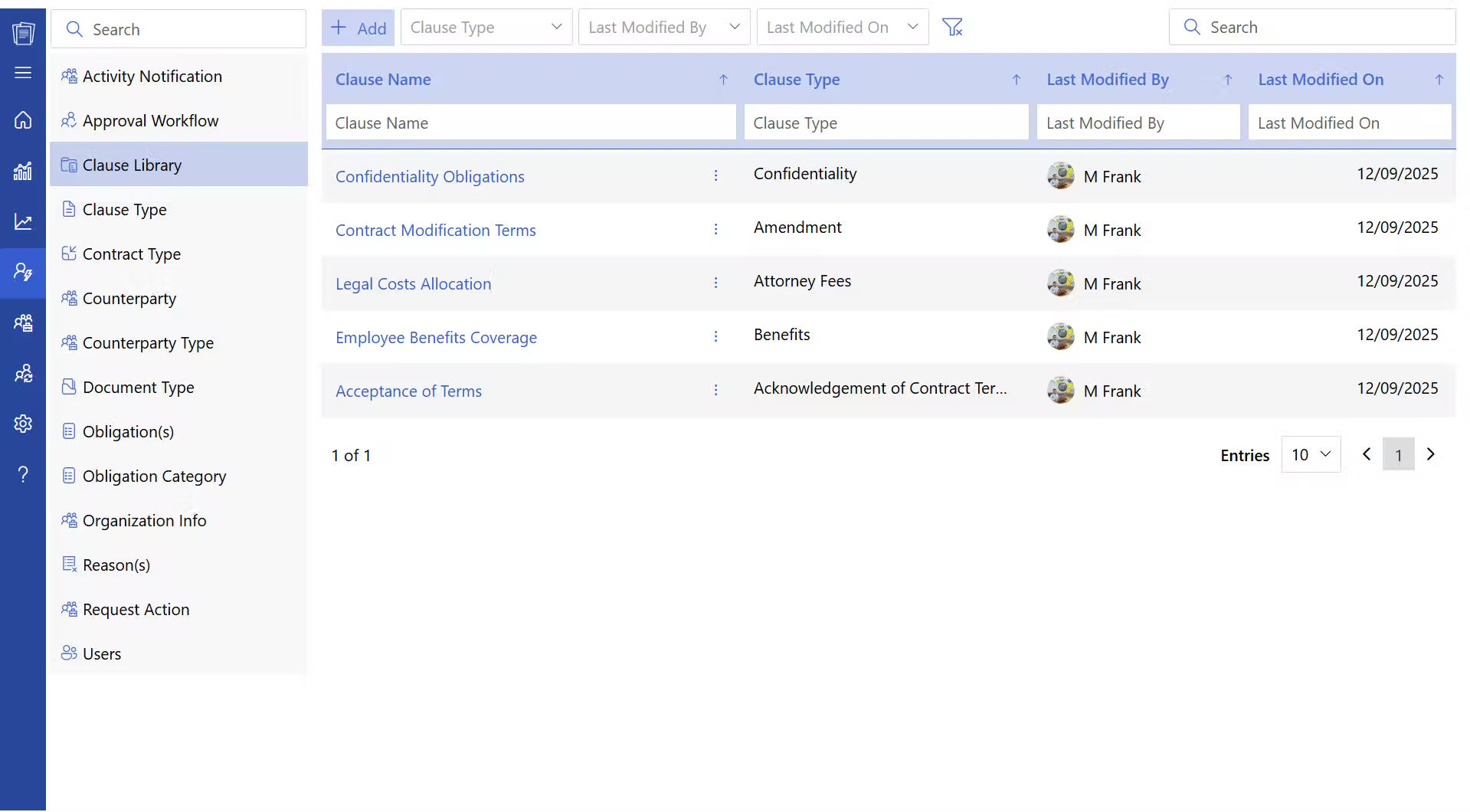
A secure system helps businesses create, store, and manage standardized agreements from a central platform.
CLM 365 is a SharePoint-based contract management that supports this approach with a centralized template library where teams can access approved documents for common business transactions.
Its clause library helps users reuse approved legal language while adjusting deal-specific details.
Automated approval workflows route requested changes to the appropriate reviewers, while version tracking helps teams identify the latest document.
With Microsoft 365 integration and centralized contract records, CLM 365 helps businesses maintain consistent drafting practices across departments.
Conclusion
Contract harmonization help businesses reduce repeated drafting work, maintain consistent legal language, and manage common transactions more effectively.
However, successful contract standardization requires a balance between approved wording and the flexibility needed for different business relationships.
The best approach is to standardize what remains common and allow changes where each deal needs them.
Frequently Asked Questions
Can businesses use the same uniform agreement across different countries?
They can use a common agreement structure, but local laws, tax requirements, privacy rules, and industry regulations may require specific changes.
Does a standardized agreement contain non-negotiable terms?
Yes. Businesses can designate certain provisions as non-negotiable, provided those terms comply with applicable laws and are properly communicated.
Which clauses should businesses avoid standardizing?
Clauses involving complex liability arrangements, unusual indemnification obligations, specialized performance requirements, and significant financial exposure may require individual review while handing standardized contracts.
Can small businesses benefit from standard form agreements?
Yes. They can use approved agreements for recurring customer, supplier, employment, and service transactions without drafting every document from scratch.
How can businesses decide which terms should remain flexible?
They should consider transaction value, legal exposure, industry requirements, negotiation needs, and the commercial impact of each provision.


























