Employee Self-Assessment: How HR Software Improves Performance Reviews

- An employee self-assessment highlights your achievements, growth, and contributions before a performance review, giving managers a more complete view of your performance.
- Use measurable results and specific examples to demonstrate your impact instead of listing daily responsibilities or routine tasks.
- Discuss areas for improvement with a growth mindset by explaining what you’ve learned and the actions you’re taking to develop new skills.
- Set clear, realistic career goals that align with your role and future development to make your performance review more meaningful and action oriented.
Writing an employee self-assessment can feel challenging, especially when you’re trying to summarize months of work into a few meaningful responses. Many people struggle to decide what accomplishments to highlight, how to discuss areas for improvement, or how to present their contributions with confidence during a performance review. A thoughtful self-assessment goes beyond listing completed tasks—it tells the story of your impact, growth, and future goals.
According to Gallup, only 21% of employees worldwide are engaged at work, highlighting the importance of regular feedback and meaningful performance conversations that encourage growth and development. A well-prepared employee self-assessment helps managers understand your achievements, recognize your progress, and have more productive performance review discussions.
Organizations also use HR software to make employee self assessments more structured by keeping goals, feedback, and performance records in one place throughout the review cycle. In this guide, you’ll learn what to include, how to showcase your accomplishments with measurable results, how to discuss improvement areas professionally, and how to set career goals that support your long-term growth.
What Is an Employee Self-Assessment and Why Does It Matter?
An employee self-assessment is a written evaluation where you reflect on your work, accomplishments, challenges, and professional growth over a specific review period. It is typically completed before a performance review and becomes part of the overall evaluation process.
Unlike a manager’s review, a self-assessment gives you the opportunity to explain your contributions from your own perspective. It helps managers understand the work behind completed projects, recognize achievements that may not be immediately visible, and identify areas where you want additional support or development.
Why Organizations Use HR Software for Employee Self-Assessments
Many organizations use HR software to make employee self-assessments easier to complete and manage. Instead of relying on spreadsheets or emails, team members can access self-assessment forms, previous goals, manager feedback, and performance records from one centralized platform. This helps create more consistent performance reviews while reducing manual follow-up for HR teams and managers.
A well-written self-assessment can also:
- Highlight accomplishments supported by measurable results.
- Encourage meaningful conversations during performance reviews.
- Identify professional development opportunities.
- Promote accountability and continuous learning.
- Help managers understand individual career aspirations.
This collaborative approach often leads to more productive review discussions because both parties have already reflected on the review period before meeting.
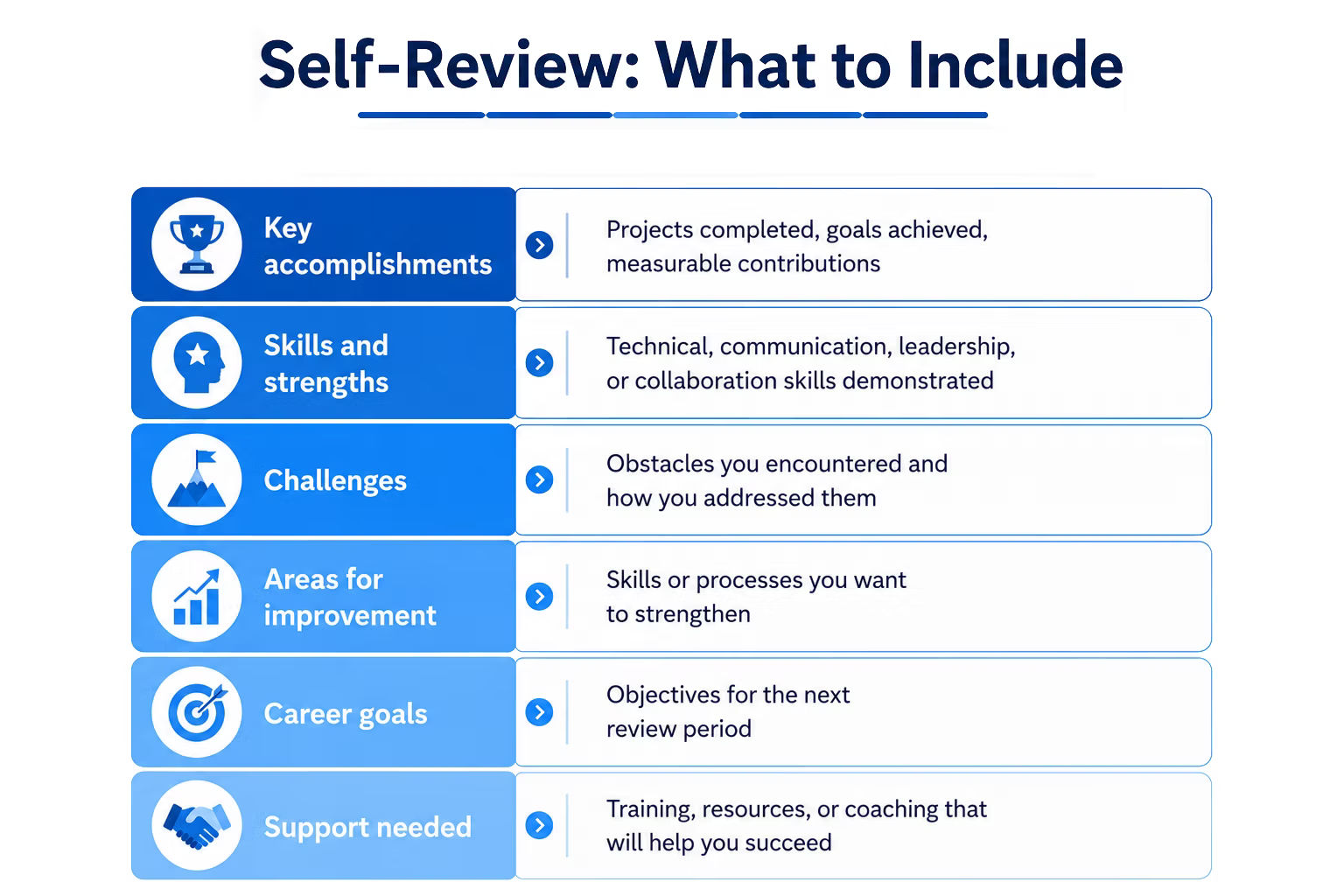
What Should an Employee Self-Assessment Include?
- Although formats vary between organizations, most self-assessments cover similar topics.
Completing each section thoughtfully gives your manager a well-rounded view of your performance instead of focusing only on recent events or individual projects.
How HR Software Supports Employee Self-Assessments
An employee self-assessment is more effective when team members have easy access to their goals, accomplishments, and feedback throughout the review period. Modern HR software brings this information together in one place, making it easier to prepare thoughtful, accurate, and evidence-based self-assessments without relying on memory or scattered documents.
Instead of searching through emails, spreadsheets, or meeting notes, team members can review completed goals, manager feedback, project milestones, and previous performance reviews from a centralized platform. This helps create more meaningful self-assessments while giving managers better context for productive performance review discussions.
It Gives Context to Your Accomplishments
Managers oversee multiple people and projects, so they may not remember every contribution you’ve made during the review period. An employee self-assessment helps connect your daily work to measurable outcomes.
Instead of listing tasks, explain the value your work created.
For example:
Less effective
“Completed monthly reports.”
More effective
“Prepared monthly operational reports that improved reporting accuracy and helped leadership identify project delays earlier.”
The second example explains why the work mattered, making your contribution easier to recognize during the performance review.
It Creates a More Balanced Performance Review
A manager’s feedback is important, but it represents only one perspective. Your employee self assessment adds your own observations, making the review more collaborative.
For example, you may have:
- Worked on cross-functional initiatives.
- Supported new team members.
- Solved unexpected challenges.
- Improved an internal process.
- Learned new skills outside your regular responsibilities.
These contributions may not always appear in project summaries or weekly updates, making your self-assessment an important opportunity to document them.
It Encourages Meaningful Career Conversations
Performance reviews shouldn’t only focus on past work. They should also help shape future growth.
A thoughtful employee self assessment gives managers insight into:
- Skills you want to strengthen.
- Projects you’re interested in joining.
- Leadership opportunities you’re ready to explore.
- Training that would support your development.
- Career goals for the next review period.
This information helps managers provide more relevant feedback and identify opportunities that align with your professional interests.
It Demonstrates Accountability
Taking time to evaluate your own work shows that you’re willing to reflect on both successes and challenges.
Rather than waiting for feedback, you’re actively considering questions such as:
- What went well?
- What could I have done differently?
- What skills have I improved?
- Where should I focus next?
This level of self-awareness often leads to more productive discussions because it shows you’re committed to continuous improvement rather than simply completing assigned tasks.
It Helps You Recognize Achievements You Might Forget
Many professionals underestimate how much they’ve accomplished over several months.
Think back to the beginning of your review period. You may have:
- Completed major projects.
- Learned a new software platform.
- Helped onboard new team members.
- Improved customer satisfaction.
- Reduced errors in a recurring process.
- Introduced a more efficient way of working.
Without documenting these accomplishments, it’s easy to overlook important contributions when writing your employee self assessment.
Creating a list before you start writing helps ensure your performance review reflects the full scope of your work.
It Builds Confidence Before the Review Meeting
Preparing an employee self assessment also prepares you for the conversation that follows.
As you organize your accomplishments, identify growth areas, and define future goals, you’ll have a clearer understanding of your own performance. That confidence makes it easier to answer questions, discuss challenges, and participate in a constructive performance review.
Instead of trying to remember examples during the meeting, you’ll already have a well-organized record of your work.
Common Mistakes That Reduce the Value of a Self-Assessment
Even experienced professionals sometimes miss opportunities to present their work effectively. Avoid these common mistakes:
- Listing responsibilities instead of achievements.
- Using vague statements without supporting examples.
- Ignoring challenges or lessons learned.
- Focusing only on recent projects.
- Forgetting to include measurable results.
- Setting unrealistic or unclear future goals.
- Writing in a tone that’s either overly modest or overly confident.
A balanced employee self assessment should recognize accomplishments, acknowledge growth opportunities, and demonstrate a commitment to continuous improvement.
By approaching your self-assessment thoughtfully, you create a stronger foundation for a productive performance review and a more meaningful discussion about your future within the organization.
Why Should You Use HR Software for Employee Self-Assessments?
HR software makes the employee self-assessment process more organized by bringing performance information together in one place. Instead of searching through emails, spreadsheets, or notes, team members can access their goals, accomplishments, manager feedback, and previous performance reviews whenever they need them. This helps them write more accurate, evidence-based self-assessments while preparing confidently for their performance review.
Gathering this information can be much easier when your accomplishments, goals, and feedback are documented throughout the year. Many organizations use HR software to keep performance information in one place, making it easier for team members to review completed goals, project milestones, manager feedback, and previous performance reviews before writing their self-assessment. This helps create more accurate and evidence-based responses.
1. Start With Your Biggest Accomplishments
Begin by identifying the contributions that had the greatest impact. These should go beyond your everyday responsibilities and demonstrate how your work supported your team or organization.
Think about questions such as:
- Which projects am I most proud of?
- What goals did I achieve?
- What problems did I help solve?
- Where did I make a measurable difference?
- What positive feedback did I receive?
Choose achievements that reflect different aspects of your role rather than repeating similar examples.
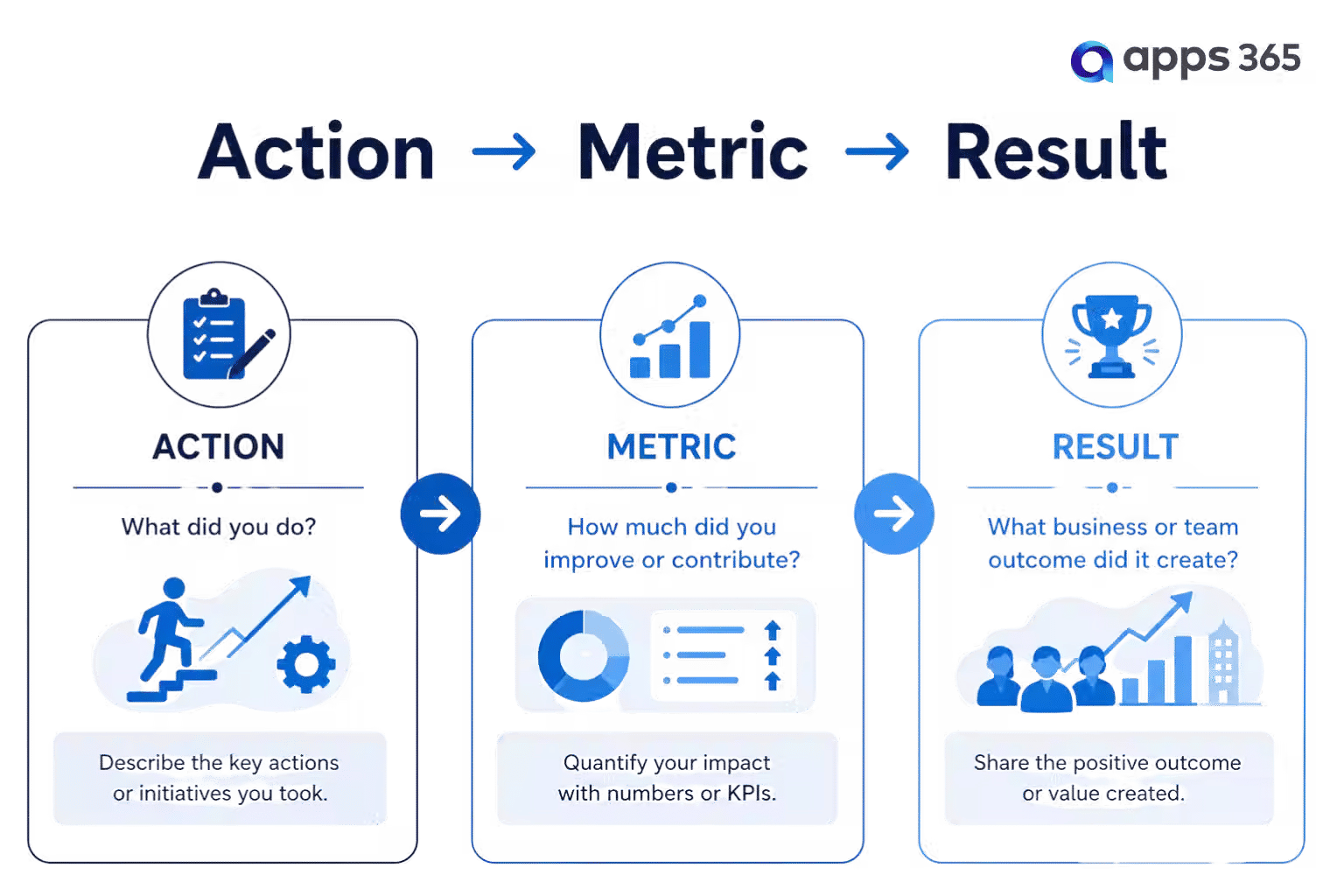
2. Use the Action + Metric + Result Framework
One of the easiest ways to write a stronger employee self assessment is to structure each accomplishment using a simple framework.
This format gives managers clear evidence of your contribution instead of asking them to interpret general statements.
3. Focus on Achievements, Not Responsibilities
One of the most common mistakes in an employee self assessment is describing routine job duties.
For example:
Instead of:
I attended weekly meetings and completed assigned work.
Write:
I coordinated weekly project updates, identified potential delivery risks early, and helped the team complete key milestones on schedule.
The second example explains how your work contributed to progress instead of simply describing your responsibilities.
Ask yourself:
“If someone else performed this task, what difference did my approach make?”
That answer often reveals your true accomplishment.
4. Support Your Statements with Evidence
Specific details make your self-assessment more credible.
Whenever possible, include measurable information such as:
- Percentage improvements
- Time saved
- Projects completed
- Revenue supported
- Customer satisfaction improvements
- Process improvements
- Training completed
- Team collaboration outcomes
Even if exact numbers aren’t available, explain the outcome your work produced.
5. Highlight Collaboration
Performance reviews rarely focus only on individual work. Organizations also value people who contribute to team success.
Include examples of how you:
- Supported colleagues during busy periods.
- Shared knowledge with new team members.
- Worked across multiple departments.
- Contributed ideas during projects.
- Helped resolve challenges collaboratively.
This demonstrates both technical contribution and teamwork.
6. Show How You've Grown
Managers want to see progress over time, not just completed work.
Think about skills you’ve developed during the review period.
Examples include:
- Learning a new business application.
- Improving presentation skills.
- Taking ownership of larger projects.
- Becoming more confident when communicating with stakeholders.
- Developing leadership skills by mentoring colleagues.
Describe both the skill and how you applied it.
This shows practical growth rather than simply listing completed training.
7. Maintain a Professional and Balanced Tone
An employee self assessment should sound confident without exaggerating accomplishments.
Avoid statements like:
- I was the best performer.
- Nobody contributed more than I did.
- I solved every problem successfully.
Instead, use balanced language that focuses on facts.
Professional language helps your achievements speak for themselves.
8. Common Writing Tips for a Strong Self Assessment
Before finalizing your employee self assessment, keep these best practices in mind:
- Write in the first person.
- Use clear and concise language.
- Prioritize achievements over daily activities.
- Include evidence wherever possible.
- Keep your tone positive and objective.
- Balance accomplishments with development opportunities.
- Review your statements for grammar and clarity.
A well-written self-assessment gives your manager meaningful insight into your work and creates a stronger foundation for your performance review discussion.
What Areas for Improvement Can You Track by Using HR Software?
Identifying areas for improvement is only the first step. Tracking your progress over time is equally important, and this is where HR software can make a significant difference. Instead of relying on memory or scattered notes, team members and managers can document feedback, development goals, and performance progress in one centralized platform throughout the review period.
With ongoing visibility into improvement areas, it’s easier to measure progress, update development plans, and prepare for future performance reviews. Solutions like HR365 HRMS Performance Management help organizations track employee development, manage continuous feedback, and monitor growth, making performance conversations more meaningful and focused on long-term success.
Be Honest, but Stay Constructive
When discussing areas for improvement, avoid language that sounds overly negative or self-critical. At the same time, don’t choose a strength and disguise it as a weakness.
For example, statements like these don’t add much value:
- I work too hard.
- I’m a perfectionist.
- I care too much about quality.
These responses are common and rarely provide meaningful insight during a performance review.
Instead, identify a genuine area where you’re actively working to improve and explain the steps you’re taking to make progress.
Focus on Skills You Can Develop
The best improvement areas are those that can be strengthened through learning, practice, or experience.
Consider skills such as:
- Time management
- Delegation
- Public speaking
- Project planning
- Technical knowledge
- Written communication
- Leadership
- Cross-functional collaboration
- Data analysis
- Prioritization
These areas demonstrate a growth mindset because they can improve over time with consistent effort.
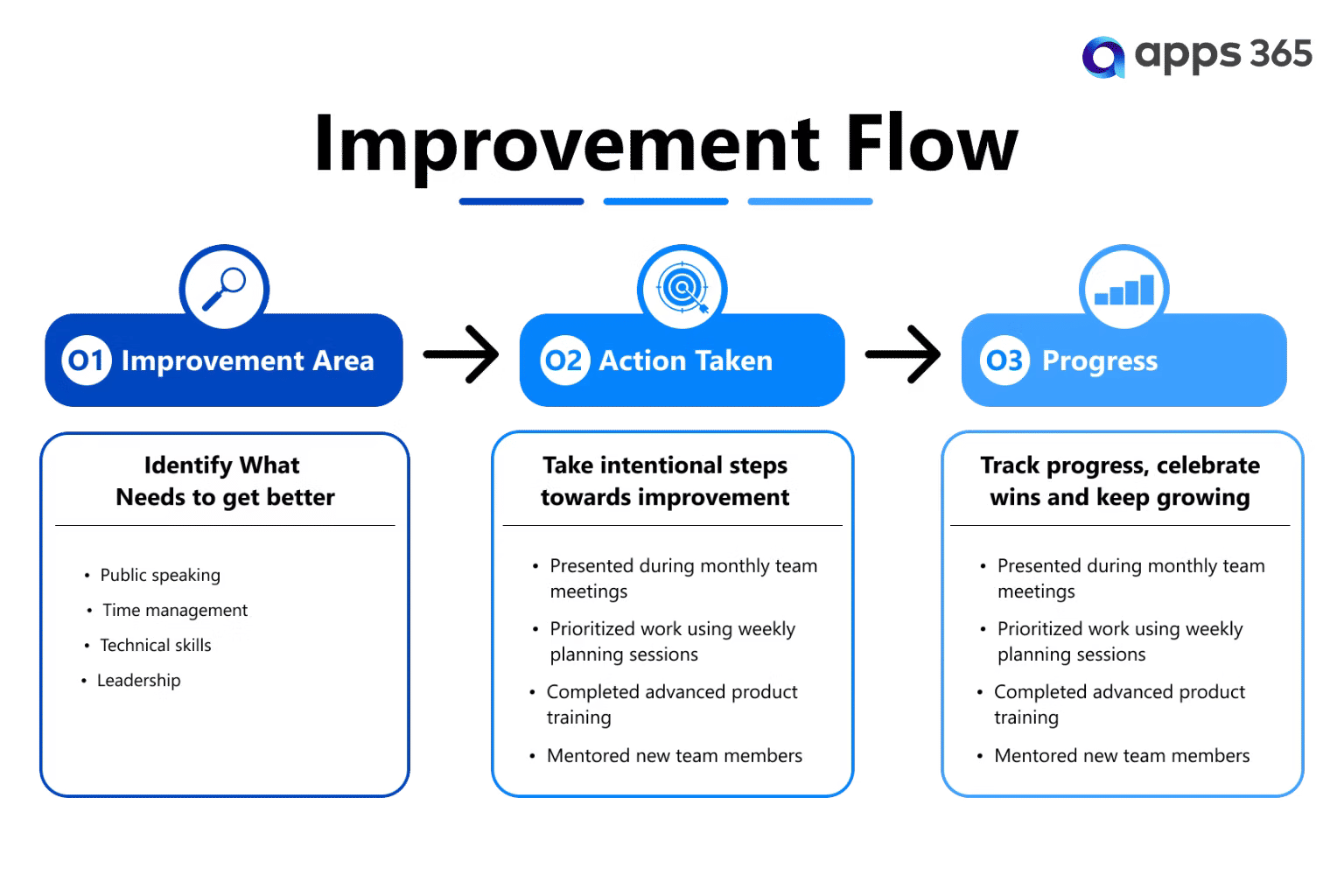
Explain What You’re Doing to Improve
Don’t stop after identifying an improvement area. Explain the specific actions you’re taking.
A simple structure works well:
Improvement Area → Action → Progress
This structure shows that you’re actively working toward improvement rather than simply acknowledging a challenge.
Connect Improvement Areas to Future Growth
Managers appreciate team members who think beyond their current role.
Whenever possible, explain how improving a particular skill will help you contribute more effectively in the future.
Avoid Common Mistakes
When writing this section, try to avoid these common pitfalls:
- Listing too many weaknesses.
- Being overly critical of yourself.
- Mentioning skills unrelated to your role.
- Blaming other people for challenges.
- Identifying a problem without explaining how you’re addressing it.
- Using vague statements without examples.
A focused and balanced response creates a stronger impression than a long list of unrelated improvement areas.
Turn Feedback Into Action
Performance reviews often include valuable feedback from managers and peers. Your employee self assessment is a good place to demonstrate how you’ve applied that feedback.
Balance Confidence With Self-Awareness
A strong employee self assessment recognizes accomplishments while also acknowledging opportunities for growth.
Managers generally value team members who can answer questions such as:
- What did I learn this year?
- Which skills have improved the most?
- What challenges helped me grow?
- What should I continue developing next year?
Thoughtful answers to these questions create a balanced self-assessment and lead to more productive performance review conversations.
How HR Software Supports Career Goals and Self-Assessments
Setting career goals and completing an employee self-assessment become more effective when performance information is organized throughout the year. HR software gives team members access to their goals, accomplishments, manager feedback, and development plans in one centralized platform, making it easier to reflect on progress and prepare for performance reviews.
With clear visibility into individual goals and performance history, organizations can encourage continuous development instead of limiting feedback to annual reviews. HR365 HRMS Performance Management helps HR teams and managers track career goals, monitor progress, manage employee self-assessments, and conduct performance reviews within Microsoft 365, creating a more structured and consistent performance management process.
Align Your Goals With Your Role
Start by thinking about how you can become more effective in your current position before aiming for larger responsibilities.
Ask yourself:
- Which skills would help me perform my job better?
- What responsibilities would I like to take on?
- Which projects could help me gain new experience?
- How can I contribute more to my team?
Goals that support your current role often have a greater impact than goals that are too broad or unrelated.
For example:
- Improve project planning and organization.
- Strengthen communication with stakeholders.
- Learn advanced reporting or analytics tools.
- Develop stronger leadership skills.
- Improve customer relationship management.
These goals demonstrate continuous improvement while remaining practical and achievable.
Use the SMART Goal Framework
A common way to write career goals is by using the SMART framework.
Your goals should be:
- Specific – Clearly define what you want to achieve.
- Measurable – Include a way to track progress.
- Achievable – Make sure the goal is realistic.
- Relevant – Align it with your responsibilities.
- Time-bound – Set a target completion date.
For example:
Less Effective Goal
Improve communication.
SMART Goal
Complete a business communication course within six months and apply the techniques by leading monthly project updates for my team.
The second example gives your manager a clear understanding of what you plan to accomplish and how success can be measured.
Focus on Skill Development
Learning new skills is one of the most valuable goals you can include in your self-assessment.
Depending on your role, you might focus on developing:
- Leadership and coaching
- Strategic thinking
- Technical expertise
- Project management
- Problem-solving
- Communication
- Data analysis
- Negotiation
- Collaboration across departments
- Decision-making
When possible, explain how improving these skills will benefit your team or organization.
Include Goals That Support Team Success
Career goals don’t have to focus only on individual achievement.
Managers appreciate goals that contribute to the success of the entire team.
Examples include:
- Share knowledge through internal training sessions.
- Help improve team documentation.
- Support onboarding for new colleagues.
- Contribute ideas that improve existing processes.
- Participate in cross-functional projects.
Avoid These Common Goal-Setting Mistakes
Career goals are most effective when they are practical and actionable. Avoid goals that are too vague or difficult to measure.
Common mistakes include:
- Setting unrealistic expectations.
- Choosing goals unrelated to your role.
- Writing goals without timelines.
- Focusing only on promotions.
- Including too many goals at once.
Instead, prioritize three to five meaningful goals that you can realistically achieve before your next performance review.
Review Your Goals Before You Submit
Before completing your employee self assessment, ask yourself:
- Are my goals clear and measurable?
- Do they support my current responsibilities?
- Have I explained why these goals matter?
- Can I track my progress over time?
- Will these goals benefit both my development and my team?
If the answer is yes, you’re creating goals that are more likely to receive support during your performance review.
Conclusion
An employee self-assessment is more than a requirement before a performance review. It gives you the opportunity to highlight your achievements, reflect on your professional growth, identify areas for improvement, and set meaningful career goals. When supported by measurable results and thoughtful examples, a well-written self-assessment creates a stronger foundation for productive conversations with your manager.
For organizations, having the right tools makes the process even more effective. HR365 HRMS Performance Management helps HR teams, managers, and team members manage employee self-assessments, career goals, continuous feedback, and performance reviews from one centralized platform built for Microsoft 365. By keeping performance information organized throughout the year, organizations can create a more consistent, transparent, and growth-focused performance management process.
Ready to Make Employee Self-Assessments More Efficient?
See how HR365 HRMS helps you manage employee self-assessments, performance reviews, and career goals from one centralized Microsoft 365 platform.
Frequently Asked Questions
What is an Employee Self Assessment?
An employee self assessment is a written evaluation where team members review their accomplishments, challenges, skills, and career goals before a performance review. It provides managers with additional context about an individual’s contributions and professional development.
What should I include in an employee self assessment?
Include your key achievements, measurable results, skills you’ve developed, areas for improvement, challenges you’ve overcome, and goals for the next review period. Support your statements with examples whenever possible.
How long should an employee self assessment be?
The ideal length depends on your organization’s requirements. Most self-assessments are between one and three pages and focus on quality rather than quantity. Clear, evidence-based responses are more valuable than lengthy descriptions.
What are good examples of areas for improvement?
Common examples include improving communication, leadership, time management, technical knowledge, project planning, delegation, or presentation skills. Always explain the steps you’re taking to improve these areas.
How can HR software support employee self assessment?
HR software centralizes employee self assessment, performance goals, manager feedback, review history, and development plans in one platform. This helps team members prepare more accurate self assessment while giving managers better visibility into individual performance throughout the review period.