

How to Write a Performance Review: A Complete Guide for Managers

To write an effective performance review, assess the employee against previously agreed goals, support your feedback with specific examples, recognize real achievements, explain improvement areas constructively, and set measurable goals for the next review period. A good review is balanced, evidence-based, and followed by a two-way conversation.
- A strong performance review should be based on specific results, examples, and agreed goals, not personal opinions or recent events.
- Balanced feedback that recognizes achievements and explains improvement areas clearly helps employees grow and perform better.
- Setting measurable goals and a development plan makes performance reviews more useful and actionable.
- Regular feedback throughout the year makes formal reviews more accurate, fair, and productive.
Quick Answer: How to Write a Performance Review
- Review the employee’s role and goals.
- Collect performance evidence.
- Evaluate results against expectations.
- Recognize specific achievements.
- Identify areas for improvement.
- Use objective and constructive language.
- Create an employee development plan.
- Set measurable goals for the next period.
- Discuss the review with the employee.
10. Document the agreed next steps.
What Is a Performance Review?
A performance review is a structured evaluation in which a manager assesses an employee’s achievements, goals, competencies, behaviours and development needs over a defined period.
Reviews are usually conducted by an employee’s direct manager, sometimes with input from peers or other stakeholders. Most organizations run formal reviews once or twice a year, though many now add quarterly or monthly check-ins to keep feedback current. A review typically covers goal progress, key achievements, competencies, behaviours and development needs.
Unlike day-to-day feedback, which is informal and given in the moment, a performance review is a formal, documented evaluation that looks back over a set period and sets direction for the next one.
What Should a Performance Review Include?
A complete performance review should include:
- Employee name and role – Identifies who the review is for and their position at the time of review.
- Review period – States the exact start and end dates the review covers.
- Responsibilities – Summarizes the employee’s core duties during the period.
- Previously agreed goals and KPIs – Lists the targets that were set at the start of the period.
- Major achievements – Highlights the most significant results and contributions.
- Strengths – Notes the skills and behaviours the employee demonstrated well.
- Areas requiring improvement – Identifies specific gaps between expected and actual performance.
- Competency ratings – Scores the employee against defined skills such as communication or leadership.
- Manager comments – Gives the manager’s overall assessment and reasoning.
- Employee comments – Gives the employee a chance to respond and add context.
- Development actions – Lists the training or support planned to close skill gaps.
- Goals for the next review period – Sets clear, measurable targets going forward.
- Follow-up date – Confirms when progress will next be checked in.
How to Write a Performance Review in 10 Steps
Learn how to write a clear, fair, and effective performance review with this step-by-step guide. Follow these 10 practical steps to provide meaningful feedback, recognize achievements, and support employee growth.
1. Review the employee's role and expectations
Before writing anything, revisit the employee’s job responsibilities, goals, KPIs and any expectations agreed at the start of the review period. This gives you a fair, objective standard to measure performance against, instead of relying on general impressions.
For example, if an employee was expected to reduce customer response time by 15%, evaluate the review against that specific target rather than writing a vague statement such as “responds quickly.”
2. Collect performance information
Good reviews are built on evidence, not memory. Before you write, gather information such as:
- Goal progress
- KPI results
- Completed projects
- Customer feedback
- Peer feedback
- Attendance or reliability records
- Notes from previous one-on-ones
- Learning and development progress
Make sure this evidence spans the whole review period, not just the last few weeks. Reviews that only reflect recent events can feel unfair to employees who performed well earlier in the period.
3. Compare results with agreed expectations
Once you have the evidence, compare it against what was actually expected. This might mean evaluating performance against defined targets, role responsibilities, competencies, organizational values, or project outcomes.
Avoid comparing one employee’s performance to another’s, unless your organization uses a formal, clearly defined and fair calibration process. A review should measure individual progress against individual expectations.
4. Identify meaningful achievements
Instead of general praise, describe achievements using a simple pattern: Action + Result + Business Impact.
For example: “Daniel introduced a weekly project-tracking process that reduced missed deadlines and improved visibility across the delivery team.”
This is far more useful than a generic line like “Daniel performed well this year,” because it tells the employee exactly what they did right and why it mattered.
5. Describe strengths with specific examples
Choose two or three strengths that genuinely stood out, rather than listing every positive quality you can think of. Common strengths to consider include:
- Communication
- Collaboration
- Accountability
- Technical capability
- Leadership
- Problem-solving
- Customer service
- Adaptability
6. Address improvement areas constructively
Use this framework: Observed behaviour + Impact + Expected improvement + Support.
For example: “Several monthly reports were submitted after the agreed deadline, which delayed management review. During the next quarter, reports should be completed by the third working day of each month. A shared reporting schedule will be introduced to support this goal.”
This structure gives the employee clear, actionable direction instead of vague criticism they can’t act on.
7. Write balanced and unbiased feedback
Avoid personal judgments, assumptions about attitude, vague criticism, emotionally loaded language, absolute terms such as “always” and “never,” and any feedback that isn’t backed by examples.
Vague: “You need to be more professional.”
Clearer: “Meeting preparation needs improvement. For three recent project meetings, the required reports were not available in advance, which limited the team’s ability to make decisions.”
The second version is specific, factual and easier for the employee to act on.
8. Create a development plan
Turn your feedback into concrete next steps by suggesting training, coaching, mentoring, stretch assignments, job shadowing, certifications, or more frequent one-on-one meetings.
9. Set measurable goals
Make the next review period actionable by setting goals that clarify:
- What needs to be achieved
- How success will be measured
- Who owns the goal
- When it should be completed
- How progress will be reviewed
10. Prepare for a two-way review conversation
A written review should support a conversation, not replace it. Come prepared to ask questions such as:
- Which achievement are you most proud of?
- What challenges affected your performance?
- What support would help you improve?
- Which skills would you like to develop?
- Are the proposed goals realistic?
A performance review is most useful when both the manager and employee leave with a shared understanding of past performance, current priorities and future expectations.
Performance Review Phrases by Competency
Goal Achievement
Exceeds expectations
- Consistently surpasses agreed targets and takes on additional goals without being asked.
- Delivers results ahead of schedule while maintaining high quality.
- Proactively identifies and pursues opportunities beyond the original goal.
Meets expectations
- Achieves all agreed goals within the set timeframe.
- Delivers consistent, reliable results against defined targets.
- Meets KPIs with minimal need for follow-up or correction.
Needs improvement
- Has not yet met several of the goals agreed for this period.
- Would benefit from clearer prioritization to stay on track with targets.
- Needs closer monitoring to ensure goals are met going forward.
Communication
Exceeds expectations
- Consistently communicates risks, decisions and project updates before they affect delivery.
- Explains complex information clearly to both technical and non-technical audiences.
Meets expectations
- Provides clear and timely updates to colleagues and stakeholders.
- Communicates effectively in both written and verbal formats.
Needs improvement
- Should communicate potential delays earlier so that priorities and resources can be adjusted.
- Updates to the team are sometimes unclear or delayed.
Teamwork
Exceeds expectations
- Actively strengthens team cohesion and steps in to support colleagues under pressure.
- Encourages collaboration across teams and shares credit generously.
Meets expectations
- Works well with colleagues and contributes fairly to shared tasks.
- Reliable team member who supports group goals.
Needs improvement
- Should collaborate more consistently with colleagues on shared deliverables.
- Would benefit from being more open to input from other team members.
Leadership
Exceeds expectations
- Inspires the team through clear direction and consistent support.
- Takes ownership of team outcomes and develops others’ capabilities.
Meets expectations
- Provides clear guidance to the team when needed.
- Sets a good example through consistent, professional behaviour.
Needs improvement
- Further experience in delegation and project planning is needed before taking responsibility for a larger team.
- Should build confidence in giving direction to others.
Problem-Solving
Exceeds expectations
- Identifies root causes quickly and proposes practical, effective solutions.
- Anticipates problems before they escalate and acts early.
Meets expectations
- Resolves routine issues effectively using established approaches.
- Applies sound judgment when addressing day-to-day problems.
Needs improvement
- Should involve others earlier when a problem cannot be resolved independently.
- Would benefit from a more structured approach to troubleshooting.
Quality of Work
Exceeds expectations
- Consistently delivers work that requires little to no revision.
- Maintains a high standard of accuracy even under tight deadlines.
Meets expectations
- Delivers work that meets the required standard.
- Produces accurate, dependable output.
Needs improvement
- Recent work has required more revision than expected; more attention to detail is needed.
- Should double-check outputs before submitting to reduce errors.
Productivity
Exceeds expectations
- Consistently completes a high volume of work without compromising quality.
- Finds ways to work more efficiently and shares these with the team.
Meets expectations
- Maintains a steady, reliable pace of work.
- Completes assigned workload within expected timeframes.
Needs improvement
- Output has been below expected levels this period.
- Should focus on prioritizing tasks to increase overall output.
Time Management
Exceeds expectations
- Consistently manages competing priorities without missing deadlines.
- Plans ahead effectively, leaving buffer for unexpected issues.
Meets expectations
- Manages time well and meets most deadlines.
- Balances multiple tasks effectively.
Needs improvement
- Several deadlines were missed this period; better planning is needed.
- Should use available tools to track and prioritize tasks more effectively.
Adaptability
Exceeds expectations
- Thrives in changing circumstances and helps others adjust smoothly.
- Quickly adapts approach when priorities shift.
Meets expectations
- Adjusts well to changes in priorities or processes.
- Remains effective when circumstances change.
Needs improvement
- Should adjust more readily when plans or priorities change.
- Finds it difficult to adapt when established processes are disrupted.
What Not to Write in a Performance Review
Managers should avoid:
- Discriminatory or personal comments
- Medical or family assumptions
- Unsupported claims
- Personality labels
- Emotional reactions
- Comments unrelated to job expectations
- Surprises that were never previously discussed
- Promises about promotion or compensation without approval
| Avoid | Write instead |
| “You have a bad attitude.” | “During team discussions, concerns are sometimes raised without a proposed solution. Going forward, include at least one recommended action when identifying a problem.” |
| “You are not leadership material.” | “Further experience in delegation and project planning is needed before taking responsibility for a larger team.” |
| “You always miss deadlines.” | “Three of the six quarterly reports were submitted after the agreed deadline.” |
Common Performance Review Mistakes
- Recency bias – Don’t base the review only on the employee’s latest project. Keep goal updates and feedback notes throughout the entire period.
- Vague feedback – Replace general statements with specific, observable examples.
- Lack of supporting evidence – Back every rating and comment with a concrete example.
- Focusing only on weaknesses – Balance improvement areas with recognized achievements.
- Inflating ratings to avoid difficult conversations – Rate performance honestly and use the development plan to address gaps constructively.
- Using identical comments for multiple employees – Tailor comments to each person’s actual contribution.
- Ignoring previously agreed goals – Always evaluate against the goals set at the start of the period.
- Introducing unexpected criticism – Raise concerns as they happen, not for the first time in the review.
9. Setting goals without measurement criteria – Define exactly how success will be measured before the period begins.
Performance Review Template for Managers
Employee Information
- Employee name:
- Job title:
- Department:
- Manager:
- Review period:
- Review date:
Role and Responsibilities
Summarize the employee’s primary responsibilities.
Goal | Target | Result | Rating | Manager comment |
Improve project delivery | Complete 95% of projects on time | Completed 96% on time | 4.5/5 | Strong planning and consistent execution. |
Increase customer satisfaction | Achieve 90% CSAT score | Reached 92% CSAT | 5/5 | Excellent customer focus and communication. |
Improve team collaboration | Lead 2 cross-functional initiatives | Successfully led 3 initiatives | 4/5 | Good collaboration across departments. |
Key Achievements
Describe the employee’s most important contributions.
Strengths
Provide examples of demonstrated strengths.
Areas for Improvement
Describe specific improvement opportunities and expected actions.
Development area | Action | Support required | Target date |
|---|---|---|---|
Leadership skills | Lead a team project and attend leadership training | Manager coaching and training budget | September 30, 2026 |
Presentation skills | Deliver monthly team presentations | Presentation coaching | August 15, 2026 |
Time management | Use weekly planning and task prioritization | Productivity tools and mentor support | July 31, 2026 |
Goals for the Next Review Period
Goal | Measurement | Deadline | Review frequency |
Improve employee engagement | Increase engagement score by 10% | December 31, 2026 | Quarterly |
Develop leadership capability | Mentor 2 junior employees successfully | November 30, 2026 | Monthly |
Complete advanced certification | Earn certification and apply skills in one project | October 15, 2026 | Monthly |
Overall Manager Summary
Provide a balanced summary of performance and future expectations.
Employee Comments
Allow the employee to record their perspective.
Performance Review Checklist
Before submitting the review, confirm that:
- Feedback covers the complete review period.
- Comments are based on evidence.
- Achievements are clearly recognized.
- Improvement areas include expected actions.
- Ratings match the written comments.
- Language is professional and unbiased.
- Goals are measurable and time-bound.
- Development support has been identified.
- The employee has an opportunity to respond.
Performance Review vs. Self-Evaluation
Performance review | Self-evaluation |
Usually completed by the manager | Completed by the employee |
Evaluates employee performance | Reflects on personal performance |
Includes managerial ratings and feedback | Includes personal accomplishments and challenges |
Defines organizational expectations | Presents the employee’s perspective |
Supports management decisions | Supports review preparation and discussion |
Employees preparing for an appraisal can also read our guide on how to write a self-evaluation.
How Performance 365 Supports Better Performance Reviews
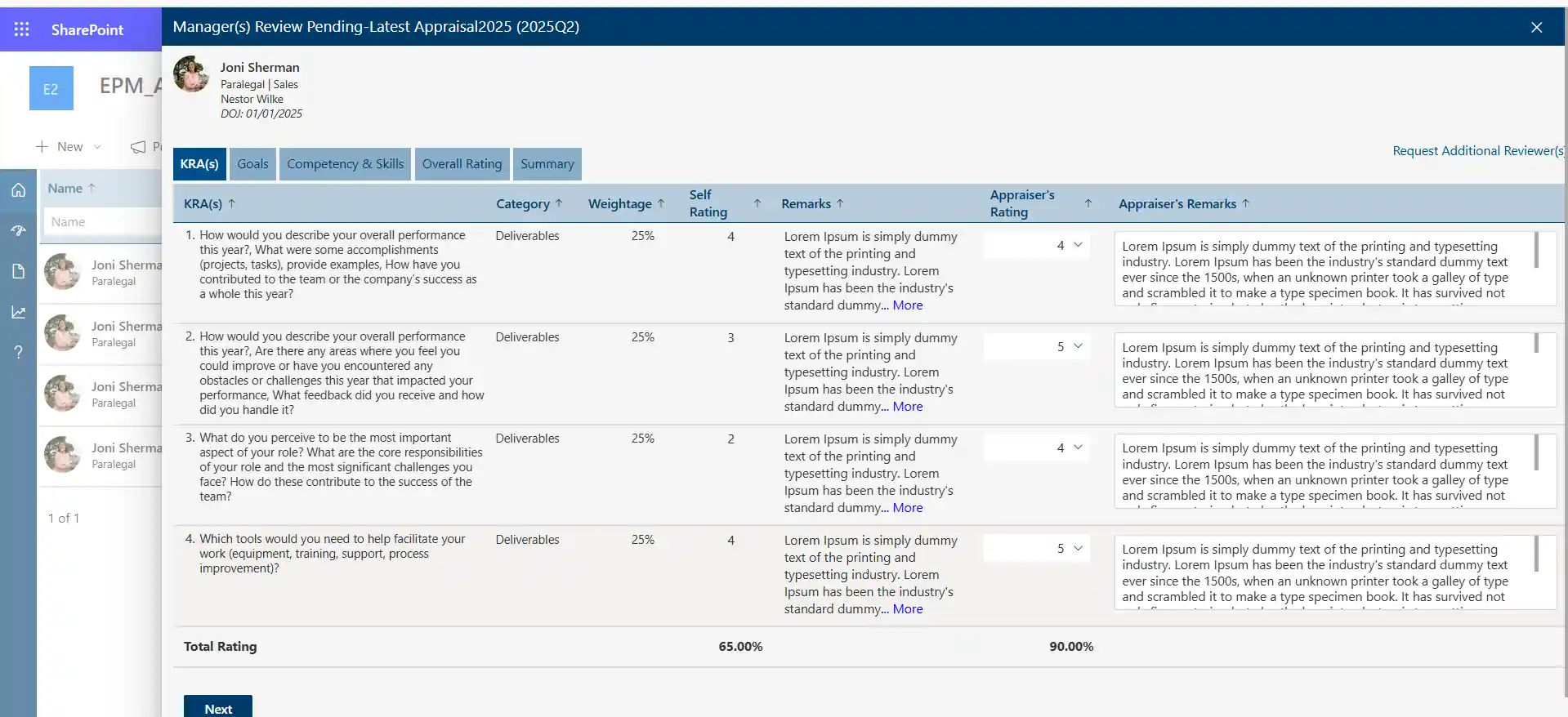
Writing a fair review becomes difficult when goals, feedback and achievements are stored across spreadsheets, emails and separate documents. Performance 365 brings this information into a structured performance-management process within Microsoft 365.
With Performance 365, managers can:
- Create configurable review cycles that match how your organization actually works
- Manage employee self-assessments alongside manager evaluations
- Track goals, KRAs, KPIs and OKRs in one place
- Maintain an ongoing feedback history instead of relying on memory
- Configure competencies and rating scales specific to each role
- Collect 360-degree feedback from peers and stakeholders
- Schedule and track one-on-one discussions
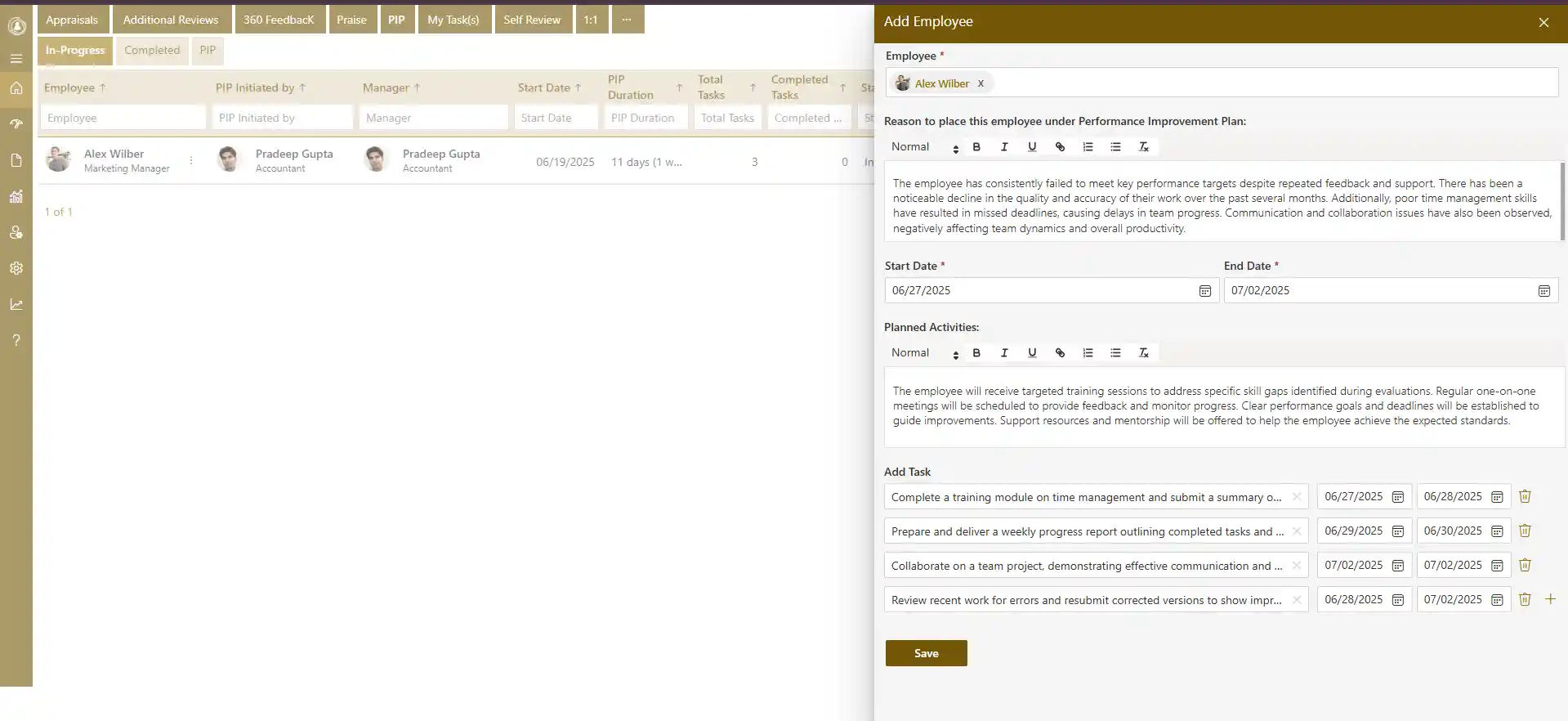
- Build performance-improvement plans directly from review outcomes
- Send automatic review reminders so nothing is missed
- Access dashboards and reports for a clear view across the team
- Manage the entire performance process within Microsoft Teams and SharePoint, where your team already works
Conclusion
An effective performance review should be clear, balanced and based on evidence. It should recognize achievements, address improvement areas constructively and set measurable goals for future growth.
Performance 365 helps managers simplify this process by bringing goals, feedback, appraisals and development plans together within Microsoft 365.
👉 Ready to make performance reviews more consistent and effective?
Join Our Creative Community
Frequently Asked Questions
What should I write in a performance review?
A performance review should include the employee’s results against agreed goals, key achievements, strengths, areas for improvement, a development plan, and specific goals for the next period. Every comment should be supported by evidence, and the overall tone should stay balanced, covering both what went well and what needs to improve.
How do you start a performance review?
Start by confirming the review period and summarizing the employee’s core responsibilities. Follow this with an overall, evidence-based summary of their performance against the goals agreed at the start of the period. This gives the reader context before you move into specific achievements and improvement areas.
How long should a performance review be?
There’s no fixed length. A review for a junior role in a straightforward job may only need a few paragraphs, while a senior or complex role may need more detail. What matters most is that every point is specific and supported by evidence, not the total word count.
How do you write a positive performance review?
Describe specific achievements using the pattern Action + Result + Business Impact, rather than general praise. Include measurable outcomes where possible, recognize the strengths that drove those results, and end with a growth opportunity or stretch goal so the employee has a clear direction for continued development.
Should employees complete a self-evaluation?
Yes. A self-evaluation gives managers additional context on how the employee views their own performance, including achievements they may not be aware of and challenges that affected results. Comparing both perspectives before the review meeting usually leads to a more balanced, productive discussion.


_JiluXJRGNl.svg)























