
HR Processes: A Complete Guide to Managing Human Resource Processes

- HR processes are structured workflows that manage every stage of the employee lifecycle, from recruitment and onboarding to performance management and offboarding.
- The 10 core HR processes help organizations standardize HR operations, maintain accurate employee records, and support day-to-day business activities.
- HR software improves HR processes by automating workflows, centralizing employee data, and providing real-time insights for HR teams and managers.
- HR365 HRMS helps organizations manage the complete HR process lifecycle in one platform, with seamless integration across Microsoft 365, SharePoint, and Microsoft Teams.
HR processes are the foundation of effective human resource management. They define how an organization recruits new talent, onboards team members, manages employee records, tracks attendance, approves leave, conducts performance reviews, supports learning, and handles offboarding. Every HR activity follows a process that helps maintain consistency, improve accountability, and support business operations.
As organizations grow, managing HR processes manually becomes more challenging. Spreadsheets, emails, and disconnected tools can slow down approvals, create duplicate records, and make it difficult to track employee information. Modern HR software helps solve these challenges by centralizing HR processes, automating routine tasks, and providing real-time visibility into the entire employee lifecycle.
What Are HR Processes?
HR processes are the structured activities organizations use to manage team members throughout the employee lifecycle. They cover everything from recruitment and onboarding to leave management, attendance, performance reviews, training, and offboarding.
Well-defined HR processes help maintain consistency, reduce manual work, and keep employee information organized. As organizations grow, many use HR software like HR365 HRMS to manage these processes from a single platform, making everyday HR tasks easier to track, automate, and manage within Microsoft 365.
The Complete HR Process Lifecycle
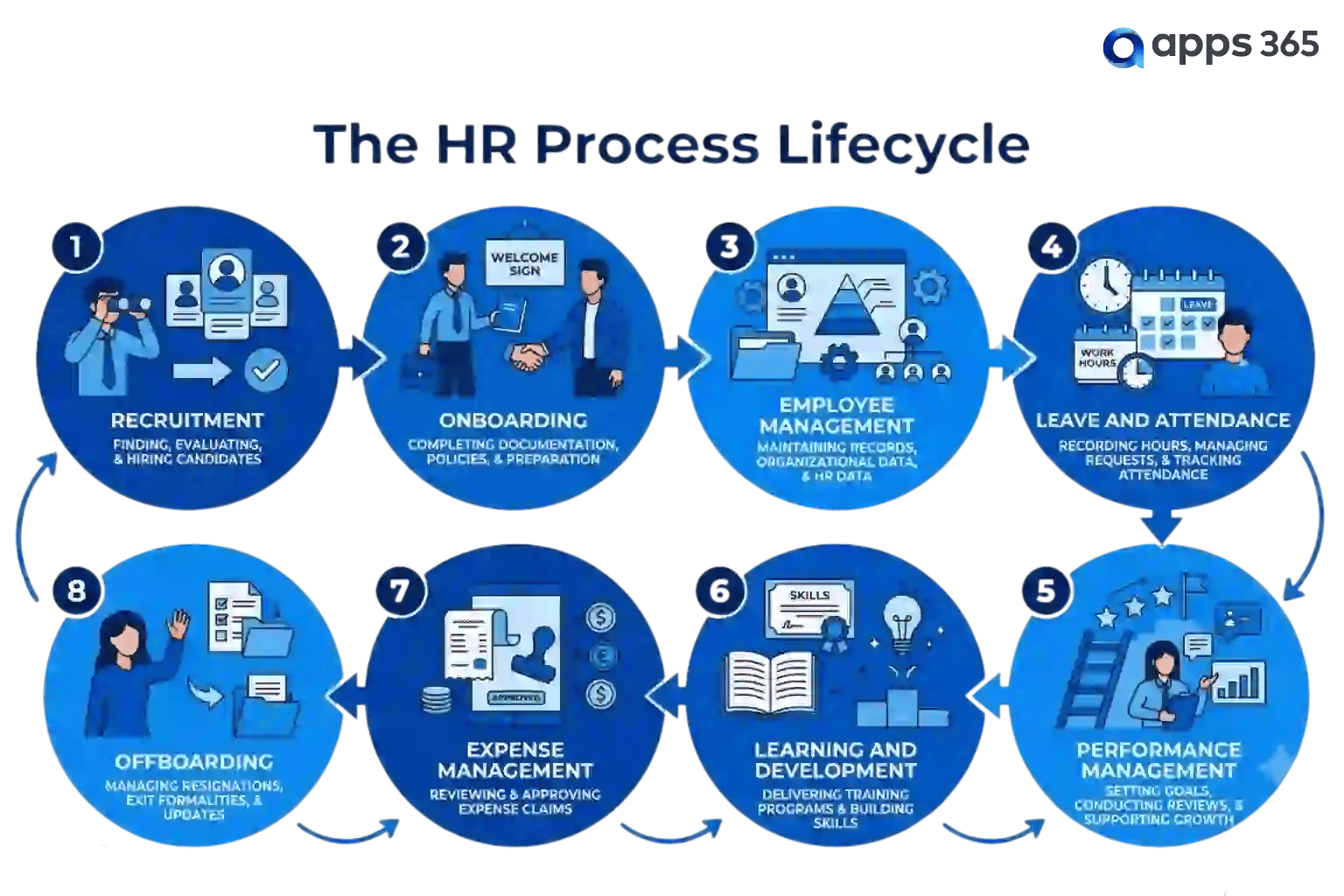
The HR process lifecycle is the complete journey of a team member within an organization. It begins when a candidate applies for a role and continues until the person leaves the company. Each stage has a specific purpose and contributes to an organized and consistent HR function.
Why Are HR Processes Important for Businesses?
HR processes are important because they create a standard way to manage people across the organization. Every HR activity follows a defined workflow, reducing delays and keeping employee information consistent.
Organizations use HR processes to:
- Recruit new talent
- Maintain employee records
- Track attendance
- Conduct performance reviews
- Deliver training
- Handle employee exits
Without documented HR processes, approvals may be delayed, records can become inconsistent, and HR teams often spend more time on manual administration.
Modern HR software centralizes these activities, giving HR teams one place to manage the complete employee lifecycle.
The 10 Core HR Processes Every Organization Should Manage
Every HR department follows a series of core processes to manage people from hiring to offboarding. These processes create a consistent framework for handling daily HR activities, maintaining employee records, and supporting business operations. Whether an organization has 20 or 2,000 team members, these ten HR processes are essential.
1. Recruitment and Hiring
Recruitment and hiring is the process of finding and selecting the right people for open positions. It starts when a hiring need is identified and ends when a candidate accepts the job offer.
A typical recruitment process includes:
- Identifying hiring requirements.
- Creating and publishing job postings.
- Screening resumes and applications.
- Evaluating candidates.
- Extending job offers.
- Completing the hiring process.
A well-defined recruitment process helps organizations hire qualified candidates faster while maintaining a consistent hiring experience.
2. Employee Onboarding
Employee onboarding prepares new hires for success during their first days, weeks, and months with the organization. An organized onboarding process helps new team members understand their responsibilities, company policies, and workplace expectations.
The onboarding process often includes:
- Completing employment documents.
- Sharing company policies.
- Assigning equipment and system access.
- Introducing managers and team members.
- Creating onboarding checklists.
- Scheduling orientation sessions.
- Assigning initial training.
A structured onboarding process helps new hires become productive more quickly and creates a positive first impression.
3. Employee Records Management
Employee records management focuses on maintaining accurate and up-to-date information throughout a person’s employment. Keeping records organized supports daily HR activities and provides a reliable source of employee information.
Employee records commonly include:
- Personal information.
- Job titles and departments.
- Employment history.
- Contracts and HR documents.
- Emergency contacts.
- Skills and certifications.
- Organizational reporting structure.
Centralized employee records help HR teams access information quickly while reducing duplicate or outdated data.
4. Leave Management
Leave management is the process of tracking and approving employee time off. It helps organizations manage leave policies while maintaining visibility into team availability.
This process typically covers:
- Annual leave.
- Sick leave.
- Casual leave.
- Remote work requests.
- Approval workflows.
- Team leave calendars.
An effective leave management process helps reduce scheduling conflicts and keeps leave records accurate.
5. Attendance and Timesheet Management
Attendance and timesheet management records when employees work and how their time is allocated. It gives managers visibility into attendance patterns and supports workforce planning.
Common activities include:
- Recording attendance.
- Managing shifts.
- Recording overtime.
- Submitting timesheets.
- Monitoring remote work.
- Generating attendance reports.
Accurate attendance records help organizations manage daily operations more effectively.
6. Performance Management
Performance management is an ongoing process that helps managers measure, review, and improve employee performance. Instead of relying only on annual reviews, many organizations use continuous feedback and goal tracking throughout the year.
Performance management includes:
- Setting individual goals.
- Conducting performance reviews.
- Collecting manager feedback.
- Tracking achievements.
- Identifying development areas.
- Recognizing accomplishments.
- Planning future objectives.
A consistent performance management process supports both individual growth and organizational success.
7. Learning and Development
Learning and development focuses on helping team members build new skills and expand their knowledge. Continuous learning prepares employees for changing responsibilities and future career opportunities.
This process may include:
- Compliance learning.
- Skill development programs.
- Online learning courses.
- Certification tracking.
- Training completion records.
Organizations that invest in learning create opportunities for continuous improvement and professional growth.
8. Expense Management
Expense management handles business expenses submitted by employees and manages the approval process before reimbursement. A structured process helps organizations maintain accurate financial records and improve transparency.
Typical expense activities include:
- Expense submissions.
- Approval workflows.
- Travel expenses.
- Business-related purchases.
- Expense reporting.
Digitizing expense management reduces paperwork and speeds up approvals.
9. Employee Engagement
Employee engagement focuses on building a positive workplace experience and encouraging participation across the organization. Engaged team members are more likely to collaborate, contribute ideas, and stay connected with business goals.
Employee engagement activities often include:
- Surveys and polls.
- Recognition programs.
- Company announcements.
- Internal communication.
- Team activities.
- Employee recognition initiatives.
Regular engagement helps organizations understand employee needs and strengthen workplace culture.
10. Employee Offboarding
Employee offboarding is the final stage of the employee lifecycle. A structured offboarding process helps organizations complete all exit activities while protecting business information and maintaining accurate HR records.
The offboarding process generally includes:
- Resignation management.
- Exit interviews.
- Knowledge transfer.
- Asset returns.
- Access removal.
- Final documentation.
- Updating employee records.
A well-managed offboarding process creates a professional exit experience and helps organizations maintain business continuity.
These ten HR processes work together throughout the employee lifecycle. When managed through a centralized HR platform such as HR365 HRMS, organizations can connect each process, reduce manual administration, and maintain accurate HR data from recruitment to offboarding.
Key Questions Every Role Has About HR Processes
How do HR processes help HR managers manage workload?
HR processes eliminate administrative burnout by automating repetitive tasks like leave tracking, onboarding workflows, and expense approvals. More importantly, standardized processes create a reliable audit trail for labor laws and policy compliance, freeing up HR teams to focus on strategic initiatives like employee retention and company culture.
Why are structured HR processes critical for business growth?
For business owners, structured HR processes protect the bottom line. They minimize costly hiring mistakes, lower employee turnover, and reduce legal liability around misclassifications or wage disputes. Standardized workflows also give leadership clear visibility into labor costs, payroll overhead, and workforce productivity.
How do HR processes make day-to-day team management easier for department leads?
HR processes remove guesswork and back-and-forth communication. They give managers clear guidelines for approving timesheets, managing shift schedules, and handling time-off requests. Standardized performance management frameworks also give managers structured templates to set goals and conduct fair, effective evaluations.
How do structured HR processes benefit everyday employees?
For employees, transparent HR processes mean clarity and fairness. They get self-service access to view pay stubs, check PTO balances, and submit expense reimbursements without waiting on manual approvals. Clear processes also establish transparent paths for career growth, training, and objective performance evaluations.
What happens when an organization operates without standardized HR processes?
Operating without standardized HR processes leads to compliance risks, inconsistent performance reviews, and administrative bottlenecks. It exposes the business to potential labor law violations, wage disputes, and lost productivity caused by managers manually solving repetitive administrative tasks.
How can companies ensure employees actually adopt new HR software and processes?
Successful adoption relies on self-service simplicity and clear communication. When employees see that an HR platform lets them quickly request time off, view pay stubs, or submit expenses from their phones without back-and-forth emails, adoption happens naturally.
Common Challenges in Managing HR Processes
Managing HR processes becomes more difficult as an organization grows. Without clear workflows and a centralized system, HR teams often spend more time on administrative tasks than supporting business goals. Identifying these challenges is the first step toward improving HR operations.
1. Manual and Time-Consuming Processes: Many organizations still rely on spreadsheets, emails, and paper forms to manage HR activities. This increases administrative work and makes routine tasks harder to track.
2. Scattered Employee Information: Employee records stored across multiple systems can lead to duplicate data, outdated information, and difficulty finding important documents when needed.
3. Inconsistent HR Workflows: When departments follow different procedures for hiring, onboarding, leave approvals, or performance reviews, HR processes become inconsistent and difficult to manage.
4. Delayed Approvals: Manual approval processes can slow down leave requests, expense claims, onboarding tasks, and other HR activities, affecting both HR teams and team members.
5. Limited Visibility into HR Activities: Without dashboards and centralized reporting, it can be difficult to monitor recruitment progress, attendance trends, leave balances, or performance reviews in real time.
6. Poor Communication Between HR and Managers: HR teams and managers often rely on emails or messaging apps to exchange information, making it harder to track requests andmaintain a clear record of decisions.
7. Difficulty Scaling HR Operations: As the number of team members grows, manual HR processes become increasingly difficult to manage. Tasks thatwere manageable for a small organization may no longer support a growing workforce.
8. Lack of Process Automation: Repetitive activities such as sending reminders, collecting documents, updating records, and routing approvals consume valuable time when they are handled manually.
Best Practices for Improving HR Processes
Improving HR processes starts with creating clear, consistent workflows that are easy for HR teams, managers, and team members to follow. Well-designed processes reduce delays, improve collaboration, and keep HR information accurate throughout the employee lifecycle.
Follow these best practices to build effective HR processes:
- Document every HR process so each step, responsibility, and approval is clearly defined.
- Standardize workflows to maintain consistency across recruitment, onboarding, leave, performance, and other HR activities.
- Automate repetitive tasks such as approvals, notifications, reminders, and document collection to reduce manual effort.
- Centralize employee information in one secure system instead of using multiple spreadsheets and disconnected applications.
- Use self-service features so team members can update personal information, submit leave requests, and access HR documents without contacting HR.
- Monitor HR metrics such as onboarding completion, leave trends, attendance, and performance progress through dashboards and reports.
- Review HR processes regularly to identify bottlenecks and update workflows as business needs change.
- Integrate HR tools with platforms like Microsoft 365 and Microsoft Teams to support collaboration and reduce duplicate work.
Organizations that regularly review and improve their HR processes are better prepared to support business growth, maintain accurate records, and deliver a consistent experience for every team member.
How HR Software Supports Every HR Process
HR software supports every HR process by centralizing employee data, automating workflows, and providing one platform to manage the entire employee lifecycle. Instead of using spreadsheets, emails, and disconnected tools, organizations can manage HR operations from recruitment to offboarding in a single system.
- Centralizes Employee Information—HR software stores employee profiles, documents, job history, organizational details, and HR records in one secure location, making information easier to access and manage.
- Automates HR Workflows—Routine activities such as leave approvals, onboarding tasks, document collection, reminders, and notifications are handled through automated workflows, reducing manual follow-ups.
- Simplifies Recruitment and Onboarding—HR software helps HR teams manage hiring activities, organize candidate information, issue offer letters, and complete onboarding tasks from a single platform.
- Digitizes Leave and Attendance Management—Leave requests, attendance records, work hours, and timesheets can be managed digitally with approval workflows and real-time tracking.
- Supports Performance and Learning—Managers can set goals, conduct performance reviews, monitor progress, assign training, and maintain learning records throughout the employee lifecycle.
- Improves Employee Self-Service—Team members can update personal information, submit leave and expense requests, access HR documents, and track approvals without depending on HR for every request.
- Provides Real-Time Reporting and Dashboards—Interactive dashboards and reports give HR teams and managers visibility into recruitment, attendance, leave, performance, and other HR metrics.
- Connects with Business Applications—Modern HR software integrates with platforms such as Microsoft 365, SharePoint, and Microsoft Teams, helping organizations manage HR activities within their existing digital workplace.
- Uses AI and Automation for Routine Tasks—AI-powered features assist with repetitive HR activities, generate insights, automate notifications, and help HR teams respond to requests more efficiently.
- Scales as the Organization Grows—As businesses expand, HR software supports larger teams, additional departments, and more complex HR workflows without requiring separate systems.
Why HR365 HRMS Is the Right Solution for Managing HR Processes
HR365 HRMS helps organizations manage the complete HR process lifecycle from a single platform built for Microsoft 365. Instead of using separate tools for recruitment, onboarding, leave, attendance, performance, and employee records, HR teams can manage every HR process in one connected solution.
HR365 HRMS supports every stage of the HR process by offering:
- Recruitment Management to organize hiring activities, candidate information, and interview workflows.
- Employee Onboarding with digital checklists, document collection, and onboarding tasks.
- Employee Directory to maintain accurate employee profiles and organizational information.
- Leave Management with configurable leave policies, approval workflows, and leave tracking.
- Attendance and Timesheets to record work hours, attendance, and project time entries.
- Performance Management to set goals, conduct reviews, and monitor employee progress.
- Learning and Training to assign courses and track learning completion.
- Expense Management to digitize expense submissions and approval workflows.
- Task Management to assign, monitor, and complete HR-related activities.
- AI-Powered Automation to reduce repetitive administrative work and improve workflow efficiency.
- Interactive Dashboards that provide real-time insights into HR activities and workforce trends.
HR365 HRMS is designed for businesses that use the Microsoft ecosystem. It integrates with Microsoft 365, SharePoint, and Microsoft Teams, allowing HR teams and managers to access HR information and complete everyday HR tasks without leaving their familiar work environment.
Whether you’re managing a growing business or an established organization, HR365 HRMS provides a centralized platform to manage HR processes, improve visibility across departments, and support the complete employee lifecycle from recruitment to offboarding.
Conclusion
HR processes provide the foundation for managing people throughout the employee lifecycle. From recruitment and onboarding to leave management, performance reviews, learning, and offboarding, each process plays a key role in keeping HR operations organized, consistent, and aligned with business goals.
As organizations grow, managing these processes manually becomes more challenging. A modern solution like HR365 HRMS brings every HR process together in one platform, helping organizations automate routine tasks, maintain accurate employee records, and manage HR operations efficiently within Microsoft 365, SharePoint, and Microsoft Teams. Whether you’re improving existing workflows or implementing a new HR system, the right HR software can help build a more connected and scalable HR function.
Manage Every HR Process from One Platform
Book a Demo to see how HR365 HRMS helps you manage every HR process in one centralized solution built for Microsoft 365.
Frequently Asked Questions
What are HR processes?
HR processes are the structured activities used to manage people throughout the employee lifecycle. They include recruitment, onboarding, employee records management, leave, attendance, performance management, learning and development, expense management, and offboarding.
Why are HR processes important?
HR processes help organizations manage HR activities consistently and efficiently. They reduce manual work, improve record accuracy, support better decision-making, and create a standardized experience for both HR teams and team members.
What are the core HR processes?
The core HR processes include recruitment, onboarding, employee records management, leave management, attendance tracking, performance management, learning and development, expense management, employee engagement, and offboarding.
How does HR365 HRMS HR processes?
HR software centralizes employee information, automates workflows, digitizes approvals, provides real-time dashboards, and connects different HR functions into one platform. This reduces administrative effort and improves visibility across the employee lifecycle.
Can HR365 HRMS manage the complete HR process lifecycle?
Yes. HR365 HRMS supports the complete HR process lifecycle by combining recruitment, onboarding, employee directory, leave management, attendance and timesheets, performance management, learning and training, expense management, task management, AI-powered automation, and dashboards in a single platform built for Microsoft 365, SharePoint, and Microsoft Teams.


_JiluXJRGNl.svg)























