


An ideal Learning Management System (LMS) creates opportunities for individual learning, development, and best performance. It is more than an administrative tool to handle training it builds employee skills, aligns with compliance, and helps keep employees in the right frame of mind to be more successful together.
✨
Key Takeaways
- An Enterprise LMS centralizes training, onboarding, compliance, and skill development.
- Choose an LMS based on scalability, integrations, reporting, security, and user experience.
- Platforms like LMS365, Docebo, Litmos, and Cornerstone offer different strengths for different needs.
- The right Enterprise LMS improves productivity, compliance, learning insights, and continuous development.
The right LMS is one that scales with your organization’s size, integrates seamlessly with your existing tools, and has demonstrable impact. An organization with a strong learning culture has 30–50% higher retention and 21% greater profitability than a similar organization with little or no learning culture. The right LMS can turn learning into a true strategic advantage for your company.
In this guide, you will discover the 12 best enterprise learning management systems available. You can consider each one and see what best fits your goals and vision.
What Is an Enterprise Learning Management System?
An Enterprise Learning Management System is built to manage training across large, complex organizations. Unlike traditional or standard LMS systems, enterprise LMS platforms support larger learner groups, diverse training needs, complex structures, and stronger compliance requirements.
There are several features that distinguish an Enterprise LMS from other solutions, including:
- Scalability for Global Teams: Supports thousands of learners across locations while delivering consistent training at scale.
- HR System Integration: Connects with HR tools to sync data, reduce manual work, and minimize errors.
- Advanced Analytics: Customizable reporting and analytics dashboards help track progress, completion, skill gaps, and compliance.
- Custom Branding and Workflows: Allows organizations to tailor the LMS experience to internal processes and brand identity.
- Strong Data Security: Uses role-based access, encryption, and compliance controls to protect sensitive information.
These features will enable Enterprise Learning Management Systems are the types of LMS to use for large, complex organizations that need centralized control, compliance monitoring, and comprehensive reporting, for successful employee learning and development.
Key Features to Consider in an Enterprise Learning Management System
When choosing an enterprise LMS, focus on features that support your learning goals, operations, compliance, and user needs. Here are the key features to consider.
Scalability & User Management: Supports large teams with role-based access, group segmentation, and easy user management.
Integration: Connects with HR systems, CRM tools, and Microsoft Teams for smoother workflows and data sharing.
Compliance & Certification Management: Automates mandatory training, certification tracking, and compliance reporting.
Advanced Analytics & Reporting: Tracks engagement, completion rates, skill gaps, and training effectiveness through clear dashboards.
Customization & Branding: Allows organizations to personalize branding, workflows, and learning paths.
Mobile & Offline Access: Enables learners to access training anytime through mobile-friendly and offline learning options.
Security & Data Privacy: Protects sensitive data with encryption, role-based access, MFA, and privacy compliance.
Support & Training: Provides onboarding, training, technical support, and regular platform updates.
Concentrating on these elements can help organizations choose an enterprise LMS capable of the current training needs, as well as with the future or “future-proof” their learning needs based on a changing business landscape.
12 Most Effective Enterprise Learning Management Systems
Check out the 12 best learning management systems for enterprises to boost employee training and facilitate compliance workflows. Find out which LMS will help your organization grow and elevate your success.
1. LMS365
Overview:
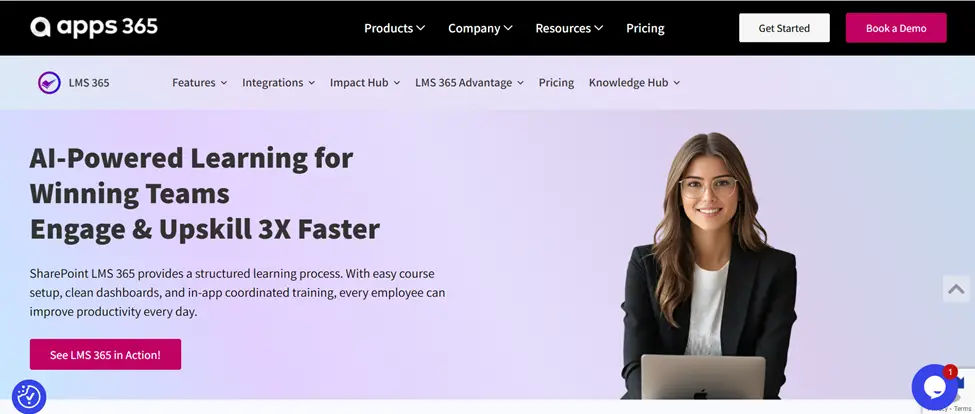
LMS 365 is designed to support large enterprise workforces with structured, scalable training. It offers personalized learning paths, centralized course management, progress tracking, and strong integration with Microsoft 365 tools such as SharePoint and Teams.
By working within a familiar Microsoft environment, LMS 365 makes it easier for employees to access learning, collaborate with colleagues, and complete training without switching between multiple platforms. This helps organizations simplify learning management, improve engagement, and deliver more consistent training experiences across teams and locations.
Key Features: Supports adaptive learning paths, HRIS integration, real-time analytics dashboards, compliance tracking, MS Teams integration.
Pros: Highly configurable, user experience, security, and compliance.
Cons: Customization may require dedicated support services to complete your initial setup.
Pricing: Variable based on the number of users and configuration options.
Ideal For: Enterprise needing an LMS with deep integration into Microsoft 365 tools.
💼 Ready to Transform Workplace Learning with LMS 365?
2. SAP Litmos

Overview:
Litmos is a cloud-based LMS designed for fast deployment and easy access across devices. Its mobile-friendly experience supports flexible learning, while features for compliance training, reporting, and learner engagement help organizations manage training more efficiently.
It is well suited for businesses that need a scalable platform for onboarding, compliance, and ongoing employee development.
Key Features: Compliance management, gamification, large content library, and mobile access.
Pros: Capable user interface, strong mobile experience, and a wide range of third-party integrations.
Cons: Less customization capabilities than other LMS options.
Pricing: Subscription-based SaaS model with multiple tiers.
3. Docebo

Overview:
Docebo is an AI-powered LMS designed to deliver personalized and engaging learning experiences. It combines AI-driven learning, social learning, virtual coaching, and cohort-based training to support employee development at scale.
Its automation, analytics, and content management capabilities help organizations streamline training while creating more relevant learning experiences for different roles and skill levels.
Key Features: AI learning recommendations, virtual coaching & cohorts, learning portals, and social learning features.
Pros: Innovative AI features, powerful analytics, and engaging learner experience.
Cons: May be pricey for small teams or start-ups.
Pricing: Tiered subscription models from small teams to enterprise.
4. Cornerstone OnDemand

Overview:
Cornerstone OnDemand is a comprehensive talent and learning management platform designed to support employee development, compliance, and workforce growth. It helps organizations manage learning, skills, performance, and training from one centralized system.
Its reporting, personalized learning, compliance tracking, and talent development features make it suitable for large organizations looking to align employee growth with broader business goals.
Key Features: Learning paths, certification tracking, performance management, and content marketplace.
Pros: Extensive features not included in a standard LMS solution offering, strong compliance tools and global support/implementation.
Cons: Implementation can be complicated; more cost-structure than other LMS solutions.
Pricing: Custom pricing based on organization size and modules selected.
5. TalentLMS

Overview:
TalentLMS is a user-friendly LMS designed to help organizations create, manage, and deliver online training with ease. It supports course creation through built-in templates and allows teams to upload learning content in multiple formats.
With integrations, reporting tools, assessments, and flexible learning options, TalentLMS helps businesses manage employee training, onboarding, and skill development without adding unnecessary complexity.
Key Features: Author a course, blended learning, SCORM support, and integrations with video conferencing and HR tools.
Pros: User-friendly UI, cost effective, can be delivered and implemented in few days.
Cons: Lacks some of the advanced reporting and processing of analytics of larger platforms.
Pricing: Pricing is subscription based, and has a free tier for small teams.
6. Absorb LMS

Overview:
Absorb LMS is a user-friendly learning platform designed to support personalized learning journeys for employees, customers, and partners. It helps organizations deliver structured training while keeping the learner experience simple and engaging.
With reporting, automation, content management, and third-party integrations, Absorb LMS can connect with existing business tools and expand its functionality as training needs grow.
Key Features: Adaptive learning paths or journeys, e-commerce support, mobile learning, compliance tools.
Pros: User-friendly, clean interface, excellent reporting tools, and high-quality customer service..
Cons: No publicly available pricing and must negotiate pricing with Absorb.
Pricing: Custom pricing models.
7. LearnUpon

Overview:
LearnUpon is a flexible cloud-based LMS designed to deliver training to employees, customers, and partners from one platform. It supports course management, learner tracking, reporting, and automated training workflows.
Its simple interface, scalable structure, and integration options help organizations streamline training delivery while creating consistent learning experiences across different audiences.
Key Features: Multi-tenant architecture, certification tracking, SCORM/xAPI support, reporting, and automated workflows.
Pros: Well-designed UX, strong customer service, and the ability to scale training in complex enterprise scenarios.
Cons: Limited customization of the UI design.
Pricing: Varies by features, user counts, and is subscription-based.
8. SkyPrep LMS

Overview:
SkyPrep is a cloud-based LMS designed for organizations that want fast, simple, and efficient employee training. It supports onboarding, compliance training, course management, assessments, and learner tracking through an intuitive platform.
With automation, reporting, content management, and integration capabilities, SkyPrep helps teams launch training quickly, reduce administrative work, and manage learning programs as their organization grows.
Key Features: SCORM compliant, easy course creation, quizzes, compliance tracking, automated workflows, mobile learning, and detailed reporting.
Pros: Easy to use, robust analytics, and great for compliance-based learning.
Cons: Customization of the platform is limited.
Pricing: Tiered plan based on user count and features.
9. Adobe Captivate Prime

Overview:
Adobe Learning Manager is designed to deliver a smooth and engaging learning experience for employees, customers, and partners. It combines an intuitive interface with AI-powered recommendations that help learners discover relevant content based on their roles, interests, and learning activity.
With features for course management, reporting, content delivery, and personalized learning paths, Adobe Learning Manager helps organizations create more targeted training experiences while supporting large-scale learning programs.
Key Features: Personalized learning, fluidic player, content marketplace, progress tracking, and offline learning modes.
Pros: Quick user interface and setup, good compliance tools, effective automation options.
Cons: Limited deep customization, some advanced enterprise features less than some high-end, feature-full LMS.
Pricing: Tiered subscription pricing based on user count and features.
10. iSpringLearn

Overview:
iSpring Learn is a simple and user-friendly LMS designed for organizations that want to launch training quickly. It supports employee onboarding, compliance training, skill development, and progress tracking through an easy-to-manage platform.
Its course creation tools, reporting features, mobile learning support, and integration options make it a practical choice for enterprises that need to create and deliver training without a complex setup.
Key Features: SCORM compliant, mobile apps, video learning, quizzes, and assessments.
Pros: Simple setup and use, affordable pricing, and a strong content creation suite.
Cons: Less robust advanced analytics compared to bigger LMS.
Pricing: Flexible subscription plans.
11. SAP SuccessFactors Learning

Overview:
SAP SuccessFactors Learning is part of the broader SAP SuccessFactors ecosystem, combining learning management with talent and human resources capabilities. It helps organizations manage employee training, compliance, skill development, and learning programs within a connected HR environment.
With reporting, learning assignments, certification tracking, and integration with other SAP SuccessFactors modules, it is well suited for enterprises that want to connect learning with broader workforce development and talent management strategies.
Key Features: Compliance training, personalized content, learning paths, extensive reporting, and social learning.
Pros: Deep HR fit, scalable globally, and emphasizes compliance.
Cons: Complicated implementation and more expensive.
Pricing: Custom pricing depending on enterprise requirements.
12. Workday Learning

Overview:
Workday Learning provides a connected learning experience by integrating employee training with Workday’s broader HR and workforce management ecosystem. It helps organizations manage onboarding, skill development, compliance training, and ongoing learning from one platform.
With personalized learning, reporting, content management, and workforce data integration, Workday Learning helps organizations align employee development with broader talent and business goals.
Key Features: Personalized recommendations, content authoring, social learning, and compliance tracking.
Pros: Flawless Workday integration, mobile-friendly, scalable while delivering a smooth experience.
Cons: It could be expensive and may require complex set-up.
Pricing: There are various pricing models that you can customize (ask for additional information).
How to Choose the Right Enterprise Learning Management System
Choosing the right LMS means finding a platform that fits your current training needs and can grow with your organization. Focus on the factors that will have the biggest long-term impact:
- Organization Size and Growth: Choose an LMS that can scale with more learners, teams, and locations.
- Integration Needs: Look for strong connections with HR systems, Microsoft 365, Teams, Outlook, and SharePoint.
- Budget and Pricing: Compare subscription costs along with implementation, customization, training, and support fees.
- Vendor Support: Reliable onboarding, training, technical support, and regular updates can improve adoption.
- User Experience: Simple navigation and easy administration help increase engagement and course completion.
- Security and Compliance: Check for encryption, role-based access, MFA, GDPR, ISO, and other required standards.
- Demos and Trials: Test the LMS before deployment to evaluate usability, features, and integration.
Reviewing these areas will help you choose an enterprise LMS that supports both immediate training needs and long-term growth.
Advantages of Implementing an Enterprise Learning Management System
An enterprise LMS can improve workforce development, compliance, and overall business performance. Key benefits include:
Boost Employee Skills and Productivity: Deliver role-based training that helps employees build relevant skills and improve performance.
Ensure Compliance: Automate mandatory training, certification tracking, and reporting to keep teams audit-ready.
Improve Learner Engagement: Modern LMS platforms use multimedia, quizzes, gamification, and social learning to increase participation.
Support Flexible Learning: Mobile and offline access allow employees to complete training from any location.
Enable Data-Driven Decisions: Analytics help track progress, identify skill gaps, and improve learning strategies.
Reduce Administrative Work: Automation simplifies enrollment, reminders, recertifications, and reporting.
Standardize Training: A learning management system helps deliver consistent training across teams and locations.
Fundamentally, investing in an enterprise level LMS is not solely an upgrade of technology; it is a laser-focus investment into your labor force, impacting growing the business, compliance, and employee satisfaction.
Best Practices for Enterprise Learning Management Systems
In order to achieve a comprehensive impact on the investment in your LMS and sustain long-term success, here are some considerations:
Define Clear Learning Objectives:
Begin with precise objectives that are in sync with your overall business strategy. Knowing what an employee needs to learn or what skills are required will help you design an effective course and leave you with a good tool to gauge success.
Engage Leadership and Stakeholders:
Gain executive buy-in and actively involve key departments as early as possible. Gaining relevant support for adequate resources and adoption will reinforce the initiative of learning.
Prioritize User Experience:
Select a user-interface for the LMS that is easy to use and easy to navigate from both the learner and administrator perspective. A simple user-interface inherently leads to an increase in engagement & reduces frustration when it comes to learner training.
Leverage Data and Analytics:
Consistently assess LMS analytics to evaluate course completion rates, learner progress, and skill gaps. Strengthen content and personalize the learner journey with the findings.
Promote Social and Collaborative Learning:
Facilitate interaction and collaboration in the LMS with discussion boards, peer reviews, and group assignments. Social learning not only fosters knowledge sharing and exchange, it also contributes to a culture of continuous improvement.
Provide Mobile and Flexible Access:
Give learners access to training materials anywhere, anytime, on any type of device. This flexibility accommodates an increasingly diverse workforce and enhances learner participation.
Maintain Compliance and Security:
Continually update compliance training and track certification renewals. Secure training information and sensitive personal information about employees and the business, by upholding strong security measures in the LMS.
Offer Ongoing Support and Training:
Offer every user continued support to feel more hapterschied with tutorials and associated resources of the LMS. Ongoing training of LMS will keep learners and administrators informed of features and better engage learners.
Foster a Culture of Continuous Learning:
Beyond any mandatory courses, enable ongoing development with optional learning resources, microlearning, and career development opportunities.
Following the best practice recommendations, organizations can take advantage of their enterprise LMS to further drive employee growth, remain compliant and obtain measurable outcomes for their business.
Conclusion
Choosing the right enterprise LMS can strengthen learning, improve compliance, and support employee productivity. A scalable LMS gives employees easy access to ongoing training while helping organizations build skills and prepare for future growth.
By focusing on your business needs, integrations, and long-term goals, you can choose a platform that supports both employees and organizational success.
Ready to get started? Book a demo now and explore the LMS experience with a 14-day free trial.
Join Our Creative Community
Frequently Asked Questions
What is an Enterprise Learning Management System?
An Enterprise LMS is a scalable software platform designed to manage and deliver training, development, and compliance programs across large organizations with diverse learner populations.
How do I choose the right Enterprise LMS for my organization?
Consider your organization’s size, growth plans, integration needs with existing systems, budget, user experience, security requirements, and vendor support. Testing demos and trial periods can help make an informed decision.
What are the key features to look for in an Enterprise Learning Management Systems?
Important features include scalability, integration capabilities, compliance management, advanced analytics, customization and branding options, mobile and offline access, security, and vendor support.
In what ways can an Enterprise LMS add value to my organization?
It boosts employee skills and productivity, ensures regulatory compliance, enhances learner engagement, supports remote work, enables data-driven learning decisions, and streamlines administrative tasks.
What are best practices for implementing an Enterprise Learning Management Systems?
Define clear learning objectives, engage leadership, prioritize user experience, leverage analytics, promote collaborative learning, ensure mobile access, maintain compliance and security, provide ongoing support, and foster continuous learning culture.
Table of Contents
Blog Categories
Power Productivity—Start Today
All Your Work, One Smart Platform
Your Team's New Favorite Workspace
Organize, Collaborate, and Thrive—For Free

























