
10 Contract Lifecycle Management Challenges — And How to Fix Them

- Contracts are often stored across emails, shared drives, and spreadsheets, making them difficult to find and manage.
- Manual approval and review processes can slow down contract execution and create bottlenecks.
- Missing renewal, expiration, or obligation deadlines can lead to compliance risks and lost revenue opportunities.
- Limited visibility into contract status and performance makes it harder for teams to track risks, responsibilities, and key milestones.
Contract lifecycle management challenges are costing businesses millions in lost revenue, missed deadlines, and compliance failures. If your contracts are sitting in email inboxes and shared drives, you are not alone but you are at risk.
An average of 9.2% of annual revenue is lost due to contract mismanagement. That’s not a rounding error it’s a significant, preventable loss. And yet, 89% of organizations feel their contract process is simply not effective enough.
This guide breaks down the 10 most common contract lifecycle management challenges from finding contracts to closing deals faster and shows exactly how purpose-built contract management software can help your team take back control.
10 Contract Lifecycle Management Challenges
While contract lifecycle management helps organizations improve efficiency and control, many teams still face challenges that slow processes, increase risk, and make it difficult to maintain visibility across contracts. Here are ten common contract lifecycle management challenges businesses encounter.
1. Contracts Scattered Across Multiple Locations
One of the most common contract lifecycle management challenges is simply not knowing where your contracts live. Contracts get saved to personal drives, buried in email threads, stored in department folders, or printed and filed in cabinets. When someone needs a contract fast during a dispute, an audit, or a renewal the search turns into a fire drill.
90% of contracting professionals find it challenging to locate contracts efficiently, according to research by EY. That’s almost every person working in legal, procurement, or sales.
Without a central place to store and search contracts, teams waste hours every week, duplicate work, and sometimes cannot prove what was agreed to at all.
How CLM 365 Solves This
One Central Repository for Every Contract
The contract repository software gives your entire organization one searchable, secure place to store every contract NDAs, vendor agreements, customer contracts, employment agreements, and more. Full-text search means anyone with the right permissions can find any contract in seconds, not hours. No more “which folder was it saved to?” moments.
2. Missing Renewal Deadlines and Auto-Renewals
Auto-renewal clauses are one of the most expensive challenges of contract management. A vendor contract quietly renews for another year at a price you wanted to renegotiate. A software subscription you cancelled internally keeps charging because the contract auto renewed. A customer contract lapses because no one sent the renewal notice in time.
When renewal dates are tracked manually or stored in different places, it becomes harder to stay on top of deadlines. This can lead to unnecessary renewals, missed opportunities to renegotiate terms, or delays in engaging customers and vendors at the right time.
How CLM 365 Solves This
Automated Renewal Alerts and Milestone Tracking
The system automatically tracks every contract’s key dates expiry, contract renewal, payment milestones, and notice periods. You set the reminder schedule. The system does the rest. Your team gets notified well before a deadline arrives, giving you time to act rather than react.
How Many Renewals Are You Missing Right Now?
Most teams don’t know until it’s too late. Without a reliable way to track renewal dates, important opportunities can easily be overlooked.
3. Slow and Unclear Approval Workflows
A contract is drafted. Then it stored. Someone needs to review it, but they don’t know it’s waiting. Then it goes to legal, then back to sales for changes, then to finance for sign-off. Each step takes days and deals slow down.
This is one of the most frustrating challenges in contract management because the delay is not about the contract itself it’s about the process around it. When approvals happen over email with no clear owner or deadline, contracts get stuck.
How CLM 365 Solves This
Structured Approval Workflows with Clear Ownership
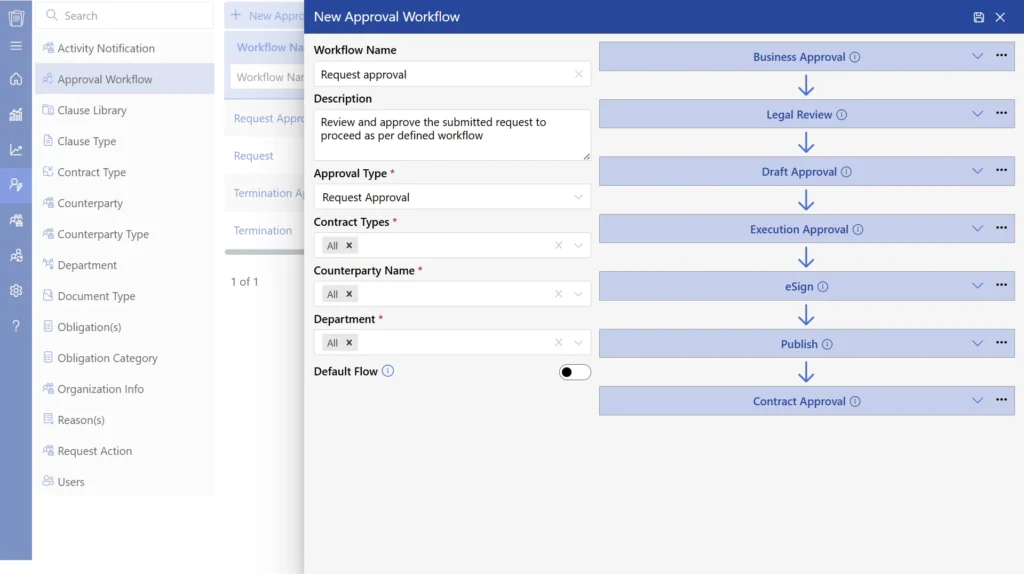
The contract approval software lets you build approval workflows that automatically route contracts to the right people at the right time. Every reviewer knows exactly what’s waiting for them, what the deadline is, and what action they need to take.
4. Inconsistent Templates and Contract Language
Every department has its own version of the NDA. Sales uses one contract template, procurement uses another, and the legal team keeps updating the master version that nobody is using. The result, contracts that contain outdated clauses, missing terms, or unapproved language sometimes all three.
Inconsistent templates are both a legal risk and an operational problem. They slow down review cycles because legal must check whether each contract uses approved language.
How CLM 365 Solves This
Pre-Approved Template Library with Clause Controls
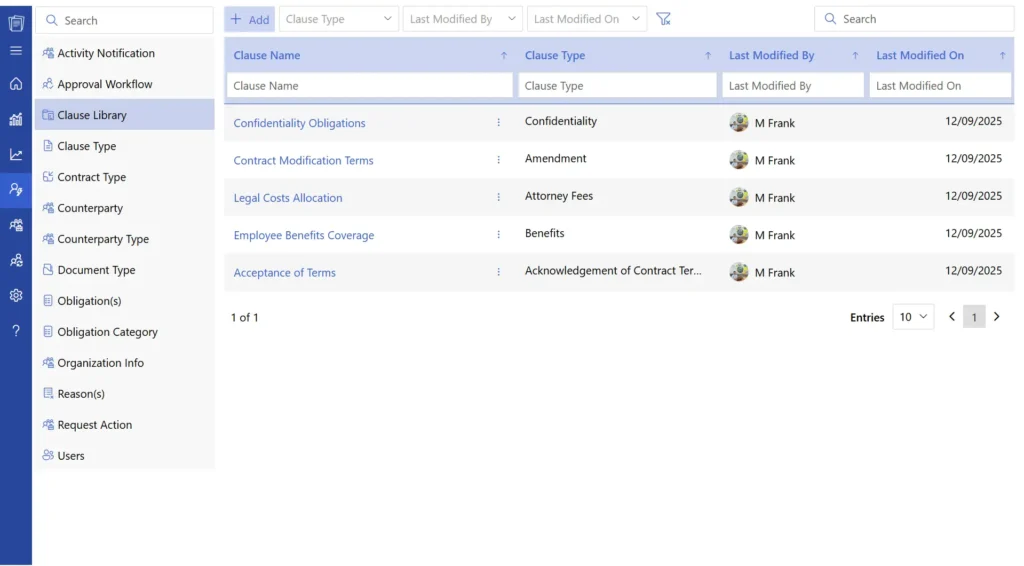
The clause library gives your legal team a library of pre-approved templates and clause options that anyone in the organization can use. Sales can generate a contract in minutes using the right, approved language without needing to involve legal for every single deal. Legal stays in control without being a bottleneck.
Ready to simplify contract creation?
See how reusable templates help teams work more efficiently
5. Compliance Management and Risk Visibility
Managing compliance across a large volume of contracts can be challenging, especially when regulatory requirements, service commitments, and internal policies vary from one agreement to another. Without a structured approach, teams may spend significant time reviewing contracts manually to confirm compliance requirements and obligations.
Organizations often need to answer important questions:
- Which contracts contain specific compliance clauses?
- Which agreements require certifications, audits, or policy reviews?
- Which vendor or customer contracts carry higher compliance risks?
Effective compliance management requires clear visibility into contract terms, obligations, and regulatory requirements throughout the contract lifecycle.
How CLM 365 Solves This
Centralized Compliance Management
The system helps organizations manage contract compliance requirements from a single place. Key clauses, obligations, certifications, and regulatory commitments are captured and organized, making them easier to review, monitor, and audit. With centralized visibility into contract-related compliance requirements, teams can improve governance and make more informed decisions.
6. Contract Comparison
Comparing contract versions manually can be time-consuming and error-prone, especially when multiple stakeholders are reviewing and editing the same agreement. Small changes to clauses, pricing terms, obligations, or legal language can easily be overlooked when teams rely on side-by-side document reviews or email attachments.
This makes it difficult to identify the latest version, track changes accurately, and maintain a clear audit trail of revisions.
This makes it difficult to identify the latest version, track changes accurately, and maintain a clear audit trail of revisions.
How CLM 365 Solves This
Automated Contract Comparison and Version Tracking
The system automatically compares contract versions and highlights additions, deletions, and modifications across documents. Teams can quickly identify changes to key clauses, pricing terms, obligations, and legal language without manually reviewing every page. Built-in contract version control ensures stakeholders always work from the latest contract version while maintaining a complete history of revisions.
7. Reviewing Large Volumes of Contracts Efficiently<
As contract volumes grow, reviewing every agreement manually becomes increasingly difficult. Legal, procurement, finance, and business teams often need to examine hundreds or even thousands of contracts to identify key clauses, obligations, risks, payment terms, renewal conditions, and compliance requirements.
Teams may struggle to quickly answer questions such as
- Which agreements require action?
- Which contracts contain risky clauses?
- Which obligations are approaching deadlines?
Finding these answers often requires significant effort and slows decision-making.
How CLM 365 Solves This
Agentic AI-Powered Contract Analysis
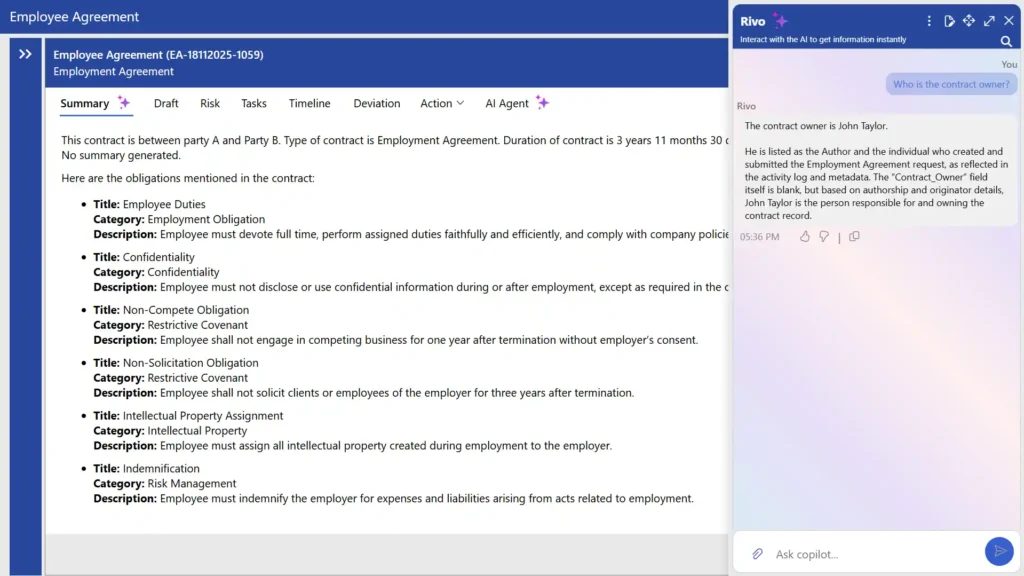
CLM 365 uses Agentic AI to review and analyse contracts automatically. It can summarize key clauses, identify obligations, highlight potential risks, and surface important terms for review. This helps reduce review time, improve visibility into contract risks, and support more efficient contract management across the organization.
8. Revenue Leakage from Untracked Obligations
Revenue leakage is one of the most financially damaging contract lifecycle management challenges and one of the least visible. It happens when contracted commitments are not tracked: discounts that should have expired but didn’t, pricing tiers that were never updated in the billing system.
40% of contract value leakage can be attributed to poor management. For a business with $10M in annual contract value, that’s $4M walking out the door through preventable gaps.
How CLM 365 Solves This
AI-Powered Obligation Identification
CLM 365 uses Agentic AI to automatically identify and highlight key contract obligations, and renewal terms hidden within agreements. This helps ensure important actions are not overlooked, improves accountability, and enables organizations to capture the full value of their contracts after signature.
9. Delays and Risks in the Contract Signing Process
Even though most organizations have moved away from paper-based signatures, the signing process can still be surprisingly manual. Contracts are often emailed back and forth between stakeholders, approvals are tracked separately, and teams spend time following up on unsigned agreements. Managing signatures across multiple tools also increases the risk of version confusion, missed approvals, and incomplete audit trails.
How CLM 365 Solves This
Secure E-Signature Integrations
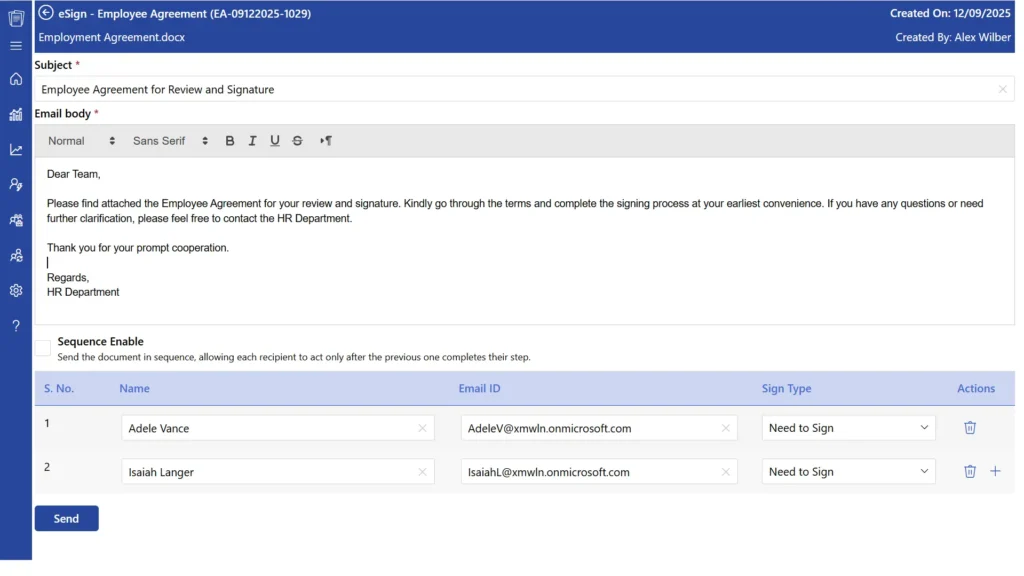
CLM 365 integrates with DocuSign and Adobe Acrobat Sign, allowing teams to send, track, and manage signatures directly from the contract workflow. Stakeholders can sign securely using trusted e-signature platforms while maintaining a complete audit trail of every signing activity.
Need contracts signed without delays?
See how electronic signing simplifies every contract.
10. Scaling Contract Volume
As businesses grow, contract volume grows with them. More customers, vendors, and agreements create additional work for legal, procurement, and operations teams. However, headcount often does not increase at the same pace, making it difficult to manage contracts efficiently.
How CLM 365 Solves This
Automation That Scales With Your Business
CLM 365 automates repetitive contract tasks such as document generation, approvals, reminders, data extraction, and reporting. As contract volume grows, teams can manage more agreements without increasing manual effort, helping them stay productive and focused on strategic work.
Conclusion
Contract lifecycle management challenges rarely stem from a single issue. Instead, they build up across the entire contract process from drafting and reviews to approvals, compliance, renewals, and obligation management.
The good news is that these challenges are solvable. With the right CLM platform, organizations can automate routine tasks, improve collaboration, gain better visibility into contracts, and reduce the administrative burden on legal and business teams.
Ready to make contract management a little easier? Explore CLM 365. Get your 14-day free trial. No credit card details required.
Frequently Asked Questions
Is there a better way to compare contract versions than reviewing them side by side?
Yes. Manually comparing contract versions can be time-consuming and makes it easy to miss important changes. CLM 365 automatically highlights additions, deletions, and modified clauses, helping teams quickly identify what changed and review contracts more efficiently.
How do I know which contracts are expiring this quarter?
The CLM system provides automated alerts and dashboards for upcoming contract milestones.
What's the easiest way to identify risky clauses across existing contracts?
Reviewing contracts one by one takes time. CLM 365 uses AI to analyze contracts and highlight clauses that may require additional review.
How do I quickly understand what changed in a contract amendment?
The contract system compares versions and highlights modifications automatically.
What's the best way to reduce contract cycle times?
Delays often occur during reviews and approvals. CLM 365 automates workflows and improves collaboration between stakeholders.
Table of Contents

Trusted by the Best

_JiluXJRGNl.svg)























