
What Is a Contract Promise? Types, Examples & Best Practices

Promises made within a deal shape how businesses, customers, suppliers, and service providers fulfil their responsibilities.
The requirements that make a contract promise legally valid, such as mutual agreement, exchange of value, clear terms, and legal intent.
Six types of promises: express, implied, conditional, unconditional, mutual, and unilateral.
Problems businesses face, including missed deadlines, unclear responsibilities, poor communication, and failure to meet agreed terms.
Ways to manage promises through written records, assigned responsibilities, deadline tracking, regular reviews, and timely updates.
A customer expects a supplier to deliver products on time, a service provider agrees to complete assigned work, and an employer promises to pay an employee for their services.
These contractual obligations form the foundation of business relationships. When parties formally include such commitments in an agreement, they become contract promises.
This article explores their meaning, different types, common examples, legal importance, and ways businesses can manage contractual commitments effectively.
What Is a Contract Promise?
A contract promise is a commitment made by one party to another to perform a particular action or refrain from doing something under an agreement. It establishes an expectation that the promising party will fulfil the stated commitment according to the agreed terms.
For example, A supplier agrees to deliver 500 units within 15 days of receiving payment. The agreement also specifies product quality, delivery location, and penalties for delays. If the supplier delivers only 300 units, the buyer may have grounds to claim that the supplier has failed to fulfil its contractual commitments, depending on the agreement and applicable law.
In simple terms: A contract commitment defines what one party agrees to do or not do as part of a contractual relationship.
What Are the Essential Elements of a Contract Promise?
Not every promise becomes a legally enforceable contract. For a promise to create legal obligations, an agreement generally needs to satisfy certain legal contract terms and conditions. These may vary across jurisdictions, but the following elements are commonly recognized.
Offer and Acceptance
Every contract starts with an offer from one party and contract acceptance from the other. Both parties must agree to the proposed terms before moving forward with the agreement.
Consideration
It is what each party agrees to exchange as part of the contract. It could be money, products, services, or another recognised form of value.
Intention to Create Legal Relations
Both parties must intend to create a legally binding agreement. A casual promise or informal discussion does not automatically create legal obligations.
Clear and Definite Terms
The terms should clearly explain what each party is expected to do. This includes responsibilities, payment conditions, deadlines, and performance expectations.
Legal Capacity of the Parties
Everyone entering into a contract must have the legal ability and authority to agree to its terms. This includes meeting applicable age and mental capacity requirements and having the necessary authority to represent an organisation.
Lawful Purpose
The agreement must be created for a lawful purpose. If a contract involves illegal activities or prohibited transactions, it generally cannot be legally enforced.
What Are the Different Types of Contract Promises?
It can take different forms depending on how the parties communicate their commitments and the conditions attached to their performance. Understanding these types helps businesses identify their responsibilities correctly.
An express promise is a commitment that parties clearly communicate through written or spoken words. The terms are directly stated rather than inferred from the circumstances.
For example, a construction company agrees to a written contract to complete a building project within 12 months. The express contract also specifies the project cost, payment schedule, and construction requirements.
The company’s commitment to complete the project within the agreed period is an express promise.
An implied promise is a commitment that is not directly stated but may arise from the circumstances, conduct of the parties, established practices, or applicable law.
For example, a customer hires a professional electrician to repair the wiring in an office. Even if the agreement does not specifically mention every safety requirement, the nature of the service may imply a responsibility to perform the work with reasonable care and skill.
Implied contracts can help establish expectations when an agreement does not address every possible situation.
It becomes due only when a specified condition is met. For example, a company agrees to release the final payment after a contractor completes the project and passes inspection.
Such promises are common in construction, insurance, financing, and service contracts, where payments or responsibilities depend on specific conditions.
An unconditional promise does not depend on a separate event or condition before it becomes due. For example, a customer agrees to pay a supplier $10,000 on November 15, as specified in the agreement. However, other contractual provisions and applicable laws may still affect its enforceability.
It occur when two or more parties make commitments to each other under the same agreement. Both parties have responsibilities to fulfil under the contract. These promises are common in sales and employment.
A unilateral contract involves one party offering something in exchange for another party completing a specified action. The legal treatment of such offers depends on the applicable contract law. The other party accepts the offer by performing the requested action rather than making a return promise.
What Is the Difference Between a Contract Promise and a Obligation?
Contract promises and obligation are closely related but have different meanings. The distinction becomes clearer when looking at their characteristics.
Basis | Contract Promise | Contractual Obligation |
Meaning | A commitment made by a party | A legal duty arising from a contract |
Purpose | Establishes what a party agrees to do | Defines what a party is legally required to do |
Scope | May be express or implied | Depends on enforceable contract terms |
Legal effect | Depends on whether it forms part of an enforceable agreement | Creates responsibilities recognised by law |
Example | A supplier promises to deliver products | The supplier must deliver products according to the agreement |
In simple terms: A promise describes the commitment, while an obligation describes the responsibility to fulfil that commitment under an enforceable deal.
When Does a Contract Promise Become Legally Binding?
A contract consent becomes legally binding when it forms part of a valid agreement that meets the requirements of contract law.
Both parties must agree to the contract clause and intend to create legal obligations. The agreement must also satisfy the applicable requirements for consideration, legal capacity, certainty, and lawful purpose.
For example, when a software company agrees to complete a project within 90 days and the customer accepts the payment terms, these commitments can become enforceable agreement obligations.
A few factors determine whether a promise is legally enforceable:
- Mutual Agreement: Both parties must accept the agreed terms.
- Legal Intention: The parties must intend to create legal relations.
- Consideration: The agreement must meet applicable consideration requirements.
- Clear Terms: Each party’s commitments must be sufficiently defined.
- Legal Capacity: The parties must have the authority to enter into the agreement.
- Lawful Purpose: The agreement must involve a legal activity.
A written contract provides evidence of these commitments, but some oral agreements and agreements formed through conduct can also be binding. Certain contracts may require additional legal formalities depending on the jurisdiction.
What Happens When a Party Breaks a Contract Promise?
When a party fails to fulfil its commitments under an enforceable deal without a valid legal excuse, it may result in a breach of contract.
Failure to Perform
This happens when a party fails to complete its agreed responsibilities. If there is no valid legal excuse, the failure may constitute a breach.
Delayed Performance
A party may fulfill its commitment but miss the agreed deadline. Depending on the importance of the timeline and terms, the delay may amount to a breach.
Partial Performance
This occurs when a party completes only some of its responsibilities without an agreed change to the scope of work.
Defective Performance
This occurs when the delivered products or services fail to meet the agreed quality standards, specifications, or performance requirements.
Repudiation of a Contract
It occurs when a party clearly indicates that it will not fulfil its contract consent. This may happen before the actual performance deadline and can give the other party legal remedies.
When a contract promise is broken, the affected party should review the agreement, document the breach, and understand the available contractual remedies.
Don’t let a missed promise turn into a contract dispute.
CLM 365 helps businesses identify important obligations with the help of AI, track deadlines, sends automated reminders, and maintain visibility into important deliverables.
How to Manage Contract Commitments Effectively
Managing contract promise requires clear documentation, assigned responsibilities, regular reviews, and communication between parties. Here are some practical ways businesses can manage them.
- Document Every Important Commitment: Record important clauses, deliverables, payment conditions, and deadlines in written agreements rather than relying on verbal discussions.
- Define Responsibilities Clearly: Assign each contractual responsibility to a specific individual or department so that important tasks are not overlooked.
- Establish Clear Deadlines: Specify delivery dates, payment schedules, renewal periods, and notice deadlines to help parties complete their responsibilities on time.
- Monitor Contractual Performance: Regularly review whether parties are meeting agreed service levels, quality standards, delivery requirements, and other terms.
- Maintain Communication Between Parties: Encourage regular updates about delays, changes, and potential issues so both parties can address them before they affect the agreement.
- Record Amendments and Changes: Document revised payment terms, additional services, contract changes, and updated timelines through appropriate contract amendments or addendums.
- Review Agreements Before Signing: Check payment conditions, termination rights, liability clauses, confidentiality terms, and other important provisions before accepting an agreement.
What Can the Affected Party Do When a Contract Promise Is Broken?
When one party fails to fulfil its contractual commitments, the affected party can take several steps to resolve the issue and protect its interests.
- Negotiate a Resolution: Both parties can discuss the issue and agree on a suitable solution. For example, if a supplier misses a delivery deadline, the buyer may accept a revised delivery date or request an alternative arrangement
- Send a Formal Breach Notice: The affected party can send a written notice explaining which contractual terms have been violated, the nature of the breach, and the corrective action expected from the other party.
- Claim Damages: If the breach causes financial losses, the affected party may seek compensation where legally permitted.
- Seek Specific Performance: The affected party may request a court to direct the other party to fulfil its contractual commitment.
- Terminate the Agreement: If the breach is serious enough or the agreement allows termination under the circumstances, the affected party may end the contractual relationship.
Taking timely action helps businesses limit financial losses, address disputes, and protect their contractual interests.
What Role Does Contract Documentation Play in Managing Promises?
Contract documentation provides a formal record of the promises made between parties. It helps organisations understand their responsibilities, review agreed terms, and establish what each party must deliver.
This creates several practical challenges.
- Difficulty finding commitments: Employees may spend time searching for agreements to verify payment terms, delivery dates, or other responsibilities.
- Missed deadlines: Renewal dates, notice periods, and performance milestones may go unnoticed without proper tracking.
- Unclear ownership: Teams may struggle to identify who is responsible for fulfilling or monitoring specific commitments.
- Version confusion: Employees may refer to outdated agreements that contain terms no longer applicable to the relationship.
- Limited visibility: Management may find it difficult to understand which agreements require attention and which commitments remain incomplete.
A structured documentation process helps businesses address these challenges.
For example, a company can maintain a central record of its agreements, assign owners to important consent, track deadlines, and record approved amendments.
How CLM 365 Helps Manage Contract Promises?
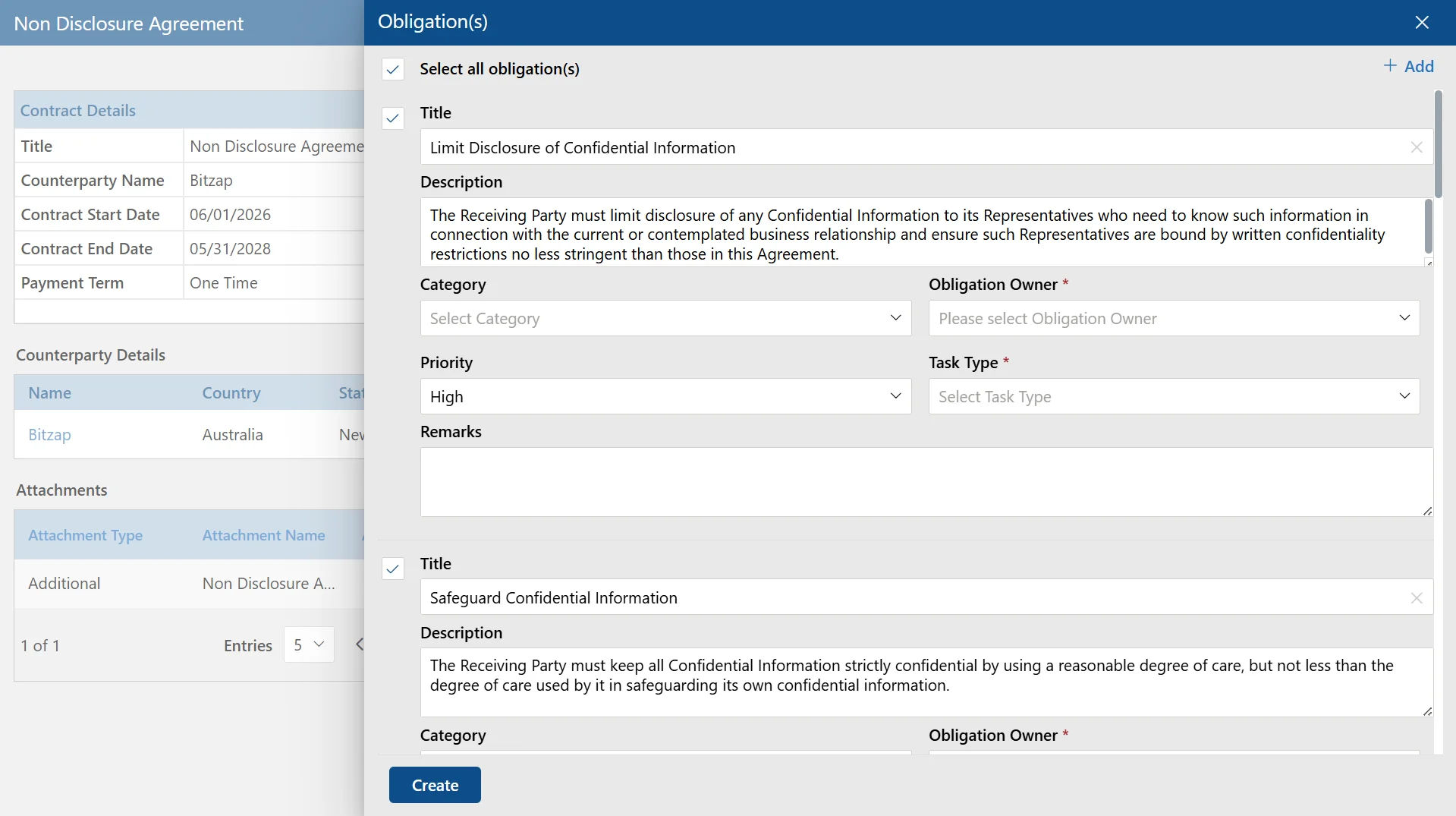
CLM 365 is a SharePoint contract management built within the Microsoft 365 environment. It integrates with Microsoft applications and stores contract data within your Microsoft tenant, supporting a secure and organised contracting process.
Here are seven features that help businesses manage responsibilities more effectively.
- AI-Powered Contract Intelligence: Use AI to summarise agreements, extract key information, identify important obligations, and understand potential risks during contract reviews.
- Centralised Contract Repository: Store all agreements in one SharePoint, making it easier for teams to access documents, review contract history, and find relevant information.
- Automated Notifications: Receive timely alerts about upcoming renewals, contract expiry, pending reviews, and important milestones.
- Automated Approval Workflows: Route agreements to the right stakeholders, manage review cycles, and track approval progress before finalising contracts.
- Contract Timeline Tracking: View important contract activities, including creation, reviews, approvals, renewals, and expiry events in one place.
- Audit Trail and Version Control: Track document revisions, approval history, and user activities to understand what changed, who made the changes, and when.
- Obligation and Task Tracking: Assign duties to individuals or departments, monitor pending activities, and follow up on important deliverables throughout the contract lifecycle.
Built with strong security standards, including SOC 2 compliance and Microsoft certifications, CLM 365 offers a trusted environment for managing business agreements.
Supports Microsoft GCC and GCC High environments, helping organisations with strict compliance requirements protect sensitive contract data.
Conclusion
Contract promises define what each party agrees to do and the responsibilities they must fulfil. But making a promise is only the beginning. Businesses must document these responsibilities, track important activities, and manage changes throughout the agreement.
Without proper oversight, important tasks can be missed, leading to delays, financial losses, and disputes.
CLM 365 helps businesses manage agreements through a centralised SharePoint-based platform with AI-powered features, automated workflows, and obligation tracking.
Frequently Asked Questions
What is the difference between a promise and a contractual obligation?
A promise is a statement of what a party agrees to do. A contractual obligation is the legal duty that arises when that promise becomes part of an enforceable agreement.
What is the difference between a material breach and a minor breach?
A material breach significantly affects the purpose or value of an agreement, while a minor breach involves a less serious failure. The distinction can influence the remedies available to the affected party.
How can businesses avoid misunderstandings about contract promises?
Businesses should document important agreements, define responsibilities clearly, specify performance expectations, and maintain records of discussions and approved changes.
How should businesses handle changes to existing agreements?
They should review the proposed changes, obtain the necessary approvals, and document the revised responsibilities through a formal amendment or another recognised process.
What happens if a party refuses to fulfil its promise?
It may result in a breach of contract, allowing the affected party to seek compensation or other legal remedies.