

Recruitment Process Automation: Automate Every Stage of Your Hiring Workflow

Hiring has stopped being a simple task of posting a job and picking from whoever applies. Recruiters today deal with hundreds of applications per role, screening that eats up entire days, delayed replies to candidates, interview coordination that drags on for weeks and a workload that keeps growing even when headcount doesn’t. Traditional, manual hiring workflows were never built to handle this volume.
That’s why more talent acquisition teams are turning to Recruitment Process Automation — using AI and workflow technology to connect every stage of hiring into one system. Instead of recruiters manually chasing resumes, sending scheduling emails and updating spreadsheets, automation handles the repetitive work so people can focus on judgment calls: who to interview, who to hire and how to build a stronger team.
Recruitment Process Automation enables faster hiring, better candidate experiences, less manual effort per requisition and hiring decisions backed by data instead of gut feeling alone. This guide covers what it is, how it works stage by stage, real statistics on its impact, tool comparisons, implementation steps and answers to the questions recruiters actually ask when evaluating it.
- Recruitment Process Automation connects sourcing, screening, scheduling, communication, approvals and reporting into a single workflow instead of separate manual steps.
- Companies using automation report meaningfully faster time-to-hire and stronger candidate experience scores compared to fully manual processes.
- AI resume screening speeds up shortlisting, but the best-performing teams still keep a human reviewing final decisions.
- Platforms built natively into tools recruiters already use — like Microsoft 365 — cut down on new logins and separate systems, which is where Recruitment Management 365 fits in.
Did you know?
According to Glassdoor, 85% of job seekers want a faster, easier application process. That means businesses using automation not only save time but also attract more qualified candidates.
What is Recruitment Process Automation?
Recruitment Process Automation is the use of AI, automation rules and connected workflow technology to manage the full hiring lifecycle — from the moment a role is approved to the day a new hire starts. Rather than treating sourcing, screening, interviews and onboarding as separate manual tasks handled in different tools, Recruitment Process Automation links them into one continuous process.
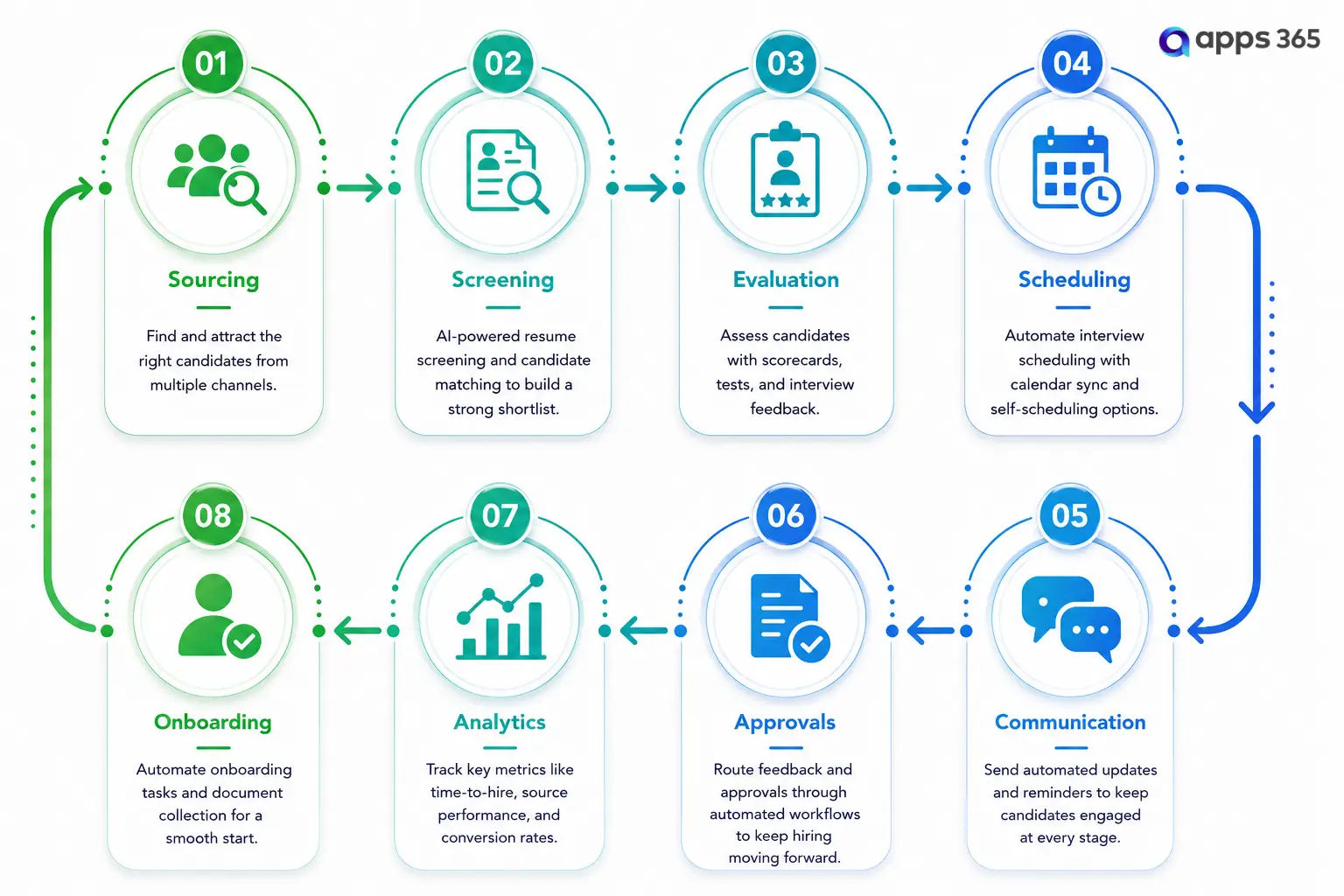
In practice, this means:
- Candidate sourcing — pulling and organizing applicants from job boards, referrals and career pages automatically
- Resume screening — using AI to read, parse and rank resumes against job requirements
- Candidate evaluation — scoring applicants on skills, experience and fit
- Interview scheduling — matching recruiter, hiring manager and candidate calendars without email chains
- Communication automation — sending status updates, reminders and follow-ups on a set schedule
- Hiring approvals — routing offers and requisitions through the right stakeholders
- Recruitment analytics — tracking metrics like time-to-hire and source effectiveness in real time
- Onboarding workflows — kicking off paperwork and new-hire tasks automatically once an offer is signed
The goal isn’t to remove people from hiring. It’s to remove the repetitive administrative work so recruiters and hiring managers spend their time on decisions that actually need a human — not chasing calendar invites.
Why Recruitment Process Automation Matters for Modern Hiring Teams
The Problem With Manual Recruiting
Manual recruiting workflows create drag at nearly every stage. Recruiters spend hours on repetitive tasks — reading resumes one by one, sending the same scheduling emails and manually updating trackers. That repetition opens the door to human mistakes: a missed follow-up, a resume overlooked, a scheduling conflict nobody caught.
The data backs this up. The average time to hire in the United States sits at roughly 44 days, according to SHRM’s annual benchmarking survey and 60% of organizations reported an increase in their time-to-hire in 2025, per GoodTime’s research. Longer hiring cycles mean more manual tracking, more candidate drop-off and less visibility into where a requisition is actually stuck.
Add in poor candidate communication and limited visibility into pipeline health and manual recruiting starts to look less like a system and more like a set of disconnected steps recruiters hold together by memory.
The Shift Toward Intelligent Hiring
Talent teams are responding by shifting to AI-assisted recruiting and automated workflows. Roughly 87% of companies now use AI somewhere in their recruiting process, up sharply from just 26% in 2024 — a sign that automation has moved from experiment to standard practice. This shift is data-driven at its core: instead of relying on instinct, recruiting teams can now see conversion rates by stage, cost per hire and where candidates are dropping off and adjust in real time. That visibility is what makes scalable recruitment operations possible, even as hiring volume grows.
How Recruiting Workflow Automation Powers Recruitment Process
It helps to separate two related terms. Recruitment Process Automation manages the complete hiring lifecycle end to end. Recruiting Workflow Automation refers to the individual automated processes that sit inside that lifecycle — the building blocks.
Here’s how the pieces fit together:
- Candidate Screening Workflows — application filtering, resume analysis and candidate ranking that narrows a large applicant pool down to a shortlist
- Interview Workflows — scheduling, reminders and interview coordination that removes email back-and-forth between recruiters, hiring managers and candidates
- Candidate Engagement Workflows — automated communication, follow-ups and status updates that keep candidates informed without manual sending
- Approval Workflows — hiring approvals and stakeholder notifications that route decisions to the right people automatically
- Reporting Workflows — recruitment dashboards and hiring insights that turn raw activity into metrics leadership can act on
Each of these workflows can technically run on its own. But Recruitment Process Automation is what happens when they’re connected — when a candidate moving through screening automatically triggers a scheduling workflow, which automatically triggers a communication workflow, which automatically feeds a reporting dashboard. That connection is what separates automation as a checklist of individual tools from automation as a real operating system for hiring.
Ready to see Recruitment Management 365 in action?
Walk through a live hiring workflow and see how Recruitment Management 365 automates recruitment inside your Microsoft 365 environment.
How Does Recruitment Process Automation Work?
Here’s the complete journey, stage by stage
The Shift Toward Intelligent Hiring
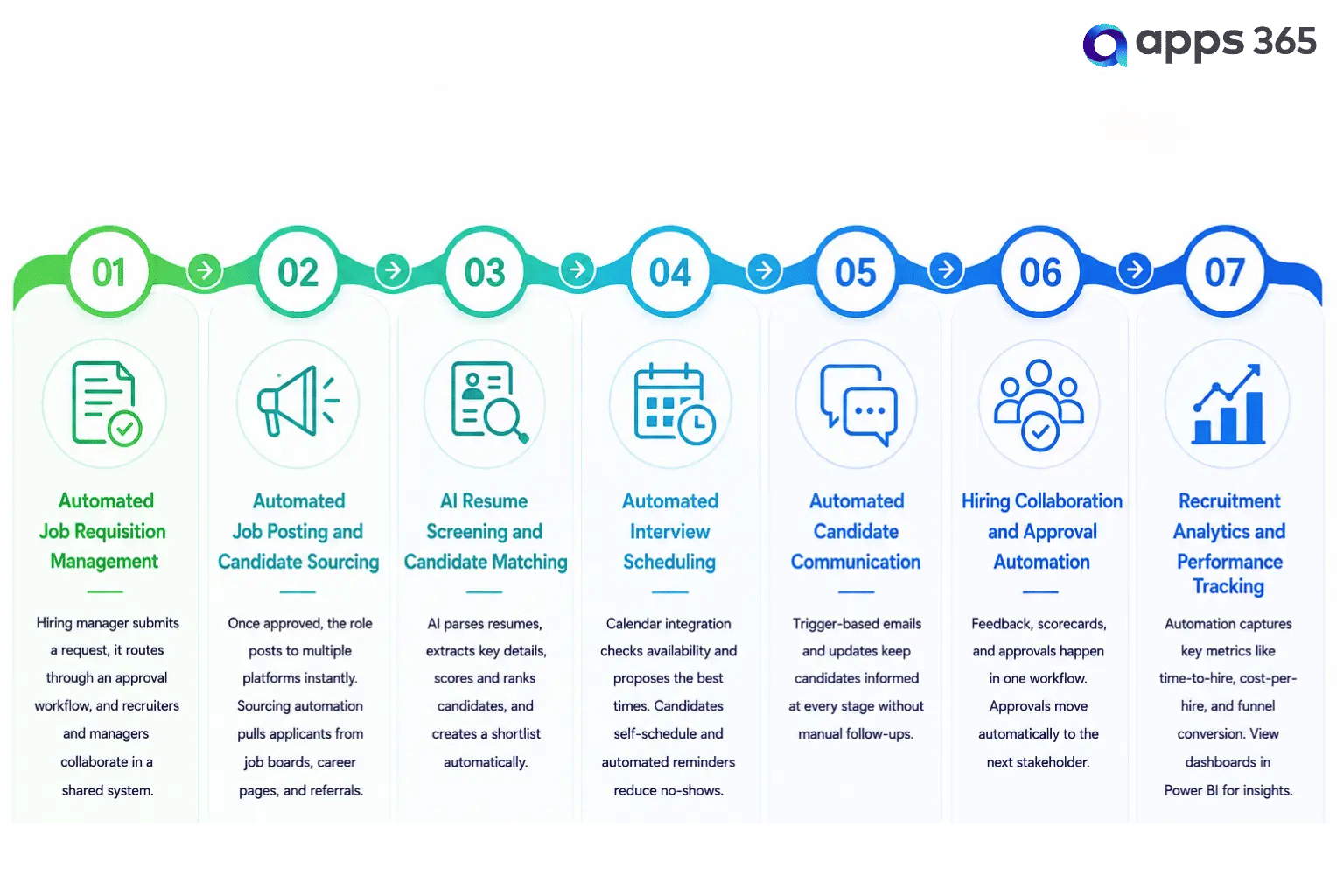
Step 1: Automated Job Requisition Management
The process starts before a job is even posted. A hiring manager submits a request, it routes through an approval workflow and recruiters and managers collaborate inside a shared system instead of email threads. This step matters more than it looks — a requisition stuck in someone’s inbox for a week adds directly to time-to-hire before a single candidate has even applied.
Step 2: Automated Job Posting and Candidate Sourcing
Once approved, the role can publish to multiple platforms at once instead of being posted manually, one site at a time. Sourcing automation pulls in applicants from job boards, career pages and referral links, with direct integrations to platforms like LinkedIn and Indeed so postings reach candidates without extra manual work per channel.
Step 3: AI Resume Screening and Candidate Matching
This is where AI does the heaviest lifting. Resume parsing extracts skills, experience and qualifications from each application, then compares them against the job requirements. Candidates get scored and ranked and a shortlist forms automatically — cutting down the hours recruiters would otherwise spend reading every single resume by hand.
Step 4: Automated Interview Scheduling
Calendar integration checks recruiter, hiring manager and candidate availability and proposes times that actually work for everyone. Candidates can self-schedule from available slots and automated reminders reduce no-shows on both sides.
Step 5: Automated Candidate Communication
Candidates get status updates, follow-ups and next-step emails on a set trigger — when they move stages, when a decision is made, when an interview is confirmed. This keeps candidates informed without a recruiter manually writing the same update dozens of times per requisition.
Step 6: Hiring Collaboration and Approval Automation
Hiring manager feedback, interview scorecards and approval routing all happen inside one shared workflow. Instead of chasing sign-off through email or Slack, approvals move automatically to the next stakeholder once a step is complete.
Step 7: Recruitment Analytics and Performance Tracking
Once candidates are moving through the pipeline, automation captures the data that matters — time-to-hire, cost-per-hire, funnel conversion by stage and which sourcing channels actually produce hires. Teams using Microsoft-native tools can pull this directly into Power BI for reporting that leadership can view without a separate export process.
Recruitment Process Automation vs Manual Recruiting
Area | Manual Recruiting | Automated Recruiting |
Resume screening | Manual review, one at a time | AI analysis and ranking |
Candidate communication | Manual updates | Automated workflows |
Interview scheduling | Back-and-forth emails | Automated scheduling |
Reporting | Manual tracking in spreadsheets | Real-time dashboards |
Hiring speed | Slower | Faster |
Scalability | Limited by recruiter headcount | High, handles volume spikes |
The productivity gap between the two approaches shows up clearly in the data. Organizations using AI in hiring report meaningful reductions in time-to-hire, with implications for offer acceptance rates and candidate experience. Beyond speed, candidates notice the difference too — faster responses and clearer updates translate into a hiring process that feels organized rather than left to chance.
Benefits of Recruitment Process Automation
1. Faster Hiring Cycles
Automated screening and scheduling remove the bottlenecks that hold candidates up between stages, so qualified applicants move through the pipeline faster instead of going cold while waiting on a recruiter’s calendar.
2. Improved Recruiter Productivity
Less time on administrative tasks means more time for the parts of recruiting that actually need a person — building relationships, negotiating offers and thinking through hiring strategy.
3. Better Candidate Experience
Faster communication and a clear, consistent process make candidates feel informed instead of left waiting, which matters directly for offer acceptance.
4. Reduced Recruitment Costs
Less manual effort per hire means recruiters can manage more requisitions without adding headcount, improving how recruitment budget gets allocated.
5. Better Hiring Decisions
AI-driven candidate scoring adds a data layer to decisions that used to rely purely on a quick resume skim, giving hiring managers evidence to support their call.
6. Improved Recruitment Visibility
Dashboards and analytics show exactly where each requisition stands, instead of a recruiter having to remember or dig through email.
7. Scalable Hiring Operations
Automation lets a lean recruiting team support enterprise-level hiring volume and manage sudden spikes in applications without falling behind.
What Recruitment Tasks Can Be Automated?
Nearly every repetitive step in hiring can run on automation today:
- Job posting across multiple boards
- Candidate sourcing and pipeline building
- Resume screening and parsing
- Candidate matching and scoring
- Interview scheduling and reminders
- Candidate communication and follow-ups
- Feedback collection from hiring managers
- Hiring approvals and routing
- Recruitment reporting and dashboards
- Onboarding tasks and documentation
Curious which of these your team could automate first?
Start a free trial of Recruitment Management 365 and see it mapped to your own hiring process.
7 Real Recruitment Process Automation Examples in Action
Example 1: AI Resume Screening
Challenge: A team receives thousands of applications for a single role and can’t manually review each one in time.
Automation: AI analyzes every resume against the job requirements and ranks candidates by fit.
Outcome: Faster shortlisting, with recruiters focused on the top candidates instead of the full stack.
Example 2: Automated Candidate Matching
Matching goes beyond keyword search — it compares skills and experience against the role and surfaces candidates a keyword filter would have missed, improving candidate discovery across the whole pool.
Example 3: Interview Scheduling Automation
Calendar coordination happens automatically across recruiter, hiring manager and candidate, cutting out the scheduling delays that used to stretch a single interview booking into a week-long email thread.
Example 4: Automated Candidate Communication
Notifications, follow-ups and engagement emails go out on triggers, keeping candidates in the loop without a recruiter manually writing every message.
Example 5: AI Recruitment Assistants and Chatbots
Chatbots handle candidate questions and initial screening around the clock, giving applicants instant answers instead of waiting on a reply days later.
Example 6: Hiring Approval Automation
Internal approvals route automatically to the right stakeholder and the whole team can track exactly where a requisition sits in the approval chain.
Example 7: Automated Onboarding Workflows
Documentation, new employee communication and process tracking kick off the moment an offer is signed. Organizations with automated onboarding report an 82% improvement in new-hire retention and productivity gains of more than 70% — a strong argument for extending automation past the offer stage.
AI Resume Screening: How AI Is Changing Candidate Shortlisting
AI Resume Screening
Resume analysis, candidate scoring and skill matching that actually reflects the job requirements, not just keyword density.
Recruiting Workflow Automation
Automated workflows, notifications and approvals that trigger based on where a candidate sits in the pipeline.
Interview Scheduling Automation
Calendar integration and candidate coordination that removes manual back-and-forth.
Recruitment Analytics
Dashboards, hiring insights and reports that show real pipeline health, not just headcount.
Enterprise Integrations
This is where platforms differ the most. Look for native connections to the tools your team already uses — Power BI, Power Automate, Power Apps, Outlook, Power Virtual Agents, LinkedIn, Indeed and open APIs for anything custom.
How Does Recruitment Management 365 Help Automate the Hiring Process
This is where Recruitment Management 365 fits into the picture. It’s built as a Microsoft 365-native recruitment platform, running directly on SharePoint, Teams and Outlook instead of asking recruiters to learn a separate system.
Intelligent Candidate Screening
AI resume evaluation and scoring that speeds up shortlisting without recruiters leaving their existing inbox.
Automated Recruitment Workflows
End-to-end process automation covering requisitions, screening, scheduling and approvals in one connected system.
Smart Interview Scheduling
Coordination that works directly against Outlook calendars, so there’s no separate scheduling tool to manage.
Connected Recruitment Ecosystem
Enterprise integrations with Power BI, Power Automate and Power Apps mean recruitment data lives alongside the rest of a company’s Microsoft 365 environment instead of in a walled-off platform.
The practical outcome: faster hiring, lower recruiter workload, better visibility for hiring managers and leadership and fewer separate logins to manage.
Ready to automate your hiring process?
Recruitment Management 365 streamlines recruitment inside Microsoft 365 — from requisitions to approvals. See it in action.
Recruitment Process Automation Software Comparison Guide
When evaluating platforms, weigh them against these criteria:
- AI capabilities — how resumes are parsed, scored and ranked
- Workflow automation — how deeply screening, scheduling and approvals connect
- Scheduling features — calendar integration and self-scheduling for candidates
- Reporting — real-time dashboards vs. manual exports
- Integrations — native connections to tools already in use, especially email, calendar and HRIS
- Scalability — whether the platform holds up during hiring spikes
- Security — data handling, access controls and where candidate data actually lives
The 10 Best Recruitment Process Automation Tools Ranked
Tool | Best For | AI Features | Automation Features | Integrations |
Recruitment Management 365 | Microsoft 365 organizations | AI resume screening, candidate scoring | Full lifecycle workflows, approvals | SharePoint, Teams, Outlook, Power BI, Power Automate |
Greenhouse | Structured enterprise hiring | Structured interview scoring | Workflow templates, approvals | Broad ATS/HRIS ecosystem |
Lever | Relationship-driven recruiting | AI sourcing suggestions | “If this, then that” automation rules | CRM-style candidate nurture |
Workable | SMB and mid-market teams | AI screening assistant | One-click posting to 200+ boards | Broad job board network |
BambooHR | Small HR teams | Basic AI resume matching | Onboarding automation | HRIS-centered integrations |
JazzHR | Budget-conscious small teams | Lightweight AI screening | Workflow templates | Standard job board posting |
Zoho Recruit | Zoho ecosystem users | AI candidate matching | Workflow automation, approvals | Zoho suite integrations |
iCIMS | Large enterprise hiring | AI-driven candidate insights | Complex approval chains | Enterprise HRIS systems |
SmartRecruiters | Global enterprise hiring | AI sourcing and matching | Collaborative hiring workflows | Marketplace of integrations |
Bullhorn | Staffing and agency recruiting | AI candidate matching | Automated pipeline management | Agency-specific integrations |
Most of these platforms handle the fundamentals well. The differentiator for Microsoft 365 organizations is architecture: Recruitment Management 365 runs natively inside SharePoint, Teams and Outlook, so recruiters don’t need a separate login or a new system that keeps candidate data outside the Microsoft ecosystem they already trust.
What Does Recruitment Process Automation Software Cost?
Pricing Factors
- Number of users and licenses needed
- Hiring volume and requisition count
- Feature depth — basic screening vs. full workflow automation
- Integration requirements with existing systems
- Customization needs for approval chains and workflows
ROI Factors
- Reduced recruiter workload per hire, meaning more requisitions handled per person
- Faster hiring cycles, which reduces the cost of an open role sitting unfilled
- Lower operational costs from fewer manual tasks and fewer tools to license separately
Most teams find the ROI conversation gets easier once they can point to concrete numbers. SHRM data shows nearly 9 in 10 HR professionals, 89%, say AI saves time or increases overall efficiency, which is the metric that tends to matter most when building a budget case internally.
How to Successfully Implement Recruitment Process Automation
Step 1: Analyze Current Hiring Processes
Map out every stage of your current workflow before automating anything — you can’t automate a process you haven’t documented.
Step 2: Identify Automation Opportunities
Look for the stages with the most repetitive, manual work — usually screening, scheduling and status updates.
Step 3: Select the Right Platform
Match the platform to your existing tech stack. If your team already lives in Microsoft 365, a native platform avoids adding another separate system.
Step 4: Integrate Existing Tools
Connect calendars, email, HRIS and reporting tools so automation actually plugs into the workflow your team already uses.
Step 5: Train Recruitment Teams
Give recruiters and hiring managers time with the new workflows before going live on every requisition at once.
Step 6: Measure Results
Track time-to-hire, cost-per-hire and candidate experience scores before and after rollout to see what’s actually working.
Common Recruitment Automation Challenges and How to Overcome Them
Employee Adoption
Recruiters used to manual processes may resist new workflows. Involve them early and show how automation removes their most tedious tasks rather than replacing their judgment.
Data Quality
Automation is only as good as the data feeding it — clean, consistent job requirements and candidate data matter more than the platform itself.
Integration Complexity
Some platforms require heavy setup to connect with existing tools. Native integrations, like those built directly into Microsoft 365, cut down on this work considerably.
AI Transparency
Recruiters and candidates alike want to understand how AI scoring works. Choose platforms that explain scoring criteria rather than operating as a black box.
Maintaining Human Involvement
Automation should support decisions, not replace them entirely. Keep a person reviewing final shortlists and making the actual hiring call.
Conclusion: Automate Every Stage of Your Hiring Workflow
Recruitment Process Automation isn’t about replacing recruiters — it’s about giving them back the hours lost to repetitive tasks so they can focus on the judgment calls that actually need a person. From AI resume screening and automated interview scheduling to connected reporting and onboarding, each stage of the hiring workflow can run faster and with far less manual effort once it’s automated and connected.
For teams already working inside Microsoft 365, that connection is easier to build than it looks. Recruitment Management 365 brings sourcing, screening, scheduling, approvals and analytics directly into SharePoint, Teams and Outlook — no separate system, no new login, no data leaving the environment your team already trusts
Ready to see it running against your own hiring process? start a free trial of Recruitment Management 365 today.
Join Our Creative Community
Frequently Asked Questions
Does AI resume screening reject good candidates without a human ever seeing them?
It depends on how the platform is configured. Most tools are built to rank and shortlist, not auto-reject — a recruiter still reviews the ranked list before anyone is removed from consideration. If you’re evaluating a platform, ask specifically whether auto-rejection is on by default and whether you can turn it off.
How long does it actually take to roll out recruitment automation across a team?
This varies with team size and how many systems need to connect, but most mid-sized teams can get core workflows — screening and scheduling — running within a few weeks. Full rollout across approvals, onboarding and reporting typically takes longer.
Will my candidate and applicant data stay inside our existing systems, or does it go to a third-party server?
This is worth asking directly during any sales call. Platforms built natively on Microsoft 365, like Recruitment Management 365, keep data inside SharePoint and the existing Microsoft environment rather than moving it to an external database.
Is this going to replace recruiters, or just cut down their workload?
Automation removes the repetitive parts of the job — screening volume, scheduling, follow-up emails — not the judgment calls. Most teams use the time saved to handle more requisitions per recruiter, not to reduce headcount.
What's the real difference between an ATS and recruitment process automation software?
An ATS tracks candidates through stages. Recruitment Process Automation goes further — it actively triggers actions, like sending communications or scheduling interviews, based on where a candidate sits in the pipeline, rather than just recording it.
Our team already lives in Outlook and Teams — does it make sense to add a separate recruiting tool?
That’s exactly the gap platforms like Recruitment Management 365 are built to close — running the recruiting workflow inside Microsoft 365 instead of asking recruiters to manage a separate login and a second inbox.
How do we measure whether the automation is actually working after we roll it out?
Track time-to-hire, cost-per-hire and candidate drop-off rate by stage before and after rollout. If those numbers aren’t moving within a couple of hiring cycles, the workflow configuration likely needs adjusting rather than the tool itself.


_JiluXJRGNl.svg)























