
Customer Health Score: How to Measure It, Improve It, and Act on It

Which customers are happy with your service, and which ones are unlikely to renew their subscriptions? Most teams guess. A customer health score replaces that guesswork with one clear rating that shows how each account is doing.
Maintain accurate scores with fresh data, regular reviews, and clear account ownership.
AI agents combines usage, support, calls, and sentiment to spot risks early.
Identify customers unlikely to renew and address their concerns before subscription expiry.
Track health trends to improve engagement, product adoption, and customer retention.
Salesforce study shows that 85% of service decision-makers expect their teams to bring in more revenue through upselling, cross-selling, and keeping customers longer.
That pressure lands on your desk whether you lead a support team, manage accounts, or run the whole company. You cannot protect revenue you cannot see.
This guide explains what a customer health score is, which numbers feed it, and also learn how to raise a weak score, which mistakes to skip, and how an AI agent can help the process.
What Is Customer Health Score and Why Does It Matter?
A customer health score is a simple rating that predicts how likely a customer is to stay, grow, or leave. Teams build it from many small facts, such as how often people log in, how fast support fixes problems, and how customers talk about your product.
Why does it matter?
- A customer rarely cancels without warning.
- Usage drops. Emails go unanswered. Support tickets pile up.
- Each clue looks small alone, but together they tell a clear story.
- A customer health score puts those clues side by side, so you can act before the customer decides to walk away.
Key Metrics That Reveal the Health of Your Customer Relationships
This metrics show how customers feel about you, not just how they use you. Start with these.
- Customer sentiment. Read the tone of emails, calls, chats, and survey replies. Thanks and praise are good signs. Frustration, sarcasm, and long silence are warnings.
- Satisfaction scores. Customer Satisfaction (CSAT) give you a quick pulse. Watch the trend more than any single number. A slide from 9 to 7 deserves a phone call.
- Contact frequency and quality. Count how often the customer replies, joins meetings, and attends reviews. Then check who shows up. A visit from a senior leader means more than a quiet seat held by a junior employee.
- Champion strength. A champion is the person inside the customer’s company who speaks up for you. If that person leaves or goes quiet, your risk rises overnight.
- Payment behavior. Late invoices, repeated billing questions, and requests for discounts often point to doubt about value.
- Feedback and requests. Customers who share ideas and ask for new features still care. Customers who stop asking often stop believing.
- Community and event activity. Webinar sign-ups, training attendance, and user group visits show real engagement with your brand.
Together, these metrics lift a customer health score from a usage report into a true picture of the relationship. Many teams also fold them into a business relationship health score, so leaders can see trust and access at a glance.
How to Calculate Customer Health Score?
You don’t need complex calculations. You need a clear plan and reliable data. Follow these steps.
Step 1: Define your objective. Establish what a healthy customer relationship looks like for your business. For a SaaS company, this could include regular product usage, timely issue resolution, and subscription renewals.
Step 2: Select five to eight key indicators. Focus on metrics that directly reflect customer health, such as product usage, support activity, customer sentiment, executive engagement, and payment history.
Step 3: Assign weights to each indicator. Give greater importance to metrics that have a stronger influence on customer retention. For example, if product usage is a major predictor of churn, assign it a higher weight. All weights must total 100%.
Step 4: Score each indicator. Convert customer data into measurable scores. For example, if 90% of licensed users log in weekly, the usage score could be 100, while 30% usage could receive 40.
Step 5: Calculate the overall score and define health categories.
Multiply each indicator’s score by its assigned weight and add the results. Classify customers into health categories: 80–100 (Green), 60–79 (Yellow), and below 60 (Red).
Example:
Product usage (30%): 80 × 30% = 24 points
Support experience (20%): 60 × 20% = 12 points
Customer sentiment (20%): 70 × 20% = 14 points
Executive engagement (15%): 50 × 15% = 7.5 points
Payment history (15%): 100 × 15% = 15 points
Total score: 72.5
The account is moderately healthy, but low executive engagement signals an area that needs attention.
Finally, validate your scoring model against past customer churn data. Adjust the weights if the scores fail to identify at-risk accounts before renewal.
Key Customer Success Health Metrics to Evaluate
Customer relationships matter, but product and service data reveal whether customers are getting the expected value. Track these key indicators:
Time to First Value: Measure how quickly customers achieve their first meaningful result.
Onboarding Completion: Track whether customers complete setup and training.
Feature Adoption: Measure how actively customers use key product features.
License Utilization: Compare purchased licenses with active users.
Support Performance: Monitor ticket volume, response times, and resolution speed.
Recurring Issues: Identify problems that repeatedly affect customer experience.
Goal Progress: Measure progress against the objectives agreed upon during onboarding.
Product-Level Health: Evaluate each product separately when customers use multiple solutions.
A strong customer success health metrics balances these facts with the relationship metrics above. If you track too few, you miss problems. If you track too many, you miss the real message.
Effective Strategies to Improve Your Customer Health Score
Improving business relationship health score consistent engagement, faster issue resolution, and a clear focus on customer outcomes. Here are some practical ways to improve it.
Strengthen onboarding: Create a structured onboarding plan with clear milestones, assigned owners, and measurable goals.
Provide regular training: Offer product demonstrations, tutorials, and training sessions to improve feature adoption.
Schedule proactive check-ins: Connect with customers regularly to understand their challenges, expectations, and progress.
Act on customer feedback: Address complaints, share updates, and communicate how customer suggestions are being implemented.
Build multiple relationships: Engage with end users, managers, and decision-makers to strengthen account relationships.
Resolve recurring issues: Review common support tickets and address the underlying causes through product or process improvements.
Highlight customer achievements: Share performance reports that demonstrate the value customers gain from your product.
Monitor business changes: Track changes such as leadership transitions, mergers, and budget adjustments that may affect customer priorities or subscription renewals.
Consistent improvements in these areas help strengthen customer relationships, increase product adoption, and improve retention rates.
Struggling to meet your customer retention goals?
You need to know where customers are losing interest and what puts renewals at risk. AI customer success agent helps you spot these gaps early and take action before customers leave.
How to Turn Customer Health Signals for Better Retention and Renewals?
A client success health score is valuable only when it leads to action. Businesses should create clear response plans based on each account’s health status.
Strengthen healthy accounts
Schedule regular check-ins, request testimonials and referrals, and introduce relevant upgrades or additional products.
Re-engage customers showing declining engagement
Identify usage gaps, arrange training sessions, resolve support issues, and review progress within 30 days.
Recover at-risk accounts Contact customers immediately, assign a dedicated owner, involve senior management, and develop a recovery plan with clear deadlines.
Track every action
Assign responsibilities, set follow-up dates, and measure whether your efforts improve engagement, customer satisfaction, and subscription renewals.
The goal is to turn customer health insights into timely actions that reduce churn and increase long-term retention.
Customer health insights should also be accessible across departments.
Sales: Identify opportunities for account expansion.
Support: Prioritize customers experiencing recurring issues.
Product: Identify adoption challenges and product gaps.
Finance: Assess renewal risks and forecast recurring revenue.
Customer Success: Coordinate engagement and retention activities.
When departments work with the same customer health data, they can make better decisions and deliver a more consistent customer experience.
Common Customer Health Scoring Mistakes to Avoid
A client success health score is only as reliable as the data and metrics behind it. Poor indicators, outdated information, and incorrect scoring can lead to missed risks and unexpected churn. Here are common mistakes to avoid.
Tracking too many indicators
Including too many metrics can make the scoring model difficult to manage. Focus on a small set of indicators that directly influence customer satisfaction, product adoption, and retention.
Using the same formula for every customer
Different industries and business sizes have different expectations. Adjust your scoring model based on customer segments, product usage patterns, and business requirements.
Failing to review scoring weights
Customer behavior and business priorities change over time. Review your scoring formula quarterly to confirm that each metric still reflects customer health accurately.
Relying on outdated data Delayed usage reports or old support records can hide recent changes in behavior. Refresh your data regularly to identify potential risks early.
Ignoring customer context
A temporary drop in product usage may result from holidays, budget changes, or seasonal demand. Consider these factors before changing an account’s health status.
Overlooking customer feedback
Usage data alone cannot explain customer satisfaction. Combine subscription metrics with survey responses, support conversations, and meeting feedback.
Not assigning account ownership
Every account requiring attention should have a responsible team member. Without clear ownership, follow-ups and corrective actions can easily be delayed.
Treating the score as the final decision
A customer health score provides useful direction, but it cannot capture every business situation. Combine scoring insights with customer conversations and your team’s judgment.
Role of AI Agent in Analyzing Customer Success Health
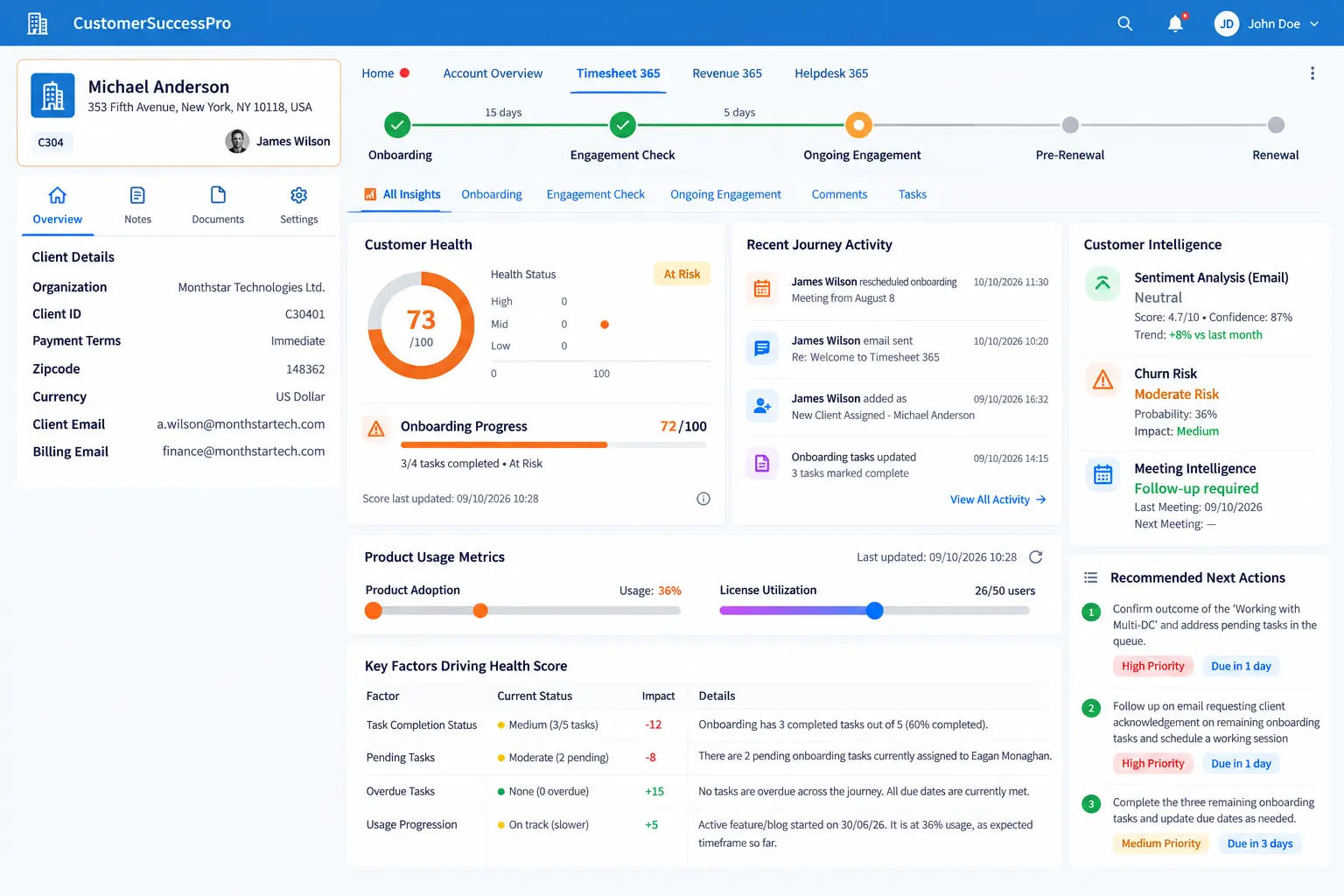
Manual scoring takes time as teams must check multiple tools, review customer data, and update spreadsheets. By then, the data may already be outdated.
AI is changing this work. The Gainsight survey found that 91% of respondents say AI will have a moderate to significant impact on their overall customer success strategy. Gainsight adds that AI saves customer success teams more than 10 hours per week. Those hours can go to real conversations with customers instead of copy and paste.
- Bring meetings, emails, support activity, and product data together and link each item to the right account
- Capture meetings, create AI-powered summaries, and pick out customer concerns, decisions, and action items
- Build one complete customer journey on a single timeline
- Measure customer health using sentiment, recurring issues, usage trends, and product-specific signals
- Spot early warning signs in sentiment, support activity, and product usage to flag accounts at risk before renewal
- Find upsell and cross-sell chances using product adoption, activity, and account behavior
- Track license utilization and show insights product by product
- Work with Microsoft Teams, Zoom, Slack, and Google Meet
Your team can view customer history, concerns, usage, and open actions in one place. Health scores also become more accurate by using live conversations and support activity instead of relying only on quarterly surveys.
Conclusion
A customer health score gives you an early warning system for your most valuable asset: the people who pay you. Start small. Choose a handful of indicators, set fair weights, and test the formula against past results. Then connect every color band to a clear action and a named owner.
Review scores regularly and combine data with customer feedback. An AI agent can gather insights and flag risks, giving your team more time to focus on customers.
Explore how the AI customer success agent helps reduce churn, improve engagement, and increase renewals.
Frequently Asked Questions
How often should businesses calculate customer health scores?
Businesses should update scores whenever relevant customer data changes. Reviewing them weekly or monthly helps teams identify changing customer behaviour and respond promptly.
Why is a customer health score important?
It helps businesses identify satisfied customers, detect potential churn risks, and understand where additional support is needed. It also helps customer success teams prioritize their efforts.
How to adapt customer health insights to different journey stages and engagement models?
Track onboarding progress for new customers, product usage for active users, and satisfaction and renewal intent for long-term customers. Adjust metrics based on how often each customer interacts with your team.
How can businesses improve their customer wellness score?
Focus on better onboarding, regular communication, product training, and faster issue resolution. Listen to customer feedback and help them achieve their goals.
How does analysing customer health scores help increase sales?
They help sales teams spot upsell, cross-sell, and renewal opportunities. By understanding customer needs and product usage, teams can make more relevant offers and grow existing accounts.


























