
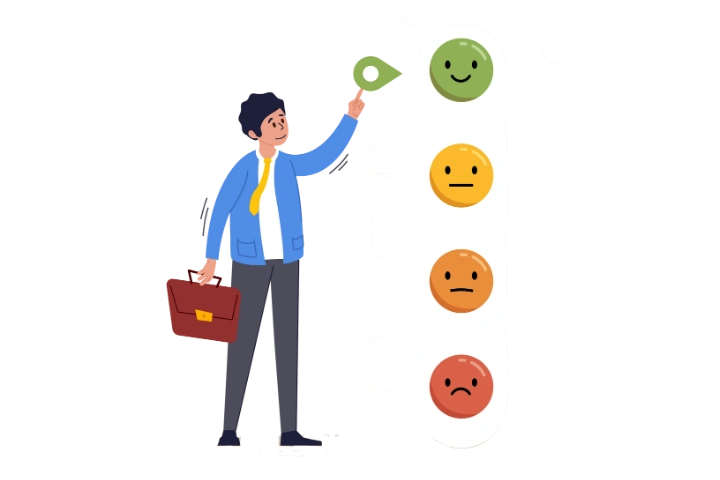
How to Measure Customer Satisfaction: 10 Practical Ways

How do you know whether your customers are truly satisfied with your business?
The simplest way to measure customer satisfaction is to ask customers about their experiences using surveys such as Customer Satisfaction Score (CSAT), Net Promoter Score (NPS), and Customer Effort Score (CES). You can also study customer reviews, support interactions, and retention rates to understand how customers feel about your products or services.
But collecting a few positive ratings does not tell the whole story.
A customer might give your support team a good rating but still struggle to use your product. Another customer might never complain but decide not to renew their subscription.
- CSAT, NPS, and CES measure satisfaction, customer loyalty, and ease of experience
- Customer reviews, interviews, and support tickets help identify the reasons behind satisfaction scores
- Retention, churn, and repeat purchases provide additional signs of customer experience
- Regular feedback analysis helps businesses identify problems and improve customer relationships
That’s why businesses need to combine direct customer feedback with customer behavior and service performance data.
In this guide, you’ll learn 10 practical ways to measure customer satisfaction, how to calculate important metrics, which methods to choose, and how to turn customer feedback into meaningful improvements.
What Does Measuring Customer Satisfaction Mean?
Measuring customer satisfaction means collecting and analyzing feedback to understand how well your business meets customer expectations.
It helps answer important questions:
- Are customers satisfied with your products or services?
- Can customers get help when they need it?
- How much effort does it take to resolve their problems?
- Are customers willing to recommend your business?
- What causes customers to stop using your services?
For example, imagine a software company that resolves most support tickets within its promised time.
From the support team’s view, everything looks good.
However, customer feedback shows that people must contact support several times before getting a complete solution.
The company is meeting its response targets, but the overall experience still needs improvement.
This is why customer satisfaction measurement should consider both customer opinions and actual experiences.
How Do You Measure Customer Satisfaction? 10 Practical Ways
There is no single method that explains every part of customer satisfaction.
Some methods ask customers directly how they feel. Others examine their actions, buying decisions, or support experiences.
Here are 10 ways to collect and understand that information.
1. Measure customer satisfaction with CSAT surveys
Customer Satisfaction Score (CSAT) is one of the most direct ways to measure how satisfied people are with a specific experience.
Businesses commonly use CSAT surveys after customer support conversations, purchases, product deliveries, or service requests.
Example CSAT question:
“How satisfied are you with the support you received today?”
Customers select a rating on a five-point scale:
- Very dissatisfied
- Dissatisfied
- Neutral
- Satisfied
- Very satisfied
CSAT formula:
CSAT (%) = (Number of satisfied responses ÷ Total responses) × 100
On a five-point scale, ratings of four and five usually count as satisfied responses.
Example:
Suppose 100 customers complete a satisfaction survey, and 82 select satisfied or very satisfied.
CSAT = (82 ÷ 100) × 100 = 82%
This means 82% of survey respondents reported a positive experience.
When to use CSAT:
- After resolving a customer support request
- Following a purchase or delivery
- After onboarding a new customer
- When evaluating a specific product or service experience
What to do with the results:
Track CSAT over time and compare it across service channels, issue types, and customer groups.
If satisfaction drops after a particular interaction, review that part of the customer journey.
2. Measure customer loyalty with Net Promoter Score (NPS)
Net Promoter Score (NPS) measures how likely customers are to recommend your business to others.
Unlike CSAT, which often focuses on a single experience, NPS helps businesses understand overall customer relationships and loyalty.
Example NPS question:
“How likely are you to recommend our company to a friend or colleague?”
Customers answer on a scale from zero to 10.
Based on their answers, they fall into three groups:
- Promoters (9–10): Customers who are highly likely to recommend your business
- Passives (7–8): Customers who are generally satisfied but less enthusiastic
- Detractors (0–6): Customers who are unlikely to recommend your business
NPS formula:
NPS = Percentage of promoters − Percentage of detractors
Example:
A business receives 100 responses:
- 60 promoters
- 25 passives
- 15 detractors
NPS = 60% − 15% = +45
NPS can range from −100 to +100.
The measurement method is also explained by Bain & Company’s Net Promoter System.
When to use NPS:
Send NPS surveys periodically, such as every quarter, or after important customer milestones.
Review comments from detractors to understand dissatisfaction and find opportunities to rebuild trust.
3. Evaluate customer effort with Customer Effort Score (CES)
Customers may receive the correct solution but still feel frustrated by the process.
Customer Effort Score (CES) measures how easy or difficult it is for customers to complete a task or get support.
Example CES question:
“How easy was it to resolve your issue?”
You can use a seven-point scale, where one means very difficult and seven means very easy.
CES formula:
Average CES = Total of customer effort ratings ÷ Number of responses
Example:
Five customers provide ratings of 7, 6, 6, 5, and 5.
CES = 29 ÷ 5 = 5.8 out of 7
With this scale, a higher score means customers found the experience easier.
Other CES survey formats use different wording or scoring methods, so keep your scale consistent.
When to use CES:
- After a customer service interaction
- Following product onboarding
- After using a self-service portal
- When evaluating checkout or account registration
For example, if customers must explain the same issue to three different support agents, CES feedback may reveal unnecessary effort.
Reducing that effort can make the support experience easier.
Start with CSAT to measure satisfaction, NPS to understand loyalty, and CES to identify difficult experiences. You do not need to send all three surveys after every interaction.
4. Collect feedback through targeted customer surveys
Standard satisfaction scores are useful, but they do not always explain why customers feel a certain way.
Targeted surveys help you understand specific parts of the customer journey.
For example, a SaaS company may want feedback about onboarding, while an online store may want to evaluate delivery experiences.
Instead of asking general questions, focus on the experience you want to improve.
Questions you can ask:
- What was the most difficult part of getting started?
- Did our product meet your expectations?
- What could we improve about our support process?
- Which feature would make your experience better?
Keep surveys short and send them when the experience is still fresh.
For example, after a customer completes onboarding, ask whether the instructions were clear and what assistance they needed.
Group similar answers into themes.
If many customers mention confusing setup instructions, your team has a clear area to investigate.
5. Conduct customer interviews to understand expectations
Not every customer wants to complete a survey.
Some customers can explain their experiences more clearly during a conversation.
Customer interviews allow businesses to ask follow-up questions and understand problems that standard surveys might miss.
Consider a customer who gives your software a satisfaction rating of three out of five.
A survey tells you the customer is not fully satisfied.
An interview may reveal that the software works well, but finding important features takes too much time.
That information can help product teams improve navigation and usability.
Questions to ask during interviews:
- What made you choose our product?
- What challenges have you faced?
- Which parts of your experience worked well?
- What would you change about our service?
Interview customers with different experiences, including satisfied customers, new users, and people who recently stopped using your product.
Look for repeated concerns rather than treating one opinion as the experience of every customer.
6. Analyze online reviews and customer ratings
Customers often share their opinions on review platforms without being asked directly by a business.
These reviews can provide useful information about product quality, support experiences, pricing, and ease of use.
For example, a software business might study feedback on G2 or Capterra, while a local service provider could review Google ratings.
Pay attention to more than the overall star rating.
Look for patterns in the written feedback.
- Positive reviews: Identify experiences customers value most
- Negative reviews: Find common complaints and unmet expectations
- Recent reviews: Understand whether customer experiences are changing
- Repeated themes: Identify issues affecting multiple customers
Suppose several reviews mention that support agents are friendly, but responses take too long.
That feedback points toward an opportunity to improve response times without losing the service qualities customers already appreciate.
Remember that online reviewers are self-selected, so ratings may not represent your entire customer base.
7. Monitor social media feedback and customer sentiment
Customers do not always contact support when something goes wrong.
They may share their experiences on social media, online communities, or discussion forums.
Social listening helps businesses identify these conversations and understand customer sentiment.
Customer sentiment generally falls into three categories:
- Positive: Praise, recommendations, and favorable experiences
- Negative: Complaints, disappointment, and frustration
- Neutral: Questions, observations, and factual comments
For example, a company introduces a new product update.
Support ticket volume stays low, but social media comments reveal that customers find the new interface confusing.
Without monitoring these conversations, the company might overlook the issue.
Track recurring topics, changes in sentiment, and the number of customers discussing similar problems.
AI-based sentiment analysis tools can help organize large amounts of feedback, but human review remains important because sarcasm and context can affect accuracy.
8. Track customer support tickets and service performance
Customer support data can reveal where customers face repeated problems.
A business may have strong survey scores but still experience frequent ticket reopenings, unresolved complaints, or delays in support.
These operational metrics do not directly measure satisfaction, but they help explain the customer experience.
Important support metrics to track:
- First Response Time: How long customers wait for the first support reply
- Average Resolution Time: How long it takes to resolve requests
- First Contact Resolution (FCR): Percentage of issues resolved during the first interaction
- Ticket Reopen Rate: Percentage of closed tickets that are reopened
- SLA Compliance: Percentage of requests handled within agreed service targets
Consider an IT support team that closes 90% of its tickets within the expected time.
However, many employees reopen tickets because the original solutions did not fully address their problems.
By reviewing ticket history alongside feedback, the team can identify gaps in resolution quality.
For businesses managing support requests, customer support software with ticket reporting and analytics can make these patterns easier to monitor.
Want Better Visibility Into Support Performance?
If your organization uses Microsoft 365, See how centralized ticket management, SLA tracking, and reporting can help your team monitor support requests and identify service issues.
9. Monitor customer retention and churn rates
Customer satisfaction also influences whether people continue doing business with you.
Retention and churn rates help organizations understand changes in customer relationships over time.
Customer retention rate measures the percentage of customers who remain with a business during a period.
Customer churn rate measures the percentage of customers who leave.
Churn rate formula:
Customer Churn Rate (%) = (Customers lost during a period ÷ Customers at the beginning of the period) × 100
Example:
A subscription business starts the month with 500 customers.
During the month, 20 of those customers cancel.
Churn Rate = (20 ÷ 500) × 100 = 4%
A rising churn rate may indicate problems with product value, pricing, service quality, or customer expectations.
However, not every cancellation happens because of dissatisfaction.
Customers may leave because of budget changes, shifting business needs, or other circumstances.
Combine churn data with cancellation reasons and customer feedback to understand the full picture.
10. Measure repeat purchases, renewals, and referrals
Customer behavior can provide additional clues about satisfaction.
Customers who repeatedly purchase products, renew subscriptions, or recommend a business may be having positive experiences.
Businesses can monitor:
- Repeat Purchase Rate: Percentage of customers who buy again
- Renewal Rate: Percentage of eligible subscriptions or contracts renewed
- Referral Rate: Percentage of customers who refer new customers
- Customer Lifetime Value: Estimated value a customer brings during the business relationship
For example, a SaaS company notices that customers who complete onboarding successfully are more likely to renew their subscriptions.
The company can study what those customers experienced differently and improve its onboarding process.
However, repeat purchases do not always mean customers are satisfied.
Some customers stay because switching providers is expensive or they have limited alternatives.
Use behavioral data together with surveys and interviews rather than treating it as direct proof of satisfaction.
CSAT vs. NPS vs. CES: Which Metric Should You Use?
These three customer satisfaction metrics answer different questions.
Metric | What It Measures | Best Time to Use |
CSAT | Satisfaction with an experience | After purchases or support interactions |
NPS | Likelihood to recommend | Periodically or after key milestones |
CES | Ease of completing a task | After support, onboarding, or self-service |
Which one should you start with?
If your main goal is to improve customer support, begin with CSAT.
If you want to understand overall customer loyalty, use NPS.
If customers complain about complicated processes, CES can help identify where they struggle.
Using the right metric at the right time produces more useful information than collecting every possible score.
How to Measure Customer Satisfaction Step by Step
Once you understand the available methods, the next step is building a simple measurement process.
Step 1: Define what you want to measure
Start with a clear goal.
For example, you might want to improve support satisfaction, reduce customer churn, or learn why customers abandon onboarding.
Choose a metric that matches that goal rather than collecting data without a purpose.
Step 2: Select the right customer touchpoints
Identify the moments when customer feedback will be most useful.
These may include completing a purchase, resolving a ticket, finishing onboarding, or renewing a subscription.
Collect feedback close to the experience, but avoid sending too many surveys to the same customer.
Step 3: Collect feedback consistently
Use a consistent question, rating scale, and survey timing.
For support satisfaction, you might send the same CSAT question after every eligible resolved ticket.
Track the response rate along with the score so you know how many customers participated.
Step 4: Analyze the results and identify patterns
Review feedback by product, department, service channel, and issue type.
Look beyond average scores.
A company-wide CSAT of 85% may appear positive, but one support category might have a much lower rating.
Understanding these differences helps teams decide where to focus their efforts.
Step 5: Take action and measure again
Turn customer feedback into specific improvements.
If customers report slow responses, review ticket assignments and staffing.
If they struggle with onboarding, improve instructions or training resources.
After making changes, compare results with your previous baseline.
Let customers know when their feedback leads to an improvement. This closes the feedback loop and shows that their opinions matter.
Customer Satisfaction Survey Questions You Can Use
You do not need a long questionnaire to begin measuring customer satisfaction.
Choose questions based on the experience you want to evaluate.
- Overall satisfaction: How satisfied are you with our product or service?
- Support quality: How satisfied were you with the help you received?
- Customer effort: How easy was it to resolve your issue?
- Customer loyalty: How likely are you to recommend our company to others?
- Improvement feedback: What is one thing we could do to improve your experience?
A short survey containing a rating question and an optional comment field is often a useful starting point.
For more detailed research, add questions about specific experiences, but avoid asking customers questions that are not relevant to them.
What Is a Good Customer Satisfaction Score?
There is no single CSAT score that every business should target.
A result that appears strong in one industry may be average in another.
Scores also depend on survey wording, the rating scale, the customers surveyed, and the type of experience being measured.
For example, a CSAT score of 80% means eight out of 10 respondents selected a satisfaction rating under that survey’s scoring rules.
It does not mean every customer is 80% satisfied.
When reviewing scores, focus on:
- Your previous satisfaction results
- Changes across different customer groups
- Feedback from dissatisfied customers
- Trends in support performance and customer behavior
- Benchmarks based on comparable survey methods
Also, avoid comparing a traditional CSAT percentage directly with the American Customer Satisfaction Index, which uses a different measurement model.
Consistent improvement supported by customer comments is often more meaningful than reaching an arbitrary number.
Common Mistakes to Avoid When Measuring Customer Satisfaction
Even a well-designed survey can produce misleading results if businesses collect or interpret feedback incorrectly.
Watch out for these common mistakes:
- Measuring only one metric: A high CSAT score does not automatically mean customers are loyal
- Sending too many surveys: Frequent requests may discourage customers from responding
- Ignoring negative feedback: Dissatisfied customers can reveal important service problems
- Overlooking response bias: Survey respondents may not represent the entire customer base
- Collecting feedback without acting: Measurement is less useful when findings never lead to changes
Another common problem is comparing scores from different questions or rating scales.
Keep your measurement methods consistent, and review both numerical scores and written feedback.
How Helpdesk 365 Supports Better Customer Service Measurement
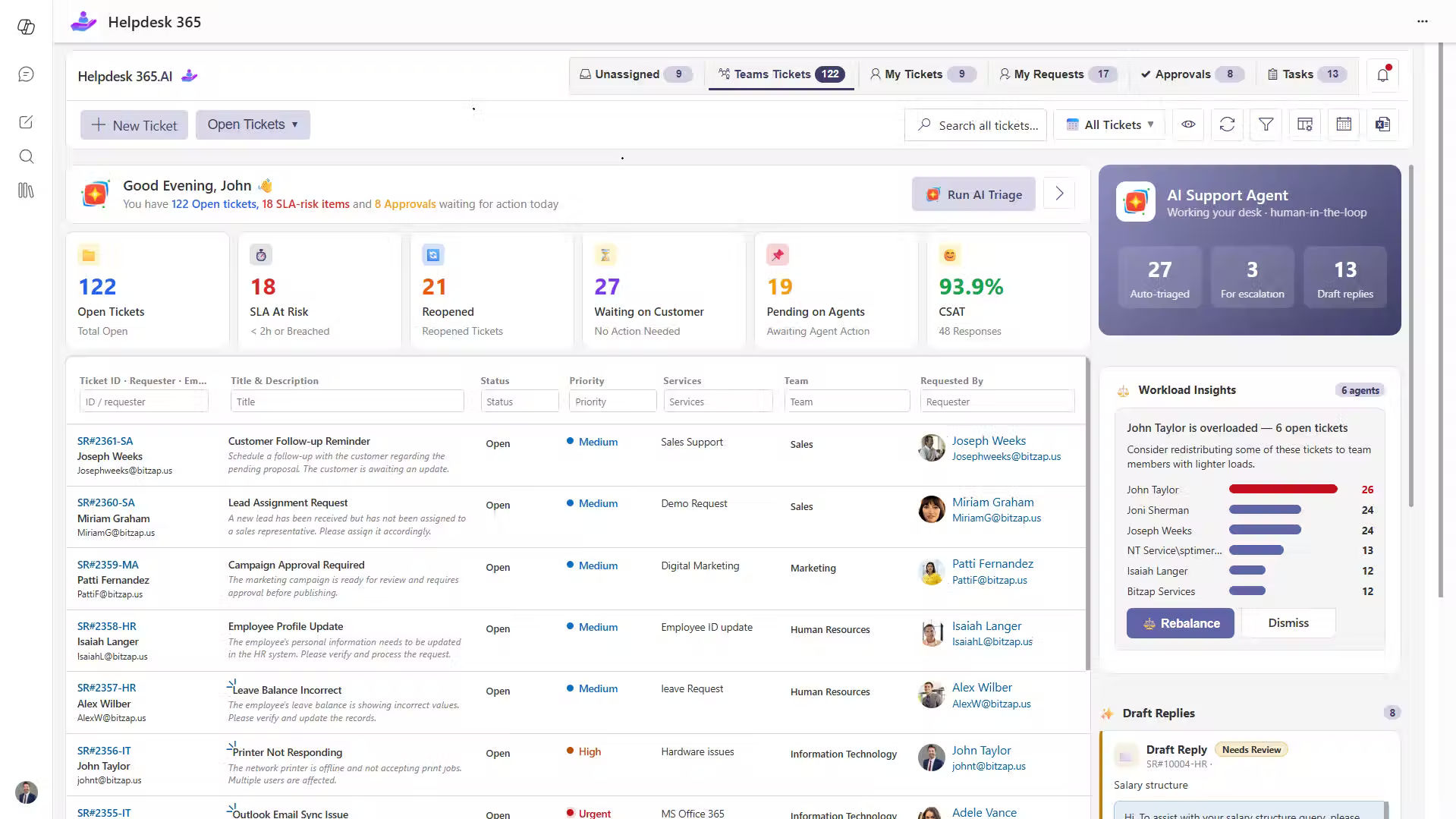
For organizations using Microsoft 365, measuring service satisfaction becomes more useful when feedback can be reviewed alongside support activity.
Helpdesk 365 is a SharePoint-based helpdesk solution that helps teams manage service requests through Microsoft Teams, Outlook, and SharePoint.
It provides capabilities such as:
- Customer satisfaction surveys: Collect feedback on support experiences in supported plans
- Ticket tracking: Monitor request status, ownership, and progress
- Reporting and analytics: Review ticket trends, response times, and support performance
- SLA management: Track service targets, reminders, and escalations
- AI-assisted ticket management: Help categorize, prioritize, and route incoming requests
For example, an IT team can review service performance and employee feedback to understand whether resolved requests are also leading to better support experiences.
This helps organizations connect operational performance with the needs of the people receiving support.
Want to track purchase order cycle time without manual reports?
Explore how ticket management, customer satisfaction surveys, automation, and reporting can support your service improvement goals.
Conclusion
Measuring customer satisfaction is not just about collecting positive ratings. It is about understanding what customers experience, where they face difficulties, and what your business can do better.
Start with CSAT, NPS, or CES based on your goals. Then use customer reviews, support data, interviews, and retention trends to understand the bigger picture.
Most importantly, turn feedback into action.
When businesses regularly measure satisfaction, investigate customer concerns, and improve the experiences that matter, they can build stronger customer relationships and make better service decisions.
Join Our Creative Community
Frequently Asked Questions
1. What is the best way to measure customer satisfaction?
CSAT surveys are a good starting point because they directly ask customers how satisfied they are with an experience. For a broader understanding, combine CSAT with NPS, CES, customer reviews, support data, and retention trends.
2. How often should businesses measure customer satisfaction?
Measure satisfaction after important interactions, such as resolving a support ticket or completing onboarding. For overall customer relationships, businesses can collect NPS feedback periodically. The right frequency depends on customer activity and how often experiences change.
3. Can you measure customer satisfaction without surveys?
Yes. You can analyze online reviews, customer complaints, social media sentiment, support ticket patterns, repeat purchases, and churn rates. However, these methods provide indirect signals. Direct customer feedback helps confirm whether those signals reflect satisfaction or dissatisfaction.
4. What is the difference between customer satisfaction and customer experience?
Customer satisfaction describes how customers feel about a product, service, or interaction. Customer experience covers the full journey, including discovering a business, making purchases, using products, and receiving support. Satisfaction is one way to evaluate that overall experience.


























