What Is Contract Value: Importance & How to Calculate It

Every deal starts with a number. But what does that number really mean? It could be the price on the first bill, the full amount over three years, or the money you expect to earn each year.
- Contract value is the total worth of a deal, but the figure depends on what you count, such as fees, add-ons, and renewals.
- TCV, ACV, and ARR each answer a different question, so choose the one that fits your goal.
- Deloitte found that poor agreement management costs the world about $2 trillion in value every year.
- A shared system gives your team instant visibility into contract value, which leads to better forecasts and fewer missed renewals.
Knowing your contract value helps you plan budgets, set sales goals, and predict cash flow.
Yet many teams use the term in different ways. Sales may count one figure, finance may count another, and legal may not track it at all. That gap costs money. WorldCC research shows the average business loses almost 9% of its value each year through poor contract management.
This guide explains contract value in plain words. You will see what goes into it, how to work it out, and how to keep it clear as deals change.
What Is Contract Value?
Contract value is the total monetary worth of a contract over its full term, representing the revenue a seller earns or the cost a buyer incurs.
Think of it as the price tag on an agreement. But unlike a tag in a store, it is rarely one simple number. A contract may have a monthly fee, a setup fee, a discount, a yearly price increase, and a bonus for hitting goals. All of these change the final figure.
Here is a quick example. A software company signs a client for $2,000 a month for 24 months. The value is $48,000. If the client also pays a one-time setup fee of $3,000, the total grows to $51,000. It is the same deal with two different totals, depending on what your team decides to count.
Key Elements That Make Up Contract Value
A deal’s worth is built from several parts. Knowing each one helps you avoid a number that is too high or too low.
- Base price or fees: This is the core amount the buyer agrees to pay. It may be a fixed price, an hourly rate, or a price per unit
- Contract term: Length matters a lot. A $10,000 monthly fee adds up to $120,000 in one year and $360,000 in three
- Payment schedule: Payments may come monthly, quarterly, yearly, or at set milestones. The schedule does not change the total, but it changes when cash arrives
- Recurring and one-time charges: Subscription fees repeat. Setup, training, and installation fees usually happen once. Keeping them apart makes the number easier to read
- Discounts and credits: Volume discounts, early payment discounts, and free months all lower the total
- Price increases: Many contracts raise prices each year by a set percent. These raises add to value over time
- Renewal terms: Auto-renewal clauses can extend a deal. Count a renewal only if your company rules say so
- Variable fees: Usage charges, overage fees, and change orders can grow the total after signing
- Bonuses and penalties: Some deals pay extra for early delivery or take money away for late work
- Termination fees: If a client leaves early, an exit fee may apply
When you list every element in one place, you get a clear picture of contract deliverables. You can also spot terms that quietly change the total.
TCV vs. ACV vs. ARR: What's the Difference?
These three terms often get mixed up. Each one shows contract value from a different angle.
- TCV (Total Contract Value): the full amount a deal is worth over its whole term.
- ACV (Annual Contract Value): the average yearly worth of a single deal.
- ARR (Annual Recurring Revenue): the yearly income from all repeating subscriptions.
Aspects | TCV | ACV | ARR |
What it shows | Full worth of one deal over its term | Average yearly worth of one deal | Yearly repeating income across all customers |
One-time fees | Included | Usually left out | Left out |
Scope | One contract | One contract | Whole customer base |
Best used for | Deal size, sales targets, buyer budgets | Comparing deals of different lengths | Tracking growth of a subscription business |
Example (24 months at $2,000 a month, plus $3,000 setup) | $51,000 | $24,000 | $24,000 from this customer |
TCV shows the full deal value, ACV standardizes annual contract value, and ARR tracks recurring subscription revenue, so define each metric consistently across teams.
How to Calculate Total Contract Value (TCV)
The easiest way to express contract value is TCV, and the math is simple.
TCV = (Recurring fees × number of periods) + one-time fees + expected variable fees − discounts
Follow these steps:
- Find the term. Check the start date, end date, and any built-in renewals.
- Add up recurring charges. Multiply the fee by the number of billing periods.
- Add one-time fees. Include setup, training, and installation.
- Add variable fees carefully. Count them only if they are guaranteed or if your company rule says to include expected amounts.
- Subtract discounts and credits.
- Apply price increases. If the price rises 3% each year, calculate each year on its own.
Example. A client signs a three-year deal. The platform costs $5,000 a month. The client gets a 10% discount on that fee for committing to three years. Onboarding costs $12,000, and training costs $6,000.
- Recurring fees: $5,000 × 36 months = $180,000
- Discount: 10% of $180,000 = $18,000, leaving $162,000
- One-time fees: $12,000 + $6,000 = $18,000
- TCV: $162,000 + $18,000 = $180,000
- ACV (recurring only): $162,000 ÷ 3 = $54,000
A few habits keep the math clean. Use the final signed version, not a draft. Write down how you got the number so others can follow it. Recalculate contract value after every contract amendment. And store the date of each calculation, since deals change over time.
Turn contracts into actionable business insights
CLM 365 gives teams a centralized view of contracts, key terms, obligations, renewals, and approvals, helping them manage every stage of the contract lifecycle.
What Is Included and Excluded from Contract Value?
Not every amount associated with a deal is included in its total value. Defining clear inclusion and exclusion criteria helps maintain consistency and prevents disputes during contract review and reporting. The exact rules may vary based on your company’s accounting and contracting policies.
Typically included:
- Fixed fees and recurring subscription charges
- One-time fees for implementation, setup, training, and installation
- Minimum purchase or volume commitments
- Contractually agreed price increases
- Signed amendments and approved change orders
- Guaranteed milestone-based payments
Typically excluded:
- Sales tax, VAT, and other applicable taxes
- Expenses reimbursed or billed to the client at cost
- Optional add-ons that have not been formally contracted
- Renewals that have not yet been signed
Why Contract Value Is an Important Business Metric?
Clear agremeent value figures do more than improve forecasting. They give finance, sales, and leadership a consistent view of the commercial value tied to each agreement.
- Better financial planning. Finance teams can forecast revenue, cash flow, hiring requirements, and spending with greater confidence when values are accurate and consistently calculated.
- Fairer sales targets. Quotas, commissions, and incentive plans built around a clearly defined contract value reduce ambiguity and help sales teams work toward consistent targets.
- Better customer prioritization. Understanding the value of each contract helps teams identify high-value accounts, allocate resources effectively, and recognize accounts that may require a different level of attention.
- Lower commercial risk. Clear contract values make it easier to identify revenue gaps, unexpected costs, pricing discrepancies, and unfavorable terms before they affect the business.
- Stronger negotiations. When teams have a clear view of what a deal is worth, they can make more informed decisions about discounts, pricing concessions, payment terms, and other negotiation points.
- Faster deal execution. Accurate contract information reduces back-and-forth between sales, finance, legal, and procurement. With fewer questions about deal value and terms, agreements can move through review and approval more efficiently.
- A clearer business picture. Consistent data gives leadership a stronger view of revenue commitments, customer value, and the overall commercial portfolio, supporting better decisions across the business.
How Contract Value Is Measured Across Different Industries
It varies by industry based on pricing models, contract terms, duration, and payment structures. Here’s how businesses typically measure it across different sectors.
- Software and SaaS. Organizations commonly use ACV and ARR for recurring revenue contracts, while TCV captures the overall value of multi-year agreements, including applicable implementation or setup fees.
- Construction. It typically starts with the original contract amount and changes as approved change orders modify the scope or cost. Retainage can also affect the timing of payments.
- Healthcare. Payer agreement value often depends on reimbursement rates, covered services, and patient volumes, making the overall value variable and dependent on actual utilization.
- Professional Services and Staffing. It is generally calculated using agreed hourly or daily rates and estimated hours, or a monthly retainer multiplied by the contract term. Minimum contract obligation and spending caps may also affect the total.
- Manufacturing and Supply Chain. It is commonly based on unit pricing and committed volumes. Price adjustment clauses tied to material or production costs can change the overall value over the contract term.
- Real Estate. Lease value typically reflects total rent over the lease term, including scheduled increases and, where applicable, charges for shared operating costs.
- Government. Many government contracts specify a maximum spending ceiling. This represents the highest amount the agency can spend rather than a guaranteed commitment.
How CLM 365 Helps You Manage Contract Value?
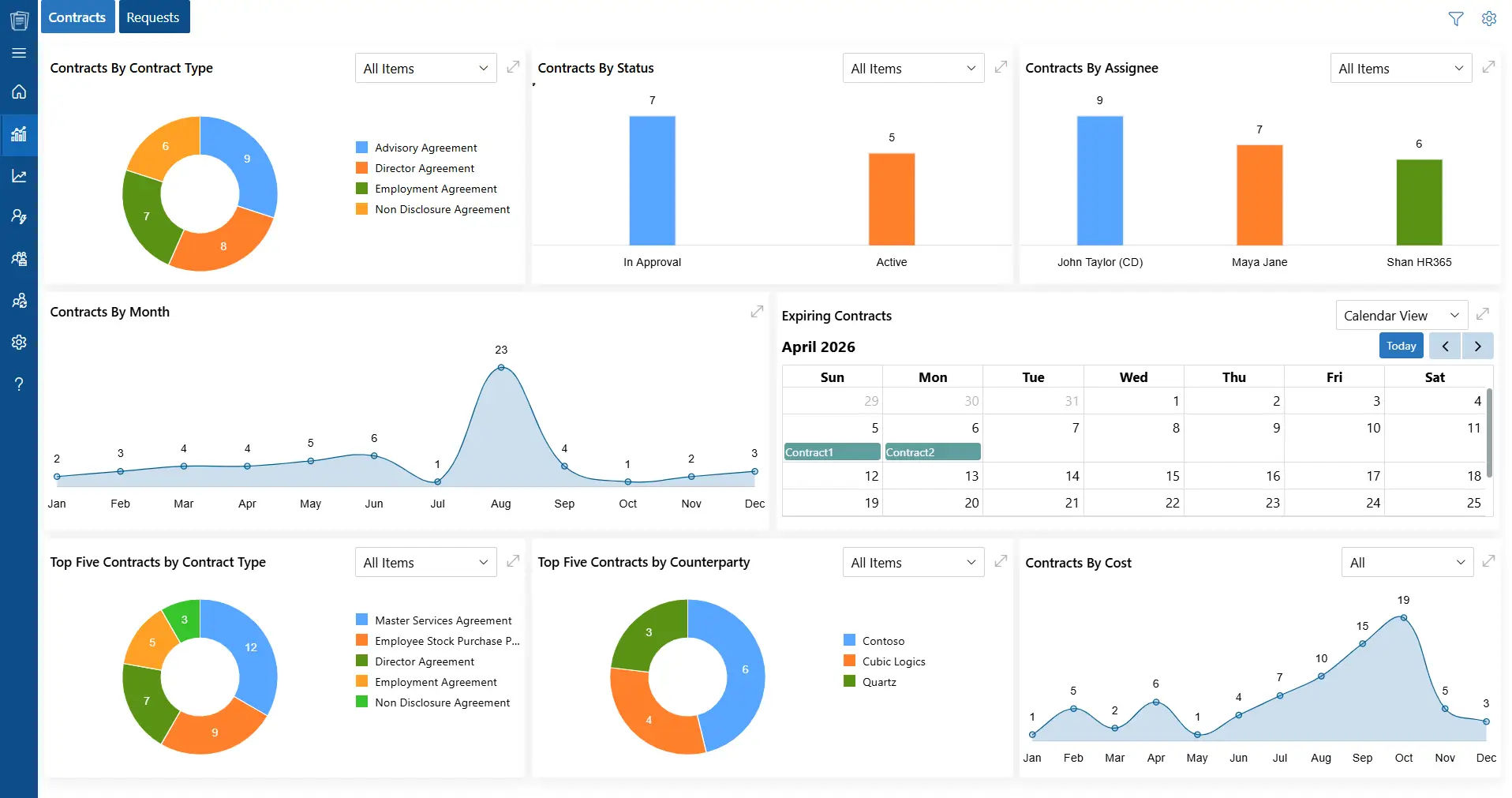
When contract values, pricing terms, commitments, and renewal details are spread across documents and spreadsheets, it becomes difficult to get a clear view of what each agreement is worth.
With CLM 365, teams can centralize contract information and manage key commercial terms throughout the contract lifecycle. This makes it easier to understand value and act on important dates, obligations, and changes.
That means:
- Centralize contract values and key terms so teams can quickly access the information they need.
- Track contract milestones and obligations to stay on top of commitments.
- Monitor renewals and expiration dates to identify upcoming opportunities and avoid missed renewals.
- Manage amendments and changes so updated terms and commercial commitments remain visible.
- Improve contract visibility with centralized access to agreements and relevant contract information.
- AI-Native Contracting Contract intelligence summarizes key clauses and suggests alternative language to support faster contract review.
Instead of treating agreement value as a figure captured at signing, CLM 365 helps teams manage the terms and commitments that determine how much value they realize throughout the contract lifecycle.
Conclusion
It is more than a number on a signed agreement. It reflects the revenue, commitments, and commercial terms a business expects to realize throughout the contract lifecycle. Managing that value requires visibility into key terms, obligations, milestones, amendments, and renewals.
CLM 365 helps teams manage these elements in one place, giving them greater visibility from contract creation and approval through execution and renewal.
Ready to get more value from your contracts? Explore CLM 365 and see how it can help your team manage the entire contract lifecycle.
Frequently Asked Questions
What is the difference between contract value and contract price?
Contract price typically refers to the agreed price for specific goods or services, while contract value can represent the broader financial value of the agreement, including recurring fees, commitments, and applicable additional charges.
Can I track value across multiple contracts?
Yes. A centralized contract management system can provide visibility into contract values across multiple agreements, customers, departments, or business units.
Can I maintain an audit trail of contract changes?
Yes. An audit trail can record important actions and changes, helping teams understand who made changes and when they occurred.
What is the best way to track contract value across multiple agreements?
A centralized contract repository allows teams to track contract values across customers, departments, business units, and contract types from one place.
How are contract renewal dates tracked?
The system can store expiration and renewal dates and provide automated notifications before important deadlines.