

Contract Management in SharePoint: A Practical Guide for Modern Businesses

SharePoint has now become much more than a document storage tool. Nowadays, almost 300 million people all over the world use it to control content, work with teams, and facilitate business processes.
This guide explains how contract management works in SharePoint, why businesses use it, and why CLM 365 is a strong option for SharePoint users. It also helps teams understand how to manage contracts using familiar Microsoft tools without adding new systems.
As organizations handle an increasing number of agreements, many teams are now exploring contract management in SharePoint as a reliable and familiar approach.
Contracts control the income, the relations with the vendors, the compliance responsibilities, and the business risk. In cases where the contracts are distributed in folders, email inboxes or personal drives, teams lose visibility and control.
What Is SharePoint?
SharePoint is an web-based platform that is used to manage documents, collaborate internally and share information. It enables organizations to develop sites, libraries and workflows that facilitate day-to-day business activities.
At its core, SharePoint helps teams
- Track changes and versions
- Organize documents in the store
- Access control through permissions
- Collaborate without using lost files
In the case of large and mid-size organizations, SharePoint contract management management center across departments.
What Is Contract Management in SharePoint?
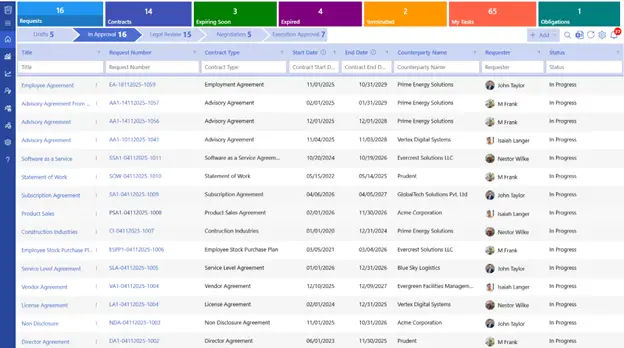
SharePoint contract management is a system that uses SharePoint libraries, lists, workflows, and integrations to manage the entire contract cycle. This involves drafting, reviewing, approvals, storage, renewals and reporting.
In the case of organizations that have been using SharePoint, the method will decrease the reliance on various tools and enhance the control over contract data.
Why Choose SharePoint for Managing Contracts?
Contracts are not documents only. They manage contract renewals, legal obligations, and vendor relations. In case the contracts are distributed through emails, local drives, or shared folders, and there is no system, teams experience friction daily. The following are the most prevalent issues associated with contracts.
1. Struggling to find Agreements
Contracts in most teams reside in inboxes, personal folders, or shared drives and are named in a way that is not very clear.
In case one requires the most recent agreement, they tend to look through emails or seek the assistance of their colleagues. This is time consuming and postpones decisions.
When it comes to contract management in SharePoint, contracts are kept in one repository and are controlled. The authorized user can access the needed document regardless of the location without the use of emails and local storage.
2. Pressure to Meet Compliance
Legal and operations teams are concerned with compliance. If contracts are not stored properly, it is difficult to establish who approves a contract, when a contract needs to be modified or what version was accepted.
SharePoint aids in maintaining records using access control, version history, and activity tracking.
These functionalities assist groups to adhere to internal policies and address regulatory requirements without the use of manual tracking or offline records.
3. Financial Losses Due to Missed Obligations
Missed renewals, overlooked provisions and unclear terms of the contract may result in loss of revenue or unwanted expenses. In the case of scattered contracts, teams can fail to notice the renewal dates or payment terms until it is too late.
By keeping contracts in one place, SharePoint helps teams stay aware of key dates and responsibilities.
Clear visibility of contractual obligations duces the risk of missed actions that affect business revenue.
4. Teams Working in Silos on the Same Contract
Legal, procurement, sales, and finance teams are usually involved in contracts. Version problems occur when the groups are working on different copies.
The comments are lost, updates are duplicated, and ownership is lost.
Contract management in SharePoint provides the ability to share a document with other teams with appropriate permissions.
All people operate on one source, which will enhance coordination and speed in cross-departmental reviews.
5. Hesitation to Adopt Yet Another Tool
Contract management in SharePoint is already utilized by many organizations as a component of Microsoft 365. Implementing a new contract system can be associated with training, resistance and slow adoption.
As almost every third user of Microsoft 365 already has access to SharePoint, dealing with contracts in a similar environment is not new.
Teams will work within a system they are already familiar with, and this will create less friction and accelerate adoption.
How Does Contract Management Work in SharePoint?
Contract management in SharePoint works by managing contracts, access control and collaboration within a single system.
- Build-in workflows control approval steps, alerts, and renewal reminders, which help in the entire lifecycle of a contract
- Sensitive contracts are secured by specifying the individuals who are allowed to see, edit, or approve documents in the system
- Contracts can be categorized based on type, vendor, department, dates or status and hence search and retrieval is quicker and more organized
- Contracts are saved in special SharePoint libraries where teams have one location to make, store and retrieve agreements whenever they need it
- SharePoint captures every change that is made in a contract and stores the previous versions, which can be reviewed to ensure that teams have the right records
- It integrates with Microsoft 365 apps enabling users to review contracts, communicate updates and analyze contract data without leaving the Microsoft environment
These steps combined describe how contract management in SharePoint supports to handle contracts in growing businesses in an organized, secure and scalable way.
Key Features of Using SharePoint for Contract Management
Contract management in SharePoint offers a practical set of features that help organizations manage agreements within a system they already use every day. Below are the core features that make the systema preferred choice for many businesses.
1. Contract Repository
SharePoint is used as a formal contract repository in which agreements may be stored according to type, vendor, region, department or contract status. This systematized process facilitates the process of finding the active, expired, or pending contracts without the need to use personal folders or email archives.
Studies suggest that weak contract handling can result in losses close to 10% of annual revenue, which highlights the value of having a single, well-managed repository.
With SharePoint, contracts remain stored in one controlled location, helping teams maintain better visibility over their agreements.
2. Integrated with Microsoft 365 Suite
SharePoint integrates with Microsoft 365 applications like Word, Outlook, Teams, Copilot, and Power BI, which are highly beneficial to contract management.
Users redline contracts in Word, update them in Teams, read mail in Outlook, and analyse data in Power BI, and the contract will be stored in SharePoint.
This integration eliminates the reliance on third-party tools and enables teams to keep operating in the familiar Microsoft applications.
Recommended Read: Advantages of Microsoft Teams Contract Management
3. Multilevel Approval Workflows
In most contracts, the approvals of various departments like legal, finance, and leadership are needed. Contract management in SharePoint allows multilevel contract approval process with each level being well defined.
The progress of the approval can be monitored at each stage, and the teams can know who has already reviewed the contract and what is still awaiting.
This systematic flow of approval enhances accountability and transparency within departments.
4. Automate Tasks with Power Automate
Power Automate can be used to automate routine tasks such as approval notifications, renewal reminders, and status updates.
This minimizes manual follow-ups and assists teams to remain concentrated on work of higher value.
The contract automation assists in taking timely measures without necessarily having to be monitored or reminded.
5. AI-Powered System
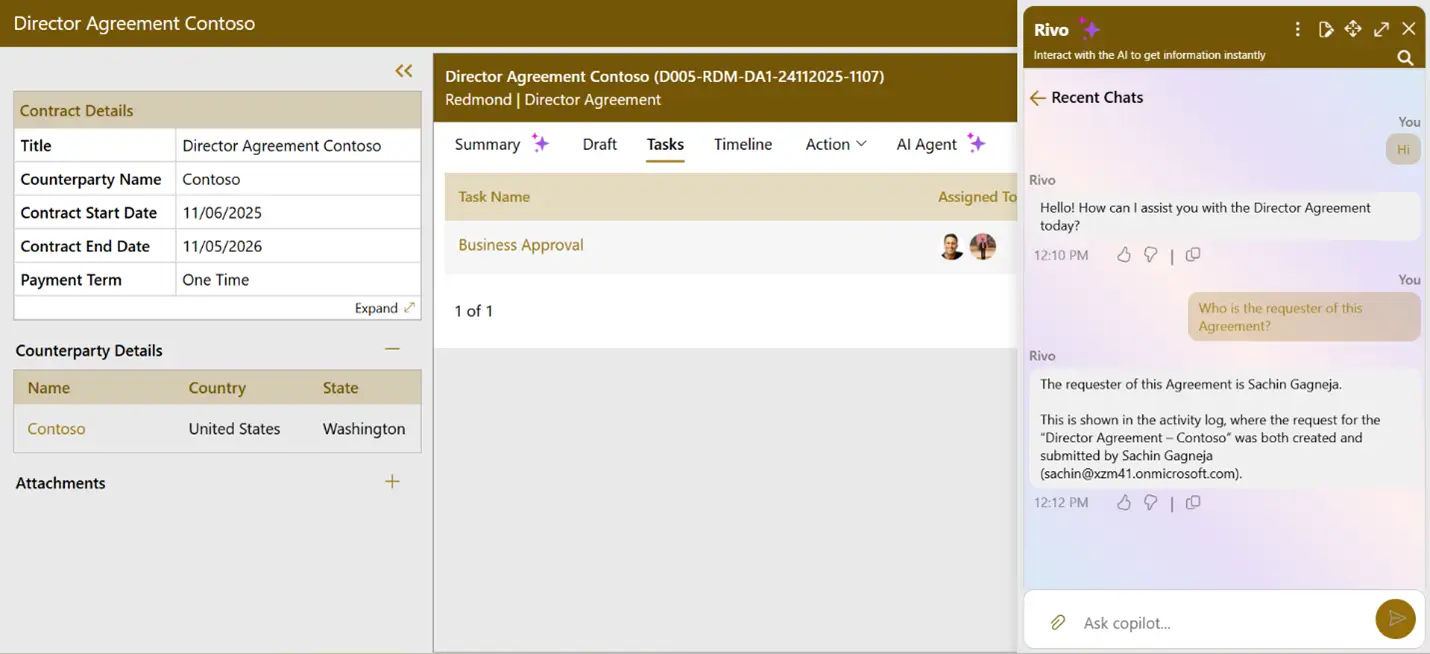
AI features support contract review by summarizing clauses, highlighting key terms, and assisting with document analysis.
A research by Deloitte shows that a 79% of legal professionals expect AI to influence how legal work is handled in the coming years.
With AI in the SharePoint contract management, teams are able to go through contracts more quickly without losing focus on key points.
6. Compliance Management
Contract management in SharePoint allows compliance with access controls, document retention settings and audit logs.
These characteristics assist organizations in keeping the right records and monitor the activity of documents.
Compliance teams can monitor access history and document changes where necessary, and this helps to back internal policies as well as external regulations.
7. Clause Library
SharePoint allows teams to maintain a clause library containing commonly used contract language.
Clauses that have been approved can be reused in numerous agreements, which is beneficial in ensuring consistency in the wording and structure.
This feature is particularly handy in organizations that deal with similar contracts either in terms of vendors, customers or regions.
8. Negotiation Support Within Documents
During contract negotiation workflow, the counterpart receives a one-time password (OTP) to access the contract securely.
This adds an extra layer of control and confirms that only the intended recipient can view or respond to the document.
All edits, comments, and revisions are captured within the same file. Stakeholders can review proposed changes and respond directly inside the system.
9. Contract Amendment Handling
Contract management in SharePoint allows amendments, addendums, and related documents to be linked directly to the original contract.
This keeps the full contract history available in one location, allowing teams to review and track contract modification over time.
Teams do not need to go through individual folders or email chains to review how an agreement has changed over time.
10. Reporting & Analytics
Contract management in SharePoint facilitates the reporting of contract volume, renewal schedule and contract ownership.
These insights can be more easily visualized and analyzed when used together with Power BI.
Analyzing contracts assists the teams to monitor the performance, future actions and to plan future contract activities more efficiently.
Benefits of Using Contract Management in SharePoint
In the case of organizations that have already been operating within the Microsoft tools, contract management in SharePoint is a natural part of day-to-day operations. Below is a deeper look at the key benefits and why many businesses rely on this approach.
1. Familiar Interface for Employees Already Using SharePoint
One of the biggest advantages of contract management in SharePoint is familiarity. Those business who already use SharePoint to store documents, internal web sites or teamwork do not require much training to work with contracts.
The layout, navigation, and document handling are familiar and this can assist teams to learn contract processes quicker.
This familiarity helps to eliminate the hesitation and enables the users to work on the contract itself and not to learn a new system.
2. Central Location for All Contract Documents
The contracts may be located on multiple places in email inboxes, local drives, or shared folders. SharePoint contract management software helps store all agreements in a single place.
Having a single source for contracts makes it easier to
- Type or departmental contracts
- Locate active and expired agreements
- Have a well-defined contract system
This central approach reduces time spent searching for documents and improves overall organization.
3. Better Visibility into Contract Timelines and Ownership
When contracts are stored without structure, it is often unclear who owns a contract or when action is required.
Contract management in SharePoint enables teams to follow contract owners, approval status, and key dates using the same system.
Timelines are easily visible, which keeps teams informed of renewals, review cycles and obligations. Clarity of ownership also facilitates ease of assigning responsibility and follow up where necessary.
4. Reduced Dependency on Email-Based Contract Handling
Drafts are frequently circulated via email, as well as approvals and feedback are sought. In the long run, this results in scattered conversations and unclear document status.
With contract management in SharePoint, contracts are stored in a common workspace where updates, comments and approvals are stored in context.
This will minimize the use of long email chains and ensure that the contract activity is linked to the document itself.
5. Improved Control Over Document Versions and Access
One of the challenges in contract handling is contract version control. The same contract may be reviewed or approved several times, which results in the outdated terms.
SharePoint keeps version history automatically and teams can view what was changed and when. Access privileges are also used to regulate who is allowed to see, edit or approve contracts.
This control level helps in enhanced control of documents without additional complexity.
5. Supports Audit Readiness and Internal Reviews
Teams may be required to present contract audit, approvals and access records during audits or internal reviews.
Audit logs, version history, and access settings give the organizations clear records that enable them to respond to audit requests.
SharePoint contract management is helping with this by providing in-built tracking capabilities.
6. Scales Easily as Contract Volume Grows
Contract management in SharePoint scales well with increasing volume, allowing organizations to add new libraries, metadata fields, and workflows as needed.
As businesses grow, so does the number of contracts they manage. Contract management in SharePoint helps managing contracts on a scale, and as an organization grows.
Whether it is handling huge volume of contracts, SharePoint offers a systematic structure that does not interfere with the current processes to promote growth.
7. Contracts Become Part of Everyday Work
Contract management does not seem to be a distinct legal activity to SharePoint users.
Contracts are integrated into the daily work that is available with other business documents and processes.
This integration promotes uniform use by teams and assists organizations to have a better control of contracts in their lifecycle.
Steps to Set Up Contract Management in SharePoint
- Use SharePoint as a single place to manage all contracts, where users can view requests, drafts, approvals, active, expired, and terminated contracts in a single dashboard.
- Create contract requests and drafts easily to allow users to save progress, review information, and provide correct information without errors.
- Set-up clear approval processes so that contracts are automatically forwarded to the right people in the correct order, avoiding delays and confusion.
- Easily manage legal reviews by enabling legal teams to add comments, files and monitor review status to ensure compliance.
- Complete execution approvals to verify that contracts are prepared, policy-compliant and approved prior to publication.
- Publish contracts to ensure that all active agreements are visible and accessible to authorized users are in a single place.
- Handle termination and expiration of the contracts and make sure that inactive contracts are distinctly separated and that there are no cases of missing renewals.
- Keep logs of activities to trace all the activities, who did what and when, which is useful in audits and transparency.
- Track deviations, risks and mitigation plans, both found manually and in reviews, to control exceptions.
- Identify risks, analyze clauses, propose alternatives, and create summaries of contracts in a few seconds using AI-powered capabilities.
- Enable collaboration with reviews, consultations, extra approval levels, and task dashboards, so every stakeholder knows their responsibilities.
- Support draft comparison, automatic language detection, and continuous workflow improvement, ensuring clarity, global usability, and long-term efficiency.
NOTE: Workflow will be the same, however, the installation process will be different in case of various integrations. Please, take a look at a knowledge base.
Why Is CLM 365 a Great Fit for SharePoint Users?
CLM 365 is built within the Microsoft ecosystem and integrates with the applications businesses already use in their daily operations. Built directly on Microsoft technologies, it extends SharePoint’s capabilities into a full contract lifecycle management solution.
The platform has a natural integration with Teams, Outlook, Word, SharePoint, and Copilot, enabling users to use the platform to work on contracts within familiar applications.
The AI-based functions are used to review clauses, provide summaries, and identify risks, whereas approvals and notifications are automated. CLM 365 is user-friendly and has strong security controls, which make it suitable to both legal and business users.
Now it is available in Microsoft Azure Marketplace .
Conclusion
Contract management in SharePoint provides a viable solution to organizations that desire control, visibility, and collaboration without the need to add complex systems. With millions of users who already use SharePoint, it is only logical to extend it to contract handling.
Contract management in SharePoint is a reliable option to organizations that want to enjoy clarity, control, and scalability.
Explore CLM 365 to manage contracts more effectively inside SharePoint.
Join Our Creative Community
Frequently Asked Questions
How does SharePoint store contracts securely?
SharePoint stores contracts in secure document libraries. Access privileges regulate access to every contract. All changes are logged in version history and activity logs, which can assist the teams to safeguard sensitive agreements.
Is SharePoint contract management easy to deploy?
Yes. For Microsoft 365 users, SharePoint is already available. Contract libraries, permissions, and workflows can be established by teams without the need to introduce a new platform.
What is required to set up contract management in SharePoint?
- A SharePoint site or contract library
- Metadata such as type of contract, owner and dates
- User permissions
- Approval workflows
Can SharePoint handle large contract volumes?
Yes. SharePoint can support thousands of contracts with the help of libraries, metadata, and views, which is why it is appropriate in the growing business.
How can existing contracts be moved to SharePoint?
The contracts are collected, stored, and uploaded to SharePoint and tagged with metadata. Migration tools are usually used when dealing with large volumes.
What digital signature integrations work with CLM 365?
CLM 365 is connected to Adobe Acrobat Sign and DocuSign to sign contracts in the Microsoft ecosystem.
Table of Contents

Trusted by the Best

_JiluXJRGNl.svg)























