
AI Based Recruitment Software: The Complete Guide to Smarter Hiring in 2026

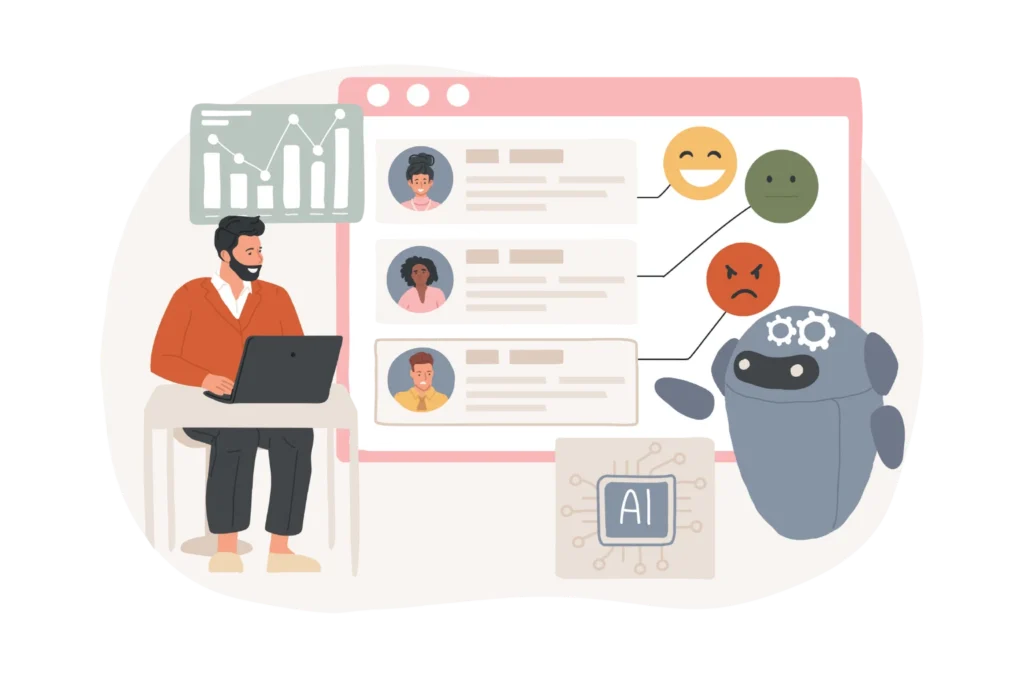
Open ten job requisitions today, and your inbox floods with hundreds of resumes before lunch. Sorting through them by hand takes days. That is the exact problem AI based recruiting was built to solve. It reads resumes, ranks candidates, schedules interviews, and flags the best-fit applicants, so your team spends time talking to people instead of scrolling through PDFs.
- AI recruiting tools reduce time spent on resume screening, candidate scoring, and interview scheduling, allowing recruiters to focus on higher-value tasks.
- Recruiting is the top AI use case in HR, ahead of payroll, learning, and employee experience, according to SHRM’s 2026 research.
- The best AI recruiting tool depends on your team size, hiring needs, and existing tech stack. Microsoft 365 users often benefit most from Microsoft-native solutions like Recruitment Management 365.
- AI improves hiring efficiency, but human oversight is still essential to ensure fairness, transparency, and a positive candidate experience.
This guide walks through what AI-based recruitment software actually does, how it works under the hood, and which tools are worth your budget in 2026. We also compare eight leading platforms, including Recruitment Management 365, Workable, Greenhouse, Lever, Manatal, Zoho Recruit, Ashby, and SmartRecruiters, so you can build a hiring plan that fits your volume and your Microsoft 365 setup.
What Is AI Based Recruitment Software?
AI-based recruitment software is a hiring platform that uses machine learning and natural language processing to handle tasks that used to sit on a recruiter’s desk: reading resumes, matching candidates to job openings, ranking applicants, drafting job descriptions, and setting up interviews. Instead of a keyword search that just looks for exact word matches, it reads context. It can tell the difference between someone who “managed a team of 12” and someone who merely listed “team management” as a skill.
At its core, this kind of platform combines three things: an applicant tracking system (ATS) to hold candidate data, a language model or scoring engine to evaluate that data, and automation rules that move candidates through your hiring plan without a recruiter clicking through every step manually. Search interest around AI based recruiting has grown fast, because hiring teams are under pressure to fill roles quicker with smaller headcount.
See how the right platform fits your hiring plan.
Why AI Based Recruitment Software Is Transforming Modern Hiring
Hiring has changed shape in the last three years. Application volumes are up, candidates apply from their phones in minutes using auto-fill tools, and recruiters get buried before they open their first cup of coffee. This shift is exactly why AI based recruiting exists: the old model, one recruiter manually reading every resume, cannot keep pace with today’s application volume.
The numbers back this up. SHRM’s State of AI in HR 2026 report found that recruiting is the most common practice area for AI use inside HR, ahead of HR technology, learning and development, and employee experience. The same report found that 89% of HR professionals using AI in recruiting say it saves them time or improves their efficiency. LinkedIn’s internal research adds another data point: recruiters who use AI-assisted messaging are 9% more likely to make a quality hire than recruiters who barely touch the feature. On the candidate side, Greenhouse’s 2025 hiring study found that 70% of hiring managers trust AI to help them make faster, better decisions, even though only 8% of job seekers currently feel the same way, a gap that shows why transparency matters as much as speed.
Cost is another driver. SHRM’s 2025 Recruiting Benchmarking Report puts the average cost per hire in the U.S. at roughly $4,700, with a time-to-fill of about 44 days. Shaving even a week off that timeline, across dozens of open roles a year, adds up to real budget saved. That is the business case hiring leaders bring to their CFO when they ask to invest in a recruitment plan built around AI.
How AI Based Recruitment Software Works
Most platforms in this category follow a similar flow, even though the interface and branding differ from vendor to vendor.
- Resume parsing. The software pulls structured data out of a resume, name, work history, education, skills, and certifications, no matter the file format.
- Candidate scoring and matching. The AI compares that structured data against the job description and ranks candidates by predicted fit, often with a score or a short summary explaining why a candidate ranked where they did.
- Automated screening. Chatbots or short questionnaires filter out candidates who fail basic requirements (work authorization, location, required certifications) before a recruiter ever opens their file.
- Interview scheduling. The platform checks calendars across the hiring panel and books interview slots directly in Outlook, Google Calendar, or Teams.
- Insights and reporting. Dashboards show where candidates drop off, how long each stage takes, and which sourcing channels bring in the strongest hires.
Some platforms add a sixth layer: agentic AI that can independently source passive candidates, write outreach messages, and follow up without a recruiter prompting each action. This is the direction most vendors are heading in 2026, and it is worth asking about during any product demo.
Key Features of AI-Based Recruitment Software
- Resume parsing and structured data extraction that turns any resume format into a searchable candidate record.
- AI-powered candidate scoring that ranks applicants against the job requirements, with reasoning attached to the score.
- Automated interview scheduling that syncs with Outlook, Teams, or Google Calendar and removes manual calendar checks.
- Chatbot-based screening for high-volume roles, so candidates get a quick response instead of silence.
- Bias-reduction tools, such as resume anonymization, that hide names, photos, and other identifying details during first-round review.
- Analytics dashboards that track time-to-fill, source of hire, and pipeline health in real time.
- Job description generators that write and edit postings to match a target role and tone.
- Native integrations with job boards, HRIS platforms, and communication tools your team already uses.
Benefits of Using AI Based Recruitment Software
Faster screening. Recruiters no longer read every resume line by line. Aggregated case study data from Select Software Reviews found that 86.1% of recruiters say AI makes the hiring process faster, largely because first-round screening drops from hours to minutes.
Better candidate matching. Because AI reads context instead of matching keywords, it surfaces candidates a manual search would have missed, including people whose resumes use different words for the same skill.
Lower cost per hire. SHRM’s 2025 Talent Trends data found that 36% of HR professionals using AI for recruiting say it directly reduces hiring costs, on top of the 89% who report time savings.
Reduced admin work for recruiters. Interview scheduling, follow-up emails, and status updates run in the background, freeing recruiters to spend time with candidates instead of calendars.
More consistent evaluation. A structured hiring plan with AI scoring applies the same criteria to every candidate, which helps hiring managers compare applicants on a level field rather than gut feel alone.
Data-backed hiring decisions. Dashboards show which job boards, referral sources, or outreach messages actually produce hires, so next quarter’s plan gets sharper.
Ready to see these benefits in your own pipeline?
AI Recruitment Software vs Traditional Recruitment Software
Factor | Traditional Recruitment Software | AI-Based Recruitment Software |
Resume review | Manual, keyword search only | Automated, context-aware scoring |
Candidate ranking | Recruiter judgment alone | AI score plus recruiter review |
Interview scheduling | Manual email threads | Automated calendar sync |
Sourcing | Recruiter searches manually | AI suggests and ranks passive candidates |
Reporting | Static, manual reports | Live dashboards updated in real time |
Time-to-fill | Longer, recruiter-dependent | Shorter, with fewer manual steps |
Bias controls | Left to the recruiter | Built-in anonymization and structured scoring |
Traditional ATS platforms are still useful for tracking candidates through a pipeline, but they stop there. They store data; they don’t interpret it. An AI-driven system takes the next step by using that stored data to actively guide decisions, something a plain database or spreadsheet cannot do on its own.
Types of AI Recruitment Software
Not every AI recruiting tool does the same job. Broadly, they fall into a few categories:
- Full-suite ATS with AI built in (Greenhouse, Workable, Ashby): manage the entire pipeline from job posting to offer, with AI layered across screening and scoring.
- AI-native screening specialists (Manatal, Skima-style tools): focus specifically on parsing and matching, often plugged into a separate ATS.
- Sourcing and outreach platforms: search passive candidate databases and send outreach messages automatically, without managing the full pipeline.
- Microsoft 365-native recruitment platforms (Recruitment Management 365): built directly on SharePoint, Teams, and Outlook so hiring data lives inside the same environment as the rest of the business, instead of a separate silo.
- Interview intelligence tools: record and analyze interviews, generate summaries, and flag follow-up questions for hiring panels.
- HRIS suites with recruiting modules (Zoho Recruit, Factorial-style platforms): bundle recruiting with broader HR functions like onboarding and payroll.
Top Use Cases of AI Recruitment Software Across Industries
Retail and hospitality. High-volume, high-turnover hiring benefits from chatbot screening and automated scheduling, since roles often need to be filled within days, not weeks.
Healthcare. Credential verification and compliance tracking matter as much as candidate fit, so AI tools that flag missing licenses or certifications before a candidate advances save real time.
Technology and engineering. Skills-based matching helps sort candidates by actual project experience rather than job titles, which vary wildly across companies.
Manufacturing. These platforms support shift-based hiring plans, track candidate availability by location, and reduce reliance on outside staffing agencies for repeat roles.
Staffing and recruitment agencies. Agencies managing multiple clients use AI scoring to shortlist candidates fast across dozens of open requisitions at once.
Corporate and enterprise HR teams on Microsoft 365. Teams already living in Outlook, Teams, and SharePoint get the most value from a recruitment plan built on the same platform, since candidate data, approvals, and interview scheduling stay inside tools employees already use daily.
Not sure which hiring plan fits your team?
Best AI Based Recruitment Software in 2026
Pricing below is approximate and based on published vendor pages as of mid-2026; always confirm current rates directly with the vendor before budgeting.
1. Recruitment Management 365 (RM365)
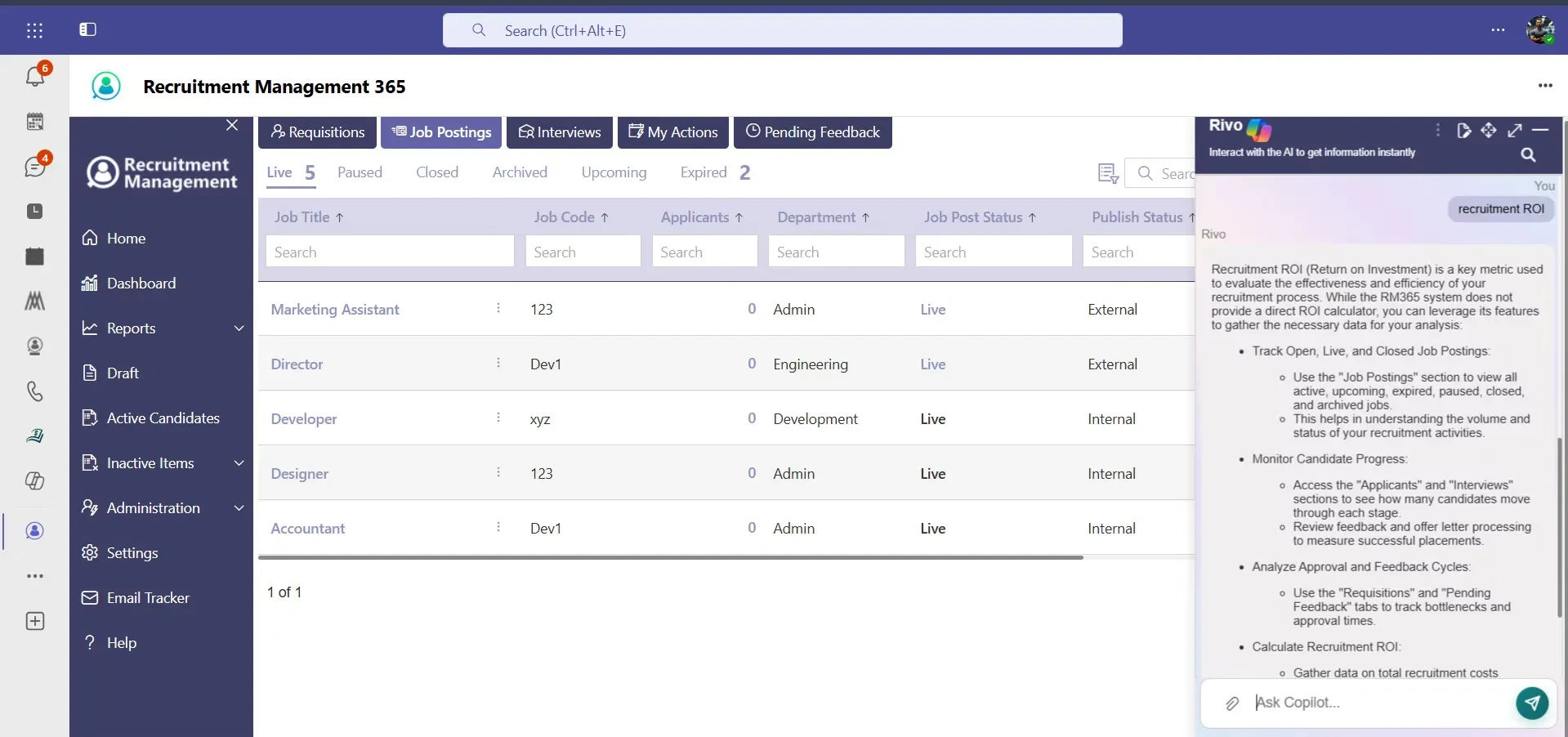
Best for: Organizations already running on Microsoft 365 that want hiring data inside SharePoint, Teams, and Outlook instead of a separate system.
Key features: AI resume screening and candidate scoring, Teams-based interview scheduling, SharePoint document storage for compliance, Power Automate workflow triggers, Power BI reporting, and Copilot AI support across the hiring plan.
Pros: No new login for employees already on Microsoft 365; deep customization through SharePoint without needing a developer; strong data security inherited from the Microsoft cloud; predictable pricing for growing teams.
Cons: Best suited to organizations already invested in the Microsoft ecosystem; teams outside Microsoft 365 would need to evaluate the migration effort first.
2. Workable
Best for: Small to mid-sized businesses that need to start hiring within days.
Key features: AI resume screening with semantic matching, one-way video interviews, sourcing across a database of 400 million-plus profiles, and an applicant chatbot for early engagement.
Pros: Broad feature set out of the box; quick setup; resume anonymization for bias reduction.
Cons: Pricing starts around $189 to $299 a month depending on the tier, which can be steep for solo recruiters; limited native outreach sequencing compared to dedicated sourcing tools.
3. Greenhouse
Best for: Mid-size to large companies that want a structured, scorecard-based interview process.
Key features: Structured interview kits, DEI-focused reporting, broad integration marketplace, and AI-assisted resume review.
Pros: Strong compliance and structured hiring reputation; wide network of integrations; good for companies hiring 50 or more people a year.
Cons: Pricing is not public and generally starts around $6,000 a year; implementation and configuration take longer than lighter tools.
4. Lever
Best for: Teams that want a combined ATS and CRM without running two separate platforms.
Key features: Candidate relationship management, nurture campaigns, pipeline analytics, and AI-assisted candidate matching.
Pros: Strong for long-term candidate relationship building; solid reporting.
Cons: AI depth is more moderate compared to Greenhouse or Ashby; owned by a private equity holding company, which has raised some questions about long-term product investment.
5. Manatal
Best for: Small to mid-sized recruiting teams and staffing agencies on a tighter budget.
Key features: AI-based candidate scoring, resume parsing, a recruitment CRM, and ChatGPT-style integrations at higher tiers.
Pros: Entry pricing starts around $15 a user per month, hard to beat for lean teams; fast to set up.
Cons: Entry plan caps you at a limited number of open jobs and candidates; no built-in passive candidate database, so sourcing depends on what you import.
6. Zoho Recruit
Best for: Small and mid-sized businesses already inside the Zoho ecosystem, or agencies on a budget.
Key features: Zia AI assistant for candidate matching and resume parsing, client portals for agencies, and integration with over 200 apps.
Pros: Genuinely useful free tier for very early-stage hiring; low-cost paid plans starting around $25 a user per month; deep Zoho ecosystem integration.
Cons: Interface feels dated compared to newer AI-native tools; some AI and parsing add-ons cost extra on top of the base plan; support response times get mixed reviews.
7. Ashby
Best for: Data-driven, growth-stage tech companies that want an all-in-one ATS, CRM, and analytics platform.
Key features: AI-powered candidate filtering using natural language, custom analytics dashboards, native scheduling, and built-in sourcing CRM.
Pros: Best-in-class reporting and dashboard customization; one platform instead of stitching four tools together.
Cons: Pricing starts at $400 a month and scales with total headcount, not just recruiter seats, so costs climb quickly as a company grows; no proactive AI sourcing without a separate tool; annual contracts only, with no free trial.
8. SmartRecruiters
Best for: Growing companies that want collaborative hiring tools plus a marketplace for add-on services.
Key features: Structured interview guides, scorecards, job distribution across multiple boards, and a marketplace for assessments and background checks.
Pros: Strong collaboration features for hiring managers; useful marketplace model for add-on services.
Cons: Pricing is quote-based and targets mid-market budgets; less suited to very small teams with occasional hiring needs.
Challenges and Limitations of AI Recruitment Software
No AI recruiting tool is a fix-it-all button. A few real limitations deserve attention before you build a hiring plan around one:
- Bias risk if scoring isn’t audited. A Gartner-cited compliance review found that a majority of organizations investigated by the EEOC over AI hiring practices lacked proper documentation of how their tools made decisions.
- Candidate trust is still low. Only 8% of job seekers, per Greenhouse’s 2025 research, believe AI evaluates them fairly, so how you communicate AI use in your hiring plan matters as much as the technology itself.
- “Skillfishing.” As AI makes it easier for candidates to polish applications, some exaggerate skills that don’t hold up in later interviews, per Software Advice’s 2026 HR trends research.
- Regulatory complexity. The EU AI Act now classifies recruitment AI as high-risk, with fines up to €15 million for violations, and city and state laws in the U.S. (like NYC’s Local Law 144) add separate audit requirements.
- Value doesn’t come automatically. A Gartner survey of HR leaders found that a large share have not yet seen real business value from their AI tools, often because teams install the software without changing how they actually work.
- Change resistance. Hiring managers used to reviewing every resume by hand sometimes push back on trusting an AI score, which slows adoption even after the tool is live.
Best Practices for Implementing AI Recruitment Software
- Start with one stage, not the whole pipeline. Pilot AI screening or scheduling before automating every step of your recruitment plan.
- Keep a human in the loop. Use AI scores as a starting point for review, not a final decision, especially for roles with compliance requirements.
- Audit for bias regularly. Run periodic reviews of who advances through AI screening versus who applies, broken down by demographic group where legally permitted.
- Tell candidates when AI is involved. Clear, upfront communication builds more trust than staying quiet about it.
- Train hiring managers, not just recruiters. Adoption fails when hiring managers don’t understand how scores are generated.
- Track outcomes, not just activity. Measure quality of hire and retention, not only time-to-fill, to know if the tool is actually working.
- Revisit your hiring plan every quarter. Hiring needs change with the business; your AI configuration should change with it.
Future Trends in AI Powered Recruitment
Agentic AI takes over multi-step tasks
Instead of scoring one resume at a time, next-generation tools independently source, screen, schedule, and follow up across an entire requisition, with a recruiter checking in at key decision points rather than every step.
Regulation reshapes vendor selection
With EU AI Act enforcement now active and more U.S. states drafting hiring-AI laws, expect procurement teams to ask harder questions about audit trails and explainability before signing a contract.
Skills-based hiring keeps growing
More employers are prioritizing verified skills over resume keywords, pushing AI vendors to build stronger assessment and verification features.
Microsoft 365-native hiring grows alongside it
As more companies standardize on Microsoft’s ecosystem for daily work, hiring plans that live inside SharePoint, Teams, and Outlook, rather than a separate silo, are gaining ground over standalone platforms.
Candidate trust becomes a selling point
Vendors that can show clear, explainable scoring will win deals over vendors that treat AI as a black box, especially as candidate skepticism about fairness remains high.
Why Recruitment Management 365 Is a Smart Choice for AI Recruitment
If your company already runs on Microsoft 365, adding a separate ATS means a new login, a new data silo, and another tool for IT to secure. Recruitment Management 365 skips that step entirely. It builds AI-based recruitment directly into SharePoint, Teams, and Outlook, so resume screening, candidate scoring, interview scheduling, and reporting all happen inside the same environment your team already uses every day.
That matters for three reasons. First, security: candidate data stays inside Microsoft’s enterprise-grade cloud instead of moving to a third-party server. Second, adoption: hiring managers who already know Teams and Outlook don’t need extra training to review candidates or join an interview. Third, customization: because RM365 is built on SharePoint, your team can adjust forms, workflows, and approval stages without waiting on a developer or a vendor’s product roadmap.
For HR teams building a recruitment plan around AI in 2026, RM365 offers a way to modernize hiring without adding a new system to manage. It brings AI screening, Power Automate approvals, and Power BI dashboards into one connected workspace.
Conclusion
AI in hiring has moved from an experimental add-on to a standard part of how recruiting teams operate in 2026. The technology handles resume screening, candidate scoring, and interview scheduling well, but it works best paired with a clear hiring plan, human oversight, and honest communication with candidates about how decisions get made. Whether you pick a full-suite platform like Greenhouse or Ashby, a budget-friendly option like Manatal or Zoho Recruit, or a Microsoft-native platform like Recruitment Management 365, the right choice comes down to your hiring volume, your existing tech stack and how much transparency you need from the AI itself.
If your team already runs on Microsoft 365, Recruitment Management 365 gives you AI-driven hiring without adding another disconnected tool to your stack. [Book a demo with RM365 today →]
Frequently Asked Questions
Is AI recruitment software actually worth it for a team that only hires 10 to 15 people a year?
For that volume, it depends on where your time actually goes. If screening resumes eats a full day every week, even a lightweight AI screening tool pays for itself in hours saved. If your bottleneck is sourcing, not screening, a full ATS with AI features might be more than you need.
Will an AI score reject a good candidate before a human ever sees their resume?
Most tools in this category rank candidates rather than auto-rejecting them, but some configurations allow auto-rejection below a set score. Ask vendors directly whether low-scoring candidates still land in front of a recruiter, and set your workflow to keep a human review step for anything close to the cutoff.
How do I explain to my legal team that our AI hiring tool won’t trigger a discrimination complaint?
You can’t promise zero risk, but you can document how scoring works, run periodic bias audits comparing applicant and advancement demographics, and keep records showing a human reviewed final decisions. This documentation is exactly what regulators ask for during an investigation.
Does the AI actually read resumes the way a person would, or is it still just keyword matching with better marketing?
A genuine AI recruiting tool uses semantic matching, meaning it interprets context rather than scanning for exact words. If a vendor’s demo only shows keyword highlighting, ask what happens with a resume that uses different phrasing for the same skill; that’s the real test.
We’re already on Microsoft 365. Is it worth switching to a separate ATS, or should we look at something built for Microsoft first?
If your team lives in Outlook, Teams, and SharePoint daily, a Microsoft-native platform like Recruitment Management 365 usually means faster adoption and fewer data silos than a standalone ATS that requires a new login and a separate integration setup.
What happens to our candidate data if we cancel the subscription later?
This varies by vendor, so get it in writing before signing. Ask specifically about data export formats, how long data is retained after cancellation, and whether candidate records can move directly into another system or a spreadsheet.
Our hiring managers don’t trust the AI ranking and keep reviewing every resume manually anyway. How do other teams get past this?
This usually comes down to transparency. Teams that show hiring managers exactly why a candidate scored the way they did, not just the number, see faster adoption than teams that treat the score as a black box.


_JiluXJRGNl.svg)























