

What are Cost-Plus Contracts? Types, Costs Covered & Process

Imagine a construction company starting a building project without knowing the full cost of materials, labor, or unexpected site work. Setting a fixed price at this stage could put both the contractor and buyer at financial risk.
- Assess whether a cost-plus contract is suitable for your project based on scope uncertainty, cost predictability, and budget flexibility.
- Calculate the contractor’s reimbursement and fee structure before agreeing on the total contract value.
- Set spending limits, approval thresholds, and documentation requirements to control project costs.
- Negotiate clauses covering cost overruns, allowable costs, audits, and payment disputes before signing.
A cost plus contract offers another approach by allowing payment for approved work costs along with an agreed fee.
This approach works well when the full scope of work is difficult to predict.
In this blog, we’ll explain how cost-plus pricing works, its types, covered costs, benefits, and key points to review before signing.
What Is a Cost-Plus Contract?
A cost plus contract is a legal agreement in which the buyer pays the contractor for eligible work costs plus an agreed fee or profit. Unlike a fixed-price contract, the final payment depends on the actual amount spent on completing the work.
This pricing method is common in construction, engineering, research, and government work where the total budget cannot be accurately estimated at the beginning.
For example, a company hires a contractor to renovate an old office building. Both parties agree to pay actual approved construction costs plus a 10% contractor fee.
Cost component | Amount |
Approved labor and materials | $100,000 |
Contractor fee (10%) | $10,000 |
Total contract payment | $110,000 |
If the approved work costs reach $120,000, the total becomes $132,000 under the same percentage-based fee, assuming the agreement allows it.
This example shows why both parties must clearly define covered spending, payment calculations, and approval limits before signing.
Why are Project Requirements Often Unclear or Subject to Change?
Some business assignments involve unknown conditions that make it difficult to agree on one final price. Even detailed planning cannot always predict what will happen once work begins. Here are common reasons businesses choose flexible pricing arrangements.
- Incomplete design plans: Construction may begin before engineers finalize every technical detail, making the final workload difficult to estimate.
- Unexpected site conditions: Hidden structural damage, underground utilities, or poor soil conditions may require additional work.
- Material price uncertainty: Market fluctuations can affect the cost of steel, concrete, equipment, and other supplies during long assignments.
- Research-based work: Product development and scientific testing may involve several attempts before teams achieve the expected results.
- Urgent business needs: Emergency repairs or disaster recovery may require immediate action before the buyer can prepare a complete scope.
- Evolving customer needs: Buyers may request additional features or adjust technical specifications as work progresses.
These situations make early price estimates less reliable. A flexible contract structure allows the parties to proceed while using written approval rules to control the work.
How Does a Cost-Plus Contract Work?
A cost reimbursement agreement follows a simple process, the contractor completes the work, records eligible costs, and receives payment based on the agreed contract terms.
Step 1: Agree on the scope and pricing
The buyer and contractor define the work, estimated budget, eligible costs, and contractor fee. They also agree on approval rules and required records.
Step 2: Complete the work and track costs
The contractor carries out the work and records costs for labor, materials, equipment, and other approved items. The buyer reviews these records.
Step 3: Verify costs and release payments
The contractor submits payment claims with supporting documents. The buyer checks the claims against the agreement before releasing payment and monitors spending against the approved budget.
Example: If approved project costs reach $50,000 and the contractor’s agreed fee is $15,000, the total payment is $65,000, subject to the terms.
This process helps both parties understand what is being paid, why it is payable, and whether it falls within the agreed budget.
What Costs are Covered Under a Cost-Plus Contract?
It generally covers direct and indirect costs that meet the eligibility rules stated in the agreement. However, not every contractor charge automatically qualifies for payment. Common categories include.
- Direct labor: Wages paid to employees working directly on the assigned job, based on approved rates and recorded hours.
- Materials and supplies: Raw materials, building components, and other items required to complete the agreed work.
- Equipment usage: Rental charges or permitted equipment-use rates for machinery needed during execution.
- Subcontractor services: Payments to approved third parties hired to perform specialized activities.
- Indirect costs: A permitted share of overhead, such as site administration or shared support services, calculated using the agreed method.
- Travel and site-related charges: Approved transportation, lodging, or field activities directly connected to the assignment.
The contract should distinguish between allowable contract costs and charges that the buyer will not cover.
For example, the agreement may exclude penalties, unsupported purchases, and costs outside the approved scope.
Under US federal contracting, FAR Part 31 sets rules for reimbursable costs, including reasonableness, allocation, and compliance with applicable standards.
Define eligible costs before work begins to avoid payment disputes later.
Where is the Cost Reimbursement Agreement Used?
Businesses use these agreements when work involves uncertain conditions, technical challenges, or requirements that are difficult to define in advance.
Builders use this pricing structure for commercial buildings, home renovations, and infrastructure work where hidden conditions may affect the final scope.
Federal agencies use cost-reimbursement arrangements for certain assignments involving technical uncertainty. Under FAR 16.301, federal buyers may use this approach when they cannot define requirements well enough for fixed pricing or estimate performance costs accurately. The rules also require proper oversight and an adequate contractor accounting system.
Developing new medicines, technologies, or scientific products involves uncertain testing and design costs. Cost-plus pricing allows research to continue while buyers monitor approved work and funding.
Custom machinery, aircraft components, and specialized equipment often involve changing technical requirements. Those contracts offer flexibility when suppliers cannot predict every production challenge upfront.
Types of Cost-Plus Contracts
Different cost reimbursement agreement types determine how contractors earn their fees. The fee may stay fixed, depend on cost savings, reflect performance, or increase with project costs.
The contractor receives approved costs plus a fixed fee agreed upon at the start. Example: If approved costs are $200,000 and the fixed fee is $20,000, the total payment is $220,000. The fee stays the same even if actual costs increase, subject to contract limits.
The contractor earns additional fees based on meeting agreed cost or performance targets. Example: Completing work below the target budget may earn the contractor an additional $5,000, based on the agreed formula.
The contractor receives approved costs and an additional fee based on the buyer’s performance evaluation. The assessment may consider work quality, deadlines, and technical results. Unlike CPIF, the award fee depends on evaluation rather than a fixed formula.
The contractor earns a percentage of the approved project costs. Example: At a 15% fee on $80,000 in costs, the contractor earns $12,000, making the total $92,000.
Cost-Plus Contracts vs Other Contract Types
Choosing the right contract depends on how clearly the buyer can define the work, predict its price, and accept financial uncertainty.
Comparison | Cost-plus | Fixed-price | Time and materials |
Payment basis | Approved costs plus a fee | One agreed price | Hours worked and materials used |
Price certainty | Lower unless a cap applies | Higher for the defined scope | Depends on time and usage |
Main financial risk | Buyer carries more overrun risk | Contractor carries more cost risk | Buyer faces longer work periods |
Best suited for | Uncertain or complex work | Clearly defined assignments | Work with flexible staffing needs |
Contract control | Cost eligibility and approvals | Scope and completion rules | Hourly rates and work limits |
Fixed-price suits clearly defined projects, cost-plus suits uncertain work, and time-and-materials suits flexible, short-term assignments. Choose based on project needs, not just upfront cost.
Benefits of Cost-Plus Contracts
It offers several advantages when both parties establish clear payment rules and maintain proper oversight.
- Supports uncertain work: Contractors can begin complex assignments without having to predict every activity or technical problem in advance.
- Reduces pricing guesswork: Buyers do not have to accept a large risk allowance added to a fixed bid for unknown conditions.
- Provides visibility into charges: Supporting records allow customers to review how payment claims relate to completed work.
- Encourages quality: Contractors may have more room to select suitable materials and technical methods instead of focusing only on the lowest initial price.
- Supports fair contractor earnings: A negotiated fee allows suppliers to earn profit while receiving payment for qualifying work.
- Allows performance rewards: Incentive-based models can encourage timely completion, better technical results, and stronger cost control.
- Helps maintain business relationships: Clear records and shared approval rules can reduce misunderstandings between the buyer and service provider.
These benefits depend on how well the parties write and manage the agreement. Without proper controls, flexible pricing can create unexpected financial commitments.
Important Things to Consider Before Signing a Cost-Plus Contract
Before signing, both parties should understand how the agreement handles pricing, approvals, performance, and financial limits. Here are the main points to review.
- Maximum value: Set a contract value and explain what happens when the contractor approaches it. State whether further work requires written contract authorization.
- Fee calculation: Specify whether the contractor receives a fixed amount, percentage, or performance-based reward. Include the calculation method to avoid confusion.
- Approval authority: Identify who can approve additional work, higher spending limits, or revised technical requirements.
- Supporting documentation: State which records the contractor must submit to support payment claims and when the buyer can review them.
- Work completion standards: Describe the expected results, quality requirements, and acceptance process so both parties understand when the job is complete.
- Audit rights: Give the buyer permission to inspect relevant records and verify whether submitted charges follow the signed rules.
- Termination provisions: Explain when either party may end the contract and how payment for accepted work will be handled.
A well-written agreement should give the contractor enough flexibility to perform the work while protecting the buyer from unauthorized commitments.
Are Cost-Plus Contracts Profitable for Contractors and Buyers?
Yes, cost reimbursement agreement can benefit both parties, but profitability depends on the agreed fee, project performance, and cost controls.
For Contractors
Contractors recover approved project costs and earn a negotiated fee. This reduces the risk of unexpected costs affecting their profit. However, unauthorized work and unsupported charges may not qualify for reimbursement.
For Buyers
Buyers can avoid large contingency amounts in fixed-price bids and hire contractors for projects with uncertain requirements.
However, they carry more financial risk if project costs increase. A 2025 World Commerce & Contracting report found that poor contracting practices cost businesses an average of 8.6% of contract value.
Ultimately, contractors need fair compensation, while buyers need clear spending limits, approval rules, and contract monitoring.
A Better Way to Manage Cost Plus Contracts with CLM 365
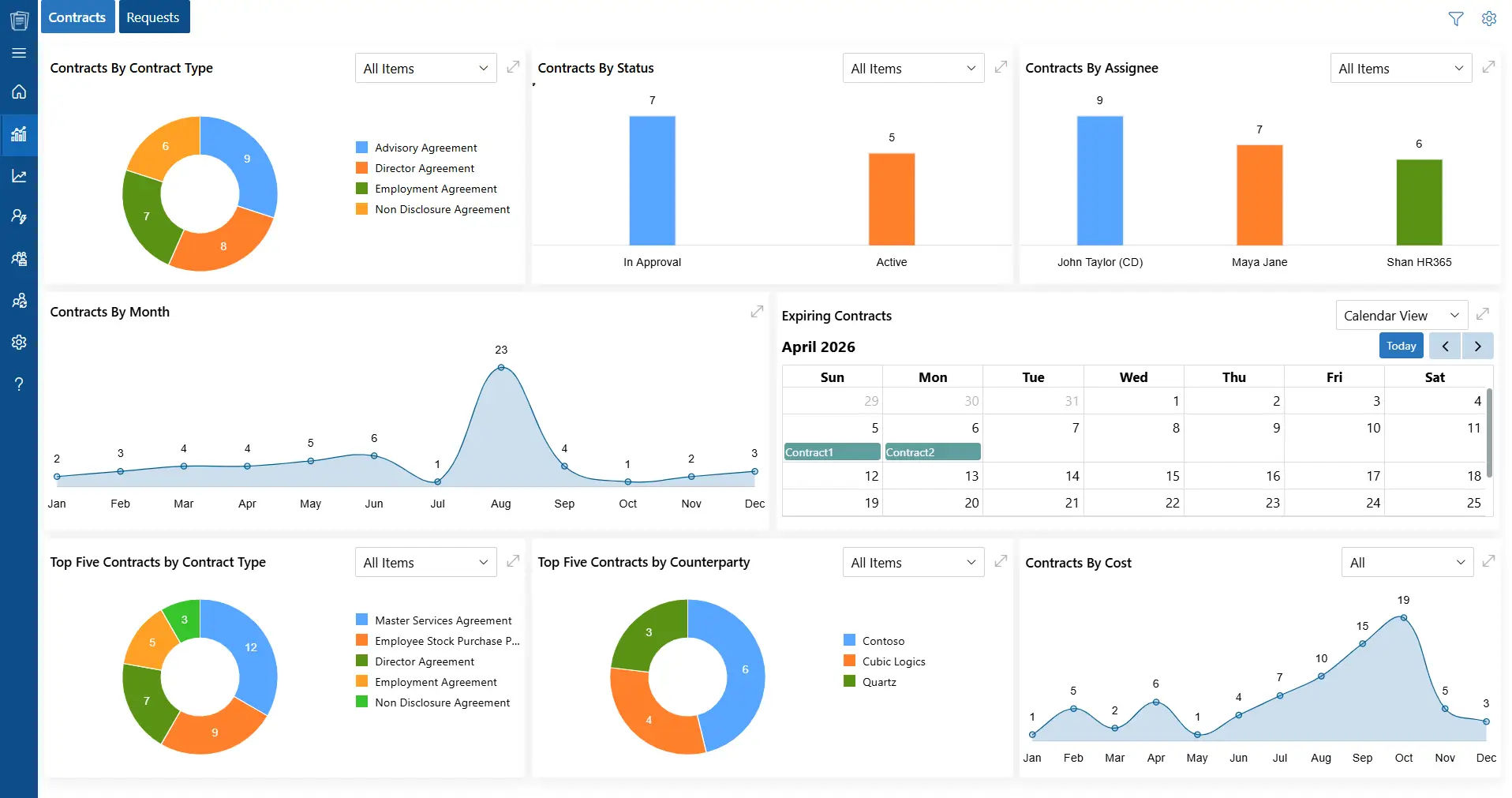
Managing a reimbursable contract costs requires more than storing a signed document. Businesses must track pricing rules, funding limits, approval decisions, and contractor commitments throughout the relationship.
CLM 365, a SharePoint based contract management, which helps businesses organize these activities in one place and reduce dependence on scattered emails and documents. Here’s how its contract management capabilities can support cost-plus arrangements.
- Centralized Contract Repository: Access signed agreements, approved costs, and key clauses from one place.
- Automated Approval Workflows: Route additional work requests and funding changes for approval.
- AI-Powered Contract Review: Identify payment terms, contract limits, and important clauses.
- Contract Alerts and Reminders: Track renewal dates, expirations, and important milestones.
- Contract Visibility and Tracking: Monitor contract status, ownership, and pending actions.
Backed by SOC 2 compliance and Microsoft certifications, CLM 365 supports GCC and GCC High environments with advanced security for regulated industries.
Manage complex pricing agreements with CLM 365. Simplify approvals, review key clauses, and track contracts throughout their lifecycle.
Frequently Asked Questions
How is the contractor's fee calculated?
The contractor’s fee depends on the agreed pricing structure. It may be a fixed amount, a percentage of approved costs, or an incentive based on project performance.
What are the risks and challenges of allowable contract costs?
Common risks include budget overruns, unclear cost terms, unsupported claims, and delayed approvals. Buyers can manage them through spending limits and regular cost reviews.
Can a reimbursable contract costs exceed its initial budget?
Yes. Actual project costs may exceed the initial estimate due to changing requirements, material prices, or unexpected work. A cost ceiling can help limit the buyer’s financial commitment.
What happens when a contractor exceeds the approved budget?
The contractor should notify the buyer and explain the additional costs. The buyer can review the request and approve revised funding, negotiate changes, or pause further work under the agreed terms.


























