Licensing Contracts: Key Things to Know Before Every IP Deal

A licensing contract allows businesses to use intellectual property owned by another party without buying it. However, unclear usage limits, payment rules, and ownership details can lead to financial losses and legal issues.
- A licensing contract gives another party permission to use intellectual property while the original owner keeps ownership.
- A well-written agreement defines permitted use, payment details, ownership, restrictions, and conditions for ending the arrangement.
- Licensing creates new income opportunities and supports business growth, but misuse, unpaid fees, and unclear conditions can cause problems.
- A software helps businesses track licensing dates, payments, approvals, and compliance requirements.
According to the World Intellectual Property Organization (WIPO), international patent applications filed through the Patent Cooperation Treaty reached approximately 273,900 in 2024. This shows the large scale of IP asset activity worldwide and why businesses need clear agreements when allowing others to use protected assets.
Whether a company licenses software, trademarks, patents, or creative work, a written agreement helps both sides understand what they can use and under which conditions.
In this blog, we explain how licensing contracts work, their key elements, benefits, risks, and how businesses can manage them effectively.
What Is a Licensing Agreement?
A licensing agreement allows an intellectual property owner to grant another person or business permission to use a protected asset under agreed terms.
The owner, known as the licensor, keeps ownership of the property. The party receiving permission, called the licensee, can use it for agreed business activities.
For example, a software company may allow another business to use its application for one year in exchange for an annual fee. The customer can access the software but cannot claim ownership or sell copies without permission.
How Does a Licensing Agreement Work?
A licensing deal follows a series of steps, from identifying the asset to managing its use after signing.
Step 1: Identify the Licensed Rights
The owner identifies the asset to be licensed, such as software, trademarks, patents, or copyrighted content, and confirms ownership rights.
Step 2: Define the Scope of Use
Both parties agree on asset purchase agreement, including permitted activities, geographical limits, and exclusivity.
Step 3: Agree on Payment Terms
The parties decide on the licensing fee, which may include a one-time payment, recurring charges, contract benchmarking, royalties, or a combination.
Step 4: Draft and Review the Agreement
The legal team prepares the contract covering usage rights, restrictions, confidentiality, obligations, and termination conditions.
Step 5: Sign the Agreement
Authorized representatives sign the final document, allowing the licensee to use the asset under the agreed conditions.
Step 6: Monitor Usage and Payments
The licensor tracks compliance, payments, usage restrictions, expiration dates, and renewal requirements.
Step 7: Renew or Terminate the License
Before expiry, both parties decide whether to renew, modify, or end the agreement. Once terminated, the licensee must stop using the licensed asset unless otherwise permitted.
What Should You Include in a Licensing Agreement?
A licensing contract should clearly explain what each party can do and what happens when someone fails to follow the agreed conditions. Here are the main elements to include.
- Identification of Parties: State the legal names, business addresses, and contact details of the licensor and licensee.
- Description of Licensed Property: Identify the software, patent, trademark, design, or copyrighted material covered by the document.
- License Grant: Explain the permission being provided and whether it is exclusive, nonexclusive, or limited to a particular purpose.
- Permitted Usage: Specify how the licensee can use the property, including approved activities, locations, and customer groups.
- Ownership: Confirm that the original contractor or legal owner retains contract ownership of the protected content unless the document states otherwise.
- Payment Structure: Describe licensing fees, royalty rates, payment schedules, and methods for calculating amounts owed.
- Geographic Coverage: Identify the countries, regions, or markets where the licensee can use or sell products involving the asset.
- Quality Standards: Set product or service requirements when the arrangement involves trademarks, manufacturing, or branded goods.
- Renewal Conditions: State whether the arrangement continues automatically or requires fresh approval after expiration.
- Liability and Legal Protection: Explain how the parties will handle losses, third-party claims, or damage caused by improper use.
A complete license agreement helps businesses avoid confusion and provides a written reference when questions arise.
What Types of Intellectual Property Can You License?
Businesses can license different forms of rights depending on their products, services, and commercial goals.
Patents
A patent license allows another company to use, manufacture, or sell a protected invention. For example, a medical device manufacturer may license patented technology from a research company.
Trademarks
A trademark license permits another business to use a protected brand name, logo, or symbol. Franchise businesses often use these arrangements to maintain consistent branding.
Copyrights
Copyright licensing gives permission to reproduce, distribute, display, or adapt creative materials. Publishers, filmmakers, and content creators commonly use these agreements.
Software
Software licenses define how customers can install, access, copy, or use an application. They may limit the number of users, devices, or approved business activities.
Trade Secrets
Businesses may license confidential formulas, manufacturing methods, or technical knowledge under strict confidentiality requirements.
Industrial Designs
A design license allows another company to use the protected appearance of a product, such as its shape, pattern, or visual features.
Technology and Know-How
Companies can grant access to technical knowledge, production methods, or specialized business systems, subject to applicable rules and confidentiality protections.
When Do You Need a Licensing Agreement?
A business needs a licensing contract when it wants to use IP owned by another party without purchasing it. Software providers use these documents when granting customers access to paid applications.
Manufacturers may need them to produce goods using patented technology or protected designs. Companies also enter licensing arrangements when expanding into new markets through brand partnerships or distribution deals.
A written agreement becomes especially important when usage restrictions, royalty payments, or ownership concerns could affect the business relationship.
What are the Benefits and Risks of Licensing an Asset?
Licensing contracts allows businesses to earn money from the asset or access them. However, it also creates financial, legal, and operational challenges.
The owners can earn licensing fees or royalties without directly manufacturing or selling products. For example, a technology company may license its patented invention to several manufacturers and receive a percentage of their sales.
Businesses can enter new geographic markets by allowing local partners to use their brands, technology, or products. License contracts reduces the need to establish separate operations in every location.
Licensees can access existing technology contracts or creative materials instead of building similar assets from the beginning. This can reduce development expenses and help companies launch products faster.
The licensor can permit commercial use while keeping ownership of the original asset. The agreement can also limit how the licensee uses, modifies, or shares the property.
Licensing contracts creates opportunities for companies to work together on product development, distribution, and innovation. For example, a software developer may partner with a hardware manufacturer to offer its application on new devices.
Risks Associated with Licensing Agreements
It can expose businesses to financial, legal, and operational risks when ownership, usage rights, or contractual responsibilities are unclear. Some common risks include.
- Licensees may modify, distribute, or use licensed assets beyond the permissions granted in the agreement.
- Unclear payment calculations, incomplete sales reports, or delayed royalty payments can create financial disagreements.
- Disputes may arise over who owns software improvements, product modifications, or new designs developed using licensed property.
- Licensees may transfer usage rights to distributors or third parties without the original owner’s approval.
- Unclear exclusivity terms may allow licensors to grant similar rights to competing businesses in the same market.
- Poor product quality or unauthorized use of trademarks can negatively affect the licensor’s brand reputation.
- Licensed assets may contain intellectual property belonging to other parties, creating potential legal disputes.
What Happens If Someone Breaks a Licensing Agreement?
Breaking a licensing contract can lead to financial penalties, loss of permission, or legal action. The outcome depends on the type of violation, the contract language, and applicable law.
For example, if a software customer allows more users than the approved limit, the provider may request additional fees or ask the customer to correct the issue.
The financial impact can be significant. A 2025 survey by Azul and the ITAM Forum found that 27% of surveyed enterprises spent more than $500,000 annually resolving software license noncompliance. The study covered 500 IT asset and software asset management professionals.
Send a Formal Notice
The affected party informs the other business about the violation and requests corrective action.
Allow Time to Fix the Problem
Some agreements provide a correction period during which the licensee can resolve issues before facing further action.
Request Financial Compensation
The owner may seek unpaid royalties, damages, or other amounts allowed under the agreement and applicable law.
Suspend or Terminate Access
A serious violation may allow the licensor to suspend access or end the license, depending on the contract.
Take Legal Action
If the parties cannot resolve the matter, the affected business may pursue a lawsuit, arbitration, or another agreed legal method.
Not every violation leads to immediate termination. The response depends on the seriousness of the issue and the remedies available.
What are the Common Reasons for Licensing Agreement Breaches?
Licensing violations often occur when businesses fail to follow usage limits, payment schedules, or other agreed conditions. Here are some common reasons.
Exceeding Usage Limits: The licensee uses software, technology, or other protected property beyond the approved number of users, devices, or products.
Missing Royalty Payments: A business fails to pay the agreed amount or submits payments after the scheduled date.
Using Assets Outside Approved Markets: A company sells licensed products in countries or regions not covered by the agreement.
Sharing Confidential Information: A partner reveals protected technical knowledge or private business details without contract authorization.
Failing to Meet Quality Requirements: A manufacturer produces branded goods that do not meet the owner’s approved standards.
Continuing Use After Expiration: A business keeps using the assets after the license ends without obtaining renewed permission.
Incorrect Sales Reporting: The licensee submits incomplete or inaccurate sales figures, affecting royalty calculations.
These issues highlight why businesses need clear records and regular checks throughout the licensing relationship.
Spend less time managing contracts. More time growing your business.
CLM 365 helps teams organize contracts, send automated reminders before expiration, track renewals, and review contract clauses using its native AI capabilities.
Steps to Consider Before Signing a Licensing Agreement
Before signing a license contract, both parties should carefully review the terms to understand their rights. Here are some key points to consider before entering into the agreement.
- Check whether the licensor owns the intellectual property or has legal permission to license it. Ask for proof of ownership to avoid disputes over licensing rights.
- Be specific about how you can use the licensed asset. Can you modify, reproduce, distribute, or resell it? Also, check geographical restrictions and exclusivity.
- Review how licensing fees and royalties are calculated. Check payment frequency, sales-based charges, minimum guarantees, and penalties for late payments.
- Identify the agreement’s start and end dates. Understand whether renewal is automatic or requires fresh approval and negotiation.
- Check how the agreement protects trade secrets, technical information, product designs, and other confidential business details.
- Determine who handles maintenance, product support, quality control, royalty reporting, and regulatory compliance.
- Ask a legal professional to examine ownership rights, liability, indemnification, and dispute resolution clauses before signing.
How CLM 365 Helps Manage Licensing Contracts?
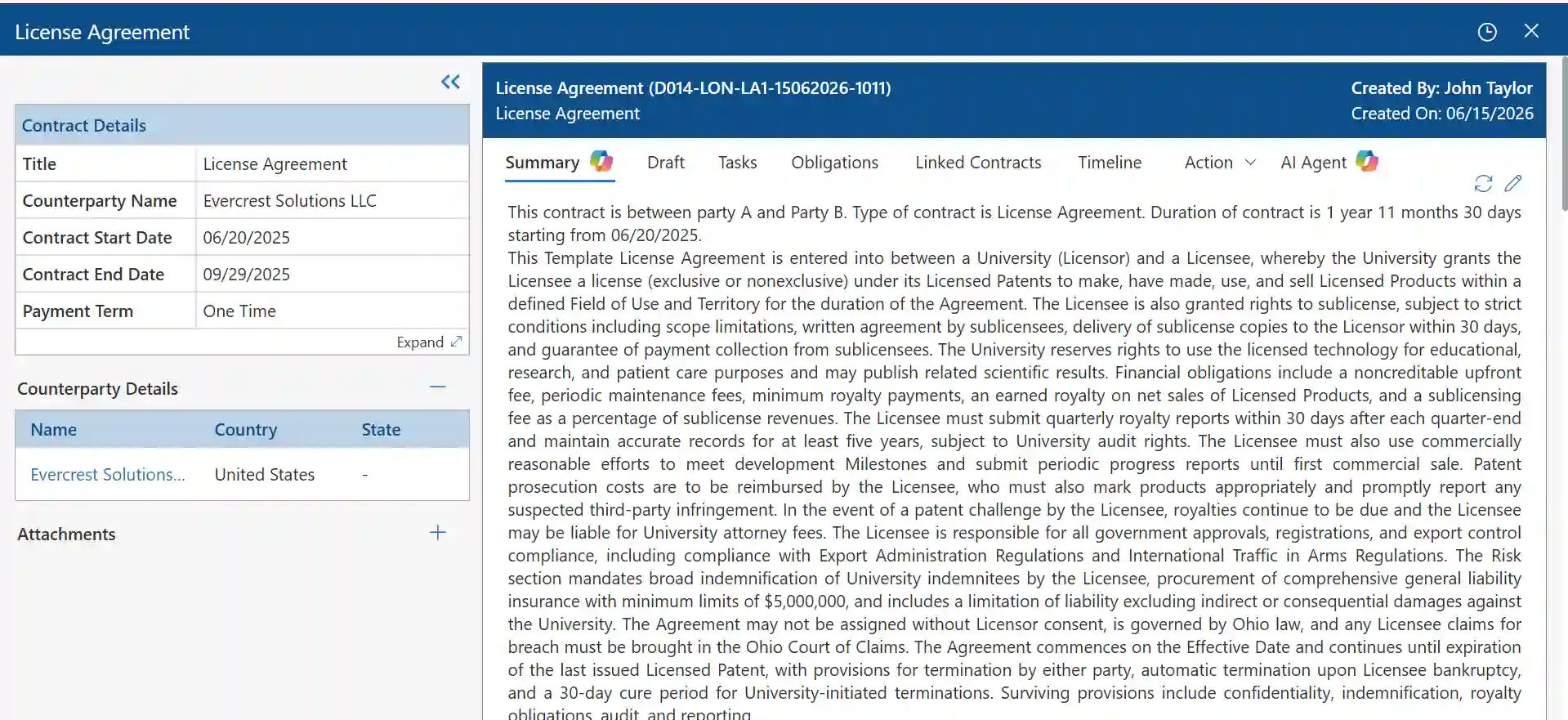
CLM 365 is a SharePoint contract management that integrates with Microsoft 365 applications, including SharePoint, Teams, Outlook, and other supported Microsoft tools. It helps businesses manage licensing contract within the Microsoft environment they already use.
All contract documents and data are stored in the organization’s Microsoft 365 tenant, using its existing access and security controls. Businesses should confirm the storage setup and permissions for their deployment.
AI Native Approach: Uses native AI to summarize licensing agreements, highlight key clauses, and identify important terms, rights, and obligations.
Centralized Storage: Stores licensing agreements, amendments, and supporting records in one location for easy access.
Automated Workflows: Routes licensing requests, contract changes, and renewals to the relevant stakeholders for review and approval.
Expiration and Renewal Alerts: Tracks deadlines and sends reminders before licenses expire or require renewal.
Payment Tracking: Records licensing fees, royalty terms, payment conditions, and upcoming financial commitments.
Access Control and Version History: Uses Microsoft 365 permissions to manage document access and track contract changes.
Compliance Monitoring: Helps assign contract responsibilities, record usage obligations, and track compliance activities.
Reporting and Visibility: Provides an overview of active, expired, and pending agreements, along with upcoming contract renewal process and key contract dates.
Take control of your licensing agreements with CLM 365. Manage contract documents, automate approvals, track renewals, and monitor obligations within your Microsoft 365 environment.
Frequently Asked Questions
What is the difference between a licensing agreement and an assignment agreement?
A licensing agreement gives another party permission to use assets while the original owner retains ownership. An assignment agreement transfers ownership of the specified licensed asset to another party.
Can a licensing contracts be terminated before its expiration date?
Yes. A licensing agreement may end early if the contract allows termination for nonpayment, unauthorized use, or another specified reason. Some agreements also permit termination with advance written notice.
Can a licensee transfer a licensing agreement to another company?
Only when the agreement permits it or the licensor provides the required consent. Many licensing contracts restrict transfers because the owner wants control over who uses the protected asset.
What assets can be covered under a licensing contract?
Licensing contracts can cover patents, trademarks, copyrights, software, trade secrets, product designs, technical processes, and other proprietary assets. The agreement specifies which assets are included and how they can be used.
What happens if a licensee misses a royalty payment?
The agreement may impose late payment interest, penalties, or a notice period to resolve the outstanding amount. Repeated payment defaults may give the licensor grounds to suspend or terminate the license.