10 Best Workforce Analytics Software in 2027: Tested, Compared & Ranked
_mVFFaHUZhS.webp)
Every manager wants the same answer: where does our team’s time actually go? Most organizations still piece that answer together from spreadsheets, payroll exports, and gut feeling. It replaces that guesswork with live data on hours, projects, productivity, and engagement.
We tested 10 leading workforce analytics tools against real team scenarios in 2026 to find the best options for 2027. Below, you’ll find how each tool performs, who it suits, and where it falls short, starting with our top pick.
- Timesheet 365 ranks #1 because its AI agent captures work, tracks time, and automates reports directly inside Microsoft Teams and SharePoint.
- Monitoring tools and HR analytics platforms solve different problems. ActivTrak, Teramind, and Hubstaff track activity, while Visier, Workday, and Lattice analyze people data.
- AI is now a baseline feature. The best platforms use AI to summarize work, flag risks, and generate reports without manual effort.
- Adoption beats feature count. Tools that live where employees already work, such as Microsoft 365, get used consistently and produce more reliable data.
Quick Comparison of Workforce Analytics Tools
Tool | Best for | Starting price (approx.) | Standout feature |
AI-powered time tracking inside Microsoft 365 | From $74.99/mo for up to 20 users (~$3.75/user) | AI agent for work capture and automated reports | |
ActivTrak | Productivity behavior insights | Free; paid from ~$10/user/mo | Burnout and workload alerts |
Teramind | Insider risk and behavior analytics | ~$15/seat/mo | Insider threat detection |
Hubstaff | Field and remote team time tracking | ~$7/seat/mo | GPS and geofencing |
Visier | Advanced people analytics | On request | Predictive attrition models |
Workday | Enterprise HCM analytics | On request | Prism Analytics |
Leapsome | Performance and engagement analytics | ~$3/user/mo | Linked reviews, goals, and surveys |
Rippling | Analytics across HR, IT, and finance | ~$8/user/mo | Unified employee record |
Lattice | People success and engagement | ~$11/seat/mo | Survey analytics with benchmarks |
ADP Workforce Now | Payroll-based workforce analytics | On request | DataCloud benchmarks |
Prices are approximate starting points as of late 2026; confirm on each vendor’s pricing page before publishing.
What is workforce analytics software?
It collects data about how employees spend their time and turns it into reports leaders can act on. It pulls from timesheets, project tools, HR systems, and activity data to show productivity, utilization, costs, and engagement trends.
The category covers two kinds of tools. Time and activity platforms measure work as it happens, while people analytics platforms analyze HR records such as headcount, attrition, and performance. The strongest options now blend both and add AI to explain what the numbers mean.
- Gallup’s State of the Global Workplace 2025 report found global employee engagement fell to 21% in 2024, costing the world economy an estimated $438 billion in lost productivity.
- Microsoft’s 2025 Work Trend Index reports that 53% of leaders say productivity must increase, yet 80% of the global workforce say they lack the time or energy to do their work.
- Deloitte’s 2025 Global Human Capital Trends urges organizations to rethink how they measure human performance beyond traditional output metrics.
- Gartner’s Top Priorities for HR Leaders in 2026 highlights AI-driven workforce planning and productivity as central HR agenda items.
Without reliable data, leaders cannot see these gaps in their own teams, let alone close them.
How we tested and ranked these tools
We set up each platform with a sample team, ran it through a typical month of work, and scored it on six criteria:
- Data capture: how accurately and automatically the tool records time, tasks, and activity.
- Analytics and reporting: depth of dashboards, custom reports, and AI-generated insights.
- Integrations: fit with tools teams already use, especially Microsoft 365, payroll, and project software.
- Ease of adoption: setup time and how readily employees and managers use it daily.
- Privacy and security: data controls, compliance support, and employee transparency.
- Value: pricing relative to features for small, mid-sized, and enterprise teams.
Tools that captured work automatically and delivered reports without manual effort ranked highest.
10 best workforce analytics software for 2027
1. Timesheet 365 – Best for Agentic workforce analytics
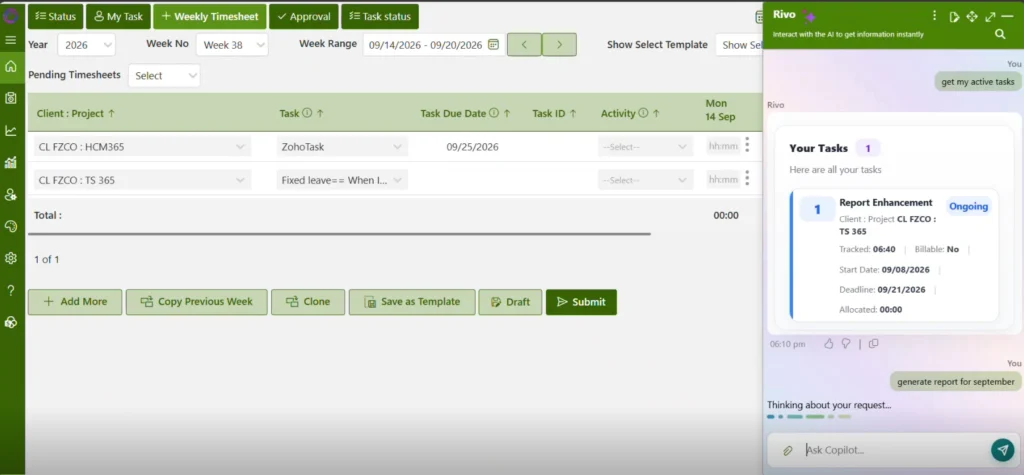
Timesheet 365 is a workforce analytics and time tracking solution built natively for Microsoft Teams and SharePoint. Its AI agent captures work automatically, monitors progress, and turns time data into ready-to-share reports, so teams spend less time logging hours and more time doing the work.
Unlike standalone monitoring tools, Timesheet 365 runs inside the Microsoft 365 apps your employees already open every day. There is no new portal to learn and no separate login, which drives consistent adoption and cleaner data.
- AI agent for work capture: automatically records tasks, projects, and time without manual timesheet entry.
- AI monitoring and tracking: follows work progress and flags missing entries, overtime, or budget overruns.
- Automated reports: generates scheduled timesheet, utilization, and project reports with no manual effort.
- Microsoft Teams integration: submit, review, and approve timesheets directly inside Teams.
- SharePoint integration: stores data within your Microsoft 365 environment for familiar security and governance.
- Approval workflows: routes timesheets to the right manager with reminders and audit trails.
- Project and client tracking: tracks billable and non-billable hours by project, client, and task.
- Higher adoption: employees track time where they already collaborate, so data stays complete.
- Hours saved every week: the AI agent removes manual logging and repetitive report building.
- Accurate billing and payroll: clean time data reduces errors in invoices and payroll runs.
- Better resource decisions: utilization insights show who is overloaded and who has capacity.
- Data stays in your tenant: keeping records in Microsoft 365 simplifies compliance reviews.
- Native Microsoft 365 experience with no new app to learn
- AI agent automates both work capture and reporting
- Quick rollout for organizations already on Teams
- Affordable flat pricing that does not rise with every new hire
- Best value for teams using Microsoft 365
Best suited for: Organizations of any size running on Microsoft 365 that want automated, AI-driven time tracking and workforce reporting.
Pricing: Affordable flat-rate plans start at $74.99 per month for up to 20 users, about $3.75 per user. Premium costs $149.99 per month for up to 30 users, and Enterprise, with Power BI and Copilot, costs $199.99 per month.
2. ActivTrak – Overall productivity behavior insights
ActivTrak is a workforce analytics platform that turns digital activity data into productivity and engagement insights. It helps managers spot burnout, balance workloads, and understand how hybrid teams actually spend their workday. Its privacy-first settings let admins anonymize data and skip screenshots entirely.
- Productivity and focus time dashboards
- Workload balance and burnout risk alerts
- Application and website usage analytics
- Benchmarks against similar teams and roles
- Goal tracking for workload and focus metrics
- Clear, visual reports that busy managers adopt quickly
- Free plan for testing core analytics before buying
- Covers digital activity only, not offline work
- Some employees may view activity tracking as intrusive
Best suited for: HR and operations leaders managing hybrid knowledge workers who want behavior insights without heavy surveillance.
Pricing: Free plan available; paid plans start around $10 per user per month.
3. Teramind – Insider risk and behavior analytics
Teramind is a workforce analytics and monitoring platform that combines behavior analytics with insider risk protection. It suits regulated organizations that need productivity visibility alongside strong data loss prevention and compliance controls. Deployment can run in the cloud, on premises, or in a private cloud.
- Real-time user activity monitoring
- Insider threat detection and rule-based alerts
- Session recording and screenshot capture
- Business process and productivity analytics
- OCR search across recorded screen content
- Deep security and compliance capabilities
- Highly configurable policies and alert rules
- Steeper learning curve for new admins and managers
- Heavy monitoring may affect employee trust and morale
Best suited for: Financial services, healthcare, and government teams where security monitoring matters as much as productivity data.
Pricing: Paid plans start around $15 per seat per month, billed annually, with a free trial.
4. Hubstaff – Field and remote team time tracking
Hubstaff is a time tracking and workforce analytics tool built for remote, hourly, and field teams. It connects tracked hours with payroll, scheduling, and project budgets so managers can control labor costs. Its mobile apps make it practical for crews working away from a desk.
- Time tracking with GPS and geofencing
- Automated payroll and invoicing
- Scheduling and attendance management
- Project budgets and activity levels
- Productivity insights through Hubstaff Insights add-on
- Strong fit for distributed, hourly, and mobile teams
- Wide range of project management integrations
- Activity screenshots may concern some employees
- Advanced analytics require higher-tier or add-on plans
Best suited for: Agencies, contractors, and field service businesses that bill by the hour and need accurate time data.
Pricing: Paid plans start around $7 per seat per month, with a free trial available.
5. Visier – Advanced people analytics
Visier is a dedicated people analytics platform that unifies HR, finance, and operational data into one analytical model. It gives HR leaders predictive insights on attrition, headcount, diversity, and workforce costs at enterprise scale. Its embedded AI assistant answers workforce questions in plain language.
- Thousands of prebuilt HR metrics and analyses
- Predictive attrition and flight-risk models
- Vee, a generative AI people analytics assistant
- Workforce planning and cost scenarios
- Secure role-based access to sensitive people data
- Very deep analytics without building custom models
- Strong benchmarking against peer organizations
- Built for enterprises, often too heavy for SMBs
- Requires clean, connected data from other HR systems
Best suited for: Large enterprises with mature HR data teams that need predictive, board-ready people analytics and benchmarks.
Pricing: Custom pricing available on request after a guided product demo with sales.
6. Workday – Enterprise HCM analytics
Workday is a cloud human capital management suite with built-in workforce analytics and planning. It combines HR, payroll, talent, and finance data, so large organizations can analyze people trends within one secure system. Its analytics refresh continuously as transactions happen across modules.
- Workday Prism Analytics for blended data
- AI-powered augmented analytics and anomaly detection
- Headcount planning and long-range workforce forecasting
- Benchmarking against Workday customer peers
- Skills Cloud for workforce capability mapping
- Single source of truth for HR and finance data
- Mature security, compliance, and audit controls built in
- Long, costly implementation for most mid-sized teams
- Pricing is not published publicly online for buyers
Best suited for: Global enterprises already running Workday HCM that want analytics and planning inside their core system.
Pricing: Custom enterprise pricing available on request through Workday sales and certified partners.
7. Leapsome – Performance and engagement analytics
Leapsome is a people enablement platform that links performance reviews, goals, engagement surveys, and compensation in one place. Its analytics help HR teams connect workforce trends with retention, growth, and team health. Built-in AI summarizes feedback and suggests next steps for managers.
- Performance review, calibration, and goal analytics
- Engagement and pulse survey insights
- Compensation and promotion tracking
- Attrition risk and retention signals
- Learning and onboarding progress reports for HR
- Strong all-in-one people enablement suite for HR
- Modern, easy interface for managers and employees
- Limited time and activity tracking depth for operations teams
- Advanced modules can raise total costs over time
Best suited for: Growing mid-market companies that want performance, engagement, and HR data connected in one modern platform.
Pricing: Modular pricing reportedly starts around $3 per user per month, depending on modules selected.
8. Rippling – Analytics across HR, IT, and finance
Rippling is an all-in-one workforce platform that connects HR, payroll, IT, and spend data. Because every module shares one employee record, its reports can answer cross-functional questions without spreadsheets. Admins can build reports by dragging any employee attribute into a view.
- Custom reports across HR, IT, and finance data
- Headcount, payroll, and turnover dashboards
- Workflow automation triggered by data changes
- Time and attendance with manager approvals
- Global payroll and employer-of-record reporting data
- Unified employee data model across departments
- Highly flexible custom report builder for admins
- Costs grow quickly as modules are added
- Deeper people analytics may need extra add-ons or tools
Best suited for: Fast-growing companies that want one employee system spanning HR, payroll, devices, apps, and spend.
Pricing: Paid plans reportedly start around $8 per user per month, plus modules.
9. Lattice – best for people success and engagement insights
Lattice is a people success platform focused on performance management, engagement, and growth. Its analytics show how goals, feedback, and survey results trend across teams, helping managers act earlier on risks. Its AI tools summarize survey comments into clear, actionable themes.
- Engagement survey analytics with benchmarks
- Performance calibration and review insights
- Goals and OKR progress tracking across departments
- Compensation, promotion, and career growth data
- HRIS module with custom people analytics reports
- Excellent manager-friendly survey and feedback reporting
- Strong performance review and career growth workflows
- Not built for time, attendance, or activity tracking
- Core analytics features are sold as separate paid add-ons
Best suited for: People-first companies that prioritize engagement, performance reviews, and manager development over activity monitoring.
Pricing: Plans reportedly start around $11 per seat per month plus optional add-ons for analytics.
10. ADP Workforce Now – Payroll-based workforce analytics
ADP Workforce Now is an HR and payroll platform with workforce analytics built on large payroll data sets. It helps mid-sized and enterprise companies benchmark pay, turnover, and labor costs against market data. Reports draw on payroll data from millions of workers.
- Payroll, labor cost, and turnover analytics
- DataCloud benchmarks from ADP client data
- Time, attendance, and shift scheduling reports
- Compliance and tax reporting tools
- Mobile app access for managers and employees
- Trusted payroll accuracy and compliance across states
- Valuable market benchmarking data for pay decisions
- Dated interface compared with newer cloud HR tools
- Pricing requires a custom sales quote and setup fees
Best suited for: Mid-sized and large employers that want trusted payroll, compliance, and benchmark-driven workforce reporting together.
Pricing: Custom pricing available on request; quotes depend on headcount and modules.
Workforce analytics software pricing compared
Tool | Pricing model | Est. monthly cost, 20 users | Est. monthly cost, 30 users |
Timesheet 365 | Flat plan | $74.99 (Plus) | $149.99 (Premium) |
Hubstaff | Per seat | ~$140 | ~$210 |
Rippling | Per user, plus modules | ~$160+ | ~$240+ |
ActivTrak | Per user | ~$200 | ~$300 |
Lattice | Per seat, plus add-ons | ~$220+ | ~$330+ |
Teramind | Per seat | ~$300 | ~$450 |
Leapsome | Per user, by module | ~$60+ per module | ~$90+ per module |
Visier, Workday, ADP Workforce Now | Custom quote | On request | On request |
Estimates use each vendor’s approximate starting price. Leapsome’s base price covers one module and does not include time tracking.
How to choose the right workforce analytics software
Start with the question you need answered, then match the tool to it:
- “Where does our time go?” Choose a time and work capture tool such as Timesheet 365, ActivTrak, or Hubstaff.
- “Who might leave, and why?” Choose a people analytics platform such as Visier, Lattice, or Leapsome.
- “What does our workforce cost?” Choose an HCM or payroll suite such as Workday, Rippling, or ADP Workforce Now.
Next, check where your team already works. If you run on Microsoft 365, a Teams and SharePoint native tool removes adoption friction. Finally, review privacy settings, AI automation, and total cost, including add-ons and implementation fees.
Join Our Creative Community
Questions about workforce analytics Tool? Start Here
What is the best workforce analytics software in 2027?
Timesheet 365 is our top pick for teams on Microsoft 365. Its AI agent captures work and automates reports inside Teams and SharePoint.
How is workforce analytics different from employee monitoring?
Employee monitoring records activity such as apps and screenshots. Workforce analytics turns time, project, and HR data into insights for planning and decisions.
Does analytics software use AI?
Most leading tools now do. AI agents capture work automatically, flag risks, and generate reports without manual effort.
Can workforce analytics integrate with Microsoft Teams?
Yes, but depth varies by tool. Timesheet 365 runs natively inside Teams and SharePoint, while others connect through add-ons.
How much does workforce analytics software cost?
Most tools cost $3 to $20 per user per month, while Workday and Visier use custom pricing. Timesheet 365 offers affordable flat plans from $74.99 a month for up to 20 users.