


- HR metrics measure the effectiveness of hiring, retention, performance, engagement, and other HR activities.
- Tracking the right HR metrics helps organizations make informed business decisions instead of relying on assumptions.
- The most valuable HR metrics vary depending on company size, industry, and business goals.
- Modern HR software can automate HR reporting through dashboards, real-time analytics, and Microsoft 365 integration.
Organizations no longer rely on assumptions when making HR decisions. They use HR metrics to understand hiring performance, retention, engagement, productivity, and other key areas that influence business growth. By tracking the right numbers, HR teams can identify trends early, solve problems faster, and support strategic planning with reliable data.
Whether you manage a small business or a large enterprise, knowing which HR metrics to measure is just as important as collecting the data itself. This guide explains what HR metrics are, why they matter, and which metrics every organization should track to make better people decisions.
What Are HR Metrics?
HR metrics are measurable data points that help organizations evaluate the performance and effectiveness of their human resources activities. These metrics provide insight into how well HR processes support business goals, from attracting and retaining talent to improving performance, learning, and productivity.
 According to Gallup’s State of the Global Workplace report, only 21% of employees worldwide are engaged at work. Tracking HR metrics such as employee engagement, turnover, and retention helps organizations identify challenges early and make better people decisions.
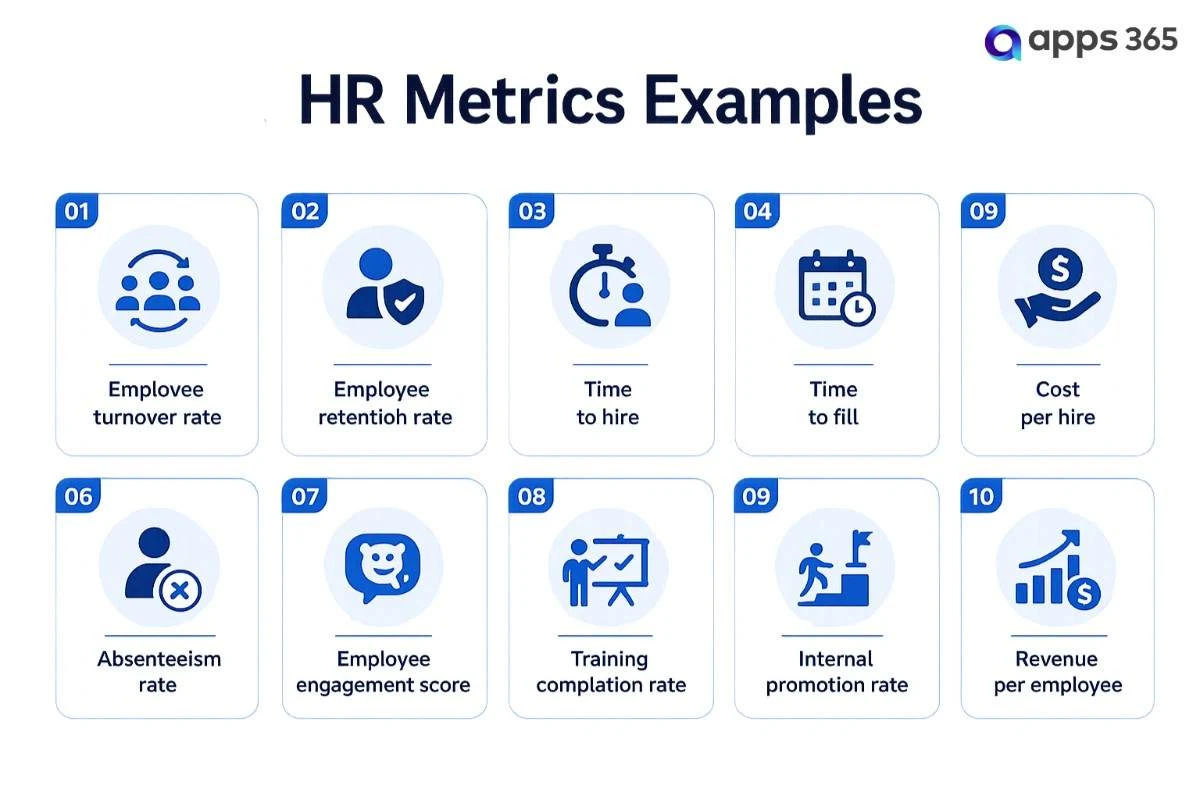
Instead of relying on assumptions, HR metrics use real data to answer important questions such as:
- How long does it take to hire a new team member?
- Are people staying with the organization longer?
- Is training improving performance?
- Which recruitment channels produce the best hires?
- How engaged are team members?
By tracking these numbers consistently, HR teams can identify trends, compare results over time, and make decisions based on facts rather than guesswork.
Why Are HR Metrics Important?
HR metrics help organizations understand whether their HR strategies are delivering the expected results. Rather than relying on opinions or assumptions, decision-makers can use measurable data to evaluate hiring, retention, performance, learning, and overall organizational health.
As organizations grow, HR teams manage larger volumes of people data. Monitoring the right metrics makes it easier to identify trends, address challenges early, and align HR initiatives with business objectives.
1. Better Hiring Decisions – Recruitment metrics such as time to hire, cost per hire, and offer acceptance rate show how efficiently the hiring process works. These insights help organizations identify delays, compare recruitment channels, and improve the quality of new hires.
2. Higher Employee Retention- High turnover can increase recruitment costs and disrupt business operations. Metrics like employee retention rate, average tenure, and early turnover rate help HR teams understand why people leave and where retention strategies need improvement.
3. Improved Performance Management- Performance related metrics reveal how individuals and teams are progressing toward organizational goals. Tracking goal achievement, performance ratings, and internal promotions helps managers recognize top performers while identifying areas where additional support or training may be needed.
4. Smarter Workforce Planning- Headcount growth, HR-to-employee ratio, and revenue per employee provide valuable insights for workforce planning. These metrics help organizations forecast hiring needs, allocate resources effectively, and support long-term business growth.
5. Better Learning and Development- Training requires both time and investment. Measuring training completion rates and training ROI helps organizations evaluate whether learning programs are increasing knowledge, improving performance, and supporting career development.
6. More Accurate Business Decisions- HR metrics give leaders reliable information that supports strategic planning. Instead of making decisions based on assumptions, executives can use historical trends and current data to improve budgeting, hiring plans, and organizational priorities.
7. Increased Accountability Across the Organization- When HR metrics are reviewed regularly, managers and department leaders gain clear visibility into the outcomes of their teams. Shared performance indicators encourage accountability, promote continuous improvement, and create a more data-driven culture across the organization.
HR Metrics vs. HR KPIs vs. HR Analytics: What Is the Difference?
The terms HR metrics, HR KPIs, and HR analytics are often used interchangeably, but they are not the same. While they all rely on HR data, each serves a different purpose in measuring and improving organizational performance.
Understanding the difference helps organizations choose the right measurements and make better business decisions.
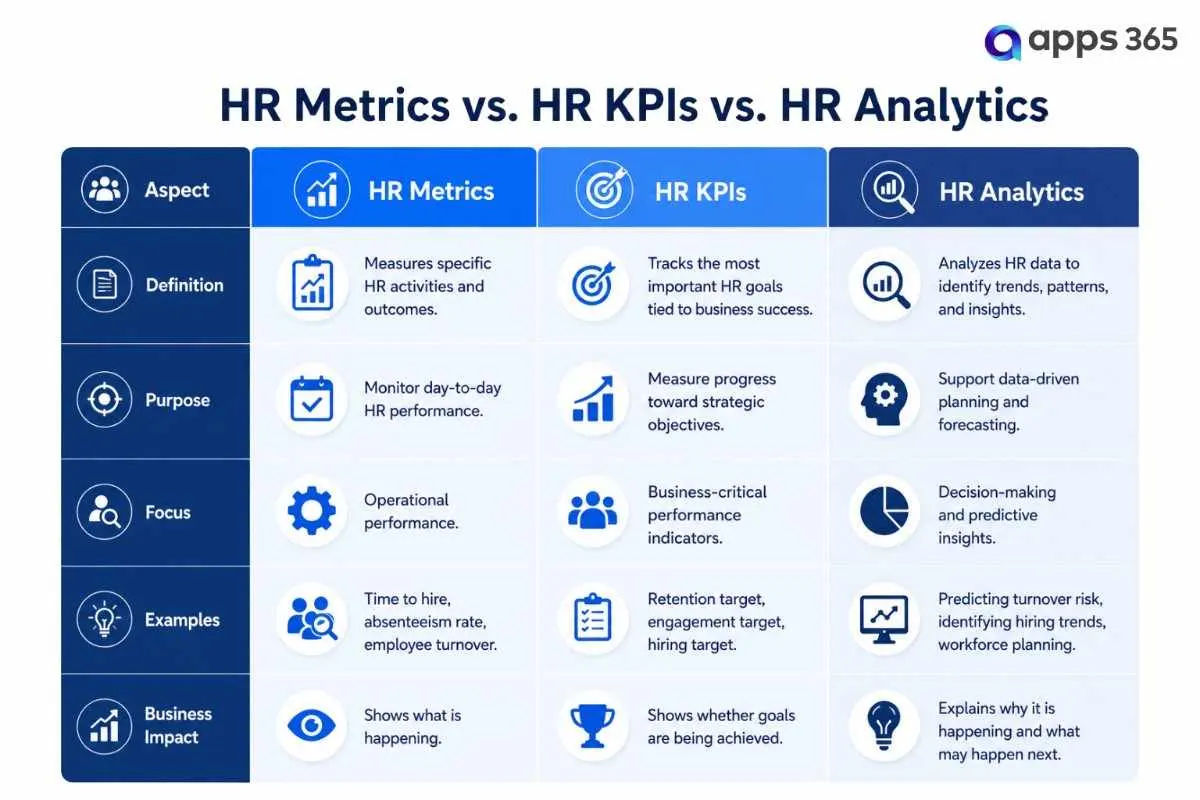
Which One Should Organizations Focus On?
Organizations need all three.
- HR metrics provide the data.
- HR KPIs measure progress toward business goals.
- HR analytics transforms data into meaningful insights for better decision-making.
When used together, they give HR leaders a complete view of organizational performance and help drive continuous improvement across recruitment, performance management, employee development, and retention.
Essential HR Metrics Every Organization Should Track
Not every HR metric carries the same level of importance. The right metrics depend on your organization’s goals, industry, and stage of growth. However, some measurements are valuable for almost every business because they provide insights into hiring efficiency, retention, productivity, engagement, and overall HR performance.
Below are the Key HR metrics every organization should monitor regularly.
1. Employee Turnover Rate
Employee turnover rate measures the percentage of team members who leave the organization during a specific period. A consistently high turnover rate may indicate issues related to job satisfaction, leadership, workplace culture, or career growth.
Why it matters
- Identifies retention challenges
- Helps estimate recruitment costs
- Measures the effectiveness of retention strategies
📋 Formula
Employee Turnover Rate = (Number of employees who left ÷ Average number of employees) × 100
2. Employee Retention Rate
Retention rate measures the percentage of team members who remain with the organization over a defined period. A high retention rate often reflects a positive work environment and strong employee experience.
Why it matters
- Measures long-term organizational stability
- Evaluates employee satisfaction
- Supports workforce planning
Choosing the right alternative to Namely involves more than comparing feature lists. Businesses should evaluate how well a platform supports their HR processes, user experience expectations, growth plans, and day-to-day operational requirements. A solution that works well for one organization may not be the best fit for another, making it important to assess multiple factors before making a decision.
📋 Formula
Employee Retention Rate = (Employees at the end of the period − New hires ÷ Employees at the start of the period) × 100
3. Time to Hire
Time to hire measures the number of days between a candidate applying for a position and accepting the job offer. It reflects the efficiency of the recruitment process from the candidate’s perspective.
Why it matters
- Evaluates recruitment speed
- Improves candidate experience
- Helps reduce hiring delays
📋 Formula
Time to Hire = Offer Acceptance Date − Application Date
4. Time to Fill
Time to fill measures the total number of days required to fill an open position, starting from when the job becomes available until a candidate accepts the offer.
Why it matters
- Identifies bottlenecks in recruitment
- Supports workforce planning
- Reduces productivity gaps caused by vacant positions
📋 Formula
Time to Fill = Offer Acceptance Date − Job Requisition Approval Date
5. Cost per Hire
Cost per hire calculates the average amount spent to recruit a new team member. It includes advertising, recruitment software, agency fees, interview expenses, onboarding costs, and recruiter time.
Why it matters
- Measures recruitment efficiency
- Supports hiring budget decisions
- Compares recruitment channels
📋 Formula
Cost per Hire = Total Recruitment Costs ÷ Number of Hires
6. Offer Acceptance Rate
Offer acceptance rate measures the percentage of candidates who accept employment offers.
Why it matters
- Evaluates employer attractiveness
- Identifies compensation or hiring process issues
- Helps improve recruitment strategies
📋 Formula
Offer Acceptance Rate = (Accepted Offers ÷ Total Offers Extended) × 100
7. Quality of Hire
Quality of hire evaluates how successful new hires are after joining the organization. It is often measured using performance reviews, retention, and manager feedback.
Common indicators
- First-year performance ratings
- Retention after one year
- Manager satisfaction
- Goal achievement
Why it matters
- Measures recruitment effectiveness
- Improves hiring decisions
- Supports long-term business success
8. Recruitment Source Effectiveness
This metric identifies which recruitment channels consistently produce the best candidates.
Common recruitment sources include:
- Career websites
- Employee referrals
- Job boards
- Recruitment agencies
- Campus hiring
Why it matters
- Optimizes recruitment spending
- Improves hiring quality
- Focuses investment on high-performing channels
9. Absenteeism Rate
Absenteeism rate measures how frequently team members are absent from work beyond planned leave.
Why it matters
- Identifies attendance trends
- Supports workforce planning
- Highlights potential engagement or wellness concerns
📋 Formula
Absenteeism Rate = (Total Days Absent ÷ Total Available Workdays) × 100
10. Leave Utilization Rate
Leave utilization rate tracks how much paid leave team members use compared to their available leave balance.
Why it matters
- Helps balance workloads
- Encourages healthy leave usage
- Supports leave planning across departments
📋 Formula
Leave Utilization Rate = (Leave Days Used ÷ Total Leave Days Available) × 100
These 10 HR metrics provide a strong foundation for measuring recruitment, retention, and attendance. Together, they help organizations understand how effectively they attract, hire, and retain talent while maintaining a healthy and productive workplace
How to Choose the Right HR Metrics for Your Organization
Selecting the right HR metrics starts with understanding what your organization wants to achieve. Measuring every available metric can create unnecessary reports without providing meaningful insights. Instead, focus on metrics that support your business goals and help answer important HR questions.
- Align Metrics with Business Goals
Choose metrics that reflect your organization’s priorities. For example, if reducing hiring time is a goal, track Time to Hire and Time to Fill. If improving retention is the priority, focus on Employee Turnover Rate, Retention Rate, and Average Employee Tenure.
- Measure What You Can Act On
The best HR metrics lead to action. If a metric highlights a problem, your HR team should be able to investigate the cause and make improvements.
For example:
▸ A high absenteeism rate may indicate workload or engagement issues.
▸ A low offer acceptance rate may suggest problems with compensation or the hiring process.
▸ A high early turnover rate could point to onboarding challenges.
- Use Reliable and Consistent Data
HR metrics are only useful when they are based on accurate and up-to-date information. Standardizing how data is collected helps maintain consistency across departments and reporting periods.
Reliable data sources may include:
▪ Employee records
▪ Recruitment data
▪ Attendance records
▪ Performance reviews
▪ Learning and training records
▪ Leave management data
- Review Metrics Regularly
HR metrics should be monitored on a regular schedule rather than only at the end of the year.
A common review cycle includes:
➜ Weekly: Recruitment progress and attendance
➜ Monthly: Turnover, retention, leave, and hiring metrics
➜ Quarterly: Performance, engagement, and training metrics
➜ Annually: Workforce planning, productivity, and long-term trends
Regular reviews make it easier to identify changes early and respond before small issues become larger challenges.
- Focus on Quality Over Quantity
Tracking too many metrics can make reporting difficult and shift attention away from the data that truly matters. Instead of measuring everything, select a smaller set of meaningful metrics that provide clear insights into organizational performance.
- Use HR Software to Automate Reporting
As organizations grow, manually collecting HR data becomes time-consuming and increases the risk of errors. HR software can automatically gather information from recruitment, attendance, leave, performance, and employee records, then present it through dashboards and reports.
For organizations using Microsoft 365, solutions like HR365 HRMS centralize HR data from modules such as Employee Directory, Recruitment, Leave Management, Performance Management, Timesheets, and Learning & Training, making it easier to monitor HR metrics from a single dashboard and generate reports with minimal manual effort. This saves time while giving managers access to up-to-date information for better decision-making.
How to Automate HR Metrics in Microsoft 365
As organizations grow, tracking HR metrics manually using spreadsheets becomes increasingly difficult. Data is often scattered across different systems, reports take longer to prepare, and there is a greater chance of errors or outdated information.
Organizations using Microsoft 365 can automate HR metrics by centralizing HR data and generating real-time reports through an integrated HR management solution.
1. Centralize HR Data
The first step is to store HR information in a single location instead of maintaining separate files for recruitment, leave, attendance, performance, and training.
A centralized system provides a single source of truth for HR data, making reporting more accurate and reducing duplicate records.
2. Capture Data Automatically
HR metrics become more reliable when data is collected automatically during everyday HR activities.
Examples include:
- Recruitment data from hiring workflows
- Leave requests and approvals
- Attendance and timesheet records
- Employee onboarding activities
- Performance reviews and goal tracking
- Learning and training completion records
Because information is captured as activities occur, HR teams no longer need to manually update multiple spreadsheets.
3. Use Real-Time Dashboards
Interactive dashboards make it easier to monitor HR metrics without creating reports from scratch.
A dashboard can display key metrics such as:
- Employee turnover rate
- Time to hire
- Leave utilization
- Attendance trends
- Recruitment progress
- Performance ratings
- Training completion
Real-time dashboards help managers identify trends quickly and make informed decisions using current data.
4. Generate Automated Reports
Instead of preparing monthly reports manually, HR software can generate reports automatically based on predefined filters and reporting periods.
Automated reports help organizations:
- Reduce administrative effort
- Improve reporting accuracy
- Share consistent data with managers
- Monitor HR performance over time
5. Use AI to Identify Trends
AI-powered reporting can help organizations go beyond basic reporting by highlighting trends, detecting unusual patterns, and providing faster access to HR insights.
Instead of spending hours analyzing spreadsheets, HR teams can focus on interpreting the results and making decisions that support hiring, retention, performance, and organizational growth.
By automating HR metrics in Microsoft 365, organizations save time, improve data accuracy, and gain a clearer view of their HR performance through a single, connected platform.
6. Integrate with Microsoft 365
Organizations already using Microsoft 365 can benefit from HR solutions that work within the same ecosystem.
HR365 HRMS integrates with Microsoft 365 and SharePoint to centralize HR information across Employee Directory, Recruitment, Leave Management, Timesheets, Performance Management, Learning & Training, and Dashboards. This gives HR teams access to real-time HR metrics without switching between multiple systems, while managers can view reports and dashboards using familiar Microsoft tools.
Common Mistakes to Avoid When Tracking HR Metrics
Tracking HR metrics is only valuable when the data is accurate, relevant, and used to improve decision-making. Avoiding these common mistakes helps organizations get meaningful insights instead of just collecting numbers.
- Tracking Too Many Metrics: Measuring every available HR metric can make reports overwhelming and difficult to interpret. Focus on the metrics that align with your business objectives and provide actionable insights.
- Focusing Only on Numbers: HR metrics show what is happening, but they don’t always explain why. Combine quantitative data with employee feedback, exit interviews, and engagement surveys to understand the reasons behind the trends.
- Using Inaccurate or Outdated Data: Reports based on incomplete, duplicate, or outdated information can lead to poor decisions. Regularly update employee records and maintain a centralized source of HR data.
- Ignoring Trends Over Time: Looking at a single month’s data provides only a snapshot. Comparing metrics over months or years helps identify long-term patterns, seasonal changes, and areas that need attention.
- Not Sharing Metrics with Managers: HR metrics are more effective when department managers and business leaders can access relevant reports. Sharing insights encourages collaboration and helps teams make informed decisions.
- Failing to Act on Insights: Collecting HR data without making improvements reduces its value. Every metric should lead to actions such as improving hiring, strengthening onboarding, increasing engagement, or reducing turnover.
- Relying on Manual Reporting: Managing HR metrics through spreadsheets becomes difficult as organizations grow. Automated dashboards and reporting tools reduce manual work, improve accuracy, and provide real-time visibility into HR performance.
By avoiding these mistakes, organizations can build a reliable HR reporting process that supports better planning, stronger decision-making, and continuous improvement.
Conclusion
HR metrics provide organizations with a clear way to measure the effectiveness of their HR strategies. By tracking the right metrics, businesses can improve hiring, strengthen retention, support employee development, and make informed decisions based on reliable data instead of assumptions. The key is to focus on metrics that align with business goals and review them consistently to identify trends and opportunities for improvement.
For organizations using Microsoft 365, HR365 HRMS makes HR metrics easier to manage by bringing employee data, recruitment, leave, attendance, performance, learning, and reporting into one centralized platform. With real-time dashboards, automated reports, and AI-powered insights, HR teams can monitor key HR metrics more efficiently and spend less time preparing reports while making better business decisions.
Turn HR Metrics into Better Decisions
Book a demo today and discover how HR365 HRMS helps your organization measure HR performance more effectively.
Frequently Asked Questions
What are HR metrics?
HR metrics are measurable data points used to evaluate the performance of HR activities such as recruitment, retention, attendance, employee engagement, training, and performance management. They help organizations make informed decisions based on data rather than assumptions.
Why are HR metrics important?
HR metrics help organizations measure the effectiveness of HR strategies, identify trends, improve hiring and retention, monitor productivity, and support better business planning through accurate data.
What is the difference between HR metrics and HR KPIs?
HR metrics measure specific HR activities, while HR KPIs (Key Performance Indicators) are the most important metrics tied to strategic business goals. Every KPI is an HR metric, but not every HR metric is a KPI.
What are the most important HR metrics to track?
Some of the most commonly tracked HR metrics include:
- Employee turnover rate
- Employee retention rate
- Time to hire
- Time to fill
- Cost per hire
- Absenteeism rate
- Employee engagement score
- Training completion rate
- Internal promotion rate
- Revenue per employee
The right metrics depend on your organization’s goals and priorities.
How often should HR metrics be reviewed?
The review frequency depends on the metric:
- Weekly: Recruitment progress and attendance
- Monthly: Turnover, retention, leave, and hiring metrics
- Quarterly: Performance, engagement, and training metrics
- Annually: Workforce planning and long-term organizational trends
Regular reviews help identify issues early and support continuous improvement.
How can Microsoft 365 help automate HR metrics?
Microsoft 365 can automate HR metrics when combined with an HR management solution like HR365 HRMS. It centralizes HR data, automates reporting, provides real-time dashboards, and integrates recruitment, leave, attendance, performance, and employee records into a single platform.


_JiluXJRGNl.svg)























