

Employee Performance Cycle: 4 Key Stages, Benefits, and Examples

Most organisations still treat performance management as a single annual event: a rushed review, a rating, and a form that disappears into a folder until next year. The result is predictable. Employees feel surprised by feedback, managers dread the conversation, and goals drift away from business priorities long before anyone notices.
The employee performance cycle fixes this by turning performance management into a continuous loop of planning, monitoring, reviewing, and rewarding. In this guide, you will learn what the cycle is, how each stage works with real employee-level examples, the measurable benefits it delivers, and how to implement it using KPIs, 360-degree feedback, and performance software. You will also get a ready-to-use tracking checklist.
- The employee performance cycle includes four stages: Planning, Monitoring, Reviewing, and Rewarding.
- It aligns employee goals with business objectives throughout the year.
- SMART goals support fair and objective performance evaluations.
- Regular check-ins identify performance issues early.
- An effective cycle improves engagement, retention, and employee development.
- KPIs, 360-degree feedback, and performance management software simplify tracking and evaluation.
What Is the Employee Performance Cycle?
The employee performance cycle (also called the performance management cycle) is a structured, repeating process that helps managers and employees set goals, track progress, evaluate results, and recognise achievement. Instead of a single conversation at the end of the year, it creates an ongoing dialogue between the employee and their manager, linked directly to the organisation’s strategy.
Traditionally, the cycle runs over 12 months and ends with a formal review. Today, many organisations run shorter cycles, quarterly or even monthly, because frequent check-ins make it easier to adjust goals as business priorities change.
Performance cycle vs. annual performance appraisal
People often use these terms interchangeably, but they are not the same thing. The appraisal is one event inside the cycle.
| Aspect | Annual Performance Appraisal | Employee Performance Cycle |
|---|---|---|
| Frequency | Once a year | Continuous, with regular check-ins |
| Focus | Looking back at past performance | Planning, improving, and developing |
| Feedback | One-way, manager to employee | Two-way and ongoing |
| Goal alignment | Often outdated by review time | Updated as priorities change |
| Employee experience | Stressful, “surprise” ratings | Transparent, no surprises |
| Outcome | A rating and a form | Growth, recognition, and development plans |
The 4 Key Stages of the Employee Performance Cycle
Every effective performance cycle follows four stages. Each stage feeds into the next, and the final stage loops back into planning for the next cycle.
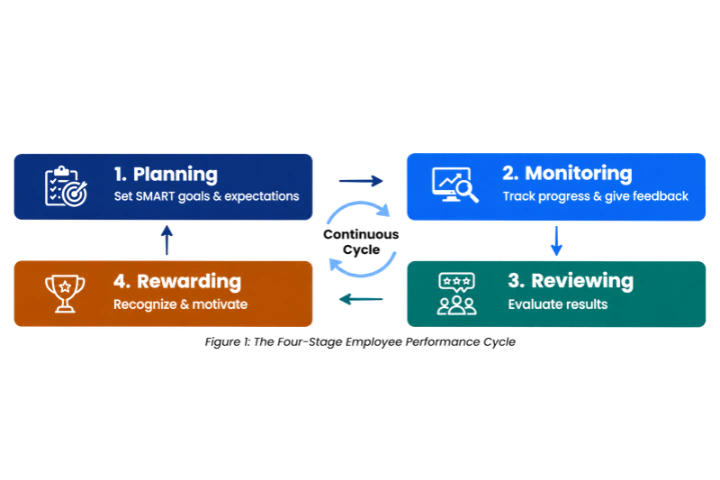
Planning lays the foundation for the entire cycle. The manager and employee meet to agree on what success looks like for the period ahead, making sure individual goals support team and organisational objectives. Without this clarity, everything that follows becomes subjective.
Goals should follow the SMART framework:
- Specific – clearly defined, with no room for interpretation.
- Measurable – tied to a number or clear indicator of completion.
- Achievable – stretching, but realistic with the resources available.
- Relevant – connected to the employee’s role and company priorities.
- Time-bound – with a deadline or review date.
Employee example: A customer support executive agrees to “reduce average first-response time from 6 hours to 3 hours by the end of Q2, while keeping customer satisfaction (CSAT) above 90%.” The manager also adds one development goal: complete an advanced product training course by May.
Monitoring means tracking progress throughout the cycle, not just at the end. Regular check-ins help managers spot obstacles early, offer coaching, and adjust goals if priorities shift. Problems that go unnoticed for months become much harder to fix.
- Hold short one-to-one check-ins monthly or bi-weekly.
- Review progress against KPIs using dashboards or shared trackers.
- Give real-time feedback, both positive and corrective.
- Document key conversations so the review stage is evidence-based.
Employee example: In the monthly check-in, the support executive’s response time has dropped to 4.5 hours, but CSAT has dipped to 87%. The manager identifies that rushed replies are the cause and pairs the employee with a senior colleague for two weeks of response-quality coaching.
The manager and employee formally evaluate performance against the goals set in the planning stage. Because monitoring has been ongoing, this conversation should hold no surprises. The review is also a two-way exchange: employees share their self-assessment and feedback on the support they received.
Useful review questions include:
- Were the original goals realistic and aligned with business objectives?
- Which goals were achieved, exceeded, or missed, and why?
- What new skills or experience did the employee gain?
- Did the organisation provide the right tools, training, and support?
- What should change in the next cycle?
Employee example: The support executive finishes Q2 with a 2.8-hour response time and 92% CSAT, beating both targets. Their self-assessment highlights that the coaching made the biggest difference, and they ask to take on mentoring new hires next quarter.
The final stage recognises and rewards performance. Employees who work hard all year but receive no acknowledgement quickly lose motivation, and may start looking elsewhere. Rewards should be merit-based, transparent, and consistent across teams.
Rewards do not always have to be financial. Common options include:
- Salary increase or performance bonus
- Promotion or expanded responsibilities
- Public recognition or a written thank-you from leadership
- Learning and development opportunities, such as courses or certifications
- Extra paid time off or flexible working options
Employee example: The support executive receives a performance bonus, public recognition in the company all-hands meeting, and a new “team mentor” responsibility, which becomes a development goal in the next planning stage, restarting the cycle.
Track every stage of the performance cycle in one place
Set SMART goals, run check-ins, collect 360 feedback, and manage reviews without spreadsheets.
Benefits of an Effective Employee Performance Cycle
A well-run performance cycle benefits employees, managers, and the business as a whole. Here are the most significant gains, along with how you can measure each one.
| Benefit | What it means | How to measure it |
|---|---|---|
| Stronger goal alignment | Every employee knows how their work supports company objectives | % of employees with goals linked to company OKRs |
| Higher engagement | Regular feedback makes employees feel seen and supported | Engagement or eNPS survey scores |
| Better retention | Clear growth paths reduce the urge to leave | Voluntary turnover rate; regretted attrition |
| Faster problem-solving | Issues are caught in check-ins, not at year-end | Number of goals adjusted mid-cycle; time to resolve issues |
| Fairer rewards | Decisions are based on documented evidence | Rating distribution; pay-equity analysis |
| Skill development | Development goals close capability gaps | Training completion; internal promotion rate |
| Improved business results | Individual performance adds up to company performance | Goal attainment rate; revenue or productivity per employee |
The key point is that the benefits come from the cycle, not from any single stage. Planning without monitoring leads to forgotten goals; reviewing without rewarding leads to disengagement. Each stage reinforces the others.
How to Implement an Employee Performance Cycle
Knowing the four stages is the easy part. Making the cycle work consistently across every team is where most organisations struggle. These practical steps will help.
Decide whether you will run annual, semi-annual, or quarterly cycles. Publish a calendar with dates for goal-setting, check-ins, reviews, and reward decisions so managers can plan ahead.
Key performance indicators turn goals into numbers everyone can track. Pick three to five KPIs per role, mixing output measures (what was delivered) with quality and behaviour measures (how it was delivered).
| Role | Example KPIs |
|---|---|
| Sales executive | Revenue vs. quota, win rate, average deal size |
| Customer support | First-response time, CSAT, ticket resolution rate |
| Software developer | Sprint commitments delivered, defect rate, code review turnaround |
| Marketing specialist | Qualified leads generated, conversion rate, campaign ROI |
| HR business partner | Time to hire, retention in assigned teams, engagement scores |
Manager-only reviews can be biased or incomplete. 360-degree feedback collects input from peers, direct reports, cross-functional colleagues, and the employee themselves. It gives a fuller picture of collaboration, leadership, and communication, areas that KPIs alone rarely capture. Keep feedback surveys short and focused on observable behaviours.
The cycle is only as good as the conversations behind it. Train managers in goal-setting, giving constructive feedback, coaching, and reducing rating bias. A short guide with sample questions for each stage goes a long way.
Spreadsheets and email work for a small team, but they break down quickly as you grow. Performance management software centralises goals, check-in notes, feedback, and review forms, sends automatic reminders, and gives HR real-time visibility into where every team is in the cycle.
At the end of every cycle, ask managers and employees what worked and what did not. Use their feedback to simplify forms, adjust timelines, or improve training before the next cycle starts.
Employee Performance Cycle Examples, Challenges, and Templates
| Stage | Timing | What happens |
|---|---|---|
| Planning | Week 1 | Agree on goals: generate 300 qualified leads, improve landing-page conversion from 2% to 3%, complete a Google Analytics certification. |
| Monitoring | Weeks 2–11 | Bi-weekly check-ins; at week 6, leads are behind target, so budget is shifted from display ads to search campaigns. |
| Reviewing | Week 12 | Self-assessment plus manager review and peer feedback: 320 leads, 2.8% conversion, certification completed. |
| Rewarding | Week 13 | Spot bonus, recognition in the team meeting, and ownership of a new product launch campaign next quarter. |
| Challenge | Solution |
|---|---|
| Goals are vague or not measurable | Use a SMART goal template and have HR review goals before they are finalised. |
| Check-ins get skipped | Schedule recurring meetings at the start of the cycle and use automated reminders. |
| Review ratings feel biased | Use 360 feedback, clear rating definitions, and calibration sessions across teams. |
| Too much paperwork | Shorten forms to the essentials and move the process into software. |
| Rewards don’t match performance | Publish clear criteria linking ratings to rewards and development opportunities. |
Use this checklist to make sure each stage is complete for every employee.
| Stage | Checklist item | Done? |
|---|---|---|
| Planning | 3–5 SMART goals agreed and documented | ☐ |
| Planning | Goals linked to team or company objectives | ☐ |
| Planning | At least one development goal included | ☐ |
| Monitoring | Regular check-ins scheduled (monthly or bi-weekly) | ☐ |
| Monitoring | KPI progress reviewed and notes recorded | ☐ |
| Monitoring | Goals adjusted if business priorities changed | ☐ |
| Reviewing | Employee self-assessment completed | ☐ |
| Reviewing | 360-degree feedback collected | ☐ |
| Reviewing | Manager review and rating completed | ☐ |
| Rewarding | Reward or recognition decided and communicated | ☐ |
| Rewarding | Development plan created for the next cycle | ☐ |
Get the free Employee Performance Cycle Template
Download our editable goal-setting sheet, check-in agenda, and review checklist.
Conclusion
The employee performance cycle turns performance management from a once-a-year formality into a continuous system for growth. By setting clear goals, checking in regularly, reviewing results fairly, and rewarding achievement, organisations build a workforce that is aligned, engaged, and constantly improving. Start small, define your cycle calendar, agree SMART goals with your team, and use the checklist above, then refine the process with every cycle.
Join Our Creative Community
Frequently Asked Questions
What are the 4 stages of the employee performance cycle?
The four stages are Planning (setting SMART goals), Monitoring (tracking progress and giving feedback), Reviewing (evaluating results against goals), and Rewarding (recognising performance and planning development).
How long should an employee performance cycle be?
Traditional cycles run for 12 months, but many organisations now prefer quarterly or semi-annual cycles with monthly check-ins. Shorter cycles keep goals relevant and make feedback more timely.
What is the difference between performance management and a performance appraisal?
Performance management is the continuous process covering all four stages of the cycle. A performance appraisal is a single formal evaluation that happens during the reviewing stage.
Who is involved in the employee performance cycle?
The employee and their direct manager are the core participants. HR designs and oversees the process, while peers and other colleagues often contribute through 360-degree feedback.

Trusted by the Best

























