

Customer Sentiment Analysis: Meaning, Importance & Benefits

Most renewals are decided long before a deal reaches the customer’s desk. They are shaped by every support interaction, product experience, and meeting that came before.
- Renewals start early: Sentiment analysis helps teams spot concerns before renewal discussions begin.
- Guide renewal conversations: Understand customer concerns, priorities, and likelihood of renewing.
- Reveal hidden risks: Combine sentiment with usage and support data to understand account health.
- Monitor continuously: AI analyses customer conversations, support activity, and product data to identify changes and risks early.
A CSM team that enters a renewal call without understanding how the customer feels is negotiating blind.
Customer sentiment analysis turns conversations, support tickets, and usage signals into clear insights, helping teams understand customer health score.
This guide explains how customer emotional analysis guides renewal conversations, which signals deserve attention, and how an AI-powered approach replaces manual review with timely, account-level insight.
What Is Customer Sentiment Analysis?
Customer sentiment analysis is the practice of evaluating customer communications and behavior to determine whether the underlying attitude is positive, neutral, or negative.
It interprets the language used in meetings, emails, chats, surveys, and support tickets to reveal satisfaction, frustration, or hesitation.
Why Customer Sentiment Analysis Matters for Increasing Renewals?
According to study by Harvard Business Review, acquiring a new customer costs five to 25 times more than retaining an existing one
Voice of customer analysis helps identify early renewal risks by uncovering frustration, unresolved issues, and declining confidence that usage metrics alone may miss.
Three outcomes make sentiment a renewal priority.
- Earlier intervention: Teams can address concerns months before the renewal date, while the customer is still open to resolution.
- Better preparation: Conversations focus on what the customer actually cares about, not on a generic account review.
- Greater confidence: Decisions about discounts, escalations, and expansion rest on evidence rather than instinct.
Qualtrics XM Institute’s research found that 11% of experiences globally are bad, and 47% of those lead customers to cut spending, and it estimates nearly $3 trillion in sales at risk in 2026.
Where Customer Sentiment Data Comes From?
Reliable customer emotional analysis depends on collecting signals from every touchpoint, not only from surveys. The most useful sources include.
- Meetings and calls: Recorded discussions reveal concerns, objections, and enthusiasm in the customer’s own words.
- Support tickets: Volume, severity, and recurring themes show where the product experience falls short.
- Emails and chat messages: Written exchanges capture tone and unanswered questions.
- Surveys and feedback forms: Direct ratings provide a baseline for customer mood analysis.
- Product usage and license utilization: Adoption trends confirm or contradict what customers say.
Treating each interaction as feedback is the foundation of voice of customer analysis.
How Customer Sentiment Analysis Guides Renewal Conversations?
It guides renewal conversations by showing how an account feels, which issues drive that feeling, and what the customer is likely to do next. Teams use it to set the agenda, match tone, resolve open issues first, and recognize renewal intent early.
Accounts renew because their priorities were addressed, not because of features alone. Sentiment data shows which topics surfaced repeatedly as concerns, so the customer success manager (CSM) can open with those topics instead of a standard review.
A satisfied account welcomes a forward-looking discussion about growth. A frustrated account needs acknowledgment and a recovery plan first. Customer tone analysis helps teams match their approach to the customer’s current state, which prevents a premature upsell pitch to an unhappy customer.
According to Qualtrics, 30% of consumers don’t tell anyone after a bad experience and simply switch brands silently, and 29% are less likely to share feedback directly. This shows sentiment linked to specific tickets and meetings show which unresolved problems carry the most weight. Resolving them before the call demonstrates accountability and rebuilds confidence.
Customer mood analysis identifies whether an account is leaning toward renewal, evaluating alternatives, or considering a smaller scope. Questions about contract flexibility, data export, or competing vendors signal intent well before any formal notice. Recognizing these cues early lets the team respond while options remain open.
Want to understand your customers before renewal time?
Use AI-powered sentiment insights to identify customer concerns, understand their feedback, and make better renewal decisions.
Customer Sentiment Analysis Signals to Look for Before Renewal
Certain patterns deserve attention in the months leading to a renewal date.
- Repeated complaints about the same issue: Indicate that the customer’s concerns remain unresolved.
- Declining engagement: Fewer meeting attendees and delayed responses may signal reduced interest or involvement.
- Negative changes in communication tone: Shorter responses, expressions of frustration, or escalations to senior management may indicate growing dissatisfaction.
- Declining product adoption: Reduced usage of features that influenced the purchase decision may suggest the customer is not receiving the expected value.
- Change in key customer contacts: When the primary point of contact leaves and no replacement takes responsibility, communication gaps and renewal risks may increase.
Customer mood analysis across successive meetings helps confirm whether a negative shift is temporary or sustained. The strength of customer sentiment analysis comes from combining signals into a pattern and tracking how that pattern changes over time.
How to Prepare for a Renewal Call Using Sentiment Insights?
A structured process turns customer emotional analysis into a repeatable routine rather than an occasional exercise.
Review the customer journey: Look at previous interactions, important decisions, and unresolved concerns to understand how the relationship has developed.
Track changes in customer sentiment: Identify whether customer opinions are improving or declining. This helps you understand whether the account is moving towards renewal or requires attention.
Address unresolved issues: Review pending support tickets and unanswered questions. Assign responsibilities and resolve these concerns before starting renewal discussions.
Evaluate product adoption: Check how frequently customers use different products and features. Identify areas where they are struggling to get the expected value.
Prioritize accounts based on risk: Identify customers showing signs of dissatisfaction and give them additional attention before renewal discussions begin.
Personalize renewal discussions: Use previous feedback and customer concerns to prepare relevant talking points, address objections, and demonstrate how the product continues to meet their needs.
How to Handle Positive, Neutral, and Negative Accounts?
Customer mood analysis sorts of accounts into positive, neutral, and negative profiles, and each profile calls for a different conversation.
Positive Sentiment
Confirm the value delivered, document measurable successes, and introduce relevant expansion opportunities. Positive accounts are also strong candidates for references and case studies.
Neutral Sentiment
Neutral accounts are the easiest to overlook. They show no obvious problems and little enthusiasm. Ask what would increase value, then propose enablement steps such as training or feature adoption plans.
Negative Sentiment
Acknowledge concerns directly, present a concrete remediation plan, and involve senior stakeholders where appropriate. Defer pricing discussions until the customer feels heard.
The tool is particularly useful here, because it reveals whether dissatisfaction stems from a specific incident or from a broader doubt about product value.
Benefits of Using Sentiment Analysis
These insights allow teams to identify concerns, improve customer relationships, and make decisions based on actual customer feedback rather than assumptions.
Not every customer expects the same thing from your product. Some may need help understanding a feature, while others may want faster support or a better solution to an existing problem. Customer tone analysis helps identify these differences by examining customer feedback and conversations. Teams can use these customer sentiment insights to understand individual needs and offer more relevant support.
A customer might continue using the product but still struggle with certain features or services. If nobody addresses these concerns, their experience can gradually get worse. Customer mood analysis helps identify such problems through customer conversations and feedback, giving teams an opportunity to resolve them before dissatisfaction grows.
Clients rarely decide to leave without a reason. Repeated complaints, negative feedback, and declining engagement can indicate that something is not working for them. The customer sentiment analysis helps CSM teams recognize these warning signs and reach out before customers start looking for alternatives.
Retaining customers requires more than checking whether they are still using your product. Teams need to understand whether customers are getting the value they expected. Voice of customer analysis
assists in identifying accounts that need attention, unresolved concerns, and opportunities for better engagement.
- Customer success teams detect concerns and renewal risks early.
- Support teams identify recurring ticket patterns and unresolved issues faster.
- Account managers understand sentiment and renewal signals before key conversations.
- Product teams apply voice of customer analysis to turn feedback into roadmap priorities.
- Revenue operations connect account trends and expansion signals to forecasting.
Best Practices for Using Customer Sentiment Analysis in Renewals
The tool helps teams understand customer concerns and address them before renewal discussions begin.
Start early: Begin understanding customer feedback during onboarding rather than waiting until the renewal date approaches.
Gather feedback from different sources: Review customer meetings, support tickets, emails, and product usage to develop a better understanding of their experience.
Monitor changes over time: Look beyond individual feedback or scores. Pay attention to whether customer opinions are improving or becoming less positive.
Consider customer health scores: Combine customer feedback with product usage, engagement, and support activity to get a more complete picture of account health.
Assign responsibility for client concerns: When a customer raises an issue, identify the right person to address it and agree on a suitable resolution timeline.
Follow up with customers: Use AI customer sentiment insights to prepare for conversations, understand their concerns, and discuss possible solutions directly with them.
Share feedback with relevant teams: Pass recurring customer concerns to product and support teams so they can identify the underlying problems and work on suitable improvements.
Role of AI Agent in Analysing Customer Sentiment
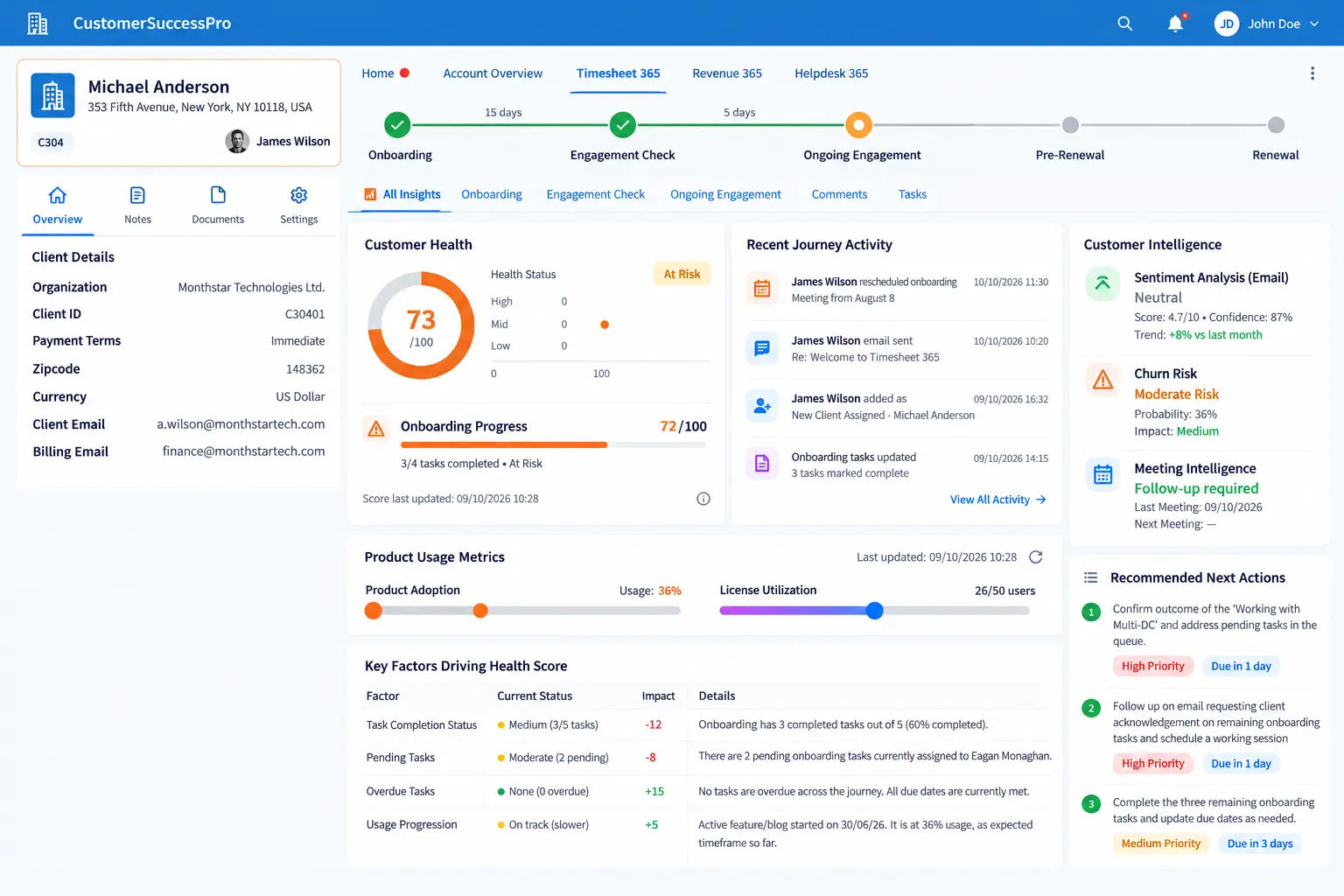
The AI powered CSM Agent brings these capabilities into one connected workflow, turning every customer interaction into retention intelligence. Its key capabilities include.
- Complete customer journey: Every interaction from purchase to renewal appears on a single timeline.
- Automatic meeting summaries: Each call produces a summary of discussions, decisions, and concerns.
- Instant action items: Follow-ups and unresolved questions become tasks routed to the responsible team.
- Health scores and sentiment tracking: Scores reflect sentiment, recurring issues, usage trends, and product-specific signals.
- Renewal risk detection: Early warning signs across sentiment, support activity, and usage identify at-risk accounts.
- Upsell and cross-sell insights: Adoption and engagement data point to the right expansion opportunities.
- License utilization insights: Teams see how much of each purchased product is used.
The agent works with Microsoft Teams, Zoom, Google Meet, and Slack, so customer teams keep their existing communication habits. Enterprise-grade security, governance, and access controls protect conversation data.
The agent combines meeting, support, and product data to continuously analyse customer sentiment, giving CSMs faster insights and more time to focus on customer relationships.
Want to understand what your customers really think? Use AI-powered sentiment insights to spot concerns early, improve customer experiences, and build stronger relationships.
Frequently Asked Questions
How early should teams start tracking sentiment before a renewal?
From the first meeting after purchase. Early baselines make later changes easier to interpret and give teams months, rather than weeks, to act on concerns.
Can customer sentiment analysis work on meetings and calls?
Yes. Meeting summaries and transcripts reveal concerns, objections, and enthusiasm in the customer’s own words, which written feedback often misses.
How does analysing customer sentiment helps with renewals?
It shows how each account feels, which issues drive that feeling, and what the customer may do next. Teams use it to set the agenda, match tone, resolve open issues first, and recognize renewal intent early.
How should teams handle an account with negative sentiment?
Acknowledge the concerns directly, present a concrete remediation plan with owners and dates, involve senior stakeholders where needed, and defer pricing discussions until the customer feels heard.
How does it help businesses deliver a better customer experience?
Customer emotional analysis improves customer experience by helping businesses understand customer concerns, identify recurring problems, personalize interactions, resolve issues early, and improve products and services based on customer feedback.


























