
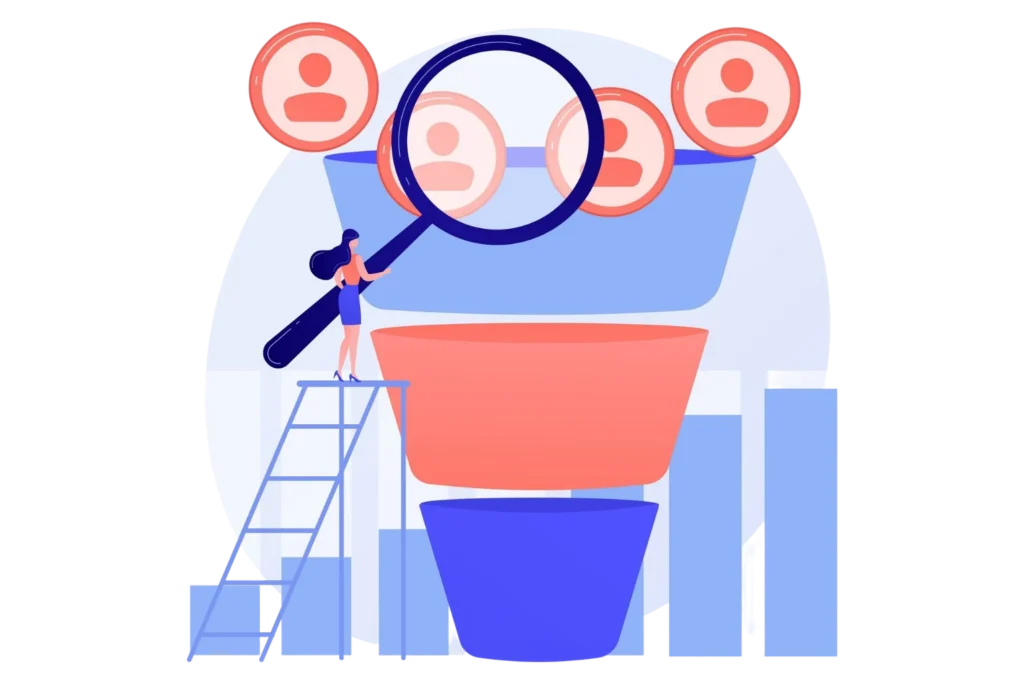
The Recruitment Funnel: A Stage-by-Stage Guide to Building One That Converts

Most hiring teams don’t have a candidate shortage. They have a leak somewhere between “applied” and “accepted” and most never find it because they’re not measuring the journey, just counting the results.
A recruitment funnel fixes that. It maps how candidates move from first hearing about your company to signing an offer and it shows you exactly where good people fall out of the process.
- A recruitment funnel tracks candidate movement across seven stages — awareness, sourcing, application, screening, interview, offer and onboarding — revealing exactly where qualified candidates drop off.
- 60% of candidates abandon online applications that are too long or complicated (CareerBuilder) and 57% lose interest when hiring drags on too long (Robert Half).
- Conversion rate is calculated as (candidates advancing ÷ candidates entering a stage) × 100 and should be tracked per stage rather than judged against a single industry benchmark.
- Strong onboarding after the offer stage improves new-hire retention by 82% (Brandon Hall Group), making the funnel’s final stage as important as the first.
What Is a Recruitment Funnel?
A recruitment funnel is a structured model of how candidates move through your hiring process — from initial awareness of a job opening to becoming a hired employee. Unlike a straight-line hiring process (post job, review resumes, interview, hire), a funnel treats every stage as a checkpoint where candidates either move forward or walk away.
It answers the questions a linear process can’t:
- How many candidates enter the process and how many actually finish it?
- Where do qualified people leave?
- Which sourcing channels bring in candidates worth hiring?
- How long does each stage take?
- What single change would improve outcomes the most?
Here’s why that matters: a company might collect 1,000 applications and make one hire. Without funnel data, the obvious conclusion is “we need more applicants.” The real cause is usually something else entirely — vague job descriptions, slow interview scheduling, or a five-page application form nobody finishes.
Why Funnel Thinking Beats a Linear Process
A linear hiring process assumes candidates keep moving forward until someone gets hired. Reality doesn’t work that way. People abandon applications. Strong candidates take competing offers because another company moved faster. Some vanish after a great first interview and never respond again.
Funnel thinking reframes the question. Instead of “why aren’t we getting enough hires,” you ask “which stage is costing us good candidates?” That’s a fixable question. It lets teams target one weak stage instead of rebuilding the entire hiring process from scratch.
The 7 Stages of a Recruitment Funnel
- Awareness and employer attraction
- Candidate sourcing
- Application and screening
- Interview and assessment
- Candidate selection
- Offer and negotiation
- Hiring and onboarding transition
Each stage has its own goals, its own failure points and its own way to measure success.
Stage 1: Awareness and Employer Attraction
Recruitment starts before anyone applies. Candidates size up your company through your career page, employee reviews, social presence and the job post itself.
Where it goes wrong: Job descriptions that list duties and nothing else. Candidates want to know why the role matters, what impact they’ll have and what growth looks like a year in. A post that only reads like a task list attracts volume, not quality.
According to LinkedIn’s Global Talent Trends report, 75% of job seekers weigh an employer’s brand before they apply. Recruitment success is already being decided before the first resume arrives.
Stage 2: Candidate Sourcing
Sourcing pulls candidates in through job boards, referrals, social media, agencies, talent communities and internal databases. Strong sourcing doesn’t lean on one channel — it tracks which sources actually produce candidates worth hiring.
Where it goes wrong: Measuring sourcing by application count instead of candidate quality. A flood of resumes from one job board sounds productive but often just means more screening hours, longer cycles and weaker interviews downstream.
LinkedIn research shows 70% of the global workforce is passive talent — not job hunting, but open to the right offer. Waiting for applications alone leaves most of the market untouched.
Stage 3: Application and Candidate Screening
This is where candidates get sorted by qualifications, experience and fit. A good screening process is fast, consistent and easy for the candidate — built on clear criteria rather than gut checks.
Where it goes wrong: Friction. Long forms, clunky mobile applications, unclear requirements and no confirmation after submitting all push candidates out the door. A candidate who abandons the application here rarely comes back.
CareerBuilder research found that 60% of candidates quit filling out online applications because they’re too long or too complicated.
How Recruitment Management 365 helps: RM365 keeps candidate information, application status and screening activity in one place instead of scattered across spreadsheets and inboxes, so recruiters can see exactly where each candidate stands without digging through email threads.
Still tracking applicants across three different spreadsheets?
See how RM365 organizes screening in one view and watch a real candidate move through the pipeline in real time.
Stage 4: Interview and Assessment
The interview stage tests skills, experience and cultural fit. Strong versions of this stage have defined rounds, prepared questions, clear scoring and fast feedback — candidates know what’s coming next.
Where it goes wrong: Interviews that drag. Unclear round structure, feedback that takes weeks, unavailable decision-makers and inconsistent updates all chip away at candidate interest.
Robert Half research found 57% of candidates lose interest in a job when the hiring process takes too long.
How Recruitment Management 365 helps: RM365 tracks interview stages, assigns responsibility for next steps and keeps communication records in one thread, so hiring managers know what’s pending without chasing status updates.
Stage 5: Candidate Selection
Selection is where the best candidate gets identified based on evidence — structured evaluations, interview feedback, skill assessments and scorecards — rather than gut feel.
Where it goes wrong: Delay. Strong candidates almost always have other options in play. Every day spent debating internally is a day a competitor can use to make an offer.
Glassdoor research puts the average U.S. hiring process at 23.8 days. Organizations that trim unnecessary delay tend to see better acceptance rates as a result.
How Recruitment Management 365 helps: RM365 keeps evaluation notes, candidate records and approval steps together so hiring teams can compare candidates and move to a decision without waiting on a scattered paper trail.
Stage 6: Offer and Negotiation
The offer stage turns interest into commitment — but it’s not the finish line. Candidates are still comparing your offer against everything else on the table: salary, growth path, flexibility and how the process has felt so far.
Where it goes wrong: Recruiters treat selection as the finish line and go quiet. Slow offer letters, unclear compensation conversations and misaligned expectations from earlier in the process all lead to declined offers.
SHRM research puts average cost per hire around $4,700, often higher depending on role and industry. A declined offer means repeating several expensive stages from scratch.
How Recruitment Management 365 helps: RM365 tracks offer status and pending actions in one dashboard, keeping recruiters and hiring managers aligned instead of relying on side conversations to know where things stand.
A declined offer means starting the whole cycle over.
RM365 keeps every offer-stage action visible so nothing slips through the cracks
Stage 7: Hiring and Onboarding Transition
The funnel doesn’t end at “yes.” How the handoff from recruiter to new employee goes shapes early engagement and how long that hire actually stays.
Where it goes wrong: Communication drops after the offer is signed. Unclear start instructions, delayed responses and missing paperwork create doubt right when a new hire needs reassurance, not silence.
Brandon Hall Group research found organizations with strong onboarding improve new-hire retention by 82%.
How Recruitment Management 365 helps: RM365 keeps candidate records and next steps visible to both recruiting and HR, so the handoff from “hired” to “onboarded” doesn’t lose information along the way.
How to Measure Recruitment Funnel Conversion Rate
The formula is simple:
Conversion Rate = (Candidates moving to the next stage ÷ Candidates entering the stage) × 100
Example: 500 candidates apply, 50 reach the interview stage.
(50 ÷ 500) × 100 = 10% application-to-interview conversion rate.
A strong funnel isn’t about pulling in more candidates — it’s about improving how many move forward at each stage while keeping quality intact.
Metrics Worth Tracking
- Application conversion rate — how many visitors actually finish applying. Low numbers point to weak job descriptions or overly complex forms.
- Screening pass rate — the share of applicants meeting baseline requirements. Too low suggests weak sourcing; too high suggests criteria that are too loose.
- Interview-to-offer ratio — how many interviews it takes to reach an offer, a signal of both candidate quality and interview effectiveness.
- Offer acceptance rate — a drop here usually points to compensation, communication, or employer brand issues.
- Time-to-hire — longer cycles raise cost and give competitors an opening to grab strong candidates first.
- Source effectiveness — referrals often bring fewer but stronger candidates; job boards bring volume that needs heavier screening.
Recruitment Funnel vs. Recruitment Life Cycle
These get confused often, but they answer different questions.
Recruitment Funnel | Recruitment Life Cycle |
Measures candidate movement between stages | Explains the full recruitment process |
Focused on conversion and drop-off | Focused on overall hiring activities |
Built on metrics and analytics | Built on process management |
Improves hiring performance | Defines the recruitment workflow |
The life cycle tells you what happens during hiring. The funnel tells you how well each part is performing. Used together, the life cycle might show interviews are a required step — the funnel reveals whether interviews are actually where you’re losing candidates because of slow feedback or unclear scheduling.
Where Recruitment Management 365 Fits In
Most recruiting teams lose visibility because candidate information is spread across email, spreadsheets, job boards and disconnected tools. RM365 brings recruitment activity into one environment — candidate tracking, workflows, interview management, hiring team collaboration and reporting.
Instead of asking “where is this candidate right now,” recruiters can see current stage, pending actions, interview progress and next steps at a glance. That visibility is what catches funnel leaks before they cost you a hire.
Conclusion
A strong recruitment funnel isn’t about maximizing applicant volume — it’s about building a process where qualified candidates move forward without unnecessary friction at any stage. Weak messaging loses applicants early. Slow screening loses interest. Long interview cycles lose candidates to competitors. Poor offer follow-through turns a good interview into a declined offer.
Recruitment Management 365 gives HR teams one connected place to manage candidate movement, spot where the funnel is leaking and act before a strong hire slips away.
Ready to see where your own funnel is leaking?
walk through your hiring stages with a real product specialist — no generic sales pitch, just your data.
Frequently Asked Questions
What's the main purpose of a recruitment funnel?
It tracks how candidates move through hiring stages and shows where the process needs work helping teams cut delays and improve conversion at each step.
How many stages does a recruitment funnel have?
Most funnels run six to seven stages: awareness, sourcing, application, screening, interview, offer and hiring/onboarding. The exact count varies by organizatio
What's a good conversion rate for a recruitment funnel?
There’s no universal benchmark it depends on role, industry and sourcing mix. Track your own numbers over time and focus on improving your weakest stage rather than chasing an outside average.
How can recruiters improve funnel performance?
Write clearer job descriptions, tighten candidate communication, cut unnecessary interview rounds, track the right metrics and regularly review where candidates are dropping off.
Is a recruitment funnel the same as an applicant tracking system?
No. An ATS manages candidates and hiring activity. A funnel is the measurement model showing how candidates move through those stages — the right software just makes the funnel easier to see and act on.
Is ATS software suitable for small businesses?
Absolutely. Small businesses often benefit the most from ATS software because they have limited HR staff and cannot afford to lose time on manual tasks. Modern platforms like Recruitment Management 365 are designed to scale — offering core automation features that are affordable and easy to implement for teams of any size.
How long does it take to implement an applicant tracking system?
Implementation time varies depending on the platform and your team size. Simple setups with pre-built templates can be live in a matter of days. More complex configurations with custom workflows, integrations, and multi-department rollouts typically take two to four weeks. Recruitment Management 365 is recognized for its fast implementation, earning a G2 Fastest Implementation badge.


_JiluXJRGNl.svg)























