

25 Key HR Reporting Metrics Every Organization Should Track in 2027

- HR reporting metrics measure the effectiveness of hiring, retention, performance, engagement and other HR activities.
- Tracking the right metrics helps organizations make informed decisions based on data rather than assumptions.
- The most relevant HR metrics vary based on an organization’s size, industry and business goals.
- Modern HR software can automate HR reporting through dashboards, real-time analytics and Microsoft 365 integration.
Organizations no longer rely on assumptions when making HR decisions. They use HR metrics to understand hiring performance, retention, engagement, productivity, and other key areas that influence business growth. By tracking the right numbers, HR teams can identify trends early, solve problems faster, and support strategic planning with reliable data.
Whether you manage a small business or a large enterprise, knowing which metrics to measure is just as important as collecting the data itself. This guide explains what HR metrics are, why they matter and which ones every organization should track to make better decisions about their teams.
What Are HR Metrics?
HR metrics are measurable data points that help organizations evaluate the performance and effectiveness of their human resources activities. These metrics provide insight into how well HR processes support business goals, from attracting and retaining talent to improving performance, learning, and productivity.
According to Gallup’s State of the Global Workplace report, only 21% of employees worldwide are engaged at work. Tracking HR metrics such as employee engagement, turnover, and retention helps organizations identify challenges early and make better people decisions.
They help HR teams answer questions such as:
How many employees are leaving?
How long does hiring take?
How much does recruitment cost?
Are employees regularly absent?
Are employees engaged?
Is employee productivity improving?
Are training programs producing results?
HR reporting metrics turn workforce information into measurable data that HR leaders can use for planning and decision-making.
Why Are HR Metrics Important?
HR teams manage large amounts of employee information. Without clear measurements, it can be difficult to understand whether HR programs and workforce strategies are producing the expected results.
- Make Data to Informed Decisions– HR leaders can use measurable workforce data instead of relying only on assumptions or individual opinions.
- Identify Workforce Trends– Metrics can reveal changes in turnover, absenteeism, hiring speed, engagement, and productivity over time.
- Improve Employee Retention– Retention and turnover metrics help HR teams identify where employees are leaving and which areas may require attention.
- Improve Recruitment– Hiring metrics show whether recruitment processes are fast, efficient, and cost-effective.
Measure HR Performance – HR reporting metrics make it easier to measure the results of programs related to hiring, training, engagement, attendance, and performance.
- Support Workforce Planning– Headcount, turnover, hiring, and productivity data help organizations plan future workforce requirements.
- Connect HR With Business Goals– Metrics such as revenue per employee, training ROI, and productivity help show how workforce decisions contribute to broader business performance.
HR Metrics vs. HR KPIs vs. HR Analytics: What Is the Difference?
The terms HR metrics, HR KPIs, and HR analytics are often used interchangeably, but they are not the same. While they all rely on HR data, each serves a different purpose in measuring and improving organizational performance.
Understanding the difference helps organizations choose the right measurements and make better business decisions.
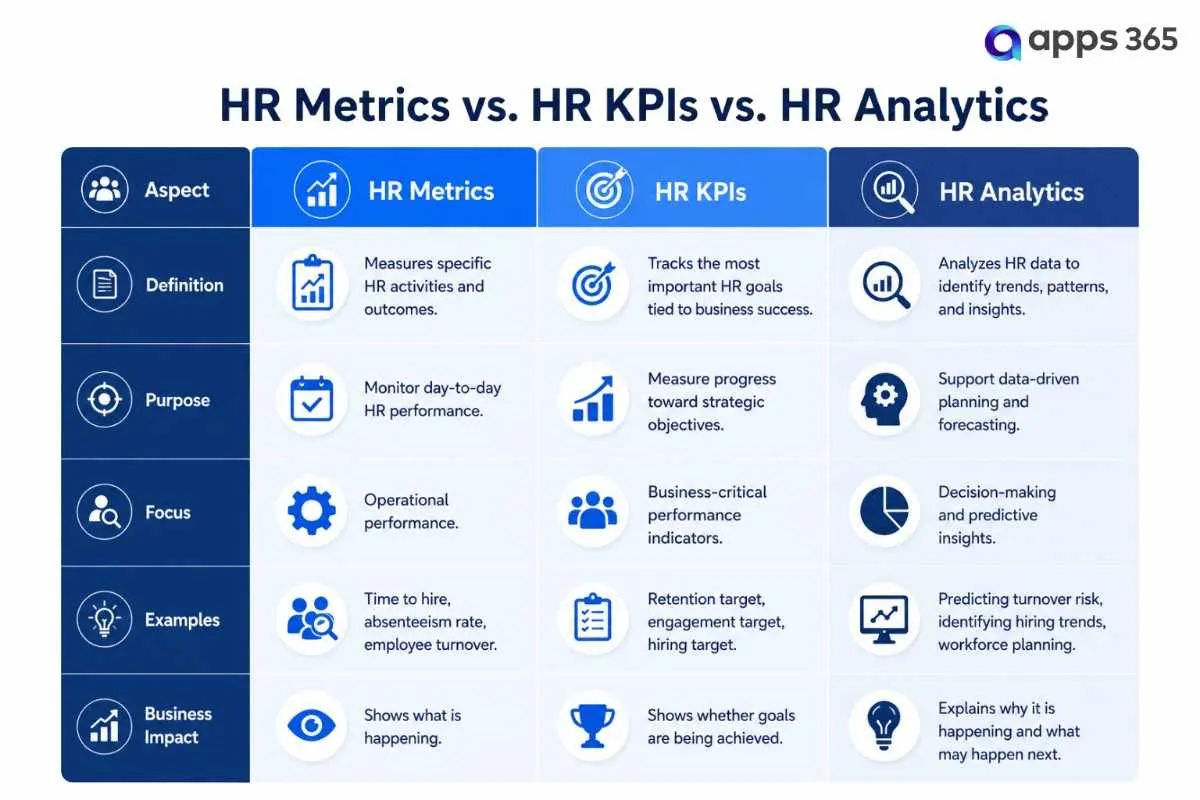
An HR metric provides the measurement.
An HR KPI compares that measurement against a strategic target.
HR analytics looks deeper into the data to understand trends, relationships, and possible causes.
25 HR Reporting Metrics Every Organization Should Track
Not every organization needs to track the same measurements. However, the following metrics provide a strong foundation for recruitment, retention, workforce planning, employee engagement, performance, and learning.
Recruitment metrics help HR teams measure hiring speed, cost, effectiveness, and candidate quality.
Time to hire measures how long it takes to move a candidate from entering the recruitment process to accepting a job offer.
Formula:
Time to Hire = Offer Acceptance Date − Candidate Application Date
Time to fill measures how long it takes to fill an open position from the date the role is approved or posted.
Formula:
Time to Fill = Position Filled Date − Job Requisition Date
Cost per hire measures the average amount spent to recruit one employee.
Formula:
Cost per Hire = Total Recruitment Costs ÷ Total Number of Hires
Offer acceptance rate measures the percentage of candidates who accept job offers.
Formula:
Offer Acceptance Rate = Accepted Offers ÷ Total Offers Made × 100
Quality of hire measures how successful new employees are after joining the organization.
Formula:
Quality of Hire = (Performance Score + Engagement Score + Retention Score) ÷ 3
This metric shows which recruitment channels generate the most hires.
Formula:
Recruitment Source Effectiveness = Hires From a Source ÷ Total Hires × 100
Retention metrics help organizations understand workforce stability and why employees stay or leave.
Employee turnover rate measures the percentage of employees who leave during a specific period.
Formula:
Employee Turnover Rate = Employees Who Left ÷ Average Number of Employees × 100
Employee retention rate measures the percentage of employees who remain with the organization.
Formula:
Employee Retention Rate = ((Employees at End of Period − New Hires) ÷ Employees at Start of Period) × 100
9. Voluntary Turnover Rate
Voluntary turnover rate measures employees who choose to leave the organization.
Formula:
Voluntary Turnover Rate = Voluntary Departures ÷ Average Number of Employees × 100
Early turnover rate measures how many new hires leave within a defined period, such as the first 90 days or first year.
Formula:
Early Turnover Rate = New Hires Who Left Early ÷ Total New Hires × 100
Average employee tenure shows how long employees typically stay with the organization.
Formula:
Average Employee Tenure = Total Years of Employee Service ÷ Total Number of Employees
Attendance and workforce metrics help HR teams understand employee availability, staffing levels, and workforce capacity.
Absenteeism rate measures the percentage of scheduled work time lost because of employee absence.
Formula:
Absenteeism Rate = Total Absent Days ÷ Total Available Workdays × 100
Leave utilization rate shows how much available employee leave is actually used.
Formula:
Leave Utilization Rate = Leave Days Used ÷ Total Leave Days Available × 100
Overtime rate measures the percentage of total working hours spent on overtime.
Formula:
Overtime Rate = Overtime Hours ÷ Total Hours Worked × 100
Headcount growth rate measures how quickly the workforce is increasing or decreasing.
Formula:
Headcount Growth Rate = (Ending Headcount − Starting Headcount) ÷ Starting Headcount × 100
These metrics help organizations measure employee output, goal achievement, and overall workforce contribution.
Goal achievement rate measures the percentage of employee or team goals successfully completed.
Formula:
Goal Achievement Rate = Goals Achieved ÷ Total Goals Set × 100
Revenue per employee shows how much business revenue is generated relative to workforce size.
Formula:
Revenue per Employee = Total Revenue ÷ Average Number of Employees
Employee productivity compares employee output with time, effort, or other resources used.
Formula:
Employee Productivity = Total Output ÷ Total Employee Input
The definition of output can vary depending on the role or industry.
Internal promotion rate measures the percentage of employees who receive promotions.
Formula:
Internal Promotion Rate = Employees Promoted ÷ Total Number of Employees × 100
Employee engagement metrics help organizations understand how connected, satisfied, and motivated employees feel at work.
Employee engagement score measures overall employee engagement based on survey responses.
Formula:
Employee Engagement Score = Total Engagement Survey Score ÷ Total Possible Survey Score × 100
Employee Net Promoter Score, or eNPS, measures how likely employees are to recommend the organization as a place to work.
Formula:
eNPS = Percentage of Promoters − Percentage of Detractors
Employee satisfaction rate measures the percentage of employees who report being satisfied with their workplace experience.
Formula:
Employee Satisfaction Rate = Satisfied Employee Responses ÷ Total Survey Responses × 100
Learning and development metrics help HR teams understand employee participation, training costs, and program effectiveness.
Training completion rate measures the percentage of assigned training successfully completed.
Formula:
Training Completion Rate = Completed Training Assignments ÷ Total Assigned Training × 100
Training cost per employee measures the average amount spent on learning and development for each employee trained.
Formula:
Training Cost per Employee = Total Training Costs ÷ Total Employees Trained
Training ROI measures the financial return generated from employee training.
Formula:
Training ROI = (Training Benefits − Training Costs) ÷ Training Costs × 100
Conclusion
HR metrics help organizations understand what is happening across recruitment, retention, attendance, workforce planning, performance, engagement, and employee development.
By tracking the right metrics consistently, HR teams can identify trends earlier, improve workforce decisions, and connect employee performance with broader business goals.
The goal is not to track every possible number. It is to focus on HR reporting metrics that provide useful insights and support better decisions.
Turn HR Metrics into Better Decisions
Track employee information, attendance, leave, performance, and HR processes in one connected Microsoft 365 platform with HR365 HRMS.
Frequently Asked Questions
What are HR metrics?
HR metrics are measurable data points used to evaluate the performance of HR activities such as recruitment, retention, attendance, employee engagement, training, and performance management. They help organizations make informed decisions based on data rather than assumptions.
Why are HR reporting metrics important?
HR reporting metrics help organizations measure the effectiveness of HR strategies, identify trends, improve hiring and retention, monitor productivity, and support better business planning through accurate data.
What is the difference between HR metrics and HR KPIs?
HR metrics measure specific HR activities, while HR KPIs (Key Performance Indicators) are the most important metrics tied to strategic business goals. Every KPI is an HR metric, but not every HR metric is a KPI.
What Are the Most Important HR Reporting Metrics to Track?
Some of the most commonly tracked HR reporting metrics include:
- Employee turnover rate
- Employee retention rate
- Time to hire
- Time to fill
- Cost per hire
- Absenteeism rate
- Employee engagement score
- Training completion rate
- Internal promotion rate
- Revenue per employee
The right metrics depend on your organization’s goals and priorities.
How often should HR metrics be reviewed?
The review frequency depends on the metric:
- Weekly: Recruitment progress and attendance
- Monthly: Turnover, retention, leave, and hiring metrics
- Quarterly: Performance, engagement, and training metrics
- Annually: Workforce planning and long-term organizational trends
Regular reviews help identify issues early and support continuous improvement.
How can Microsoft 365 help automate HR metrics?
Microsoft 365 can automate HR metrics when combined with an HR management solution like HR365 HRMS. It centralizes HR data, automates reporting, provides real-time dashboards, and integrates recruitment, leave, attendance, performance, and employee records into a single platform.

























