
Sales Contract Explained: Why It Matters, and How to Manage It Better

Buyers today do not want a long pitch before they buy. They want clear contract terms and a fast decision. According to a Gartner survey, 61% of B2B buyers now prefer a rep-free buying experience.
- A sales contract is a legal agreement that sets the terms of a sale between a buyer and a seller, and it protects both sides if something goes wrong later.
- Poor contract management can cost a business close to 9.2% of its yearly revenue, so getting the basics right has a direct, measurable impact on profit.
- Knowing the key parts, types, and legal terms found in sales agreement helps teams avoid disputes, close deals faster, and build trust with buyers.
- AI tools and platforms such as CLM 365 can improve clause review accuracy and cut down the manual work needed to manage these agreements at scale.
In plain words, most buyers would rather read the terms themselves and decide on their own than sit through a call where a rep walks them through every clause.
This shift puts real pressure on how a business writes its sales contract. If the language is unclear or hard to follow, the buyer may hesitate, ask for changes, or walk away from the deal entirely.
In this blog, we will look at what this type of agreement is, why it matters, its key parts, the different types you should know.
What Is a Sales Contract?
A sales contract is a legal agreement between a buyer and a seller that lays out the terms of a sale.
It states what is being sold, at what price, under what conditions, and what happens if either side fails to meet its part of the deal. This kind of document can cover physical goods, services, software licenses, or even property.
Once a contract is signed, the agreement becomes legally binding. Both parties must follow the terms they agreed to, and if one side does not, the other has legal grounds to seek payment, a replacement, or damages. This is what separates a sales contract from a simple quote or a casual promise made over email.
Importance of Sales Contracts
That is a large share of income lost to missed contract deliverables, unclear terms, unused discounts, and disputes that a well-written sales agreement could have prevented. Here is why these agreements matter so much for a growing business.
- They set clear expectations: Both sides know exactly what is being delivered, when, and at what cost, so there is little room for guesswork.
- They protect against disputes: If a disagreement comes up months later, the written terms act as proof of what was agreed.
- They support cash flow: Clear payment terms help finance teams forecast income and plan instead of chasing late payments.
- They build trust: A well-drafted agreement shows the buyer that the seller is professional and serious about the relationship, not just the sale.
What are the Key Elements of a Sales Contract?
A strong sales agreement should always include a few core elements. Missing even one of these can leave room for disagreement down the line.
- Parties Involved: The full legal names and addresses of the buyer and the seller, so there is no doubt about who is bound by the agreement.
- Description of Goods or Services: A clear and detailed description of what is being sold, including quantity, specifications, and quality standards.
- Price and Payment Terms: The total price, payment schedule, accepted payment methods, and any penalties for late payment.
- Delivery Terms: When and how the goods or services will be delivered, including the shipping method and delivery location.
- Warranties: Any promises made about the quality, performance, or lifespan of the product or service being sold.
- Termination Clause: The conditions under which either party can end the agreement before it runs its full course.
- Dispute Resolution: How disagreements will be handled, whether through mediation, arbitration, or a court of law.
- Governing Law: Which state or country’s laws will apply if a dispute ever needs to be settled formally.
- Signatures: Signed and dated by both parties, which is what makes the document legally valid and enforceable.
Types of Sales Contract
Not every agreement of this kind looks the same. The type used depends on the nature of the deal, the industry, and how often the buyer and seller do business with each other. Some of the most common types include:
- One-Time Sales Contract – Used for a single transaction between a buyer and a seller, such as buying a piece of equipment or a one-off order.
- Recurring Sales Contract – Used when the same goods or services are sold repeatedly over time, such as monthly supply orders or subscription renewals.
- Conditional Sales Contract – The buyer takes possession of the goods right away, but ownership only transfers once the full payment is made.
- Installment Sales Contract – The buyer pays for the goods or services in fixed installments spread across an agreed period.
- Wholesale Sales Contract – Used between manufacturers or distributors and retailers, usually for bulk orders at a discounted rate.
- Service Sales Contract – Covers the sale of a service rather than a physical product, such as consulting, IT support, or maintenance work.
- International Sales Contract – Covers cross-border transactions and includes terms around customs, tariffs, currency exchange, and shipping across borders.
Ready to get your sales contracts moving?
CLM 365 brings contract creation, approvals, electronic signatures, tracking, and renewals into one place, built natively for Microsoft 365.
Difference Between Sales Contracts vs Business Contracts
People often use the terms sales contract and business contract as if they mean the same thing, but they are not quite identical.
Sales Contract | Business Contract |
Covers the sale of goods or services | Covers any type of business agreement |
Focuses on price, delivery, and payment | Can cover hiring, leasing, partnerships, and more |
Signed between a buyer and a seller | Signed between any two or more parties in business |
So, every sales agreement is a form of business contract, but not every business contract deals with a sale.
Benefits of Sales Contracts
A well-drafted sales agremeent brings several real benefits to both buyers and sellers involved in a deal.
- Legal Protection – Both parties have a written record to refer to if the deal does not go as planned.
- Clear Payment Terms – Reduces the chance of late or missed payments by spelling out due dates and penalties upfront.
- Faster Deal Closure – Buyers who understand the terms clearly are more likely to sign quickly, which lines up well with the shift toward rep-free buying.
- Better Record Keeping – These agreements act as a record for accounting, audits, and tax purposes down the line.
- Stronger Relationships – Clear terms lower friction between the buyer and seller, building a better long-term working relationship.
- Lower Legal Risk – A clear, well-written agreement lowers the odds of a costly lawsuit or dispute reaching a courtroom.
Important Legal Terms to Be Reviewed in Sales Contracts
Before signing any contract, both parties should slow down and review contracts carefully.
- Indemnification: States who is responsible for covering losses or damages if something goes wrong during or after the deal.
- Limitation of Liability: Sets a cap on how much one party can be held responsible for in case of a claim.
- Force Majeure: Covers events outside anyone’s control, such as natural disasters or strikes, that may delay or cancel the agreement.
- Non-Compete and Non-Solicitation: Restricts one party from competing with, or taking clients from, the other party for a set period.
- Assignment Clause: States whether either party can pass their rights or duties under the agreement to a third party.
- Confidentiality: Protects sensitive business information that is shared while the deal is being worked out.
- Governing Law and Jurisdiction: Decides which region’s laws apply and where any legal dispute would be heard.
Leveraging AI to Improve Clause Review Accuracy
A survey by McKinsey states that 78% of respondents say their organizations use AI in at least one business function, and contract review is quickly becoming one of the most common use cases. Here are five benefits of using AI based contract management.
- Faster Clause Detection – AI can scan hundreds of pages within minutes and flag clauses tied to payment terms, liability, or termination, saving hours of manual reading.
- Consistent Risk Scoring – AI applies the same rules and standards every single time, so risky terms are flagged the same way across every agreement, no matter who is reviewing it.
- Fewer Missed Clauses – Unlike a tired reviewer, AI checks every section of the document against a set playbook, catching small details a human eye might skip past.
- Faster Negotiation Cycles – With AI flagging problems early, legal and sales teams can address issues sooner, which shortens the time it takes to finalize the deal.
- Better Compliance Tracking – AI can compare each document against company policy and regulatory requirements, helping legal teams spot non-standard terms before they become a real problem.
AI does not replace legal judgment, and it should not be treated as the final word. But it gives legal and sales teams a strong starting point, so their time and energy go toward the clauses that truly need a human eye.
Best Practices to Manage Sales Contracts
Managing this kind of document well takes more than just signing it and filing it away in a drawer. Here are some practical steps every business should follow.
- Use Standard Templates: Start with approved templates for common deal types to keep the language consistent and lower legal risk from the start.
- Set a Clear Approval Process: Define who needs to review and sign off on the agreement before it goes out, based on deal size or level of risk.
- Track Key Dates: Keep a record of renewal dates, payment due dates, and expiration dates so nothing slips through the cracks.
- Store Documents in One Place: Keep every signed agreement in one central, searchable system instead of scattered across emails and shared drives.
- Review Regularly: Set a fixed schedule to review active agreements and update terms as the business or market changes.
- Train Your Team: Make sure sales reps understand the basic legal terms involved so they do not agree to risky wording during a live negotiation.
- Use the Right Technology: Adopt a CLM system to automate tracking, reminders, and clause review at scale.
Manage every sales contract from one place
Keep contracts, approvals, e-signatures, and renewal dates together, so your team always knows what needs attention.
Role of CLM 365 in Managing Sales Contracts
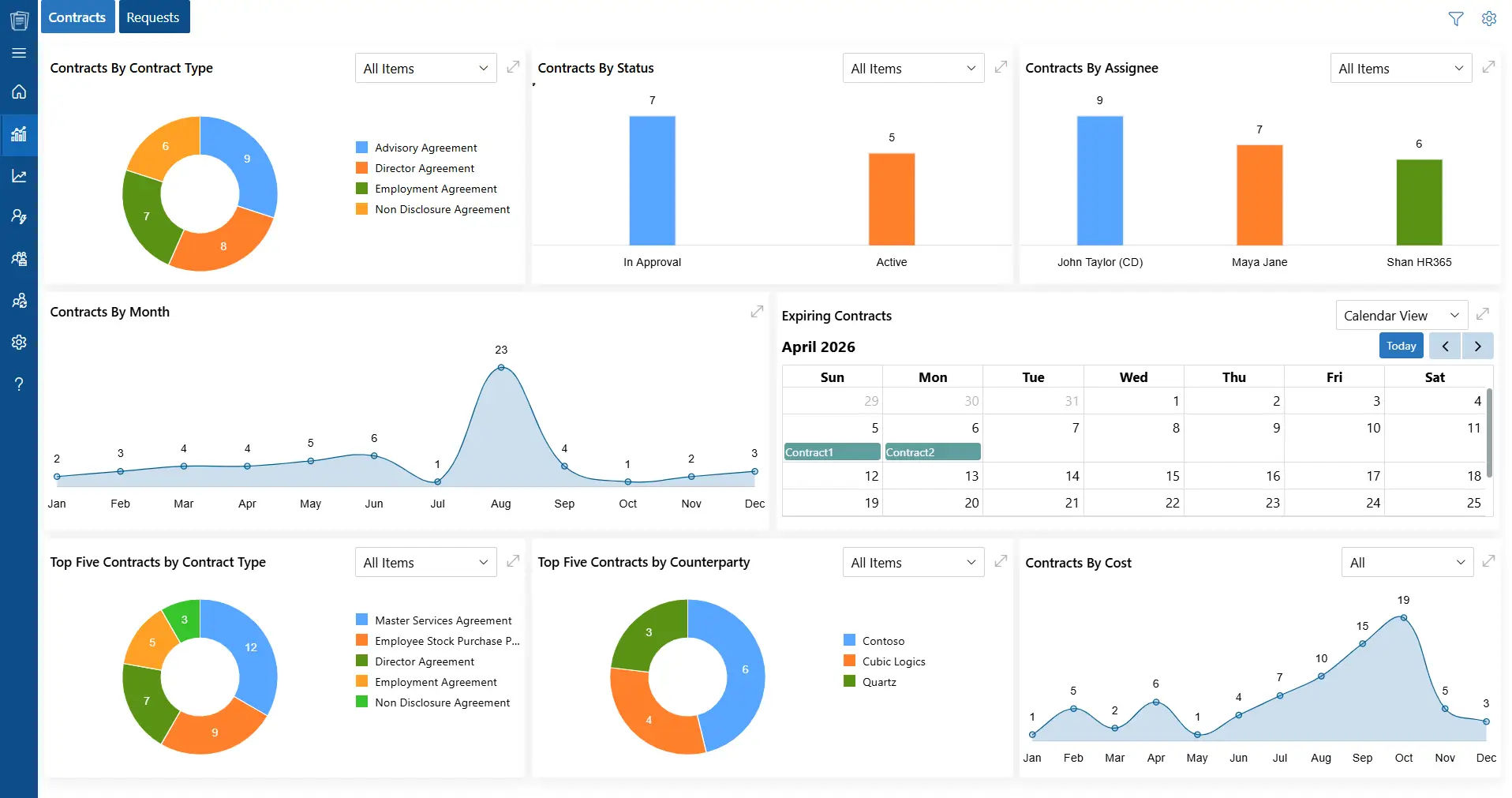
Managing a growing pile of agreements by hand becomes hard once a business starts to scale. This is where CLM 365 comes in. Built for legal, sales, and procurement teams, it helps manage the full lifecycle of a sales contract, from the first draft all the way through renewal. Here is how CLM 365 supports better contract management day to day.
- Centralized Repository – Every signed agreement is stored in one secure place, making it easy to search for and pull up documents whenever they are needed.
- AI-Powered Clause Review – CLM 365 uses AI to flag risky or unusual clauses in an agreement before it goes out for signature.
- Automated Workflows – Approval requests are sent automatically to the right people, based on deal size or the type of agreement involved.
- Renewal and Deadline Alerts – CLM 365 sends automatic reminders ahead of renewals, expirations, or payment dates, so important dates are never missed.
- Version Control – Every edit made to an agreement is tracked, so teams always know exactly what changed and who made the change.
- Reporting and Insights – CLM 365 gives leadership visibility into contract status, turnaround time, and risk exposure across the whole business.
With these features working together, CLM 365 helps legal and sales teams manage every deal with far less manual effort and a much higher level of accuracy.
Conclusion
A sales contract is one of the most important documents behind any business deal.
It protects both the buyer and the seller, sets clear terms from day one, and lowers the risk of disputes later on. But writing, reviewing, and managing these agreements by hand takes real time and carries real risk, especially as a business grows and the number of deals climbs.
If your business is ready to take contract management to the next level, book a demo with CLM 365 today and see for yourself how much time and risk you can save.
Frequently Asked Questions
How does a contract management software help manage sales contracts?
The system centralizes contracts and helps teams manage creation, approvals, negotiations, signatures, storage, tracking, and renewals from one place.
How do contract templates help sales teams?
Contract templates help sales teams create agreements faster using pre-approved terms and clauses while maintaining consistency across customer contracts.
How can sales teams track contract signing status?
The system show whether a contract is awaiting signature, partially signed, completed, or requires follow-up.
How does Microsoft 365 integration support sales contracts?
Microsoft 365 integration allows teams to manage contract information within an environment they already use, with capabilities connected to tools such as SharePoint, Teams, and Outlook.
How can sales teams monitor contracts by deal value?
Custom fields, filters, dashboards, and reports can help teams organize and analyze contracts based on contract value and other sales-related criteria.


_JiluXJRGNl.svg)























