
_mVFFaHUZhS.webp)
Employee onboarding application is an important tool in the way your new employees feel about your organization even on the first day. An automated online onboarding system allows employees to feel welcomed, confident, and productive, and decreases the workload of HR and manual follow-ups.
An employee onboarding application simplifies the onboarding process through automation of tasks, training and communication. It makes new employees feel welcome, secure, and productive on the first day and decreases the workload of the HR.
The application provides personalized guidance, progress tracking, and a consistent and engaging experience to remote, hybrid, and on-site workers with AI-driven capabilities and the integration of Microsoft Teams.
Click here to listen on the go!
This is a step-by-step tutorial on how an employee onboarding application can be used, why it is important, and how business can utilize onboarding automation to enhance retention, engagement, and long-term performance.
What Is an Employee Onboarding Application?
An employee onboarding application is a web-based platform that helps to control and automate the onboarding process of new employees. It unites documentation, training, task assignments and communication into a single structured workflow.
In contrast to manual onboarding, a modern onboarding application begins prior to the first day and proceeds through the initial few months of the employee-employer relationship- ensuring that all is clear, consistent and that the employee is given a smooth introduction into the company culture.
According to an SSRN study, structured digital onboarding improves employee clarity and early engagement. Technology-driven onboarding helps new hires integrate faster during the initial employment phase.
Key Components of an Onboarding Checklist
Creating an effective employee onboarding checklist is essential for ensuring that new employees have a smooth and organized introduction to the company. It sets the foundation for a productive work environment and helps integrate them quickly into the company culture. Here’s a detailed look at the key components of an onboarding checklist:
The Reason why Business need an Employee Onboarding Application
Reliance on spreadsheets and emails in organizations is likely to cause delays, confusion and disengaged new employees. The centralized employee onboarding application can remove these issues by providing a standardized, automated, and scalable employee onboarding process to all employees- irrespective of position or location.
Key Benefits
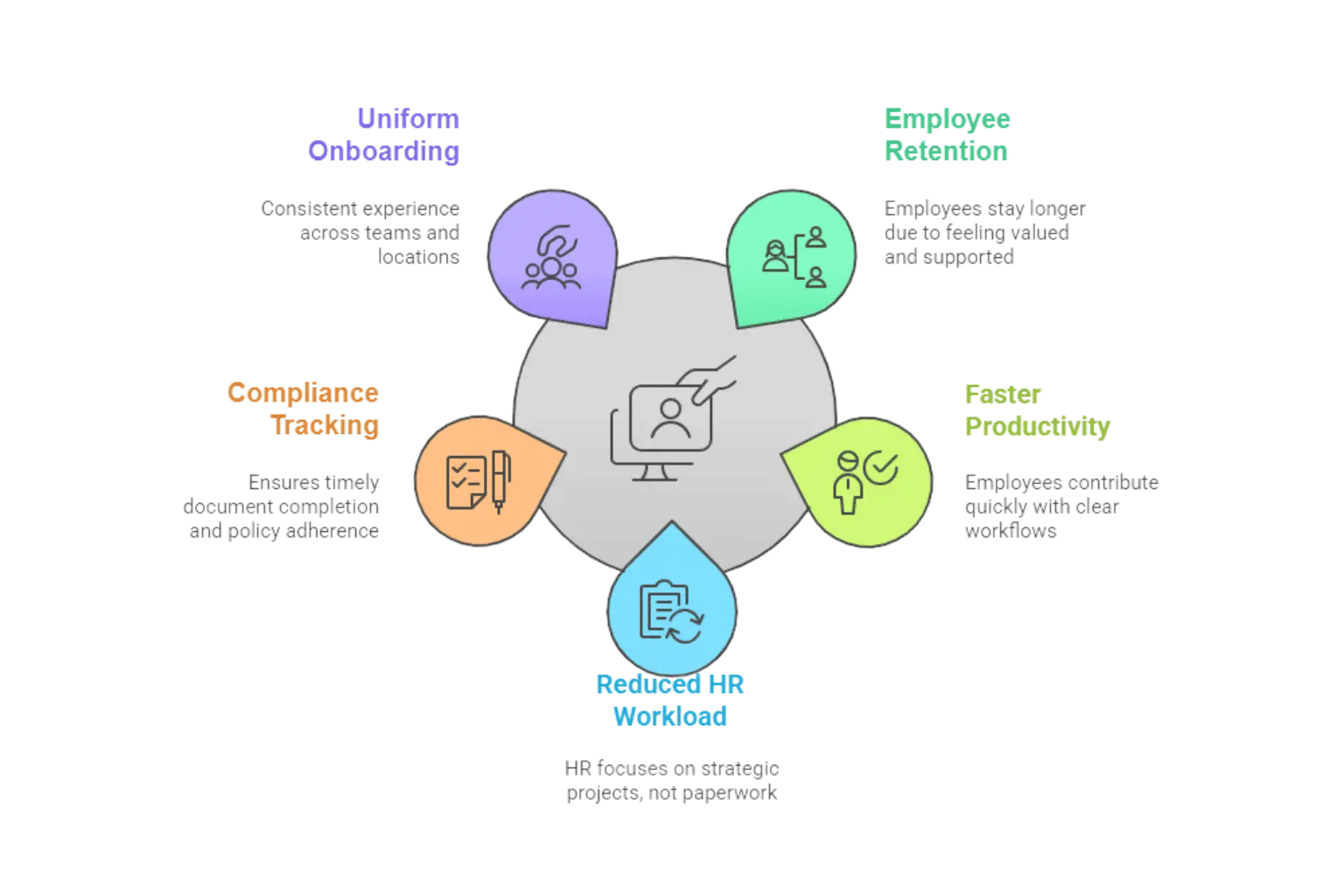
Increased Employee Retention and Satisfaction
Employees will have a higher chance of staying longer when they feel welcomed and supported since the first day. Onboarding application helps to make the process of hiring a new employee clear, structured, and guided, making new employees feel safe and appreciated.
Faster Time-to-Productivity
Employees learn the expectations within a short period due to clear onboarding workflows, role based training and task assignments. Having all the things on one platform, new employees can be able to contribute earlier without following up or being given manual instructions.
Less HR Administrative Work
Paperwork, approvals and onboarding are automated and this greatly saves repetitive HR work. HR departments will be able to work on strategic projects rather than pursue paperwork, emails, and various onboarding systems.
Improved Documentation and Tracking of Compliance
Onboarding application is used to make sure that all the required documents, policies and acknowledgements are filled in time. This minimizes compliance risks and also offers a clear audit trail of legal and regulatory requirements.
Uniform Onboarding in Teams and Locations
Unified onboarding procedures will mean that all employees have the same experience regardless of whether they are working remotely, hybrid, or in the office. This uniformity enhances the company culture and guarantees coordination among departments and geographical locations.
Step-by-Step Guide to Using an Employee Onboarding Application
Step 1: Preboarding - Interact Before Day One
Preboarding preconditions the positive experience of onboarding and minimizes the stress on the first day. An effective employee onboarding application will allow the HR department to prepare their new employees beforehand so that they feel well-informed, welcome, and ready to begin their work on the first day.
Key activities include:
Sending Welcome Emails that are Personal
Make a friendly initial impression by giving a personalized welcome message that has the start date details, reporting time, team introductions and what the new hire should expect on the first day.
Communication of Company Policies and Handbooks
Make company policies, employee handbooks and code of conduct documents available early enough to allow new employees to read through the expectations, values and workplace guidelines at their own time.
Digital Paperwork (Tax, Payroll, Contracts) Complete
The employee onboarding application can be used to store and organize the necessary documents in the digital format, eliminating the delays in paperwork and providing compliance with it prior to the official joining of the employee.
Allowing Access to Systems and Tools
Prepare email accounts, teamwork tools and necessary software before new employees join the company to enable them to begin work without technical hitches.
Allotment of Mentor or Onboarding Buddy
Assign new employees a mentor or a buddy who can help them in the initial days of the company, guide them through the company culture, and answer their questions.
Step 2: The First-Day Orientation Simplified
Connection and not confusion should be the order of the day. A properly designed employee onboarding application would make sure that all the necessary information, tools and resources are readily available so that new employees feel comfortable, confident and welcomed from the very first moment.
First-day essentials:
Introduction and Overview of Values of the Company
Present the mission, vision, and core values of the organization to make new employees know what the company is and how their work will help in achieving the overall objectives.
Introductions and Reporting Structure of Teams
Introduce employees to their colleagues, supervisors, and other important stakeholders and clarify reporting relationships, roles, and working relationships.
HR and IT Implementation Within One Platform
Make sure that access to HR portals, payroll information, communication applications, and IT systems are smooth to ensure that employees do not have to wait on technicalities.
Virtual or Office Workplace Tour
Give a physical office tour or a virtual tour of online workplaces, including how to locate resources, tools, and support resources.
Step 3: Training and Learning Paths based on Roles
The most effective training is one that is organized, pertinent and oriented to the role of the employee. Digital employee onboarding application facilitates both guided learning and self-paced learning to ensure that new employees acquire the appropriate knowledge at the appropriate time.
Training features include:
Role-Specific Onboarding Checklists
Offer job-specific checklists to make sure that employees do not leave out the most important tasks, training programs, and duties without taking the necessary steps.
Video Tutorials and Documentation
Provide simple to access learning resources like videos, guides and articles on the knowledge base that assist the employees to learn about the tools, workflows and internal processes.
Quizzes and Assessments
Short quizzes or tests should be used to support learning, confirm learning, and help to detect areas where further support or training might be necessary.
HR and Manager Tracking Progress
Enable HR departments and managers to track training completion, learning progress, and activity in real-time via a centralized dashboard.
Step 4: Task Assignment and Early Productivity
New employees ought to be slowly transitioned into practical work once training is started. The application of onboarding employees assists in the process of assigning tasks in a systematic manner, which makes the employees develop confidence without being overwhelmed.
Best practices include:
Break Things Down into Small, Manageable Pieces
Give new hires simple and manageable tasks at the very beginning to make them feel confident, learn workflows, and have quick wins.
Team Support: Collaboration Tools
Spur collaboration via collaboration tools where new staff can ask questions, update and learn with their colleagues.
Monitor Task Accomplishment and Performance
Keep track of set tasks, timeframes, and results to make sure that employees are on schedule and get proper guidance or feedback in time.
Develop an Onboarding 30-60-90 Day Plan
Establish a set of milestones (structured) to be achieved in the first three months to measure the progress, add responsibility step by step, and synchronize the expectations of the employees and the managers.
Step 5: Check-ins, Continuous Support, and Feedback
Feedback is important to effective onboarding. With a formalized employee onboarding application, it is easy to maintain communication, transparent, and consistent during the initial phases of employment.
Feedback methods include:
Planned Individual Meetings
Conduct frequent meetings between new employees and managers to talk about their progress, challenges, and give them personalized advice.
Onboarding Experience Pulse Survey
Get fast feedback by conducting brief surveys to learn how new employees are experiencing the onboarding process and what needs to be improved.
Peer and Manager Feedback
Foster the feedback of colleagues and managers to assist new workers to adapt, enhance performance, and feel encouraged.
Rewards of Early Success
Recognize achieved milestones and initial contributions to enhance motivation, confidence and general interest.
Artificial Intelligence in Employee Onboarding Software
Onboarding is being revolutionized by AI and is becoming quicker, smarter, and more personalized. An AI-based employee onboarding solution assists HR departments in providing personalized experiences and minimizing human resources.
Onboarding with AI Enables:
Automated Tasks
Onboarding is automatically allocated by AI, timely reminders are sent, and priorities are placed on activities to ensure that nothing is overlooked, and the onboarding process is smooth and well-organized for all new employees.
Smart Training
Role-specific learning recommendations are offered to new hires according to their progress, skill gaps, and job responsibilities to learn effectively and concentrate on the most important things.
HR Chatbots
The employees have access to 24/7 instant support on HR-related questions, policies, and processes, which enhances clarity, minimizes delays, and gives guidance without straining HR teams.
Predictive Insights
AI compares the engagement patterns and onboarding activity to forecast possible risks of disengagement or poor performance early so that HR can take proactive measures and enhance retention.
Remote & Hybrid Support
AI will provide a stable, personalized, interactive onboarding process to employees who work remotely or in hybrid arrangements, maintaining their connection, communication, and engagement during the first day.
Employee Onboarding Application for Remote and Hybrid Teams
Onboarding remotely needs to be clear, structured, and regularly communicated. An employee onboarding program can be hosted on the cloud, which makes new employees feel supported, engaged, and connected without necessarily having to interact with them in person.
Remote Onboarding Best Practices
Onboarding Virtual Sessions
Conduct interactive online lessons to comprehensively expose new employees to the company culture, values, policies, processes, and expectations of the position held. These sessions make employees feel completely ready, confident, and interested on the first day, eliminating first-day anxiety and increasing initial productivity.
Single-source Access to Documents and Training
Offer a centralized location where employees can conveniently access handbooks, compliance forms, onboarding checklists, training materials, and other necessary resources. This makes it easier to navigate, avoid confusion, and ensure employees can quickly locate the information they need to be successful.
Video Introductions and Team Collaboration
Promote personalized video introductions by team members and managers and allow them to collaborate through digital means. This assists new employees in establishing meaningful relationships, feeling welcomed, and learning about team dynamics early, thus enhancing communication and interaction.
Good Communication using Digital Media
Leverage chat, notifications, and updates in the onboarding platform to keep remote employees informed, engaged, and on track with team goals. Effective communication leads to trust, reduced misunderstanding, and employees feeling secure and connected throughout the onboarding process.
How Employee Onboarding 365 Works with Microsoft Teams
Employee Onboarding 365 is a robust and efficient onboarding platform that is interoperable with Microsoft 365 and fully integrated with Microsoft Teams. This allows the onboarding tasks and activities to take place easily in the environment employees are already familiar with in their day-to-day operations, making adoption and efficiency much faster and more effective.
Benefits of Employee Onboarding 365:
Automate Onboarding Processes in Microsoft Teams:
Automate workflows, approvals, reminders, and task assignments, reduce the amount of work in the HR department, eliminate manual follow-ups, and ensure that no part of the onboarding process is overlooked.
Centralized Distribution of Responsibilities, Policies and Training:
Have it all, all the tasks, policies, training modules and resources and have it in one place and this provides clarity, organization and consistency to the new employees.
Monitor Employee Progress, Tasks and Learning Modules in Real Time:
View the progress of employees, tasks and learning modules in real time enabling managers and HR teams to support, guide and provide feedback to employees in real time.
Enhance HR-Manager-New Hire Cooperation:
Enhance the communication, coordination, and alignment of HR teams, managers, and new employees, which will increase the engagement, retention, and cohesion of the team.
With this integration, the fatigue of the tools is reduced, the rate of adoption is accelerated, and a more effective, smooth and interactive experience of onboarding is realizing employees feel supported, informed and ready to contribute on the first day.
Choosing the Right Employee Onboarding Application
The selection of an onboarding system is critical to the procedure of giving a new worker a smooth, consistent, and scalable adventure. The ideal employee onboarding software should be automated, integrated, secure, and intelligent so as to streamline the process.
Key Features to Look For
Workflow Automation:
Automate the repetitive processes of onboarding, approvals and reminders to reduce the workload of the HR and remove the errors and omission of key steps in the onboarding process.
Microsoft 365 and HR System Integrations:
Microsoft Teams, Outlook, SharePoint, and current HR systems can be easily integrated to make sure that new employees can onboard, access resources, and work in the tools they already know.
Onboarding Checklists:
Role-based, flexible checklists that can be tailored to different departments, locations and compliance needs will assist all new employees in having a systematic and uniform onboarding experience.
Training and Performance Monitoring:
Track the progress of employees, their completion of learning, and their initial performance indicators to understand the areas of assistance required, provide feedback promptly and help new employees succeed.
Mobile-Friendly Access:
It should be flexible and convenient to enable employees to do onboarding, training content, and communicate with the HR at any time and any place.
Copilot AI Assistance:
AI-based support to suggest the relevant training modules, automatically assign tasks, and provide assistance in real-time to allow new employees to follow up with the onboarding process and stay engaged throughout it.
State-of-the-art Security and Compliance:
Protect employee data through advanced logins, role-based access, and encrypted storage and ensure that it is not violating privacy laws and the company policy.
The appropriate employee onboarding software does not just simplify the HR procedures but also improves engagement, increases productivity and allows scaling success of employees in the long-term as your organization grows.
Conclusion
Employee onboarding software simplifies the process of onboarding, enhances interaction, and increases productivity at the first working day. Through automation of workflows, monitoring of progress, and a smooth experience, new hires are confident and connected on the first day.
Schedule a demo and learn how a digital onboarding solution can revolutionize your onboarding process.
Join Our Creative Community
Frequently Asked Questions
Which is the most effective Employee Onboarding Application to HR?
HR onboarding application assists in facilitating the hiring, assignment of tasks, training, and documentation. It makes new employees feel accommodated, structured, and efficient on the first day.
What is the effect of Employee Onboarding Software in enhancing retention?
Onboarding software is an automated workflow, training module, and progress tracker that assists HR teams in delivering a cohesive, engaging, and structured onboarding experience to enhance retention.
Does it have Free Employee Onboarding Software?
Yes! There are platforms that provide free onboarding software to employees or trial versions where the HR teams can test functionalities such as automation of tasks, document management and training modules before committing.
Is it possible to have a trial of Employee Onboarding 365?
Absolutely! Employee Onboarding 365 offers a 14 days free trial, allowing the HR teams to explore its features, Microsoft Teams integration, and AI-based onboarding and then subscribe to a plan.
Where do I get an Onboarding Application Template of Employees?
Templates of employee onboarding applications allow you to develop organized checklists, training programs, and assignments of tasks in a short period of time. The templates of various roles and departments are also customizable in many employee onboarding solutions.


_JiluXJRGNl.svg)























