

Subscription Management Platform: Everything You Need to Know

- Subscription economy hit $492B in 2024, heading past $1.5T by 2033. Manual billing collapses before growth stage.
- Expired cards and failed payments silently drain revenue. Automated dunning retries and recovers it no manual effort needed.
- 10 customers is manageable; 10,000 is not. Tiers, proration, and multi-currency multiply fast only a platform keeps up.
- Siloed data means late, unreliable reports. A unified platform gives every team live MRR, ARR, churn, and CLV instantly.
As per a study by Grandview Research, the global subscription economy reached $492.34 billion in 2024 and is projected to exceed $1.5 trillion by 2033.
That kind of growth signals one thing: businesses need the right infrastructure to manage subscription operations effectively. That is exactly where a subscription management platform comes in.
What Is a Subscription Management Platform?
A subscription management platform is a software platform that manages all the recurring billing and customer lifecycle management. It automates the operational component of running a subscription business model from onboarding customers, issuing invoices, collecting payments, plan changes, and revenue tracking.
How Does a Subscription Management Platform Work?
A subscription management system is at the heart of your billing system. The following is a basic description of the way it usually functions:
1. Customer Onboarding and Plan Setup
Once a new customer registers, the platform records their information, allocates them to a payment plan and switches on their subscription. This will be automatically done on your site or app.
2. Billing Cycle Management
The platform plans and initiates billing depending on the plan of each customer, whether weekly, monthly, annually, or individually. It works out the right price, charges any discounts, taxes or add-ons and creates an invoice automatically.
3. Payment Collection
Invoices are forwarded to the payment gateway. When a payment is unsuccessful, the platform triggers retry logic -the charge is attempted again after some time and the customer is notified when necessary.
4. Subscription Changes and Lifecycle Events
Plans are upgraded, downgraded, paused or cancelled by customers. These changes are processed in real time by the subscription management platform, and any prorated amounts are calculated and billing is updated.
5. Reporting and Revenue Tracking
Every data in transactions is directed to reporting dashboards where you can monitor MRR (Monthly Recurring Revenue), churn rate, customer lifetime value and other important metrics that are of interest to subscription businesses.
Importance of Subscription Management Platforms
The subscription businesses are based on the recurrent transactions, and the operational overhead may increase rapidly. This is why a specific subscription management system is worth the investment.
1. Accurate Revenue Recognition
The subscription revenue is not recognized as one-time sales. The revenue to be earned during a billing period should be allocated appropriately in accounting periods. This is easily complicated without the proper tools, and this is particularly true when your customer base is expanding. A subscription management platform is an automatic revenue recognition system that ensures your financials are correct and auditable.
2. Customer Retention
It is very expensive to attract a new customer compared to retaining an existing customer. The subscription management platforms provide you with insight into renewal dates, payment failures, and churn signals to allow your team to act promptly. Average subscription customers generate 3-5x more revenue over their lifetime compared to transactional buyers. That kind of long-term value can only be captured when you actively manage the customer relationship.
3. Increase in Billing Complexity
With ten customers, it is possible to handle the billing manually. It is not when you have ten thousand. Various levels of prices, currencies, tax regulations, and terms of contracts multiply rapidly. The complexity is managed in a subscription management platform, which does not need a correspondingly larger team.
4. Real-Time Visibility
The subscription businesses require real-time data to make decisions. You require good numbers whether you are planning on expansion, SaaS revenue forecasting or the performance of a new pricing model. A subscription management platform provides finance, sales, and leadership teams with a common perspective of revenue information – without having to wait until the end of the month.
5. Payment Recovery
Involuntary churn customers who leave not because they want to, but because a payment failed is one of the most overlooked revenue leaks in subscription businesses. A subscription management platform automates dunning workflows, retries failed payments intelligently, and sends recovery notifications, helping you retain revenue that would otherwise be lost silently.
Types of Subscription Businesses
The subscription models have become common in almost all industries. There are seven large categories of subscription businesses that exist today.
1. SaaS (Software as a Service)
SaaS vendors provide subscriptions to cloud software to their clients at a regular fee, typically monthly or annually. For example, project management tools, CRM platforms, accounting software, and communication tools. One of the most popular and the most rapidly expanding types of subscriptions is SaaS.
2. Media and Content Streaming
Platforms that deliver digital content video, audio, news, or OTT services on a subscription basis
Revenue comes from continuous access rather than one-time purchases. This model depends heavily on content volume, quality, and consistent delivery.
3. E-Commerce Subscription Boxes
Ecommerce subscription business are booming, As per a study, The subscription e-commerce segment specifically will expand at a 9.36% CAGR from 2025 to 2034. Physical goods that are selected and delivered to the customer on a regular basis. Categories include food, beauty, wellness, fitness, and niche hobbies. The retention is based on the quality of curation and the perceived value of the individual delivery.
4. B2B Services and Retainers
Agency, consultants, managed service providers (professional service firms) provide continuous service packages based on a fixed monthly fee. This model generates a predictable revenue to the provider and a steady support to the client.
5. Usage-Based or Metered Services
Customers are charged according to the number of calls they make to the API, the amount of data they use, data storage, or transactions. The model is prevalent in infrastructure, telecom and developer tools. It is cost efficient and therefore appealing to both the early-stage and enterprise customers.
6. Healthcare and Wellness Subscriptions
Recurring services for monitoring healthcare revenue operations, telemedicine, fitness programs, mental health support, or prescription refills. This sector has expanded significantly as consumers look for ongoing, accessible health support rather than single episodic care.
Challenges in Managing Business Subscriptions
Operating a subscription business is truly complex. Knowing these challenges will enable you to solve them and leverage systems that can handle them with ease.
1. Managing Pricing Flexibility Without Breaking Billing
Subscriptions businesses frequently desire to experiment with pricing – adding new levels, experimenting with usage limits, promoting. The problem is that the change in prices may have a cascading impact on subscription billing, renewals, and contracts. To do this correctly, it needs to be properly configured and have a billing system that can support various pricing models without producing errors in customer invoices.
2. Keeping Up With Tax and Compliance Requirements
The taxation of digital services and subscriptions in various countries and regions is quite different. The larger your customer base is spread around the world, the harder it is to remain in line with VAT, GST and other local tax laws. Companies that do it manually usually end up being vulnerable to compliance risks as they grow.
3. Handling Subscription Changes Accurately
The billing system must be able to compute prorated charges accurately and indicate them in real time when customers upgrade in the middle of the subscription lifecycle. In the case of businesses that have a large customer base, any minor errors in proration can multiply into large billing errors.
4. Reducing Involuntary Churn from Payment Failures
A significant percentage of subscription cancelations is not deliberate but occurs due to a credit card expiring or a payment being declined. Although this is a typical problem, it is also a more solvable problem. A large portion of these payments can be made by automating retry logic and proactively communicating with customers for subscription renewal.
5. Generating Reliable Financial Reporting
Subscriptions businesses require proper MRR, ARR, churn, and cohort reports to present to management and investors. When billing information is stored in separate systems, or manually managed, generating dependable reports is time-consuming and risky. One of the challenges facing growing businesses is to build a single source of truth of subscription data.
Manual vs automated subscription management
A side-by-side breakdown of how each approach handles the core demands of a recurring revenue business
Dimension | Manual management | Automated platformRecommended |
Billing & invoicing | Created manually per customer; high risk of errors and delays across multiple plans | Fully automated billing cycles monthly, quarterly, annual with prorated adjustments in real time |
Scalability | Manageable for ~10 customers; breaks down rapidly at scale without additional headcount | Scales to thousands of subscribers without adding staff; handles volume and plan complexity automatically |
Failed payment recovery | Relies on manual follow-up; involuntary churn often goes undetected until revenue is already lost | Smart dunning workflows auto-retry failed payments, send reminders, and recover revenue silently |
Tax & compliance | Manually tracked per region; grows increasingly error-prone as the customer base spans multiple countries | Tax rules applied dynamically by geography, product type, and customer — VAT, GST, and local regulations handled automatically |
Revenue recognition | Prone to misallocation across accounting periods; especially error-prone as subscriber volume grows | Revenue allocated correctly across periods with auditable records; financials are accurate and audit-ready |
Reporting & analytics | End-of-month reports compiled from disparate sources; unreliable and slow to produce | Real-time dashboards for MRR, ARR, churn, CLV, and NRR accessible to finance, sales, and leadership simultaneously |
Multi-currency support | Manual conversion and tracking per customer; difficult to maintain accuracy across rate changes | Invoices issued in local currencies with automatic exchange rate handling; simplifies global operations |
Plan changes & proration | Upgrades and downgrades require manual recalculation; errors in proration damage customer trust | Mid-cycle upgrades, downgrades, pauses, and cancellations processed in real time with accurate prorated charges |
Operational cost | Low upfront cost, but headcount grows proportionally with subscriber volume — expensive at scale | Platform investment up front; marginal cost per new subscriber near zero — operational efficiency improves at scale |
Best suited for | Early-stage businesses with fewer than ~50 subscribers and simple, single-plan billing | Any business operating at growth stage or beyond, with multiple plans, global customers, or usage-based billing |
Core Features of a Subscription Management Platform
The right subscription management platform covers the full lifecycle of a subscription — from the first charge to the final renewal. Here are the core features to look for:
1. Automated Billing and Renewals
A good subscription management system must be able to fully automate the subscription billing system to create invoices and initiate payments and renewals without any problems. This removes the use of manual errors and wastes time in the hands of finance teams. It must also accommodate a variety of billing cycles (monthly, quarterly, annual) and be able to accommodate upgrades or downgrades in the middle of the subscription lifecycle.
2. Integration With Existing Systems
An effective revenue management software can be easily integrated with your current business applications like SharePoint, MS Teams, Outlook, Power BI and Power Automate apps. These integrations will guarantee a seamless flow of data between departments, eliminate duplication, and assist teams. The helps them to operate with precise and up-to-date information without having to switch between different systems.
3. Multiple Currency Invoices
A subscription management platform must be able to invoice in multiple currencies, in case of businesses functioning on an international level. It must enable you to charge clients using their local currencies and automatically exchange rate and conversions. This enhances customer confidence as well as making financial reporting of international operations easier.
4. Manage Custom Bundles and Add-Ons
Customers often want more than a standard plan. A reliable subscription management platform allows companies to develop their own packages, add-ons, and customized pricing packages. They can be readily attributed to individual customers or provided as upsell opportunities, which can contribute to raising revenue and providing individual solutions.
5. Custom Invoice
There should be brand consistency and clarity in billing. An excellent subscription management system will enable users to completely customize invoice templates. Your client logo, branding, line items, and any other custom fields that your customers may need. This will make it professional and enhance communication with clients.
6. Proforma Invoice
In most B2B transactions, customers would need a proforma invoice prior to concluding payments. Proforma invoices should be automatically created on the platform as a pre-billing process. This assists in accelerating approvals, lessening back and forth communication as well as making the transaction process smoother.
7. Flexible Tax Management
Handling of taxes may be complicated, particularly when a business is operating in more than one region. It must have a platform that allows flexible tax settings depending on geography, product types, and customer categories. It must be able to automatically implement the appropriate tax regulations, which means that it will be complying and will minimise the need of manual intervention.
8. Reporting and Analytics
The subscription management platform must offer real-time access to important subscription metrics. This includes MRR, ARR, churn rate, customer lifetime value, and net revenue retention. The teams can make data-driven decisions using built-in analytics dashboards without using external tools and manual reporting.
How Subscription Management Platforms Help Businesses
Investing in a dedicated subscription management platform delivers tangible advantages across operations, revenue, and customer experience. Here are seven key ways it adds value:
1. Speeds Up Revenue Collection
Automated invoicing and payment processing ensure customers are billed on time, every time. There is no delay between the billing trigger and invoice delivery, reducing the time it takes for payments to be completed. Digital billing directly improves cash flow, allowing businesses to reinvest in growth and operations without waiting on delayed payments.
2. Reduces Revenue Leakage
Manual billing processes often result in missed invoices, incorrect pricing, or unpaid balances. A subscription management platform minimizes these risks by automating the entire billing workflow from pricing rules to payment collection. This ensures every charge is captured accurately, reducing financial losses and improving overall revenue consistency.
3. Supports Business Growth
As your subscriber base grows, billing operations become more complex with different plans, upgrades, downgrades, and usage-based charges. A subscription management platform scales alongside your business, handling increased transaction volume and complexity without requiring additional staff. According to Staxbill, 53% of top finance executives indicate that 40% or higher of their revenues are recurring. Businesses at this level of recurring revenue need infrastructure that can manage it reliably without constant human intervention.
4. Improves Customer Experience
Billing is a key process in the customer journey. Accurate invoices, timely renewals, flexible plan changes, and clear communication all contribute to a better experience. A subscription management platform ensures consistency across these interactions, helping build trust and long-term customer relationships.
5. Enhances Financial Accuracy and Compliance
Managing revenue recognition, tax calculations, and financial reporting manually can be complex and error-prone. A subscription management platform automates these processes, ensuring compliance with accounting standards and tax regulations. It also provides clear audit trails, making it easier to prepare for audits and financial reviews.
6. Gives Teams Better Data for Decision-Making
When all subscription data is centralized, businesses gain access to real-time insights. Teams can analyze key metrics such as churn rate, customer lifetime value, and revenue trends. A subscription management platform empowers finance, sales, and product teams to make data-driven decisions, identify growth opportunities, and optimize pricing strategies.
7. Reduces Involuntary Churn Through Smart Recovery
Failed payments are a common cause of sudden churn. With built-in dunning management, the platform automatically retries failed transactions, sends timely reminders, and escalates issues when needed. This proactive approach helps recover lost payments, retain customers, and protect recurring revenue without manual follow-up.
Best Practices to Manage Business Subscriptions
Having the right subscription management platform is important, but how you operate within it matters just as much. Here are eight practices that subscription businesses benefit from:
- Define your pricing model clearly before building billing logic. Whether you use flat-rate, tiered, usage-based, or per-seat pricing, your billing system should reflect the model exactly — not approximate it.
- Set up automated dunning from day one. Do not wait until failed payments become a visible problem. Configure retry schedules and customer notifications early so recovery becomes a standard part of your billing workflow.
- Keep customer billing data up to date. Expired cards and outdated billing information are the leading causes of payment failures. Prompt customers to update payment details before issues occur, not after.
- Use proration to handle mid-cycle changes fairly. When customers upgrade or downgrade, calculate the correct prorated charge automatically. Overcharging or undercharging damages trust and creates billing disputes.
- Track subscription metrics weekly, not just monthly. MRR movements, churn signals, and renewal rates can change quickly. Frequent monitoring lets your team respond earlier and with more context.
- Segment your reporting by cohort and plan type. Aggregate metrics hide important differences. A cohort of annual subscribers behaves very differently from a cohort on monthly plans. Segmented data leads to better decisions.
- Build a process for handling cancellation requests. Not every cancellation is final. A well-designed cancellation flow with options to pause, downgrade, or delay can recover a meaningful percentage of customers who would otherwise churn.
- Review and audit your billing configuration regularly. As your pricing evolves, discrepancies can develop between your intended pricing model and the actual billing rules in your system. Periodic audits catch these issues before they affect customers.
Why Choose Revenue 365 for Managing Subscription?
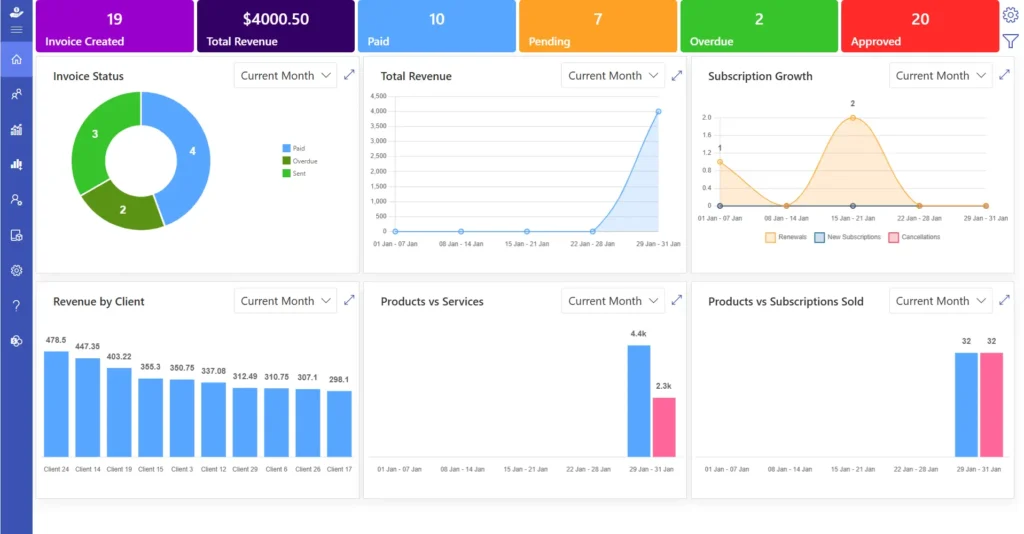
Revenue 365 is designed with subscription companies in mind that require a billing system that can be scaled as they expand. It manages the entire subscription cycle – plan creation and automated billing, dunning, multi-currency, and revenue reporting.
It is built within the Microsoft ecosystem and integrates seamlessly with tools such as SharePoint, Microsoft Teams, Outlook, Power BI, and Power Automate, ensuring smooth collaboration.
The platform is designed for B2B SaaS companies, service businesses, and any organization operating on a recurring revenue model. It integrates with the tools your team already uses, so you are not rebuilding your stack you are adding a strong billing layer on top of it.
How to Deploy Revenue 365
- Navigate to the App Catalog page using the following URL format:
Replace yourtenantname.sharepoint.com with your actual tenant name (for example, cubiclogics.sharepoint.com). - Once the page loads, switch to the Classic Experience.
- Click on Apps for SharePoint as shown on the page. This will open the Apps for SharePoint library.
- Click on Upload and select the application package file from your system.
- After the file is uploaded, select the checkbox next to the uploaded package and click Deploy.
- Open the site collection where you want to install the application.
- Locate and click on the Revenue App. At the top, you will find the File module.
- Navigate to the Deploy option and click on it. A pop-up window will appear.
- Ensure the required checkbox is selected in the pop-up.
- Click Deploy to complete the installation of the package.
Conclusion
The subscription economy is not slowing down. As more businesses move toward recurring revenue models, the operational demands of managing subscriptions billing, renewals, pricing changes, tax, reporting, and retention grow with them.
A subscription management platform gives businesses the infrastructure to handle that complexity on a scale.
If you are ready to build a billing infrastructure that grows with your business, Revenue 365 is worth exploring. Start your 14-day free trial now.
Join Our Creative Community
Frequently Asked Questions
Does it handle usage-based billing with tiered pricing?
Yes it tracks usage in real time and applies predefined pricing tiers automatically at invoice generation, eliminating manual calculations.
Can one customer have multiple subscriptions on the same account?
Yes all subscriptions are consolidated under a single customer profile while maintaining separate billing schedules and invoices for each.
Can I invoice the same customer in multiple currencies?
Yes different subscriptions under one account can be billed in different currencies, with exchange rates handled automatically.
How does tax work for customers across different countries?
Tax rules are applied dynamically based on customer location and product type VAT, GST, and local regulations are calculated and included automatically.
Is there an approval workflow before invoices go out?
Yes invoices can be routed through predefined internal approval workflows before being sent, ensuring accuracy and compliance.


_JiluXJRGNl.svg)























