

Contracts are the foundation of every business relationship vendor agreements, NDAs, service contracts, employment terms. But let’s be real: most people find them painful to deal
According to recent research, almost 90% of business users find contracts difficult or impossible to understand. And it’s not just about reading the fine print. Someone must catch the risky language buried in clause.
Someone must compare what legal approved against what the other side sent over. Someone must flag the missing indemnity cap before it becomes a very expensive problem.
That’s where AI clause analysis comes in and it’s changing how legal and procurement teams work with contracts day to day.
- AI clause analysis automatically reviews contract clauses to identify risks, inconsistencies, and non-standard language in minutes.
- It helps legal and procurement teams accelerate contract reviews, reduce manual effort.
- By comparing clauses against approved templates and playbooks, AI improves compliance and reduces the risk of unfavorable contract terms.
- Organizations using AI clause analysis can make faster, more informed contracting decisions while increasing accuracy.
What Is AI Clause Analysis?
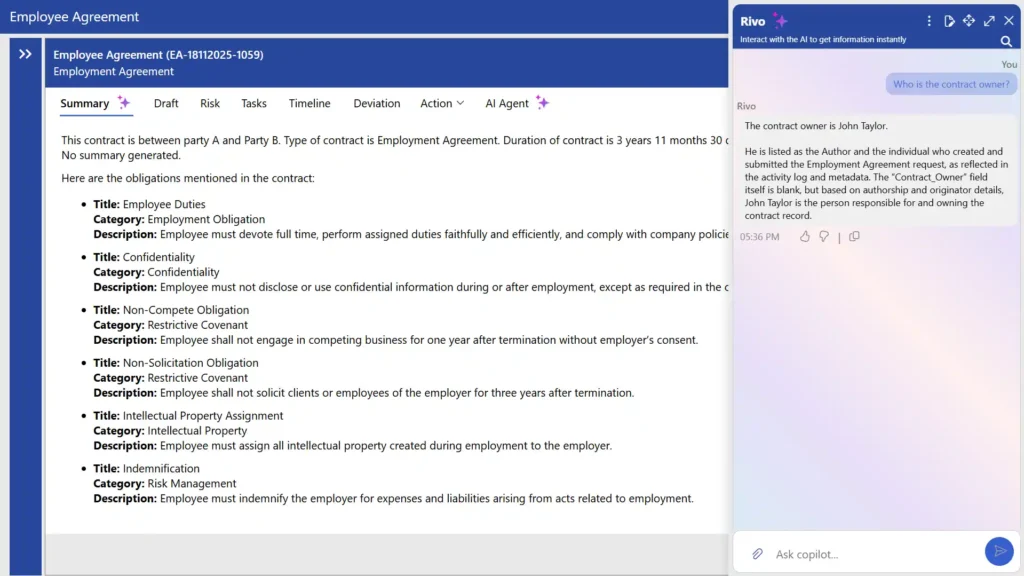
AI clause analysis is the use of artificial intelligence specifically natural language processing to read, understand, and evaluate individual clauses within a contract.
Think of it as having a trained legal reader who never gets tired, never skips a section, and never misses an unusual phrase. The AI reads through every clause, compares it to what it knows about standard or approved language, flags potential risks, and surfaces what matters fast.
To understand where AI clause analysis fits in the bigger picture, it helps to first know what contract analysis actually involves. Clause-level review is just one part of a broader process that includes extracting data, summarizing obligations, and tracking risk across your entire contract portfolio.
How AI Helps Analyse Complex Contract Clauses
Contracts aren’t written in plain English. They’re written in legal terminologies which, as anyone who’s tried to read an indemnification clause knows, is practically a different language.
A typical enterprise contract might run 40 to 60 pages. It might reference other agreements, use defined terms established twenty pages earlier. Manual review of this kind of document takes time significant time. Research shows AI can cut a 92-minute review down to just 26 seconds.
Here’s how AI handles this in practice:
Reading in context: AI doesn’t just scan for keywords. It reads clauses in relation to the rest of the document understanding that “the effective date”.
Parsing legal structure: Trained on thousands of contracts across industries, The agentic AI learn how legal clauses are typically constructed and can recognize when something deviates from the norm.
Pulling out what matters: Instead of making a lawyer scroll through the whole document, AI surfaces takes care of contract review process, and reads termination rights, payment terms, governing law, limitation of liability, IP ownership, and more.
The Role of AI in Identifying Risky Clauses
This is where AI clause analysis delivers its biggest value. Not just reading but highlighting risks.
Some of the riskiest language in contracts is also the most subtle. A missing “mutual” before an indemnification clause. An auto-renewal provision buried in the service schedule.
Common risks that AI clause analysis is trained to flag include:
- Unlimited liability exposure — clauses with no cap on damages
- Unilateral amendment rights — language that lets the other party change terms without consent
- Broad IP assignment clauses — provisions that may transfer ownership of work product
- Non-standard termination rights — unusual conditions for ending the agreement
- Evergreen renewal clauses — contracts that auto-renew without sufficient notice periods
By 2027, 50% of organizations will use AI-enabled contract risk analysis tools for supplier negotiations, according to Gartner. The direction is clear. The question is just how far along your team is.
Understanding contractual obligations in detail is the first step then AI clause analysis helps make sure those obligations are captured correctly in every agreement.
Your next contract review could save hours of manual work
CLM 365 summarizes contracts, highlights risks and obligations and helps teams review agreements more efficiently within a secure platform.
How AI Maintains Accuracy During Clause Analysis
One of the most common concerns people raise: “How do I know the AI is actually right?”. It’s a fair question. AI clause analysis tools maintain accuracy through a few key mechanisms
Training on large and domain-specific datasets
Legal AI models are trained on hundreds of thousands of contracts not generic text. This domain-specific training means the model understands the difference between a “force majeure” clause and a “material adverse change” clause.
Continuous learning: When legal teams accept or override AI suggestions, the model learns from those decisions over time.
Structured review workflows: AI clause analysis doesn’t operate in isolation. It feeds into review workflows where humans make final calls especially on anything flagged as high risk.
This is also why AI contract analysis tools are built with legal teams, not around them. The goal is augmentation, not replacement.
How AI Compares Clauses Against Approved Contract Language
One of the most practical uses of AI clause analysis is clause comparison checking what came in from the other side against your organization’s approved or preferred language.
Most legal teams maintain a clause library, a set of pre-approved, legally vetted versions of standard clauses. When a third-party contract comes in with its own language, someone has to compare the two clause by clause.
Without AI, that’s a manual work. With AI, the comparison is instant. The system highlights where the incoming language deviates from your standard, explains what the difference means in practical terms, and suggests which version of your approved language to substitute.
This is particularly valuable in:
- High-volume contract environments: Procurement teams processing hundreds of vendor agreements
- Regulated industries: Where specific clause language is required for compliance
- Negotiation workflows: Where you need to move fast without compromising on key terms
Done well, this kind of AI contract analysis turns a multi-day review into a same-day turnaround.
Data Security and Confidentiality in AI Clause Analysis
This is a non-negotiable question and for good reason. Contracts contain sensitive commercial information, personal data, financial terms, and strategic details that organizations can’t afford to expose.
CLM 365 helps organizations use AI-powered contract analysis while keeping contract data within their existing Microsoft 365 environment. Instead of transferring information to separate systems, contracts remain within your organization’s Microsoft tenant, giving you greater control over your data.
Since CLM 365 is built to work within Microsoft 365, organizations can continue using their existing access controls, security policies, compliance settings, and governance frameworks. This allows teams to review and analyse contracts while maintaining the security standards already in place.
Whether you’re analysing clauses, reviewing contract terms, generating summaries, or tracking obligations, CLM 365 helps teams gain valuable insights from contracts while keeping data within a familiar and trusted environment.
Where Contract Intelligence Meets Enterprise Security
What Contract Reviews Still Require Human Expertise?
AI clause analysis is powerful but it’s not the whole answer. Some decisions genuinely require human judgment.
Strategic negotiation
AI can flag that a clause is non-standard. Deciding whether to push back, accept with a carve-out, or walk away from the deal entirely that’s a judgment call that depends on relationship context, business priorities, and risk tolerance that no AI can fully weigh.
Novel legal questions
When a clause raises a question that hasn’t been resolved, or when a new regulatory framework creates uncertainty, experienced legal counsel is essential.
Ethical and reputational considerations
Sometimes a clause is legally fine but commercially problematic. AI doesn’t have the business context to make those calls.
Final sign-off
For significant agreements, a qualified person still needs to own the decision. AI is an input to that decision not a substitute for it.
Understanding the Cost of AI-Powered Clause Analysis
Pricing for AI clause analysis tools varies widely from usage-based models to per-seat licenses to enterprise contracts.
1. Faster Contract Reviews
One of the most significant advantages of AI clause analysis is the ability to reduce the time spent reviewing contracts.
Instead of reading lengthy agreements line by line, AI can quickly scan contracts and surface important clauses for review.
Teams can immediately focus on key terms such as termination rights, indemnification provisions, payment obligations, and renewal conditions.
2. Improved Identification of Contract Risks
Contracts often contain clauses that expose organizations to financial, operational, or legal risks.
AI clause analysis helps organizations detect potentially risky clauses by highlighting unusual language and deviations from approved contract language.
By bringing these issues to attention early, organizations can address concerns before agreements are signed and reduce the likelihood.
3. Greater Consistency Across Contract Reviews
Different reviewers may interpret contract language differently, leading to inconsistent review outcomes.
AI helps create a more standardized review process by applying the same analysis criteria across all agreements.
Whether reviewing supplier contracts, customer agreements, service contracts, or employment agreements, teams can evaluate clauses using consistent standards.
4. Better Visibility
Finding important information within a lengthy contract can often take considerable time.
AI helps teams quickly locate and understand key clauses, obligations, deadlines, payment terms, renewal dates, and compliance requirements.
Rather than searching through dozens of pages manually, users can gain immediate contract visibility.
5. Increased Productivity for Legal Teams
Legal teams frequently spend a large portion of their time performing repetitive contract review tasks.
By automating clause identification and analysis, AI reduces the amount of manual effort required during the review process.
As a result, legal professionals can focus on higher-value activities such as contract negotiations and stakeholder collaboration.
6. Efficient Analysis of Large Contract Volumes
Organizations managing large contract portfolios often struggle to review agreements consistently and efficiently.
Reviewing hundreds or thousands of contracts manually can require significant time and resources.
This helps organizations uncover valuable insights that might otherwise remain hidden within their contract portfolio.
7. Faster Business Decisions
Contract delays can impact revenue, vendor onboarding, procurement processes, and overall business operations.
Stakeholders can review key information faster, resolve issues earlier, and move agreements through approval processes more efficiently.
The result is quicker contract execution, faster decision-making, and a more streamlined contract management process.
Also worth considering: the cost of not investing. According to the World Commerce and Contracting Association, in 40% of organizations, it’s unclear who is even responsible for which contract. That kind of operational confusion has real financial consequences.
AI-powered contract management doesn’t just save time it creates accountability and visibility across the entire contract lifecycle.
Beyond Clause Analysis: Other AI Capabilities in CLM 365
AI clause analysis is one piece of a broader set of capabilities that modern contract lifecycle management platforms offer.
AI Contract Summarization
Automatically generate plain-language summaries of complex agreements so stakeholders can understand what they’ve signed without reading every page. Learn more about how AI contract summaries work.
Highlights Risky Terms
AI can identify clauses that may introduce legal, financial, or compliance risks. By surfacing potentially problematic language, teams can focus their attention on areas that require closer review before a contract is approved.
Contract Data Extraction
Pull structured data dates, parties, values, obligations from unstructured contract text at scale. Useful for building contract registers and triggering renewals. See how contract data extraction works in practice.
Contract Abstraction
Abstracts long agreements into key terms and metadata for faster access and reporting. Explore what contract abstraction involves and when it’s most useful.
Obligation Tracking
AI can monitor ongoing obligations across your contract portfolio payment milestones, reporting requirements, renewal windows and alert teams before something falls through the cracks.
Identifies Missing Clauses
AI can help detect when key clauses are absent from an agreement, allowing reviewers to address potential gaps before contracts are finalized.
Recommends Industry-Relevant Clauses
AI can suggest clauses commonly used for specific industries, contract types, or business scenarios. Whether reviewing vendor agreements, service contracts, or customer contracts, teams can ensure important terms are not overlooked.
Contract Terms Analysis
Understand the standard vs. non-standard terms across your portfolio. Get a clearer picture of what contract terms you’re consistently accepting and where you can push back.
Together, these capabilities form a complete picture of what contract summary software can do for teams managing agreements at scale.
Why Organizations Choose CLM 365 for AI Clause Analysis
CLM 365 combines AI-powered contract intelligence with the tools organizations already use every day. Built natively within the Microsoft ecosystem, it integrates with SharePoint, Microsoft Teams, Outlook, Microsoft Copilot, Power BI, and Power Automate
More than just contract analysis, CLM 365 leverages Agentic AI capabilities to assist with contract reviews, identify potential risks, recommend clause improvements, and support decision-making throughout the contract lifecycle.
Security remains a core part of the platform. CLM 365 follows a Zero Trust Security Model and keeps contract data within your organization’s Microsoft environment, providing greater visibility and control over sensitive information.
Teams can continue using their existing permissions, governance policies, and compliance controls without introducing additional complexity.
The platform is backed by enterprise-grade security standards, including SOC 2 compliance, Microsoft Certification, and Microsoft Solutions Partner status.
Whether you’re a growing business looking to impro onments, making it suitable for government agencies and organizations operating in highly regulated industries. ve contract processes or an enterprise managing large contract portfolios, CLM 365 provides a secure, scalable, and AI-driven solution designed to simplify contract management while keeping data within a trusted environment.
83% of companies say AI is now a top priority in their business plans. CLM 365 is how forward-thinking teams make that priority real in their contract operations.
Conclusion
Contracts shouldn’t be a black box. And with AI clause analysis, they don’t have to be.
The technology exists today to read contracts faster, catch risks earlier, and give your team the confidence to move deals forward without wondering what you missed on page 37. Whether you’re processing ten contracts a month or ten thousand, the right AI tools change what’s possible.
Ready to see what AI clause analysis looks like in your contract workflow?
Start your 14-day free trial with CLM 365, no credit card details required. Upload your contracts, see how the AI flags clauses, and decide for yourself if it changes how your team works.
Frequently Asked Questions
How accurate is AI clause analysis?
For standard clause types, accuracy rates are high typically 85–95% depending on the contract type. Most enterprise tools include confidence scoring, so lower-confidence results get flagged for human review.
Can AI clause analysis replace lawyers?
No. AI handles the time-consuming, repeatable parts of contract review. Strategic decisions, negotiations, and novel legal questions still require experienced legal judgment. AI is a tool that makes legal teams more effective not a substitute for them.
Is AI clause analysis secure for sensitive contracts?
Enterprise tools are built with security as a core requirement encryption, role-based access, audit logs, and data isolation. Always verify a vendor’s specific data handling policies before signing up.
What types of clauses can AI analyze?
AI performs best on standard clause types: indemnification, limitation of liability, confidentiality, governing law, termination, payment terms, and IP ownership. Highly bespoke or technical clauses may require more human involvement.
How does AI compare clauses to approved language?
Most enterprise tools include a clause library feature. Your approved language is stored in the system, and incoming contracts are compared against it with deviations highlighted and alternative language suggested.
Table of Contents

Trusted by the Best

_JiluXJRGNl.svg)























