

AI contract data extraction transforms complex, unstructured contract documents into clear, usable insights that support faster decision-making and better control over agreements.
Instead of manually reviewing lengthy contracts, organizations can use AI to quickly summarize contracts, key data points such as clauses, obligations, dates, and risks.
In this blog, we’ll quickly cover the key features and practical benefits of contract data extraction, showing how it turns raw contract data into clear, actionable insights for better decision-making. You’ll also see how it helps improve accuracy, save time, and bring better visibility into contract management processes.
This shift is becoming increasingly important as businesses handle growing volumes of contracts across departments. In fact, 78% of respondents say their organizations use AI in at least one business function, highlighting how rapidly AI is being adopted to improve efficiency and accuracy.
By turning raw contract data into meaningful information, AI enables teams to reduce manual effort, improve visibility, and focus more on strategic tasks rather than routine document review.
What is Contract Data Extraction?
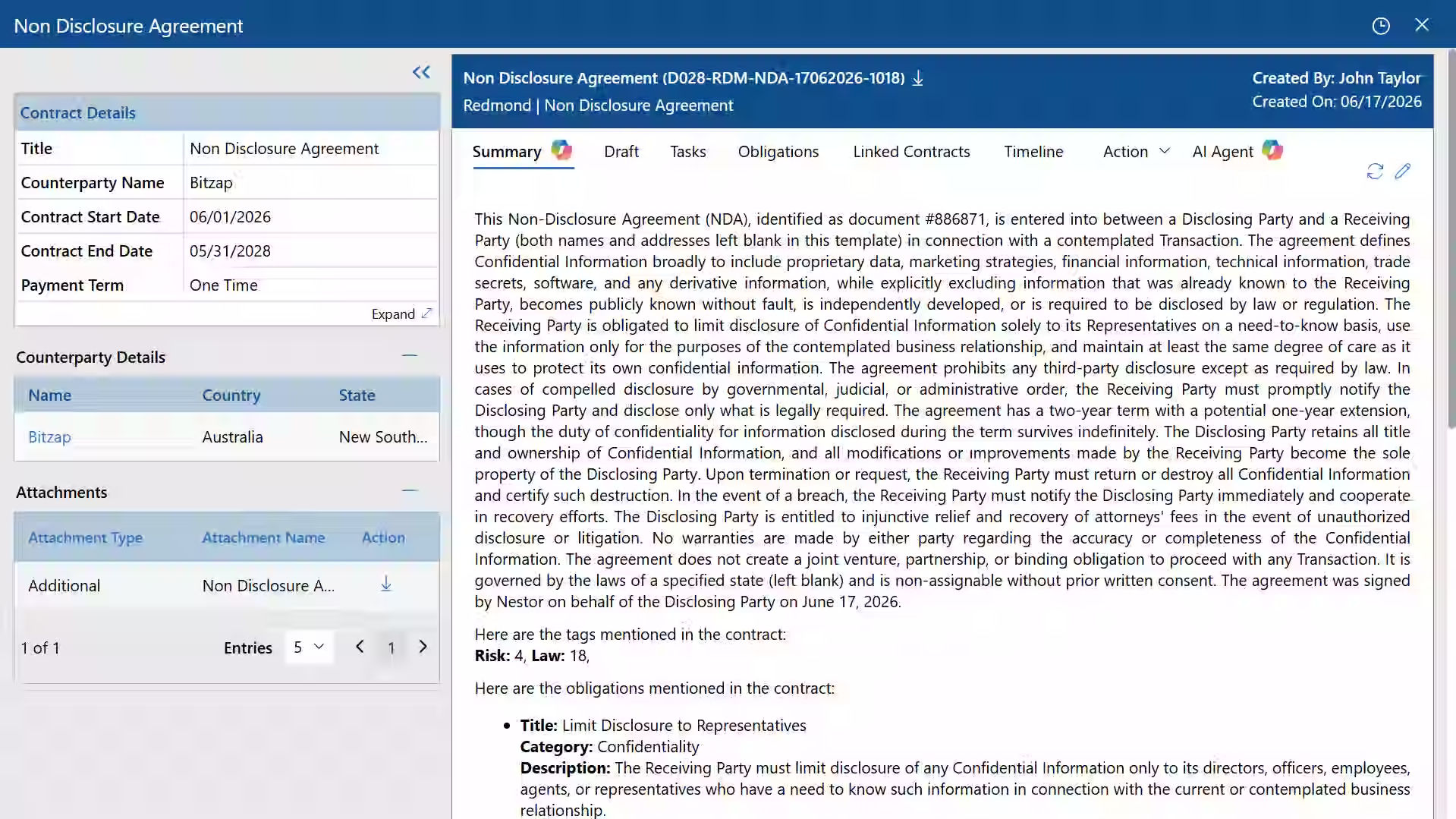
Contract data extraction identifies and pulls key information from contracts, organizing it into structured, machine-readable data for easy use and analysis.
A contract contains critical contract data like deadlines, dollar amounts, named parties, obligations, rights, limitations but that information is written in natural language, buried across dense paragraphs.
Raw Contract Language | Extracted Data Field |
“This agreement shall renew automatically for successive one-year terms unless either party provides 60 days’ written notice.” | Renewal Type: Auto-renewal / Notice Period: 60 days |
“Vendor’s total liability shall not exceed the fees paid in the preceding 12 months.” | Liability Cap: Rolling 12-month fees |
“Payment is due within 30 days of invoice receipt.” | Payment Terms: Net-30 |
Why Contract Data Extraction Matters for Modern Businesses?
The core problem is this: most companies have hundreds or thousands of contracts to manage, and almost none of that data is accessible in a usable form.
Consider a few common situations:
- Renewal risk: Your procurement team needs to know which vendor contracts auto-renew in the next 90 days. Without extraction, someone must manually open and read every agreement. With it, that’s a 30-second report.
- Liability exposure: Your CFO wants to know how many supplier contracts have liability caps below $500,000. Without structured data, this question is unanswerable without days of legal review. With contract data extraction software, it’s a prompt.
- Compliance audits: Your legal team needs to confirm which customer agreements contain data processing terms that meet the latest regulatory requirements. Extracted metadata makes this auditable in minutes.
The financial stakes are real. Research from Deloitte and WorldCC found that average contract value erosion reaches 8.6% across organizations a direct result of missed obligations, poorly tracked terms, and reactive rather than proactive contract management.
Key Features to Look for in Contract Data Extraction Tools
The goal is not just to store documents but to turn contract content into useful, connected information that teams can work with. Below are the key features to consider:
1. AI-powered clause recognition
A AI-powered contract management software should understand the meaning of contract language, not just match exact words. For example, it should identify different ways of describing the same clause, such as auto-renewal terms written in different formats. Tools trained specifically on legal language can accurately capture important details like obligations, dates, and risks, even when wording varies across contracts.
2. Centralized and searchable storage
Contract data extraction becomes valuable when all extracted information is stored in one place and is easy to access. A good system should offer a centralized contract repository where contracts and their key data points are organized clearly. Features like filters, sorting, and full-text search help users quickly find what they need without going through multiple folders or emails.
3. Automated workflows based on extracted data
One of the biggest advantages of contract data extraction is automation. Instead of just storing information, the system should use extracted data to trigger actions. For example, automated contract management can send alerts before renewal dates, assign contracts for review, or notify teams about key deadlines. This reduces manual follow-ups and ensures important tasks are not missed.
4. Support for older contracts and formats
Many organizations have contracts stored in different formats, including scanned PDFs or older documents. A good contract data extraction tool should be able to process these files without requiring manual data entry. This ensures that even legacy contracts become part of the digital system, improving visibility and consistency.
5. Data accuracy and validation
Accuracy is critical in contract data extraction. The tool should include validation checks to ensure that extracted data is correct and reliable. Some systems also allow human review where needed, combining automation with oversight for better results.
How Accurate Is AI Contract Data Extraction?
- 95–99% accuracy in extracting key contract details such as party names, effective dates, expiration dates, and contract values.
- 90–98% accuracy for commercial terms, including payment schedules, renewal dates, notice periods, and pricing information.
- Highly reliable in identifying standard legal clauses, including confidentiality, termination, indemnification, governing law, and renewal provisions.
- Consistently captures key contract metadata, making it easier to search, filter, and report on agreements.
- Quickly extracts obligations, milestones, and renewal dates, helping teams stay informed throughout the contract lifecycle.
- Processes large volumes of contracts in seconds, significantly reducing the time spent on manual data entry and review.
- Supports informed decision-making by converting unstructured contract content into organized, searchable information.
- Maintains consistent extraction quality across a wide range of commercial contract types, enabling teams to work more efficiently.
Wondering if AI can accurately extract data from your contracts?
Experience how CLM 365 AI-powered extraction helps teams review contracts faster while maintaining confidence in the extracted data.
AI Contract Data Extraction: How It Works and Where It Fits
Automated contract data extraction powered by AI is what makes large-scale contract analysis practical. Without it, the volume of contracts at any organization of meaningful size makes thorough data extraction impossible.
The Technology Behind Contract Data Extraction
Modern contract data extraction tools combine several technologies, not just one model:
- OCR (Optical Character Recognition): Converts scanned PDFs and image-based contracts into machine-readable text. This is the entry point for legacy archives that were never digitized as searchable text.
- LLM-based clause classification: Large language models read clause language in context to classify type (e.g., termination-for-cause vs. termination-for-convenience) rather than relying on exact keyword matches. This is what allows the tool to treat differently worded clauses as the same underlying concept.
- Validation and confidence scoring: Extracted fields are typically assigned a confidence score. High-confidence extractions can flow straight into your repository; low-confidence ones get routed to a human reviewer.
- Human-in-the-loop review: Even mature systems route edge cases ambiguous language, unusual clause structures, non-English contracts to a person for confirmation before the data is finalized.
According to the State of AI in Legal 2025 Report, 28% of legal professionals already identify contract review as their most impactful AI use case, and 57% say the technology has freed up meaningful time for higher-level work. The right model is AI doing the heavy lifting with human review focused on edge cases not one or the other.
How to Implement Contract Data Extraction Step by Step?
Large-scale implementation projects often fail because they try to do everything at once. A phased approach produces faster results and higher adoption.
Step 1: Define Your Priority Data Points
Start by asking: “What questions about our contracts can’t we currently answer?” Common answers include:
- Which agreements auto-renew in the next 120 days?
- What are our standard payment terms across customer contracts?
- Which vendor agreements have termination-for-convenience clauses?
These questions define your first extraction targets. Pick five to ten data points that address real, immediate problems not an exhaustive taxonomy of every possible contract field. You can expand later.
Step 2: Audit Your Contract Volume and Formats
Before you can extract data, you need to know what you’re working with. Conduct an inventory
- How many contracts do you have?
- Where do they reside?
- What formats are they in (PDF, Word, scanned image, paper)?
- Which systems touch them?
This contract audit shapes your tool selection and your migration plan.
Step 3: Handle Legacy Contracts
New contracts created in a CLM will be tagged automatically going forward. But your existing archive requires a separate migration effort. You have three options:
- AI-only extraction: Fast and scalable for large volumes; works well for standard clauses but may need human review for complex or unusual terms.
- Manual analyst review: Slower but highly accurate; appropriate for high-value or high-risk contracts.
- Hybrid approach: Use AI for the first pass across your entire archive, then have trained reviewers validate and correct where needed. This is the most practical model for most organizations.
Step 4: Set Up Ongoing Extraction for New Contracts
Once legacy migration is underway, configure your CLM software to automatically extract the same data fields from every new contract at execution. This makes ongoing extraction invisible and automatic no additional effort required.
Step 5: Connect Data to Business Processes
Extraction without action is just better filing. Build workflows, alerts, and integrations that put contract data to work: renewal alerts, approval routing based on contract value, automatic CRM updates when a customer agreement is signed.
Step 6: Measure and Expand
Track how extraction data changes your team’s work. Are renewal misses dropping? Is legal review faster? Are approval cycles shorter? Use those outcomes to justify expanding your data model to cover more fields and more use cases.
How to Use Your Extracted Contract Metadata Effectively?
Once your contracts are fully tagged whether through AI contract data extraction, analyst review, or both the practical applications expand considerably. Here are the highest-value uses of extracted contract metadata:
1. Proactive Renewal Management
Set automated alerts based on extracted renewal and expiration dates. Teams that know 90 days in advance which contracts are coming up for the contract renewal process can renegotiate from a position of preparation rather than last-minute pressure.
2. Negotiation Intelligence
Track which terms your counterparties consistently push back on. If a particular indemnification clause gets redlined in 70% of customer negotiations, you now have data to either update your standard form or prepare stronger contract negotiation strategies for keeping it.
3. Approval Routing Based on Contract Attributes
Automate routing decisions using extracted data fields. Contracts above a certain value go to finance. Agreements with data processing terms go to the privacy team. Contracts with non-standard liability language get an extra legal review. This replaces manual triage with systematic rules.
4. Performance Benchmarking
Measure how long contracts spend in each stage drafting, review, negotiation, signing. Compare the contract performance across teams, regions, or contract types. Identify where deals slow down and what factors are associated with faster closes.
5. Template Improvement
Pull the language from your most successful agreements and use it to update your standard templates. If a specific pricing structure closes faster than alternatives, or a particular warranty clause never generates pushback, that pattern is visible in your extracted data.
6. Compliance Reporting
Generate audit-ready reports on any contract attribute. Which vendors have current insurance certificates on file? Which customer agreements include a specific regulatory certification? Questions like these, which once required manual document review, become one-click reports.
Role of CLM 365 in Contract Data Extraction Process
CLM 365 is built within the Microsoft ecosystem and integrates seamlessly with SharePoint, MS Teams, Microsoft Outlook, Microsoft Copilot, Power BI, and Power Automate, enabling contract management within existing workflows.
It offers enterprise-grade security with a user-friendly interface, suitable for both growing businesses and large enterprises.
CLM 365 is certified by SOC 2 compliance, Microsoft certification, and Microsoft Solutions Partner status, ensuring a reliable and secure environment for managing contracts.
Its AI-powered workflows help teams review, summarize, suggest alternative clauses, and highlight risks and obligations, while AI agents provide quick insights through simple prompts.
Example: A company can ask, “Show repetitive clauses and renewal dates from the past 2 years,” and the AI will quickly provide a clear, summarized view of the data.
Use Case: Contract Data Extraction by Contract Type
Below are common use cases that demonstrate how AI extracts structured information across a variety of business and legal contracts.
- Vendor / Procurement Contracts: Focus on pricing terms, SLAs, renewal dates, and liability caps to manage spend and supplier risk at scale.
- Customer / Sales Contracts: Extraction centers on payment terms, contract value, data processing clauses, and renewal type to support revenue operations and forecasting.
- NDAs and Confidentiality Agreements: Key fields are confidentiality duration, scope of protected information, and survival clauses — high volume, low complexity, ideal for full automation.
- Employment Contracts: Extraction covers compensation terms, notice periods, non-compete clauses, and benefits — often routed to HR systems rather than a CLM.
- Lease and Real Estate Agreements: Focus on term length, renewal options, rent escalation clauses, and maintenance obligations.
- M&A and Due Diligence Documents: Extraction prioritizes assignment rights, change-of-control clauses, and indemnification terms, since these directly affect deal structuring.
Conclusion
Contract data extraction helps organizations turn unstructured contract content into clear, usable data. By capturing key details like clauses, dates, and obligations, teams can improve visibility, reduce manual effort, and manage contracts more efficiently.
If you’re still managing contracts on your own, it can take up valuable time that could be better spent improving processes and building stronger vendor relationships.
Start your 14-day free trial with CLM 365 and let it take care of the rest.
Frequently Asked Questions
What is a contract term extraction?
Contract term extraction is the process of using AI to identify and capture key terms, clauses, and details from contracts for easy tracking and analysis.
How does AI identify key clauses in contracts?
AI scans contract text using trained models to detect patterns and keywords, allowing it to automatically identify clauses like termination, indemnity, and payment terms.
Can contract data extraction handle different clause formats?
Yes, AI can recognize clauses even when they are written in different formats or wording, as it learns variations across multiple contracts.
What types of data can be extracted from contracts?
Common data includes clause types, renewal dates, payment terms, obligations, vendor details, and key milestones.
Does AI support multi-language contract extraction?
Many AI systems can process contracts in multiple languages, making it easier to manage global agreements.
Table of Contents

Trusted by the Best

_JiluXJRGNl.svg)























