
What Is Contract Abstraction? A Complete Guide to the Process

- The contract abstraction process involves defining scope, reviewing the contract, extracting key information, building the abstract, and quality-checking the output.
- Companies using AI have seen a 35% improvement in contract review accuracy
- 78% of organizations already use AI in at least one business function (McKinsey).
- It summarizes legal documents and highlights important contract information.
Every business depends on contracts. Vendor agreements, employment contracts, customer deals, and partnership agreements can quickly add up.
Each contract contains important details such as renewal dates, obligations, payment terms, and deadlines. When these details are buried in long legal documents, teams may overlook important information.
That is where contract abstraction helps.
It turns lengthy agreements into clear, structured contract summaries so teams can quickly find the information they need. This guide explains how the process works and how AI is making contract review faster and easier.
What Is Contract Abstraction?
Contract abstraction is the process of extracting and summarizing key information from legal contracts into a short, structured format.
Instead of reading a 40-page contract, stakeholders can analyse contracts to quickly find important details like renewal terms.
A contract abstract typically captures:
- Contract parties and agreement details
- Start dates, end dates, and renewal terms
- Payment terms, pricing, and obligations
- Termination clauses and notice periods
- Confidentiality, liability, and compliance terms
The goal is not to replace the original contract. Instead, it makes important contract information easier to find and understand. Legal, finance, procurement, HR, and other teams can quickly review the details they need without reading the entire agreement.
Why Contract Abstraction Matters for Your Business
Contracts contain information that affects payments, renewals, compliance, vendor relationships, and business risks. When these details are buried in legal language, teams may struggle to find what they need.
Gives teams better visibility: Finance can check payment terms, procurement can track renewal dates, and HR can review notice periods. Teams can analyze contracts with AI and get quick access to relevant information without depending on legal teams.
Reduces compliance risks: Missed deadlines, renewal dates, and contractual obligations can create financial and legal problems. Clear contract summaries make these details easier to track.
Speeds up contract reviews: Audits, due diligence, and M&A activities may require teams to review hundreds of agreements. It helps reviewers find important terms without reading every contract from beginning to end.
Supports better decisions: Clear access to renewal terms, obligations, and risks helps leaders make informed decisions about renewals, renegotiations, and contract termination.
It supports better decision-making: When key terms are surfaced clearly, leadership can make faster, more informed decisions about renewals, renegotiations, and exits rather than relying on memory or incomplete records.
Difference Between Manual and AI-Powered Contract Abstraction
The process has traditionally been a manual and time-consuming process, but AI-powered solutions are transforming the way businesses extract, review, and manage critical contract information.
Aspect | Manual Process | AI-Powered Contract Abstraction |
Speed | Takes hours or days to review contracts | Processes contracts within minutes |
Accuracy | Higher chance of human errors or missed clauses | Detects important terms with greater consistency |
Scalability | Difficult to handle large contract volumes | Easily manages thousands of contracts at once |
Cost Efficiency | Requires more manpower and operational cost | Reduces manual workload and saves costs |
Data Extraction | Information is manually identified and entered | Automatically extracts key clauses and data |
Is Contract Review Taking Too Much Time? CLM 365 Simplifies the Process.
How AI-Powered Contract Abstraction Works
Modern automated contract abstraction tools use a combination of AI technologies to process contracts at scale. Here’s what’s happening under the hood.
Step 1: Upload the contract
Users upload the agreement to the contract management platform.
Step 2: Analyze the document
AI reads the contract and identifies important terms, clauses, dates, and obligations.
Step 3: Extract key information
The system extracts details such as payment terms, renewal dates, termination conditions, and responsibilities.
Step 4: Highlight areas that need attention
AI can flag potential risks, missing information, compliance concerns, and important obligations for further review.
When Is Contract Abstraction Used?
Businesses use agreement abstraction when they need quick access to important information across many agreements. Common use cases include:
- Reviewing vendor, customer, employee, and partnership agreements
- Finding renewal dates, payment terms, penalties, and obligations
- Preparing contracts for audits and compliance reviews
- Reviewing agreements during mergers and acquisitions
- Comparing important terms across multiple contracts
- Giving finance, procurement, HR, and operations teams easier access to contract information
Instead of reviewing an agreement in full, teams can review structured summaries and focus on the clauses that require attention.
Industries Where Contract Abstraction Is Especially Valuable
It can benefit any organization that manages large or complex agreements. It is especially useful in industries where contracts contain strict financial, legal, or regulatory requirements.
- Technology and SaaS: Helps teams review customer, vendor, subscription, and data processing agreements.
- Financial services: Makes regulatory obligations, liability terms, and compliance requirements easier to identify.
- Healthcare: Helps organizations manage provider agreements, vendor contracts, renewal dates, and compliance terms.
- Real estate: Makes it easier to track lease terms, rent increases, notice periods, and renewal options.
- Manufacturing: Helps teams review supplier agreements, pricing, delivery terms, quality standards, and liability clauses.
Benefits of Using AI for Contract Abstraction Process
AI-powered contract abstraction helps businesses review, organize, and understand contracts faster by automatically extracting important information and highlighting critical details.
1. Faster Contract Review and Summarization
Reviewing contracts manually can take hours, especially when dealing with lengthy legal documents filled with detailed clauses and technical language.
The process significantly reduces the time required by automatically scanning contracts.
Legal teams and business users can quickly understand the purpose of the agreement from start to finish.
2. Quick Access to Important Contract Details
During negotiations, audits, and renewals, teams often need specific contract details quickly.
AI can extract contract data, dates, obligations, and other important information automatically.
Users can find what they need without searching through multiple pages of legal text.
3. Better Visibility into Risks and Obligations
Contracts may contain liabilities, penalties, strict obligations, or financial commitments that require close attention.
AI can highlight clauses related to indemnification, liability, payments, renewals, and compliance.
This gives teams a contract visibility view of potential risks before they make important contract decisions.
4. Improved Productivity for Legal Teams
Legal professionals often spend a large portion of their time reviewing repetitive contract information manually.
AI helps reduce this workload by automating routine contract review and summarization tasks.
This improves overall productivity while also reducing the pressure associated with managing contracts.
5. Consistent Contract Analysis Across Documents
Different reviewers may interpret or summarize contracts differently, especially when handling large numbers of agreements.
AI-powered contract abstraction brings greater consistency by applying the same review standards across every document.
This helps businesses maintain uniform contract analysis, standardized reporting, and structured data extraction regardless of the contract type
6. Easier Management of High Contract Volumes
As businesses grow, the number of contracts they manage also increases.
Handling large volumes of agreements manually can become time-consuming and difficult to organize.
AI-powered abstraction tools help companies process, categorize, and manage thousands of contracts more efficiently.
7. Smarter Decision-Making with Actionable Insights
AI not only summarizes contracts but also provides useful insights that support better business decisions.
By giving teams, a clear understanding of obligations, deadlines, renewal terms, financial commitments, and risk areas, AI helps organizations respond faster and plan more effectively
Reviewing contracts shouldn’t slow down productivity. Explore how CLM 365 helps
Key Components of an Effective Contract Abstraction Process
An effective abstraction process should make important contract information easy to find, understand, and use. A good process should:
- Capture key dates, terms, clauses, and obligations
- Present information in a consistent format
- Simplify complex legal language
- Highlight risks, liabilities, and financial commitments
- Track renewals, deadlines, and compliance requirements
- Make contracts easier to search and compare
- Reduce repetitive manual review
Key Things to Consider Before Starting the Contract Abstraction Process
Before implementing the process, businesses should evaluate a few important factors to improve accuracy, consistency, and overall contract management efficiency.
1. Understand Your Contract Types
Start by identifying the types of contracts your business manages most frequently, such as vendor agreements, employment contracts, procurement agreements, partnership contracts, or service agreements.
2. Define Important Contract Data
Determine which contract details are most important for your business teams to access quickly. This may include renewal dates, payment terms, pricing details, obligations, compliance requirements, confidentiality clauses, notice periods, and termination conditions.
3. Prioritize High-Value Contracts
Focus first on contracts that carry higher financial value, legal obligations, compliance impact, or operational risks. Prioritizing critical agreements allows businesses to gain faster value from the abstraction process.
4. Create a Standardized Abstraction Format
Use the same structure for every contract summary. For example, each abstract can include parties, dates, payment terms, obligations, renewal conditions, termination terms, and risks. A consistent format makes agreements easier to review, search, and compare.
5. Evaluate the Right AI Tools
Choose system that align with your contract structure, industry terminology, and document complexity. The right AI solution should support accurate extraction of contract clauses and important contract metadata relevant to your business operations.
6. Test Accuracy with Real Contracts
Before full implementation, test AI-powered abstraction tools using actual business contracts. This helps evaluate how effectively the system identifies clauses, extracts critical information, and handles different contract formats.
7. Plan Cross-Team Accessibility
Contract abstracts are often used beyond the legal department. Consider how teams such as finance, procurement, HR, operations, and sales will access and use the summarized contract information.
The Future of Contract Abstraction
It is moving beyond basic data extraction. AI can increasingly help businesses analyze information across their entire contract portfolio. For example, teams may use AI to identify:
- Vendor agreements with high liability risks
- Contracts approaching renewal
- Common negotiation points
- Frequently missed obligations
- Unusual payment or termination terms
These insights can help businesses understand patterns across hundreds or thousands of agreements.
As AI capabilities improve, contract abstraction is likely to become a more important part of contract management. However, businesses should still combine AI analysis with human review when legal judgment is required.
How CLM 365 Helps in Abstracting Key Contract Information?
CLM 365 is built within the Microsoft environment and integrates seamlessly with SharePoint, Microsoft Teams, Outlook, Microsoft Copilot, Power BI, and Power Automate. This allows teams to manage contracts directly within their existing workflows.
CLM 365 uses Agentic AI to help businesses quickly summarize, analyze, and extract important contract information. Users can identify key clauses, obligations, risks, payment terms, renewal dates, and termination conditions without manually reviewing lengthy agreements.
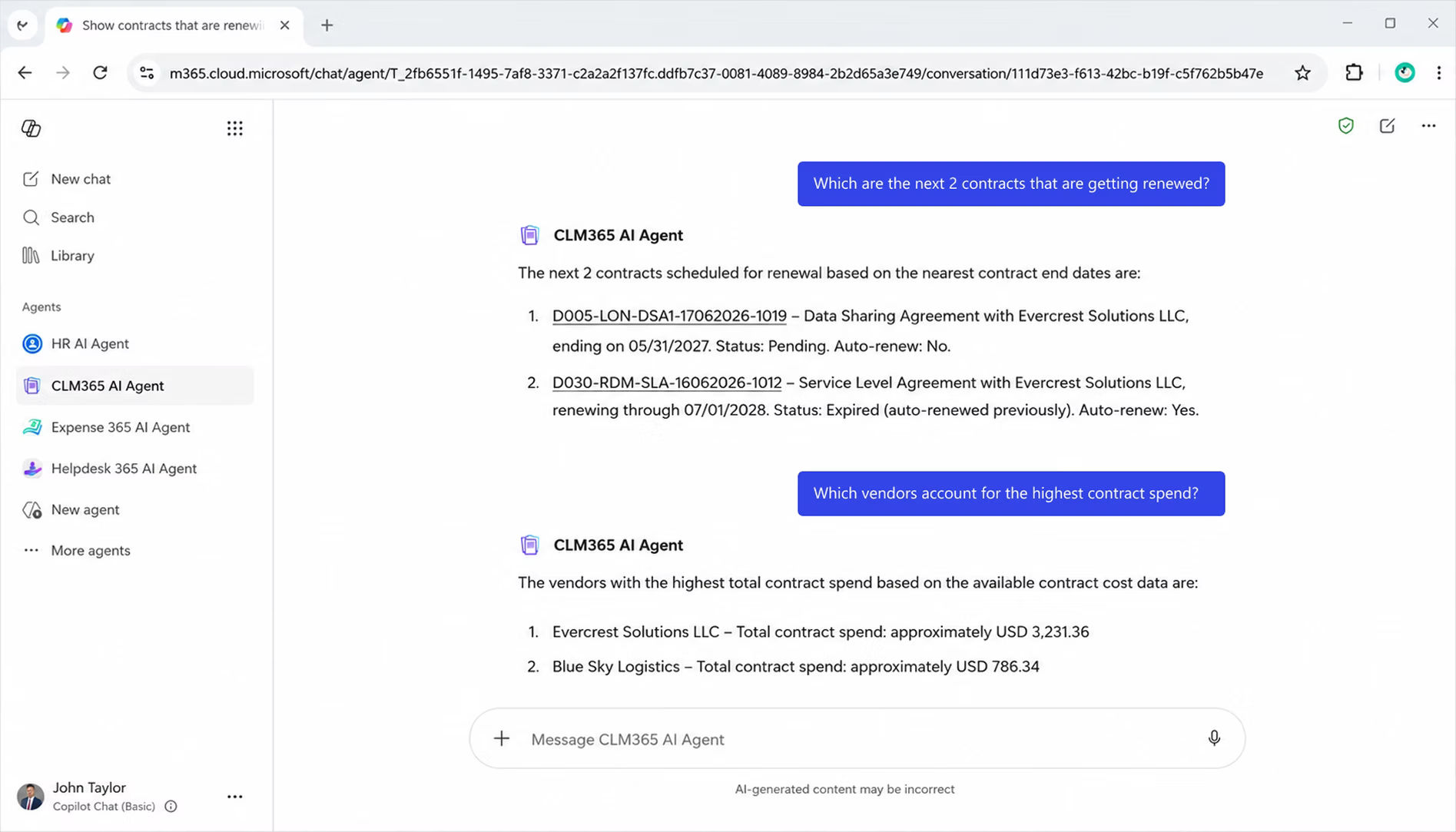
With AI powered contract management, users can interact with CLM 365 to quickly extract important contract details
- “Summarize this contract”
- “Highlight risks”
- “Show obligations”
- “Extract renewal dates”
For example: If the team wants to check renewal dates, recurring clauses, payment terms, or specific obligations, they can simply chat with CLM 365 and get the required information in clear and simple English.
Conclusion
Contract abstraction process helps businesses simplify complex agreements by extracting important details such as obligations, payment terms, renewal dates, risks, and compliance requirements into a clear and structured format.
Ready to simplify contract review and extract key insights faster? Explore how CLM 365 can help your business with AI-powered contract management.
Join Our Creative Community
Frequently Asked Questions
Does AI risky clauses in agreements?
Yes, AI can highlight clauses related to liabilities, penalties, auto-renewals, indemnification terms, and compliance risks.
Can AI help abstract key contract details across offices in different regions and languages
Yes, AI can extract and summarize key contract details across different languages and regional office agreements.
Can I ask AI to summarize only specific clauses?
Yes, Users can request summaries for clauses such as payment terms, confidentiality obligations, or liability conditions.
How does contract abstraction help during vendor negotiations?
It gives procurement and legal teams faster access to pricing terms, penalties, obligations, SLAs, and renewal conditions, making negotiations more informed and data driven.
How does AI-powered contract abstraction support compliance teams?
Compliance teams can quickly identify regulatory obligations, reporting requirements, audit clauses, and policy-related commitments across agreements.


_JiluXJRGNl.svg)























