
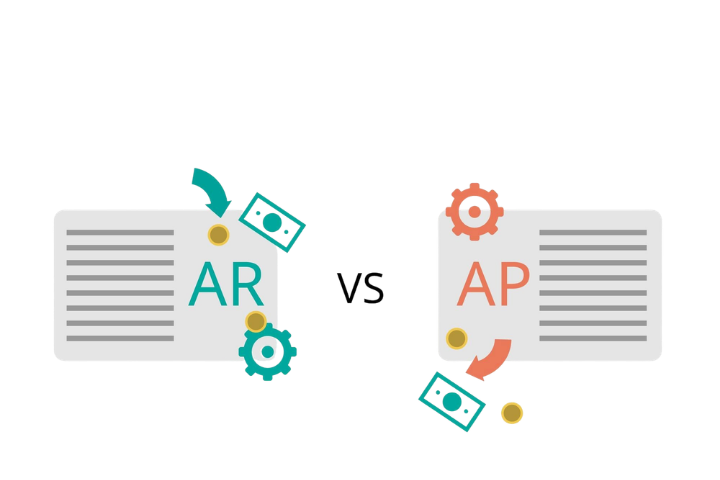

Accounts receivable vs accounts payable comes down to direction. Accounts receivable is the money customers owe you for work you’ve already done. Accounts payable is the money you owe suppliers for things you’ve already received. One brings cash in. The other sends it out.
Plenty of business owners know this in theory, then freeze when a bookkeeper says “AR is high” or “AP is late.” This article explains both terms in plain words. You’ll see real examples, simple formulas and a clear way to tell the two apart. You’ll also find answers to questions people ask on public forums.
- Accounts receivable (AR) is money customers owe you. Accounts payable (AP) is money you owe suppliers.
- AR is an asset on your balance sheet. AP is a liability.
- Quick test: money coming in is AR and money going out is AP.
- Track both together. Slow customers and early bill payments drain cash faster than most owners expect.
What is accounts receivable (AR)?
What is accounts payable (AP)?
Accounts payable (AP) is the total your business owes suppliers for goods or services you’ve received but not yet paid for. It appears on your balance sheet as a current liability, meaning a debt due within a year. Paying the bill removes the liability and lowers your cash.
Example: $12,000 flyer order from the hotel’s side. The hotel records $12,000 in accounts payable when the flyers arrive. AP covers supplier bills only. Wages, loan repayments and taxes sit in their own accounts.
Accounts Receivable vs Accounts Payable Side by Side
The main difference between accounts payable vs accounts receivable is the direction of the money. AR brings cash in from customers and counts as an asset. AP sends cash out to suppliers and counts as a liability. Who manages each one and which numbers matter, follows from that single fact.
Feature | Accounts receivable (AR) | Accounts payable (AP) |
What it is | Money customers owe you | Money you owe suppliers |
Cash direction | Coming in | Going out |
Balance sheet | Current asset | Current liability |
Normal balance | Debit | Credit |
Invoice | One you send | One you receive |
Main goal | Collect quickly | Pay on time, not early |
Key metric | Days sales outstanding | Days payable outstanding |
Main risk | Customers pay late or never | Late fees and strained supplier ties |
Accounts receivable is an asset because it’s money you expect to receive. Accounts payable is a liability because it’s money you must pay out. Both are normally current, meaning due within a year. Lenders and investors read both lines together when they judge how healthy your business is.
In bookkeeping terms, an asset normally carries a debit balance and a liability carries a credit balance. You only need that detail if you keep the books yourself.
Cash flow is the money moving in and out of your business over a period. Slow AR locks cash inside unpaid invoices. Fast AP sends cash out before customers have paid you. Together they decide how much money sits in your bank account on any given Tuesday.
Example: Say a distributor pays suppliers in 20 days but collects from customers in 55. That’s a 35-day gap and the business covers it from its own bank balance. On $60,000 of monthly purchases, the gap ties up about $70,000. A company can show a profit on paper and still miss payroll because of this.
On a balance sheet, accounts receivable is listed under current assets, near cash. Accounts payable is listed under current liabilities, near short-term loans. Reading the two lines together shows whether you can cover your near-term bills with money you expect to collect.
Example: Say a small agency has $45,000 in cash, $30,000 in AR and $50,000 in AP. It can cover its bills if customers pay on time. If $20,000 of that AR runs late, the agency falls short and may need to borrow.
How to Know When It’s Accounts Receivable or Payable
Ask one question: who owes whom? If someone owes your business money, it’s accounts receivable. If your business owes someone money, it’s accounts payable. The same invoice is both, depending on which side you’re on. The seller records a receivable and the buyer records a payable.
The two-question test
Run any transaction through these questions:
- Did we already deliver something and we’re waiting to be paid? That’s accounts receivable.
- Did we already receive something and still need to pay? That’s accounts payable.
If neither answer is yes, it probably isn’t AR or AP. Cash sales, wages and prepaid items usually fall outside both.
Real examples of AR and AP
| Situation | AR or AP? | Why |
| A freelance designer sends a $2,500 invoice to a client | AR for the designer | The client owes the designer |
| An office receives a $480 internet bill due in 15 days | AP | The office owes the provider |
| A software firm bills a client $9,000 for the year | AR for the firm | Payment is still pending |
| An employee submits an $84 taxi receipt | A payable to the employee | The company owes a reimbursement |
| A customer pays cash at the counter | Neither | Money changed hands immediately |
| A company pays six months of rent upfront | Neither | It’s a prepaid expense |
How the AP and AR Processes Work
Both processes follow a similar path: record the invoice, check it, act on it and file it. AP focuses on paying correctly and on time. AR focuses on collecting quickly. Mistakes at any step show up later as cash problems or audit headaches.
- Receive the supplier’s invoice and log it.
- Match it to the purchase order, which is your original order and to the delivery record. This is called three-way matching.
- Send it to the right manager for approval.
- Pay it on the due date, or earlier if a discount applies.
- Record the payment and file the paperwork.
Discounts deserve attention. Terms of “2/10 net 30” mean you get 2% off if you pay within 10 days, otherwise the full amount is due in 30. On a $12,000 invoice, that’s $240 saved.
- Send an accurate invoice as soon as the work is done.
- Track due dates.
- Follow up when an invoice runs late.
- Record the payment and match it to the invoice. Finance teams call this reconciliation.
Common Mistakes with Account Payable vs Receivable
The most common mistake is treating the two ledgers as an afterthought. Teams log invoices late, pay bills on autopilot and check balances only at month end. These problems show up again and again in small and mid-sized companies and each one is fixable.
- Counting AR as cash: An unpaid invoice isn’t money in the bank. Plan spending around what has actually arrived.
- Paying every bill the day it lands: Paying early gives away cash you could use elsewhere. Pay on the due date unless a discount makes early payment worthwhile.
- Letting one person control everything: One person approving bills, paying them and recording collections makes errors and fraud harder to catch.
- Ignoring small items: Employee reimbursements and card receipts are debts too. When they pile up unrecorded, your payables look smaller than they are.
- Skipping reconciliation: If you don’t compare your ledger to bank statements each month, small errors grow into large ones & reconciliation will be pending.
Numbers Worth Tracking for AR and AP
Two simple ratios show how fast cash moves through your business: days sales outstanding for AR and days payable outstanding for AP. Both count days, so anyone on the team can follow them. Check them monthly and compare each against your own past numbers rather than a generic target.
Days sales outstanding (DSO) is the average number of days it takes customers to pay you. Divide accounts receivable by credit sales, then multiply by the number of days in the period. Lower is better. A rising DSO means customers are paying more slowly.
Example: AR is $60,000 and credit sales over 90 days were $180,000. That gives $60,000 ÷ $180,000 × 90 = 30 days.
Days payable outstanding (DPO) is the average number of days you take to pay suppliers. Divide accounts payable by the cost of goods sold, then multiply by the number of days. A higher DPO keeps cash in your account longer, but stretching too far can damage supplier trust.
Example: AP is $40,000 and the cost of goods sold over 90 days was $120,000. That gives $40,000 ÷ $120,000 × 90 = 30 days.
Compare the two. If DSO is 30 and DPO is 30, cash in and cash out roughly match. If DSO is 55 and DPO is 20, you’re funding customers out of your own pocket.
Simplify Accounts Payable vs Accounts Receivable with Powerful Accounting Software from Expense 365
Expense 365 helps finance teams manage the payable side of the ledger inside Microsoft 365. Supplier bills and employee claims go through one accounts payable automation feature, backed by approval workflows, bank integration and accounting software integration like Quickbooks. Rivo, the AI agent, takes on routine tasks, so your team spends less time on manual checks.
When bills sit in inboxes and claims sit in spreadsheets, nobody knows the real total you owe. The accounts payable feature in Expense 365 puts supplier invoices and employee claims in one place. Finance sees what’s due, when it’s due and who still needs to approve it. That makes it easier to pay on the due date instead of early or late.
Each item goes through an approval workflow before anyone pays it. Managers review and approve from Outlook or Teams, where they already work. Nothing waits in a forgotten email thread and finance can see the status of every bill and claim.
Bank integration helps finance pay approved items without switching between tools. Accounting software integration then sends approved entries to your books, so your team doesn’t retype figures. Fewer manual steps means fewer typing errors and a faster month-end close.
Rivo, the AI agent in Expense 365, handles routine expense work. Your finance team spends its time on exceptions and decisions, such as an unusual invoice or a late approval.
Conclusion
Accounts receivable vs accounts payable is a question of direction. AR is what customers owe you, AP is what you owe others and both shapes how much cash you actually have. Track them together, split the duties where you can and watch DSO and DPO each month.
Employee reimbursements are money you owe, so treat them like supplier bills. Expense 365 brings approval workflows, accounts payable, bank and accounting integrations and the Rivo AI agent into Microsoft 365. Cut approval delays and keep every claim on record.
Frequently Asked Questions
How do accounts payable and accounts receivable differ?
Accounts payable is money your business owes to suppliers, so cash goes out. Accounts receivable is money customers owe your business, so cash comes in. AP is recorded as a liability and AR as an asset. They’re two views of the same credit transaction, seen from the buyer’s side and the seller’s side.
Which one is considered an asset and which one is a liability?
Accounts receivable is an asset because it represents money you expect to collect. Accounts payable is a liability because it represents money you must pay. Both are usually current, meaning they’re expected to settle within 12 months. You’ll find them on different sides of the balance sheet.
Can the same person do accounts payable and accounts receivable?
Technically yes and many small businesses do. It carries risk, though. When one person approves payments and also records incoming money, mistakes and fraud are harder to spot. Most growing companies split the roles, or have the owner review bank statements and large payments to add a second check.
Is invoicing accounts payable or receivable?
It depends on which side you’re on. When you send an invoice to a customer, it creates accounts receivable. When you receive an invoice from a supplier, it creates accounts payable. The document is the same. Your position, as the seller or the buyer, decides where it goes.
Are accounts payable business expenses?
Not exactly. An expense is the cost of running the business, like rent or software. Accounts payable is the unpaid balance you owe for that cost. When a bill arrives, you record the expense and a matching payable. Paying the bill clears the payable. The expense stays on your income statement.
How do I know when it is accounts receivable vs payable?
Look at who owes the money. If a customer owes your business, it’s accounts receivable. If your business owes a supplier, it’s accounts payable. Another quick check is cash direction. Money you’re waiting to receive is AR and money you’re waiting to send is AP.


























