

5 Whys Root Cause Analysis Template: From Problem To Corrective Action

5 whys root cause analysis template is the simplest way to turn a repeated problem into a clear fix. Instead of treating the symptom, your team asks “why” again and again until the real cause shows up. A written template keeps the talk focused and the answers on record.
This guide gives you a copy-ready format, a step-by-step method, six examples, and tips to avoid common mistakes. Use it for IT incidents, project delays, quality defects, or customer complaints.
- Prioritize problems by their frequency and business impact so your 5 Whys analysis addresses the issues that matter most.
- Compare what happened with what should have happened to pinpoint where the process first went off track.
- Test proposed changes on a small scale before applying them across the team to catch practical gaps early.
- Measure success through fewer repeat incidents and less rework, rather than the number of templates completed.
What Is a 5 Whys Root Cause Analysis Template?
A 5 whys root cause analysis template is a simple worksheet that guides a team through asking “why” about a problem, usually five times, until the true cause is clear. Each answer becomes the base for the next question. The last answer points to a cause the team can fix for good.
The method comes from Taiichi Ohno, who advised his staff to ask why five times about every matter at Toyota. It is now used in IT, finance, HR, operations, and project work. It needs no special software or training. For outages, you can also pair this method with an IT root cause analysis template for deeper technical reviews.
Stop repeating the same problem every month.
5 Whys Root Cause Analysis Template Format You Can Copy
This 5 whys root cause analysis template is short enough to fill in during one meeting.
Field | What to write |
Problem statement | One clear sentence with date, place, and impact |
Why 1 to Why 5 | One answer per level, each with proof |
Evidence | Logs, tickets, photos, or reports |
Root cause | The last answer that your team can fix |
Corrective action | The change that removes the cause |
Owner and due date | One name and one date |
Problem statement
Write what happened, where, when, and how big the impact was. Keep it factual and free of blame. “Invoices went out three days late on March 4” works. “Finance was careless” does not.
Why levels
Give each “why” its own row so the chain is easy to read. Every answer must explain the line above it. If a row feels like a leap, the team probably skipped a step.
Evidence column
Add proof beside each answer. This can be a system log, a ticket number, a time stamp, or a short quote from the person involved. Proof turns opinions into findings and makes audits much easier.
Root cause line
Write the cause in one sentence. A strong root cause points to a process, tool, or rule, not to a person. If you can fix it with a change in the process, you have gone deep enough.
Corrective action
List the change that stops the problem from returning. Add a quick fix if needed, but keep it apart from the lasting fix so the team does not mix the two.
Owner and due date
Every action needs one owner and one date. Shared ownership usually means nobody follows up. Add a review date to check that the fix worked.
Templates only help when people can find them.
RCA Agent brings your forms, tasks, and follow-ups into Microsoft 365, so every analysis has a clear owner.
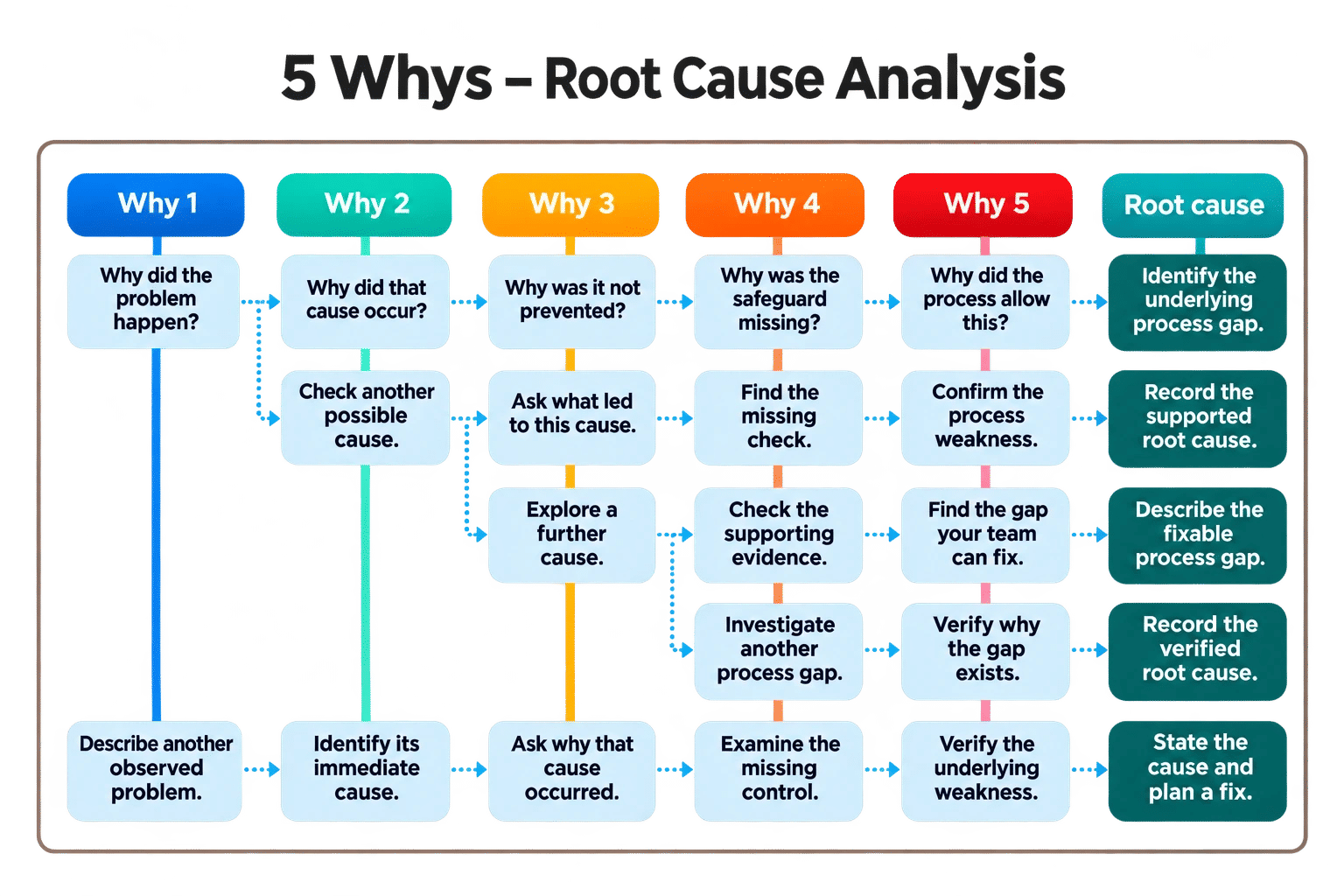
How to Fill In the 5 Whys Template Step by Step
Follow these steps to complete your 5 whys root cause analysis template in one short meeting of 30 to 45 minutes. Bring the people who saw the problem happen, not only managers.
Define the problem clearly
Start with one sentence that all members agree on. If the group argues about the problem, split it into separate problems and run one template for each.
Gather the right people
Invite those who work on the process every day, such as the support agent, the engineer, or the finance clerk. They know where things really break, and they spot weak answers fast.
Ask the first why
Ask why the problem happened and write the answer in the first row. Stay with what you can prove. If the answer is a guess, mark it and check it before moving on.
Keep asking until the cause is fixable
Use each answer to ask the next question. Most issues reach a fixable cause by the third to fifth why, but some need six or seven. Stop when the answer is a gap in process, training, or tools.
Check the chain backward
Read the chain from the root cause up to the problem and add the word “therefore” between steps. If the story holds, the analysis is solid. If a step does not follow, go back and rework it.
Assign actions and follow up
Write the fix, the owner, and the due date. Book a short review two to four weeks later. Close the template only after you confirm the problem has not returned.
5 Whys Root Cause Analysis Examples From Real Teams
The 5 whys root cause analysis template easier to use. Each one below follows the same format: a problem, a short chain of answers, and a root cause your team can fix.
IT outage example
Problem: the company portal went down for two hours.
Why? A server ran out of disk space.
Why? Log files grew without limits.
Why? Nobody set a cleanup rule.
Why? The setup guide had no such step.
Root cause: the build checklist lacks a log policy.
Late invoice example
Problem: invoices went out three days late.
Why? Approval was delayed.
Why? The approver was on leave.
Why? No backup approver was named.
Root cause: the approval process has no backup rule.
Project delay example
Problem: a software release slipped by one week.
Why? Testing started late.
Why? The build was not ready.
Why? Requirements changed twice.
Why? Sign-off was skipped.
Root cause:no formal sign-off step before development.
Quality defect example
Problem: 4% of products had faulty labels.
Why? Labels peeled off.
Why? The surface was damp. Why? Cleaning was rushed.
Root cause: the shift plan gave too little time for cleaning.
Onboarding delay example
Problem: a new hire had no laptop on day one.
Why? IT was not told in time.
Why? HR sent the request by email.
Root cause: onboarding requests had no automatic task for IT.
Tips to Get Better Results From the 5 Whys
The 5 whys root cause analysis template is only as good as the discussion behind it. Lean practitioners often note that more than 90% of problems come from the system, not from people. These tips help companies avoid weak findings and reach causes they can truly fix.
Focus on process, not people
Blame ends honest talk. Ask what in the process allowed the mistake, not who made it. People share more facts when they feel safe, which leads to better fixes.
Use facts for every answer
Check each answer against data before you write it down. Logs, reports, and timestamps keep the team from chasing a wrong theory for an hour.
Allow more than one branch
Some problems have several causes. When a “why” has two valid answers, create a branch and follow both. Pair the template with a fishbone diagram if the tree grows large.
Do not stop too early
An answer like “human error” is a stop sign, not a root cause. Ask why the error was possible, and you will usually find a missing check, rule, or tool.
Share lessons across teams
Store every completed template in one shared place. When another team faces a similar issue, they can reuse the findings and save days of work.
Conclusion
A 5 whys root cause analysis template gives your team a clear path from problem to lasting fix. It keeps talks short, answers backed by proof, and actions tied to a named owner. With a simple table and honest questions, even small teams can solve issues that keep coming back.
Start with one recent problem and fill in your 5 whys root cause analysis template today. Review the result after a few weeks, then share it with other teams. Over time, your records become a library of fixes that saves hours and prevents repeat mistakes.
Ready to build a root cause habit across your company?
RCA Agent gives teams one place to log problems, track fixes, and share lessons.
Frequently Asked Questions
What is the 5 whys template used for?
It helps teams find the real cause of a problem by asking “why” repeatedly and writing each answer in a fixed format. Teams use it for incidents, delays, defects, and complaints.
Do you always need exactly five whys?
No. Five is a common guide. Some problems reach a fixable cause in three steps, while others need six or seven. Stop when the answer points to a process you can change
What is the difference between the 5 whys and a fishbone diagram?
The 5 whys follows one chain of causes in a straight line. A fishbone diagram maps many possible causes across groups such as people, process, and tools. Many teams use both.
Who should join a 5 whys session?
Include the people who saw or handled the problem, plus a facilitator and the owner of the process. Keep the group small, usually four to six people, so everyone can speak.
Can I use a 5 whys root cause analysis template in Excel or Word?
Yes. A simple table with columns for problem, whys, evidence, root cause, action, and owner works well in Excel, Word, or a SharePoint list


























