

Customer Service Objectives: 12 Examples With KPIs

Customer service objectives are measurable goals that help businesses answer questions, solve problems, and build customer trust. Their main purpose is to make support timely, accurate, and helpful, so customers can get the answers they need without extra effort.
Imagine a customer reporting a billing error. An agent replies within 10 minutes, but the customer is transferred three times before the issue is fixed. The first response was fast, yet the overall experience was poor. Measuring speed alone would miss the problem.
- Focus on faster responses, accurate resolutions, and better customer experiences
- Use CSAT, FCR, response time, and SLA compliance to track support performance
- Set SMART goals with realistic targets, deadlines, and clear responsibilities
- Review ticket trends, recurring issues, and customer feedback
- Use ticketing systems, automation, and reporting tools to monitor progress
Clear goals help teams look at the whole experience. This guide covers 12 practical examples, the KPIs that measure them, and ways to set realistic targets.
What Are Customer Service Objectives?
Customer service objectives are specific results a company wants its support team to achieve. They may focus on faster replies, fewer repeat contacts, better satisfaction scores, or stronger customer relationships.
A broad goal such as “improve customer satisfaction” offers little direction. A measurable version is: “Raise our Customer Satisfaction Score from 80% to 88% within six months.” It states the current result, desired result, and deadline.
An objective tells the team what to improve. A KPI tells managers how progress will be measured. For example, reducing customer wait time is a goal, while first response time is a KPI.
Salesforce explains these measures in its guide to service performance metrics. Use metrics as signals of customer experience, not as numbers to improve at any cost.
Why Customer Service Objectives Matter
Without shared targets, one agent may focus on answering quickly while another focuses on closing the most tickets. Neither approach guarantees that the customer gets a lasting solution.
Measurable customer support goals give teams a common standard. They also help managers spot where training, staffing, or a change in process is needed.
- Clear expectations: Agents know which outcomes matter
- Better experiences: Customers receive more consistent help
- Stronger accountability: Managers can see whether service targets are met
- Smarter decisions: Reports show which issues need attention
- Greater loyalty: Reliable support gives customers reasons to stay
The right goals cover speed, quality, and customer effort.
12 Customer Service Objectives With Examples and KPIs
These customer service objectives address the problems support teams face every day. The targets below are examples, not universal standards. Set yours using your current performance, support hours, and customer needs.
- Reduce customer response time
Customers want to know their request has reached someone who can help. A long silence creates uncertainty, especially when work is interrupted.
Example goal: Cut median email first response time from four business hours to two within 90 days
KPI: First Response Time (FRT)
Route requests to the right agents, flag urgent tickets, and review response times by channel. An automatic “ticket received” message is helpful, but it should not count as a meaningful agent response. Check whether customers get useful next steps, not just quick acknowledgments.
- Resolve customer issues faster
A fast first reply matters little when the problem stays open for days. Resolution time shows how long customers wait for an actual fix.
Example goal: Reduce median resolution time from 36 hours to 24 hours in three months
KPI: Ticket Resolution Time
Give each ticket a clear owner and define when a case should be escalated. Make past conversations and troubleshooting notes easy to find. Also track reopened tickets: closing requests quickly only helps when the solution works.
- Increase first-contact resolution
First-contact resolution means solving an eligible problem during the first support interaction without a repeat contact. It saves customers the effort of explaining the same issue again.
Example goal: Raise first-contact resolution from 68% to 75% this quarter
KPI: First Contact Resolution (FCR) Rate
Give agents access to accurate knowledge articles and the information needed to solve common problems. Review cases that require multiple contacts to find missing tools or unclear instructions. Complex issues may still need follow-ups, so do not push agents to rush difficult cases.
- Improve customer satisfaction
Customers judge support by how they were treated and whether their issue was fixed. A good satisfaction score reflects more than speed.
Example goal: Increase Customer Satisfaction Score from 82% to 88% within six months
KPI: Customer Satisfaction Score (CSAT)
Send a short survey after resolution and ask how satisfied the customer was. On a five-point scale, ratings of four or five are often counted as satisfied. Review negative comments alongside the score, and track the survey response rate so feedback from a small group does not drive every decision.
- Make support easier to use
Customers should not have to switch channels, repeat details, or fill out long forms to get basic help. Reducing that effort can improve the entire experience.
Example goal: Increase positive customer-effort responses from 70% to 80% within six months
KPI: Customer Effort Score (CES)
Keep conversation history available when a request moves between agents. Simplify forms and provide clear next steps. Ask customers whether getting their issue resolved was easy, then use the same survey scale over time. Less effort makes support easier.
- Meet service level agreements
Service Level Agreements (SLAs) set expectations for response and resolution times. When deadlines are missed often, customers may lose confidence in the service.
Example goal: Raise SLA compliance from 90% to 95% in 90 days
KPI: SLA Compliance Rate
Set realistic targets for each priority level and define what happens when a deadline is close. Ticket alerts and escalation rules help agents act before a breach. Review missed SLAs to find whether the cause was workload, routing, or an unclear process.
- Need Clearer Visibility Into SLA Deadlines?
Helpdesk 365 helps Microsoft 365 teams manage support tickets, monitor SLA performance, and use automated workflows to keep requests moving.
- Reduce overdue ticket backlog
A large backlog may mean requests are arriving faster than the team can resolve them. But some tickets stay open because they are waiting for customer details or approval.
Example goal: Reduce tickets overdue by more than seven days from 120 to 60 within eight weeks
KPI: Overdue Ticket Count
Review the oldest requests each week. Separate tickets waiting on customers from those waiting on agents, and assign an owner to every case. Track new and completed requests too. A smaller backlog is useful only when problems are properly resolved.
- Keep support quality consistent
Customers expect dependable answers whether they contact support by email, phone, chat, or a portal. Different instructions for the same issue create confusion.
Example goal: Raise the support quality audit score from 78% to 88% this quarter
KPI: Quality Assurance (QA) Score
Build a shared knowledge base and clear guidelines for tone, accuracy, and follow-up. Review a sample of interactions from each channel and coach agents on common mistakes. Consistency means reliable information, not identical scripts for every conversation.
- Improve self-service success
Some customers would rather solve simple problems themselves. Helpful FAQs, knowledge articles, and customer portals can make that possible.
Example goal: Increase successful self-service sessions from 45% to 55% within three months
KPI: Self-Service Completion Rate
Write short guides for common issues, use screenshots where they make steps clearer, and update instructions when a product changes. Measure whether people complete their tasks, not just how many pages they view. Keep a clear path to human help for customers who get stuck.
- Reduce reopened support tickets
A closed ticket does not always mean the problem is gone. Reopened tickets can reveal an incomplete fix, missing instructions, or a recurring product issue.
Example goal: Lower the seven-day reopen rate from 12% to 8% next quarter
KPI: Ticket Reopen Rate
Review cases that reopen soon after being marked resolved. Ask whether agents confirmed the fix and documented its cause. When the same issue appears repeatedly, share the findings with technical or product teams rather than applying the same short-term fix each time.
- Develop agent skills and service quality
Agents need product knowledge, good listening skills, and clear guidance to handle difficult conversations. Ticket counts alone do not show whether they are doing a good job.
Example goal: Increase the share of agents meeting the QA standard from 70% to 90% in six months
KPI: Percentage of Agents Meeting QA Standards
Review real support conversations and give practical coaching. If agents solve issues but fail to explain what happens next, focus training on clear follow-up. Measure improvements in conversation quality as well as training completion.
- Strengthen retention through proactive support
Support can help protect customer relationships after a serious problem is resolved. A useful follow-up shows that the team cares whether the fix lasts.
Example goal: Follow up on 95% of high-priority resolved cases within two business days
KPI: Follow-Up Completion Rate
Check that the problem has not returned and ask whether the customer needs more help. Review repeat issues and retention trends, but remember that customer retention also depends on pricing, product value, and other factors beyond support.
Also Read:- Helpdesk KPIs and Metrics: Key Metrics to Track
Customer Service Goals and KPIs at a Glance
Goal | KPI | Example target |
Faster replies | First Response Time | Two business hours |
Faster solutions | Resolution Time | 24 hours |
Fewer repeat contacts | FCR Rate | 75% |
Happier customers | CSAT | 88% |
Easier support | CES | 80% positive |
Reliable service | SLA Compliance | 95% |
Smaller backlog | Overdue Ticket Count | 60 tickets |
Consistent answers | QA Score | 88% |
Better self-service | Completion Rate | 55% |
Fewer reopenings | Reopen Rate | 8% |
Stronger agents | QA Standard Attainment | 90% |
Better follow-up | Follow-Up Completion | 95% |
How to Measure Customer Service Objectives With KPIs
Metric | How to calculate it |
CSAT | Satisfied survey responses ÷ all survey responses × 100 |
FCR | Eligible issues solved on first contact ÷ all eligible issues × 100 |
SLA compliance | Tickets meeting their SLA ÷ tickets measured against that SLA × 100 |
Reopen rate | Resolved tickets reopened within a set period ÷ resolved tickets in the measured group × 100 |
Self-service completion | Successful sessions ÷ eligible self-service sessions × 100 |
How to Set SMART Customer Service Objectives
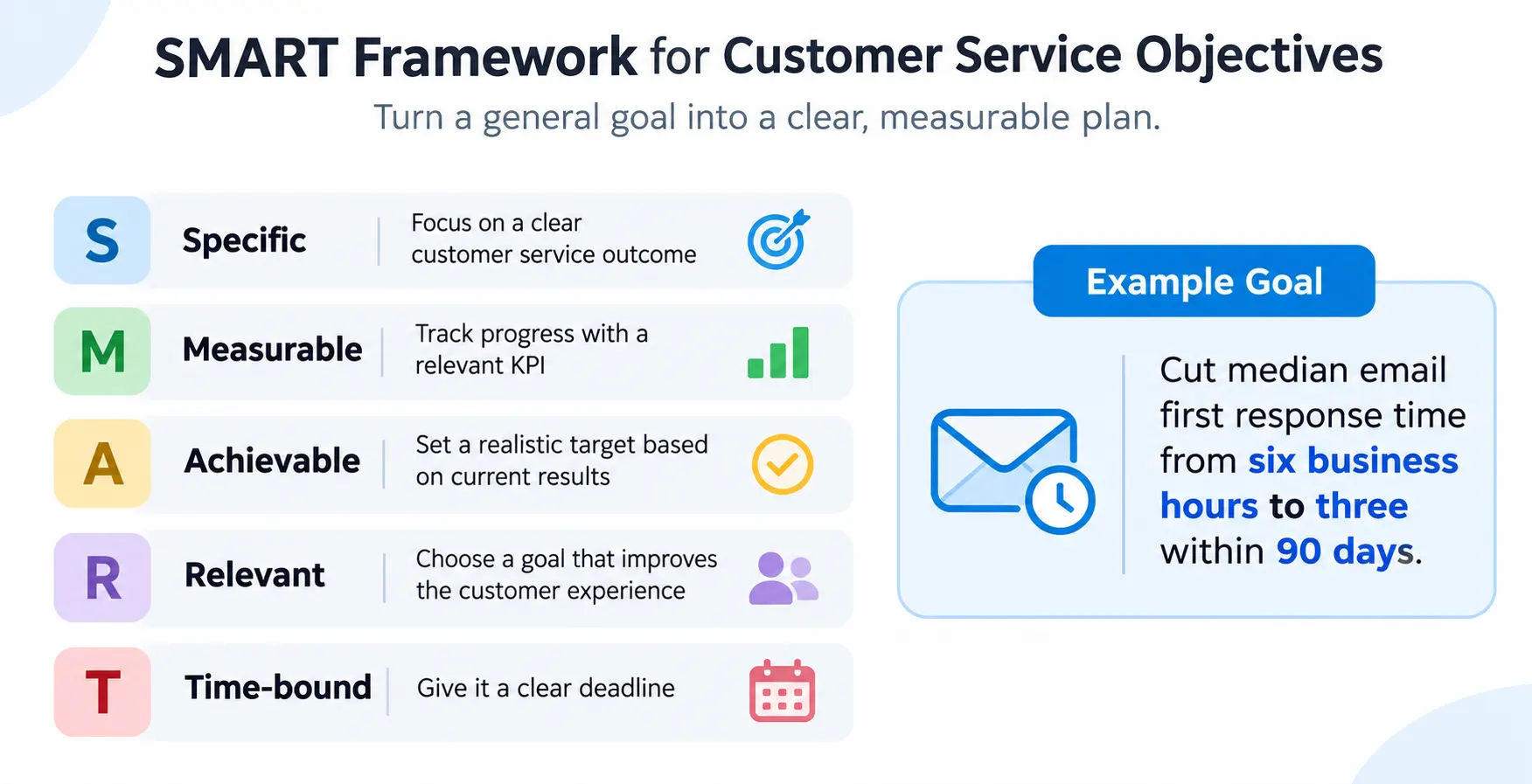
SMART goals help teams turn general wishes into plans they can measure. SMART stands for Specific, Measurable, Achievable, Relevant, and Time-bound.
- Find the biggest customer problem
Look at complaints, surveys, and tickets that require several follow-ups. If customers mention slow replies often, response time may be your first priority.
- Record the starting point
Review recent results before choosing a target. A goal should be challenging but possible with the team’s staffing and tools.
- Write a clear target
Instead of “answer faster,” use: “Cut median email first response time from six business hours to three within 90 days.” This gives everyone the same definition of success.
- Assign an owner and actions
Decide who will review the KPI and what changes the team will make. These could include new routing rules, better knowledge articles, or agent coaching.
- Review progress regularly
Check operational KPIs weekly and broader outcomes monthly or quarterly. If results do not improve, investigate the reason before changing the target.
Common Mistakes to Avoid
Good customer service goals should improve customer outcomes, not just dashboard numbers. Watch for these problems:
- Measuring only speed: Quick replies do not guarantee correct solutions
- Tracking too many KPIs: Too many targets can hide the top priorities
- Ignoring feedback: Survey comments can explain problems that numbers cannot
- Copying benchmarks: Another team’s targets may not fit your service hours or ticket types
- Changing definitions: Inconsistent calculations make month-to-month results unreliable
- Skipping reviews: Data cannot help unless teams use it to change how they work
Start with three to five KPIs, then add more when the team has a strong review process.
How Apps 365 Supports Your Service Goals
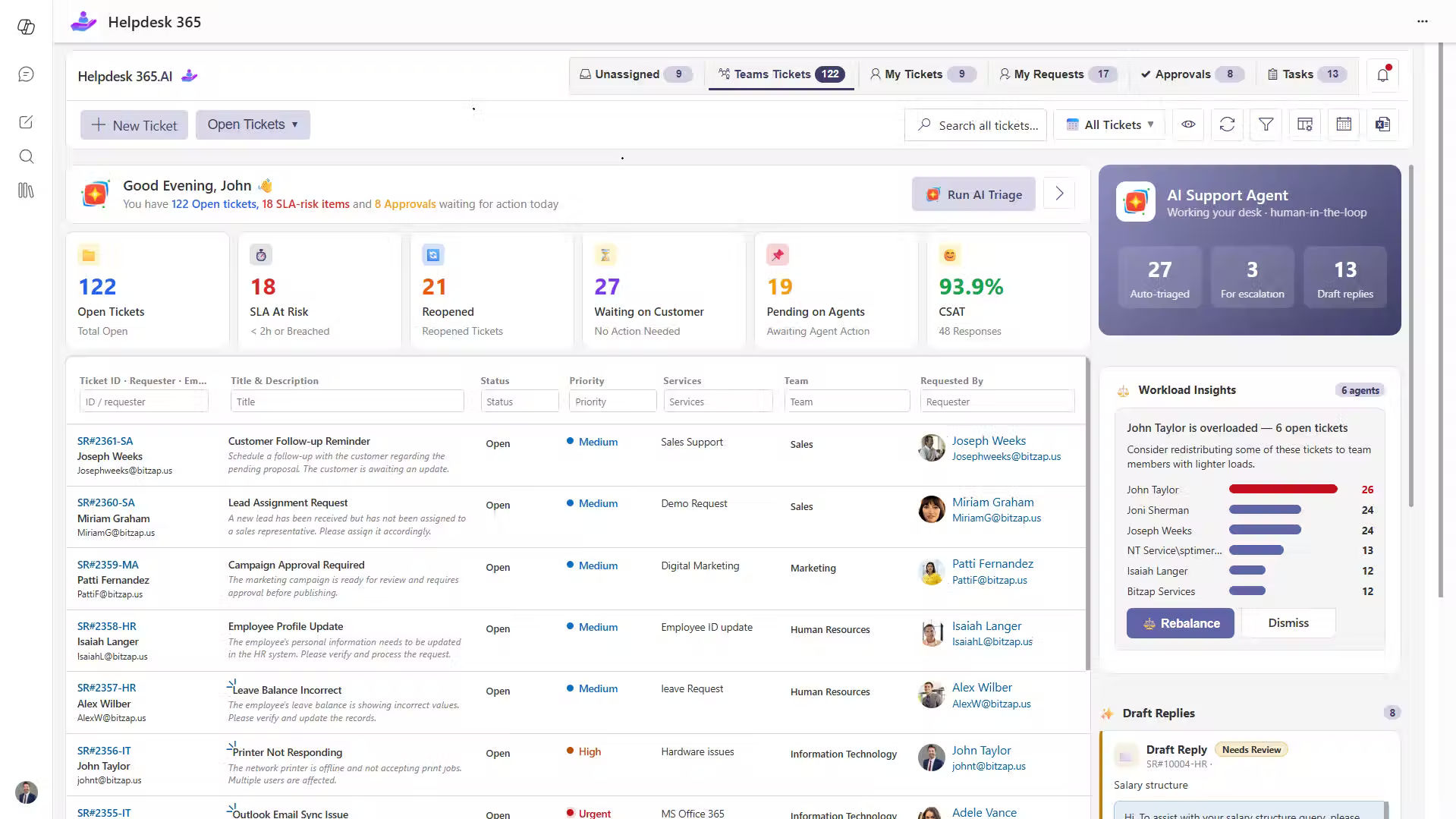
For organizations using Microsoft 365, SharePoint Helpdesk Software offers ticket management, workflow automation, and reporting tools within the Microsoft environment.
Teams can use it to capture requests, assign ownership, follow ticket activity, monitor SLAs, and identify work that needs attention. Automated notifications and routing can also reduce manual coordination.
Its reporting features help managers review trends in support operations and decide where to improve processes or train agents. These tools are especially relevant for internal IT and employee support teams already working in Microsoft Teams, Outlook, and SharePoint.
Want to Improve Support Performance in Microsoft 365?
See how Helpdesk 365 can help your team organize requests, track service targets, and manage day-to-day support work.
Conclusion:
Customer service objectives give teams a clear way to improve response speed, solve problems fully, and create better customer experiences. The best plans combine measurable targets with feedback from the people receiving support.
Choose the issues that matter most to your customers, set realistic goals, and review progress often. Keep an eye on both speed and quality so your team is not rewarded for closing tickets before problems are fixed.
Small, steady improvements can make support more dependable and help build stronger customer relationships
Join Our Creative Community
Frequently Asked Questions
What is the main objective of customer service?
The main objective is to help customers solve problems and get accurate answers with as little effort as possible. Timely, respectful support also builds trust and improves the overall customer experience.
What are the 3 most important customer service goals?
Three common priorities are increasing customer satisfaction, resolving issues efficiently, and keeping customers loyal. Teams can track these using CSAT, first-contact resolution, resolution time, and retention trends.
How do objectives differ from KPIs?
An objective explains the outcome you want, such as fewer repeat contacts. A KPI measures progress toward it, such as the first-contact resolution rate.
How often should support goals be reviewed?
Review fast-changing metrics such as backlog and SLA compliance each week. Review broader measures such as satisfaction, agent development, and retention monthly or quarterly, depending on the amount of data available.


























