
Contract Management KPIs: The Complete Guide for Every Team

Discover the metrics that matter, which teams own them, and how consistent measurement drives better contract outcomes across your organization.
- Contract management KPIs are quantifiable metrics used to evaluate the efficiency, compliance, and financial performance of your contract lifecycle — from initiation to renewal or expiration.
- Legal, procurement, finance, and sales teams each have distinct KPIs to track; alignment across these teams is what turns data into actionable contract intelligence.
- The most critical KPIs include contract cycle time, renewal rate, compliance rate, cost avoidance, and contract value leakage together they paint a full picture of contractual health.
- Platforms like CLM 365 centralize KPI tracking with dashboards, automated alerts, and AI-assisted reporting, reducing manual tracking effort by a significant margin.
What Are Contract Management KPIs?
Contract management KPIs are metrics used to evaluate how well an organization manages its contracts. They cover different processes of the contract lifecycle, including drafting, negotiation, approval, signing, renewal, and expiration.
- How long does it take to finalize a contract?
- What percentage of contracts auto-renew without review?
- How much revenue is lost due to missed milestones or unclear obligations?
For example, contract KPIs can answer questions such as:
- How long does it take to approve and sign a contract?
- How many contracts are renewed on time?
- Are all contract obligations being completed?
- How much contract value is being lost?
- How often do contracts differ from approved terms?
These metrics turn contract activity into clear data. Legal, finance, procurement, sales, and operations teams can then use that data to find problems and improve contract performance.
Why Are Contract Management KPIs Important?
Organizations may manage dozens or even hundreds of active contracts at the same time. Without clear KPIs, teams may struggle to understand which contracts need attention. Important deadlines, financial risks, compliance issues, and performance gaps can also be harder to spot. Contract management KPIs give teams a clear view of contract performance.
Here’s why tracking contracts matters at an organizational level.
Limitations
- Some users find the onboarding process lengthy
- Limited customization for complex approval chains
- Integration options may not cover every accounting or ERP system
Contract KPI Advantage | Business Impact |
Visibility into Risk Exposure | Spot contracts that do not follow standard terms and address potential legal or compliance issues before they create bigger problems. |
Improved Financial Accountability | Identify unnecessary costs, missed savings opportunities, and contract-related expenses that can impact profitability. |
Faster Decision-Making | Give teams access to accurate contract data so they can make quicker decisions and resolve issues without delays. |
Cross-Functional Alignment | Help legal, procurement, sales, and finance teams work toward the same goals using shared contract performance data. |
Stronger Vendor and Client Relationships | Monitor contract performance and recurring issues to improve communication, reduce disputes, and build stronger business relationships. |
Regulatory Readiness | Maintain clear records of contract compliance, making it easier to prepare for audits and meet industry regulations. |
Organizations that measure and actively track their contractual metrics routinely achieve a (30%-50%) reduction in contract cycle times.
Track all your contracts from one easy-to-use dashboard
Monitor expiry dates, renewals, and contract progress in real time. Get a clear view of what’s coming up and stay ahead of important deadlines.
Which Teams Track Contract Management KPIs?
Contract performance affects several departments. Each team may track different KPIs based on its responsibilities.
Legal Team
Tracks compliance, clause changes, contract cycle times, and legal risks.
Procurement Team
Reviews supplier performance, contract usage, cost savings, and cost avoidance.
Finance Team
Tracks contract value, payment terms, revenue leakage, and financial risks.
Sales Team
Reviews time to signature, renewal rates, contract wins, and customer-related metrics.
Operations Team
Tracks milestones, service commitments, vendor performance, and contract obligations.
Compliance Team
Reviews regulatory requirements, audit activity, reporting obligations, and policy compliance.
12 Important Contract Management KPIs to Track
Tracking the right contract management KPIs allows businesses to monitor performance, improve compliance, reduce delays, and maximize the value of their contracts.
1. Contract Cycle Time
Contract cycle time shows how long it takes to move a contract from the initial request to final signing.
It can include drafting, reviews, negotiation, revisions, approvals, and signatures.
A shorter cycle time usually means contracts are moving through the process more efficiently.
2. Contract Approval Time
Contract approval time shows how long a contract waits for internal approval.
Legal, finance, managers, and other stakeholders may need to review an agreement before it can move forward.
Tracking this KPI helps teams find approval stages that regularly cause delays.
3. Time to Signature
Time to signature tracks the period between the final contract draft and the completed signatures.
This KPI focuses only on the final stage of the contracting process.
A long signing period may point to stakeholder delays, approval requirements, or contract complexity.
4. Contract Volume Processed
Contract volume shows how many contracts are created, reviewed, approved, signed, or renewed during a specific period. It helps teams understand workload and available capacity.
Compare contract volume with cycle time and approval time to get a clearer picture of contract performance.
5. Contract Value Leakage
Contract value leakage is the difference between the expected value of a contract and the value the business actually receives.
Value may be lost through missed obligations, unused discounts, poor supplier performance, late payments, or missed renewals.
Tracking leakage helps teams protect the financial value of their agreements.
6. Cost Avoidance
Cost avoidance tracks expenses that a business prevents through better contract decisions.
Examples include negotiating better prices, removing unused services, changing contract negotiation strategies, or ending poor-performing agreements.
This KPI is especially useful for procurement and finance teams.
7. Savings Realization Rate
Savings realization rate shows how much of the negotiated savings a business actually receives.
For example, a supplier may agree to a discount during negotiation. The business must then confirm that the discount appears in actual invoices and payments.
A low rate may point to missed terms or contract execution.
8. Contract Compliance Rate
Contract compliance rate shows how many agreements are following their agreed terms and obligations.
This can include payment schedules, reporting requirements, service commitments, milestones, and delivery dates.
A higher compliance rate indicates that contractual commitments are being completed as agreed.
9. Clause Deviation Rate
Clause deviation rate shows how often contract terms differ from approved templates or standard clauses.
Some changes may be necessary during negotiation. However, frequent deviations can increase legal and commercial risk.
Tracking this KPI also helps legal teams find clauses that are regularly challenged.
Why manage clauses manually? When AI can handle them in minutes
10. Obligation Fulfillment Rate
Obligation fulfillment rate shows how many contractual commitments are completed on time.
These obligations may include payments, reports, project milestones, service commitments, or product deliveries.
This KPI helps teams understand how well contracts perform after signing.
11. Contract Renewal Rate
Contract renewal rate shows the percentage of expiring contracts that are renewed.
It can provide useful information about customer retention, supplier relationships, and the long-term value of agreements.
Teams should review this KPI together with contract renewal dates, contract value, and performance history.
12. Auto-Renewal Exposure
Auto-renewal exposure shows the value of contracts scheduled to renew automatically without a formal review.
Automatic renewal can prevent service interruptions. However, it can also extend outdated prices or unfavorable terms.
Tracking this KPI gives teams enough time to review important contracts before renewal.
Keep track of all your contracts in one dashboard
See contract performance, approval bottlenecks, and compliance trends at a glance. Know what’s slowing deals down and where action is needed.
How Tracking Contract Management KPIs Helps Businesses?
The business case for consistent KPI tracking goes well beyond operational efficiency. Organizations that invest in contract performance measurement see measurable returns across revenue, risk, and relationships.
1. Recovering Hidden Revenue
Many organizations lose potential revenue through missed billing opportunities, unused discounts, or contracts that renew under unfavourable terms. Financial KPIs such as contract value leakage and savings realization help identify these gaps. Tracking these metrics allows businesses to capture more value from their existing contracts.
2. Reducing Legal Risk
Compliance-related KPIs help legal teams monitor contractual obligations and identify potential issues before they become serious problems. They provide visibility into overdue deliverables, missed deadlines, and non-compliant activities. This allows organizations to address risks early and reduce the likelihood of disputes or penalties.
3. Accelerating Business Operations
Operational KPIs such as contract cycle time and approval time help businesses understand where delays occur during the contracting process. By measuring these metrics, teams can identify bottlenecks in reviews, negotiations, or approvals. Faster contract processing supports quicker business decisions and improved operational efficiency.
4. Strengthening Vendor and Client Relationships
Relationship-focused KPIs provide insights into how well contractual commitments are being met by all parties. Metrics such as renewal rates, dispute rates, and obligation fulfilment rates help organizations evaluate the health of their business relationships. This information can support more productive discussions and stronger long-term
5. Supporting Strategic Decision-Making
Contract KPIs provide leaders with data needed to evaluate contract performance and business risk. They help organizations understand trends related to contract value, renewals, compliance, and supplier performance. With access to reliable metrics, executives can make more informed decisions about future contracts and business priorities.
How CLM 365 Helps Track the Contracting Process?
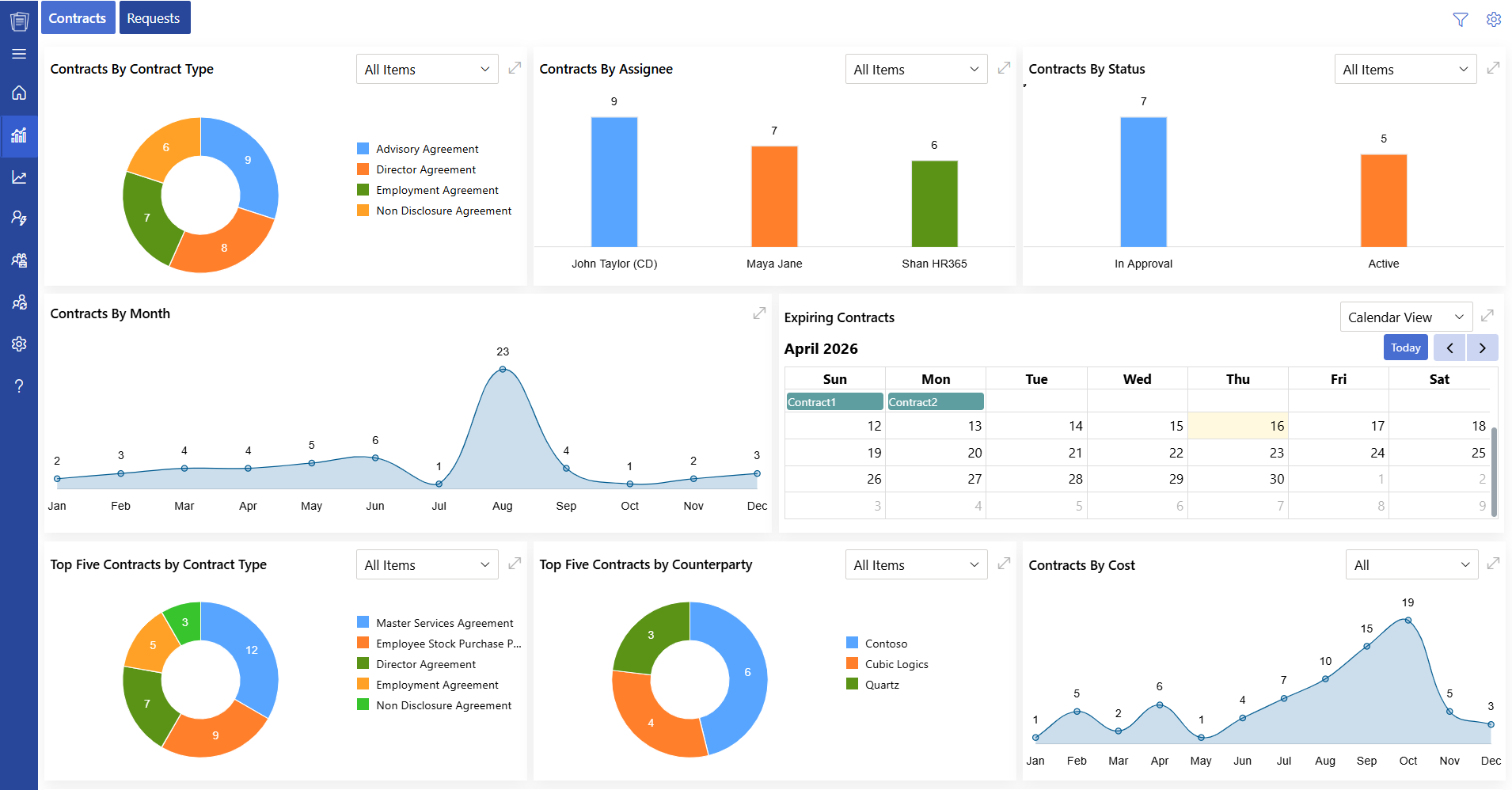
CLM 365 provides built-in Microsoft 365 apps that help organizations monitor contract performance, track key metrics, and gain visibility into the entire contract lifecycle.
Key capabilities include:
- KPI Dashboards: Review important contract metrics from a central dashboard.
- Milestone Alerts: Receive notifications for renewals, obligations, approvals, and important contract dates.
- AI-Assisted Contract Analysis: Review contract language, clauses, and obligations with AI-supported analysis.
- Role-Based Views: Give legal, procurement, finance, and sales teams information related to their responsibilities.
- Central Contract Repository: Keep contracts, amendments, and supporting documents together within Microsoft 365.
- Contract Reporting: Create reports for contract activity, compliance, audit records, and management reviews.
CLM 365 combines reliable contract management features with agentic AI, automated workflows, enterprise-grade security, backed by SOC 2 compliance and Microsoft certifications.
Conclusion
Successful organizations do not rely on assumptions when managing contracts. They use contract management KPIs to measure performance, monitor compliance, track financial outcomes, and identify areas that need attention throughout the contract lifecycle.
With clear visibility into contract performance, teams can make informed decisions, reduce risk, and maximize the value of every agreement.
Track contract management KPIs, monitor performance, and identify risks with CLM 365.
Book a demo today and see how CLM 365 helps you gain better control over your contract lifecycle.
Frequently Asked Questions
How often should contract management KPIs be reviewed?
Most contract management KPIs should be reviewed monthly, while strategic metrics such as renewal rates and contract value leakage can be reviewed quarterly. Regular reviews help identify trends and address issues early.
Can small businesses benefit from tracking contract management KPIs?
Yes. Contract management KPIs help small businesses improve compliance, reduce costs, monitor renewals, and gain better visibility into contract performance.
What is contract value leakage and why does it matter?
Contract value leakage is the gap between the expected value of a contract and the value realized. It matters because it can lead to lost revenue, missed savings, and reduced profitability.
How does a CLM platform improve KPI tracking compared to spreadsheets?
A CLM platform automates data collection, provides real-time dashboards, and tracks contract performance in one place. Unlike spreadsheets, it reduces manual work and improves reporting accuracy.
What is a good contract renewal rate benchmark?
A contract renewal rate above 80% is generally considered strong in many industries. However, the ideal benchmark depends on your industry, contract type, and business goals.


_JiluXJRGNl.svg)























