
_mVFFaHUZhS.webp)
AI onboarding is transforming the way companies receive and orient new employees. Companies are abandoning the use of fragmented emails, paperwork and manual follow-ups in favour of AI to provide structured, consistent and engaging experiences.
AI for employee onboarding automates paperwork, approvals, and training workflows, making the process faster and more organized. It reduces HR workload while improving compliance and consistency.
By delivering personalized guidance and real-time support, AI helps new hires feel confident, engaged, and productive from day one.
An effective onboarding program has direct effects on employee confidence, productivity and retention. Through AI, new employees are guided in time, learning is customized, and constant assistance is provided to them, which makes them feel part of the company and ready to work on the first day.
History of Employee Onboarding
Conventional onboarding approaches cannot match the dynamic workplaces of the modern world. Remote and hybrid teams are the new reality, and paper-based processes, distributed emails, and manual follow-ups cause confusion, delays, and inconsistent experiences.
The entire process is modernized through the use of AI, which brings structure, automation, and intelligence at each phase. Rather than reactive onboarding, companies can provide an active, guided experience that benefits the employees and the HR departments.
Onboarding, which is AI-driven, assists by:
- Substituting paperwork with automated electronic processes that minimize mistakes and time losses.
- Unify onboarding procedures in different departments to achieve uniformity and transparency.
- Decreasing the delays in accessing the system, approvals and completion of tasks.
- Having real-time visibility of the onboarding process to HR, managers, and employees.
- Providing reminders and instructions in time to ensure that no important step is missed.
With the introduction of intelligence, organizations do away with guess work and manual dependence. The outcome is a more predictable, smooth onboarding process in which new employees feel encouraged, educated, and prepared to work.
PwC Estimates that by 2026, 67% of large organizations are intending to use AI-assisted onboarding solutions to enhance consistency and efficiency.
Challenges of Traditional Onboarding
Onboarding is frustrating without automation to employees and HR teams. Manual processes are not structured and not visible, and it is difficult to provide a seamless, consistent experience.
Key challenges include:
- Delay in document and approval:
Manual approvals and paper-based forms are time-consuming and may need a follow-up on several occasions. These delays make new employees unable to use systems, tools, and resources at the time they are most needed.
- Lack of clear onboarding procedures that bombard new employees:
New employees often do not know what kind of tasks to perform, in which sequence, and at what time. Such ambiguity adds to stress and lowers confidence in the initial days.
- Much reliance on HR on repetitive queries:
HR teams waste much time responding to the same questions concerning policies, benefits, and procedures related to onboarding. In the absence of AI, this headache of repetitive work does not allow the HR to focus on strategic engagement.
- Poor team-to-team consistency in onboarding:
The various departments practice differently and this leads to disparities in experiences. Different employees can be given different degrees of guidance based on their team.
- Poor monitoring of progress and compliance:
It is difficult to track task completion, training status, and compliance requirements because of manual tracking. AI provides transparency with automated monitoring and real-time data.
Key Benefits of AI in Employee Onboarding
AI brings value to the organization through increased efficiency, consistency, and employee engagement. Rather than viewing onboarding as a single event, AI will provide a systematic experience that will help achieve success in the long term.
Key benefits include:
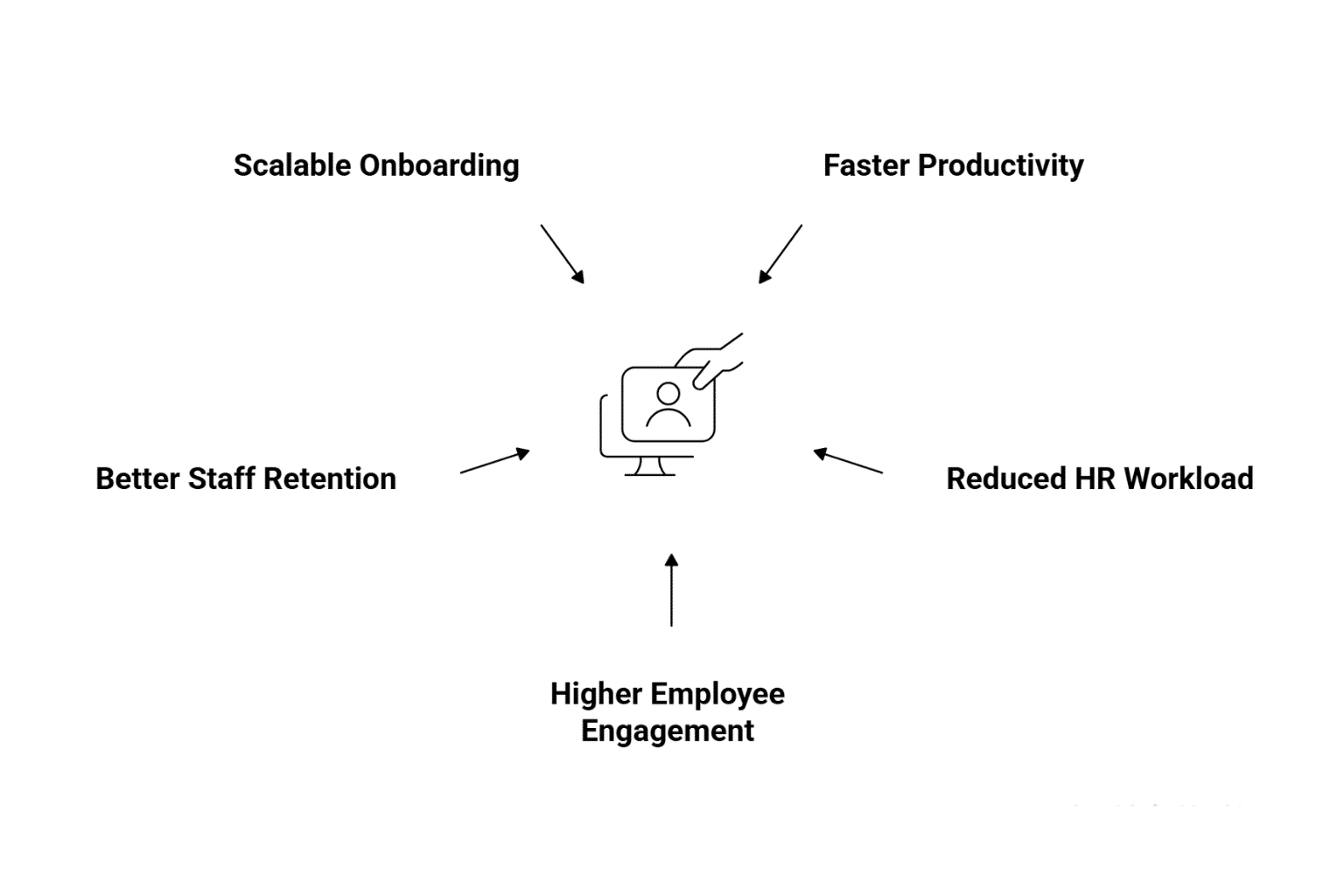
- Faster time to productivity:
The automated task tracking makes sure that new hires follow the correct sequence of steps and do it in a timely manner. The workflows, progress visibility, and reminders decrease the time spent on delays, thus employees will faster comprehend their duties and begin to contribute sooner.
- Reduced HR workload:
AI removes redundant administrative processes like document collection, approvals, and follow-ups. HR teams are able to work on engagement, culture and strategic initiatives.
- Higher employee engagement:
Individualized onboarding materials, interactive courses and live instructions ensure that employees are engaged. AI will ensure that onboarding is not dull and it minimizes information overload.
- Better staff retention:
An effective, friendly onboarding process makes the employees have confidence on the first day. Clarity and guidance will result in increased interest and commitment in the long term.
- Onboarding distributed teams at scale:
AI programs are departmental, geographical and time zone scalable. Global, remote, or hybrid teams are provided with a uniform experience without adding to HR work.
According to Gartner, onboarding enhanced with technology boosts the retention of new hires by 82% and speed of productivity onboarding by 2.5 times, confirming the importance of AI.
These advantages make AI onboarding a strategic asset, which includes building better teams, lowering turnover in the first year, and making a long-lasting first impression.
Best Practices AI for Employee Onboarding
The application of AI must be done thoughtfully in terms of automation and human touch. When used in a strategic manner, AI assists HR and improves the new hire experience, and does not eliminate personal interaction.
1. Automate high impact processes like paperwork, approvals and checklists
Begin automating monotonous administrative functions that retard onboarding. Online applications, online approvals, and checklists minimize mistakes and make sure that all new employees follow necessary procedures in due time.
2. Individualize role, department and experience onboarding experiences
Optimize the content with AI to ensure that the employees only see what is relevant. Training on the job, departmental instructions, and experience-based career paths assist new employees to learn more quickly and feel encouraged.
3. Integrate AI processes with management check-ins and mentoring
Where AI is involved in structure and automation, human interaction creates trust. Frequent manager check-ins, buddy programs and mentoring are supplementary to AI processes and help new employees feel welcome and supported both emotionally and professionally.
4. Continuous improvement through onboarding analytics
AI gives an understanding of completion rates, engagement rates and bottlenecks. HR departments are able to optimize processes, solve issues at the initial stage, and constantly enhance the onboarding process.
5. Combine AI tools with the current HR and collaboration tools
Onboarding remains on the daily workflow by seamless integration with HR systems, document management tools, and platforms such as Microsoft Teams. This minimizes the tool switching, enhances adoption, and centralizes communication.
Individualization With AI for Onboarding
Among the strongest features of AI, there is the creation of personalized experiences without the need to complicate the work of the HR teams. It is easy to scale onboarding with Copilot AI, as it is contextual, guided, and responsive.
Copilot AI enables:
- Context-based learning and task instructions
It displays pertinent tasks, documents, and learning materials according to role and level of onboarding.
- Suggestions based on progress
The Copilot AI suggests the next steps and supporting information as the new hires progress, and the process has a logical course. - Onboarding flexible schedules
It applies direction depending on task achievement and involvement, enabling the employees of varying experience to advance at their own pace.
- Role-congruent support and guidance
They are provided with specific support according to the responsibilities, policies, and tools and soon the employees know what is expected of them.
This will enable new employees to learn more quickly, remain supported, and feel confident at an earlier stage, which will make the process of onboarding new employees smoother on day one.
How AI Enhances the New Hire Experience
The early involvement is essential to success in the long-term. The initial weeks determine impressions of the job, group, and company. Absence of organization or assistance diminishes self-esteem in a short time.
AI will increase the engagement and confidence levels by ensuring clarity, consistency, and timely support during the journey:
- Give explicit task lists and workflow
The new employees are presented with a step-by-step perspective of the activities, dates, and causes. This helps them minimize guessing and remain focused on learning.
- Provide immediate help with chatbots
AI chatbots respond to policy, tool and on-boarding queries in real-time. Real time assistance reduces aggravation and dependency on HR.
- Monitor progress to encourage completion
Status updates and visual progress indicators provide a feeling of achievement, which increases motivation.
- Eliminate doubt in the initial weeks
New employees are maintained with regular instructions, frequent reminders, and convenient access to information, which enhances confidence and a smoother process.
Feeling oriented and facilitated at the beginning, employees will be more involved in their job, will work collaboratively, and develop better relationships with the organization.
Say Goodbye to Manual Onboarding Try 14 days trial
Assuring AI Compliance and Accuracy
Paper-based compliance tracking is associated with omissions in the process, slow approvals, and inaccurate records. Such gaps add pressure and risk to HR.
AI enhances compliance and accuracy through developing coherent, transparent, and reliable processes that make sure that each step is fulfilled properly and at the right time.
- Automate the collection and approvals of documents
Approvals, forms, and documents are assigned, collected and tracked automatically – removing follow-ups and errors.
- Register policy recognition and training accomplishment
AI keeps track of the time employees access the policies and complete the required training, so that no compliance requirement is neglected.
- Ensure uniform onboarding practices in departments
Standardized work flows ensure that all departments operate under the same processes and provide homogeneous experiences.
- Minimize audit risks by real-time monitoring
Dashboards give a view of the progress and the tasks to be done and gaps can be easily identified and regulatory and company standards achieved.
The use of AI-based compliance tools will minimize errors, provide a predictable experience, and increase confidence, productivity, and satisfaction.
Remote and Hybrid Onboarding Support
Remote and hybrid onboarding must be well structured, clear, and easily accessible. New employees become alienated without face-to-face instruction. AI guarantees a seamless, standardized, and interactive experience between locations.
Remote onboarding is powered by AI because it:
- Fully digital workflows
Everything is done online; documents and approvals are completed digitally, allowing tasks to be finished efficiently from anywhere.
- Training and resources on demand
New hires can access role-specific training, policies, and materials whenever needed, supporting various time zones and learning speeds.
- Time zone automated reminders
AI sends notifications for assignments, approvals, and training, reducing delays and keeping teams on track.
- Uninterrupted connectivity to collaboration tools
Integration with Microsoft Teams, Outlook, and project management tools ensures new employees stay in familiar environments, promoting productivity and cultural integration.
According to LinkedIn Global Talent Trends 2024, onboarding using digital and AI technologies results in higher engagement and shorter ramp-up times. Structured onboarding helps remote and hybrid employees integrate into the organization as quickly as possible.
Conclusion
AI for employee onboarding automates paperwork, automates workflows, and delivers personalized guidance from day one. It reduces HR workload, improves compliance, and helps new hires become productive faster. In today’s remote and hybrid workplaces, AI-driven onboarding ensures a consistent, engaging, and efficient experience for every employee.
Join Our Creative Community
Frequently Asked Questions
What are the best AI onboarding tools that would fit my organization?
People often find AI onboarding resources that can automate business processes, personalize the learning process, and increase the interaction between new employees working remotely and in offices.
How can the onboarding of employees be automated to reduce the burden on the HR staff?
HR people want to know how automation can maximize repetitive processes like documentation, approvals, and training surveillance, and thus teams are able to focus on strategic goals.
In what ways can the integration of AI improve the staffing procedure?
The most frequent questions posed by numerous stakeholders are how AI can provide guided workflows, personalized learning paths, real-time progress monitoring and compliance monitoring.
Are employee onboarding by large and small organizations truly using AI?
It is often demanded by future buyers that they be shown practical examples or statistical data that show that the adoption has been adopted in businesses of different sizes and they have been shown to result in improvements in efficiency, engagement, and retention.
What are the most distinguished employee onboarding solutions, which have AI to their advantage?
The users are interested in end-to-end platforms that combine automation, analytics, and collaboration systems to provide a unified and seamless onboarding experience to the new employees.


_JiluXJRGNl.svg)























