
How AI Agents for Contract Management Transform Legal Operations

- An AI agent for contract management can read, review, and flag issues in contracts automatically, cutting down the hours spent on manual checks.
- Research from McKinsey, Goldman Sachs, and legal industry groups shows that AI adoption in legal work is growing fast, with numbers reaching 78% to 83% across business functions.
- AI powered contract management tools are different from basic automation because they can make decisions, not just follow fixed steps.
- Platforms such as Microsoft 365 and CLM 365 give legal teams a secure, connected way to manage contracts from drafting to signing.
Contracts sit at the center of every business deal. They protect both sides, set clear rules, and keep money moving. But most legal teams still handle contracts the old way, with long email threads, printed drafts, and manual reviews that eat up hours every week.
This is where an AI agent for contract management changes the game. Instead of relying only on people to read, track, and approve every clause, companies now use smart software that can review contracts, flag risks, and speed up approvals on its own.
In this blog, we will break down what an AI agent for contract management actually does, why the old way of handling contracts is falling behind, and how tools like Microsoft 365 and CLM 365 are helping teams work smarter.
Understanding AI Agent for Contract Management
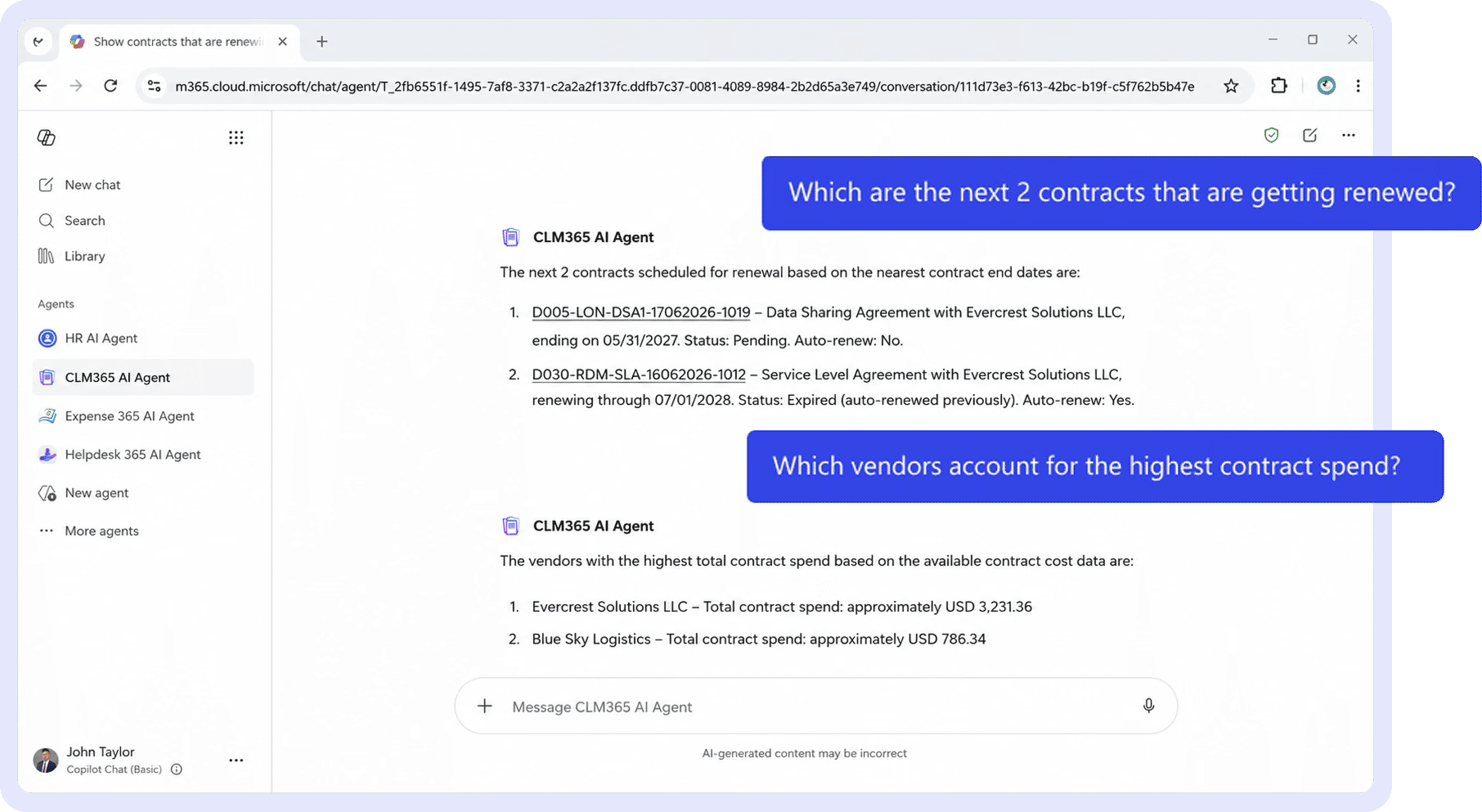
An AI agent for contract management is a software tool built to handle contract tasks with little human input. It does not just store files or send reminders. It can read a contract, understand the language inside it, compare it against company rules, and point out clauses that need attention.
Think of it as a digital assistant that never gets tired of reading fine print. AI can summarize hundreds of pages in minutes, something that would take a person days to finish. This kind of ai for managing contract work is built on natural language processing, machine learning, and rules that legal teams set up in advance.
How Do AI Agents Work in the Contracting Process?
AI agents follow a step-by-step process, but they do it much faster than a human team. Here is how it usually plays out.
- Intake and drafting – The agent pulls information from a request form or template and builds a first draft of the contract.
- Clause analysis – It scans the document and compares each clause against a playbook of approved language.
- Risk flagging – If it finds language that does not match company standards, it marks the section and explains why.
- Routing for approval – The agent sends the contract to the right person based on value, department, or risk level.
- Negotiation support – During back-and-forth edits, the agent tracks changes and suggests alternative wording based on past deals.
- Signature and storage – Once approved, it sends the contract for e-signature and files it in a searchable system.
This process runs on data. The more contracts an agent reviews, the better it gets at spotting patterns and risks. Over time, it learns what a “normal” contract looks like for a company and what looks off.
Why the Traditional Contracting Process No Longer Works?
The old way of managing contracts was built for a slower business world. Paper contracts, printed redlines, and manual filing made sense when deal volume was low. That is not the case anymore.
Today, companies sign more contracts, with more vendors, across more regions, than ever before. A legal team that relies only on manual review simply cannot keep pace. Deals get delayed. Renewal dates get missed. Important clauses get buried in long documents that nobody has time to read closely.
Business leaders now expect deals to close in days, not weeks. Customers want fast answers. Vendors want quick sign-off. The traditional process, built around slow manual steps, cannot meet these expectations. This gap is exactly why companies are turning to AI contract management software tools that can keep up with modern deal speed.
Challenges in the Manual Contract Review Process
Manual contract review comes with real problems that cost companies time and money.
- Slow turnaround times. A single contract can pass through five or six people before it is signed, and each handoff adds delay.
- Missed deadlines. Renewal dates, payment terms, and termination windows are easy to lose track of in spreadsheets or shared drives.
- Inconsistent language. Different team members may approve different wording for similar deals, creating gaps in legal protection.
- Limited visibility. Leaders often cannot see how many contracts are stuck in review or where the bottlenecks are.
- High cost per contract. Legal teams spend billable hours or internal staff time on tasks that add little strategic value, like formatting or basic clause checks.
These problems build up over time. A company signing hundreds of contracts a year can lose weeks of productivity to steps that add no real value.
What Research and Legal Professionals Are Saying About AI Agents
The shift toward AI in legal and business work is not just talk. Recent data backs it up.
- 83% of companies claim that AI is a top priority in their business plans.
- In the latest survey by McKinsey, 78 percent of respondents say their organizations use AI in at least one business function.
- With 79% of law firm professionals now incorporating AI tools into their daily work, corporate legal departments are being even more proactive in adopting AI technologies.
- Goldman Sachs estimates that 44% of current legal work tasks could be automated by AI, compared to an average of 25% across all industries.
- A study from ALM and Bloomberg Law found that contract-related tasks make up at least half of the daily work for more than 4 in 10 corporate counsel, at 43%.
These numbers point to one clear trend: legal work is shifting from manual review to AI-assisted review, and contracts are one of the biggest areas where this shift is happening.
How AI Agents Improve Contract Workflows in a Competitive Marketplace
Businesses today compete on speed as much as price. A company that can close a deal faster often wins the deal. AI agents for contract management give legal and procurement teams an edge in a few clear ways.
- Faster review cycles. Contracts that used to sit in a queue for days can now get a first-pass review in minutes.
- Consistent standards. Every contract gets checked against the same playbook, so approved language stays consistent across teams and regions.
- Better use of legal talent. Lawyers spend less time on routine checks and more time on complex negotiation and strategy.
- Clear tracking. Leaders can see exactly where each contract sits in the process and which ones need attention.
- Lower risk exposure. Automated checks catch missing clauses or risky terms before they become a legal problem.
Companies that use an AI agent for contract management can move faster on deals without giving up legal protection. That combination is hard to beat in a market where speed matters.
Your next contract shouldn’t wait on another manual review.
Let CLM 365’s AI agent handle the repetitive work review contracts, surface risks, and accelerate approvals.
AI Agent vs. Agentic AI: What's the Difference for Legal Teams?
These two terms get used a lot, and they are often mixed up. Here is a simple breakdown of how they differ.
Feature | AI Agent | Agentic AI |
Definition | A single tool built to handle one task or a small set of related tasks | A broader system made up of multiple AI agents working together toward a goal |
Scope of work | Focused, such as reviewing a contract clause or routing an approval | Wide, such as managing an entire contract lifecycle from request to renewal |
Decision-making | Follows set rules and flags issues for a human to decide | Can plan steps, adjust its approach, and make some decisions without waiting for human input at every step |
Best used for | Specific legal tasks like clause comparison, redlining, or risk flagging | End-to-end processes like full contract lifecycle management across departments |
Human involvement | Regular check-ins needed at key steps | Less frequent check-ins, since the system handles more of the process on its own |
For most legal teams, the goal is not to choose one over the other. A single AI agent might handle contract intake, AI for contract management manages the full lifecycle, connecting that agent with others that handle approvals, e-signatures, and renewals.
Benefits of Embracing AI Agent for Contracting Workflows
Legal and business teams that adopt an AI agent for contract management see gains across several areas.
- Save valuable time: Tasks that once took hours, such as comparing a contract against a playbook or reviewing standard clauses, can now be completed in minutes. Teams spend less time on repetitive reviews and more time on strategic legal and business initiatives. An AI contract analysis tool improves productivity across the entire contract lifecycle.
- Reduce operational costs: AI minimizes the time spent on routine contract reviews and administrative work, helping organizations make better use of existing resources. Legal, procurement, and operations teams can handle more contracts without increasing overhead. The result is greater efficiency and a stronger return on investment.
- Strengthen compliance: AI applies the same policies, approval rules, and contract compliance checks consistently across every contract. This reduces the risk of missed clauses, policy violations, and costly human errors. Organizations can maintain higher governance standards with greater confidence.
- Accelerate deal cycles: Contracts move through drafting, review, negotiation, and approval much faster with AI-assisted contract review. Sales and procurement teams can finalize agreements sooner and respond quickly to business opportunities. Faster turnaround helps improve customer experience and supports revenue growth.
- Maintain organized contract records: Every contract, along with its version history, approval trail, comments, and supporting documents, is stored in a centralized, searchable contract repository. Teams can quickly locate the information they need without searching through emails or shared folders. This improves collaboration, simplifies audits, and makes contract management more reliable.
- Scale with confidence: As contract volume grows, integrating AI agents can process additional agreements without requiring the same pace of hiring. Organizations can support business growth while maintaining speed, consistency, and quality across every contract. This allows teams to expand operations without adding unnecessary complexity.
Data Security and Confidentiality in AI Contract Analysis
One of the most common questions organizations ask before adopting AI for contract management is: “Is our contract data secure?” Since contracts contain sensitive legal, financial, and business information, protecting that data is a critical requirement for every organization.
With CLM 365, AI contract analysis takes place within your existing Microsoft 365 environment, allowing contract data to remain stored in your organization’s own Microsoft tenant. Organizations can leverage AI to analyze contract language, identify risks, extract key clauses, and summarize agreements while maintaining control over their contract data.
Is contract data sent to ChatGPT?
No. CLM 365 does not send your contract data to public AI services such as ChatGPT by default. You choose which AI provider your organization uses, and AI requests are processed only through your approved provider in accordance with your organization’s security and governance policies.
Does AI train on our contracts?
No. Your contracts are never used to train public AI models. AI processes contract content only to complete the requested task, such as generating summaries, explaining clauses, identifying risks, or extracting key information. Your contract data remains under your organization’s ownership and control.
By leveraging Microsoft’s enterprise-grade security infrastructure, organizations continue to benefit from existing access controls, compliance policies, audit logs, and governance standards.
Your data security matters as much as AI features
The value of AI depends on how well it protects your data. CLM 365 keeps your contract data under your control and does not send it to public AI services such as ChatGPT by default.
How Microsoft 365 Apps Powers AI-Driven Contract Management?
Microsoft 365 gives legal and business teams a strong base for contract work, because it connects the tools people already use every day. MS Word, Outlook, Teams, and SharePoint all work together, which means contract drafts, approval emails, and stored files stay in one connected environment instead of scattered across separate systems.
Microsoft Copilot, built into these apps, adds AI support directly where legal teams already work. A lawyer drafting a contract in Word can get suggestions on clause language. A manager reviewing a deal in Teams can ask questions about contract terms without leaving the chat. SharePoint keeps a secure, searchable record of every contract version.
This setup matters because it removes the need to jump between separate platforms. Legal teams get AI support inside familiar tools, which shortens the learning curve and keeps adoption high across the company.
How CLM 365 Simplifies the Entire Contract Review Process?
CLM 365 builds on the Microsoft 365 foundation to give legal teams a complete contract lifecycle management system. It covers every stage, from the first request to final renewal, inside one connected platform.
Here is how it changes the day-to-day contract review process.
- Automated intake forms collect the right details from the start, so contracts do not get sent back for missing information.
- AI-based clause review checks language against a legal playbook and flags anything that does not match approved standards.
- Smart routing sends each contract to the correct approver based on deal size, risk level, or department, cutting out manual handoffs.
- Built-in e-signature lets teams finish deals without switching to a separate signing tool.
- Renewal tracking alerts teams ahead of key dates, so contracts do not expire or auto-renew by accident.
- Searchable contract repository stores every signed document with full version history, so teams can find any contract in seconds.
Because CLM 365 runs on Microsoft’s security framework, legal teams get strong data protection without needing a separate vendor for compliance. This combination of AI review, workflow automation, and built-in security makes CLM 365 a strong option for companies that want to modernize contract management.
Conclusion
The way companies handle contracts is changing fast. Manual review, paper trails, and slow approval chains cannot keep up with today’s deal volume or business speed. An AI agent for contract management gives legal and business teams a faster, more consistent way to draft, review, and approve contracts, backed by data that shows this shift is already well underway across the legal industry.
Ready to modernize your contract management? Discover how CLM 365 helps your teams automate contract analysis, accelerate approvals, and manage the entire contract lifecycle within Microsoft 365. Book a demo to see AI-powered contract management in action.
Frequently Asked Questions
What types of contracts can AI analyze?
AI can analyze a wide range of contracts, including vendor agreements, sales contracts, NDAs, employment agreements, service contracts, procurement contracts, lease agreements, and customer contracts.
Is it safe to use AI for managing contract data?
Yes, as long as the platform uses strong encryption, access controls, and audit logs. Companies should check vendor security standards like SOC 2 before adopting any AI contract tool.
Can AI agents replace lawyers?
No. AI agents handle routine tasks like clause checks and approval routing. Complex negotiation, legal strategy, and final decisions still need a human lawyer.
What is the difference between an AI agent and agentic AI in contract work?
An AI agent handles a specific task, like reviewing a clause. Agentic AI refers to a broader system of multiple agents working together to manage an entire process, like the full contract lifecycle.


_JiluXJRGNl.svg)























