
What is a Contract Management Dashboard? Why Does It Matter?

Every contract holds value. It establishes payments, time limits, responsibilities and legal safeguards. However, once the contracts are stored in the emails, folders, and spreadsheets, it becomes difficult to see what is active, what requires attention, and what is expiring.
Looking for a simple way to track and manage all your contracts? A contract management dashboard gives a centralized view of contract status, approvals, deadlines, and key actions. It helps teams speed up approvals, avoid missed deadlines, and stay in full control.
The contract management dashboard that presents contract data in a single view. It provides teams with a clear understanding of the status of the contract, timelines, and responsibilities without having to search through various systems.
WCC reports that 9.2% annually of revenue is lost because of mismanagement of contracts.
This demonstrates the importance of having a good contract dashboard that provides visibility and control of all contracts.
What Is a Contract Management Dashboard?
A contract dashboard is a visual display that presents the essential contract information at a single location. It shows the status of the contract, expiry dates, approval status, and assigned duties through charts, lists, and metrics.
Users can view all the contract information on a single screen as opposed to opening several files.
A contract dashboard assists businesses:
- See all current and dormant contracts
- Monitor approval progress
- Follow-up renewal and expiry dates
- Ownership and liability of check contracts
It acts as a central control panel for contract management.
Most of the modern dashboards belong to the contract lifecycle management software such as CLM 365, which integrates contract creation, approval, storage, and tracking into a single platform.
Why Is a Contract Management Dashboard Important for Modern Businesses?
Contracts have an impact on finance, legal, procurement, HR, and operations. Businesses can lose revenue, deadlines or even risk compliance without proper visibility. Contract management dashboard assists businesses to become more visible, controllable, and make better decisions. The following are the reasons why it is important.
1. Improves Visibility Across All Contracts
Most organizations keep contracts in emails, localdrives and cloud folders and therefore it is hard to determine the actual number of contracts and their status. Such lack of visibility may delay decision-making and tracking of contracts. This is addressed by a contract management dashboard which shows all the contracts in one place. This full transparency makes teams aware of contract activity promptly and act in time where necessary.
2. Helps Identify Expiring Contracts on Time
Missing contract expiry dates may lead to loss of revenue, interruption of services or unwanted auto-renewals that may tie businesses in poor terms. A contract management dashboard will also highlight contracts that are yet to expire to allow teams to look at them and act before they run out. Thisassists businesses to renew significant contracts in time, examine vendor agreements appropriately, and prevent undesirable renewals.
3. Improves Contract Process Effectiveness
Contract management is an issue that isencountered by many organizations. As a matter of fact, 89% of organizations do not believe that their contracting process is very effective. This usually occurs due to low visibility, manual tracking systems and lack of a centralized system. Contract dashboard enables teams to monitor progress with ease and accomplish the contract activities without delays.
4. Helps Reduce Operational Costs
Operation costs are directly affected by contract management.Weshare states that 2% of yearly expenses can be saved by organizations due to the management of contracts. A contract management dashboard assists companies in saving money by giving them insight into the contract timelines and terms. This enhanced tracking assists the businesses to save unnecessary costs and control contracts in a better manner.
5. Supports Better Decision Making
Contract dashboard offers real-time contract data in charts, metrics, and visual reports. This enables the leadership and management teams to comprehend the performance of contracts in a short period. They can view the number of contracts in operation, those contracts that are about to expire and distribution of contracts by departments.
Key Metrics to Track in a Contract Management Dashboard
| Metric | What It Does | Why It Matters |
| Total Contracts | Shows total number of contracts stored in the system | Helps measure contract volume |
| Average Contract Approval Time | Shows how long contracts take to move from request to final approval | Helps measure approval efficiency |
| Expiring Contracts | Identifies contracts that are approaching their expiration date | Helps teams act before contract deadlines |
| Helps identify compliance risks | Displays contracts that Displays the number of contracts created weekly, monthly, or yearly | It tracks contract growth trends |
| Contracts by Status | Categorizes contracts based on their stage such as draft, under review, approved, or active | Assists teams monitor contract progress and approval stages |
| Overdue Obligations | Shows contract responsibilities that were not completed on time | It identifies compliance risks |
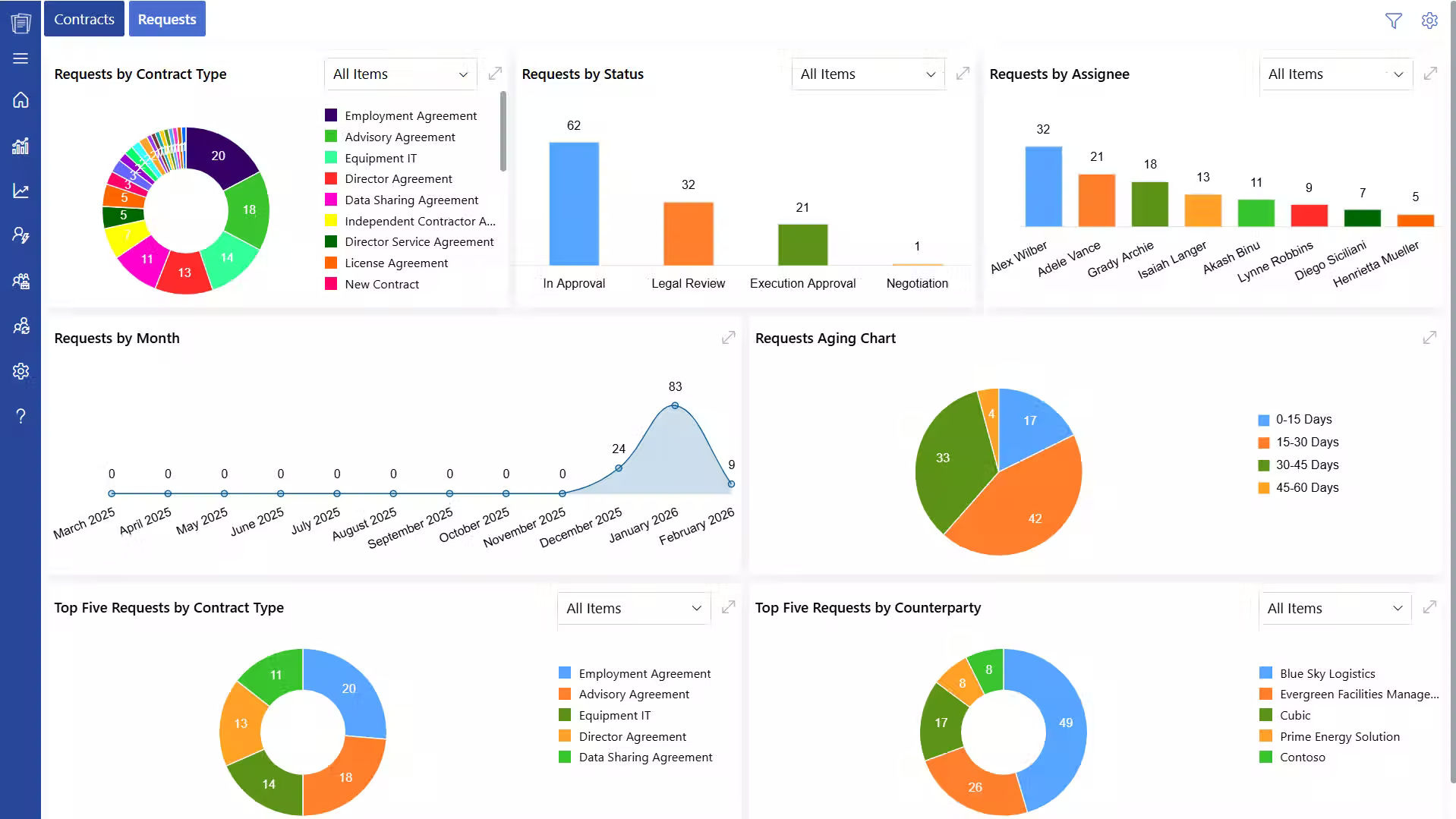
| Request Aging | Displays how long contract requests have been open or pending in the system | It identifies delays and improve request processing speed |
Features of the CLM 365 Contract Management Dashboard
The CLM 365 contract management dashboard is a centralized and visual interface that assists businesses to monitor and track contracts through their lifecycle. The main characteristics of the CLM 365 contract management dashboard are listed below.
1. Contracts by Status
The contracts by status feature allows a clear picture of the status of each contract in its lifecycle. Each contract passes through various phases which include draft, under review, approved, active and expired. The CLM 365 contract management dashboard graphically presents the contracts according to these stages and thus it is easier to track the progress of the contracts.
2. Contracts by Type
Different kinds of contracts are handled in organizations based on the business activities. These can be vendor agreements, employee contracts, client agreements, service contracts and lease agreements. The CLM 365 contract dashboard classifies contracts into various categories, which enables users to see the distribution of contracts in various categories. This option assists companies to know the quantity and significance of each category of contract.
3. Expiring Contracts
The Expiring Contracts feature highlights contracts that are approaching their expiration date. This allows users to review contracts before they expire and take necessary action such as renewal, extension, or termination. The CLM 365 contract management dashboard presents expiring contracts in a dedicated view so users can identify upcoming deadlines without searching through all contracts.
4. Manage Obligations
Managing the contract requirements is critical in ensuring that the terms of the contract are met and the business is not disrupted. Most organizations have difficulties in monitoring contract duties and research indicates that 40% of organizations are unable to monitor who oversees particular contract duties. This is solved through the CLM 365 contract management dashboard which gives a clear picture of all the obligations and owners of the contract.
5. Request View
Request view gives full visibility of all the contract requests in the organization. It shows requests of contracts submitted to approved and enables users to monitor the progress of the contract and the timelines of requests. The aging of the requests is also shown in the contract management dashboard and it assists the users to know the duration each request.
Benefits of Using a Centralized Contract Dashboard
A centralized contract dashboard assists companies to have complete visibility and control of their contracts. The following are the major advantages of centralized dashboard in managing contracts.
1. Centralized Contract Visibility
Centralized contract visibility enables businesses to see all the agreements at a single place rather than having to search through emails, shareddrives or disconnected systems. Weshare says that due to contract management, organizations can save 2% of annual costs. This demonstrates that visibility is a significant aspect in minimizing unnecessary costs. When businesses can see renewal dates, payment terms, and contract status clearly, they can avoid unwanted renewals.
2. Improved Team Accountability
Contracts should be managed by clear ownership. Lack of visibility of businesses regarding contract responsibilities may lead to ignoring of important tasks and deadlines. Research indicates that 95% of organizations lack complete visibility of contractual obligations, and this explains the need to have a centralized perspective of contract responsibilities.
3. Better Compliance Monitoring
Contractscontain significant requirements, conditions, and timelines that companies have to adhere to. The failure to adhere to these requirements may affect business activities and legal practice. A dashboard with a centralized location assists the teams in monitoring the contract obligations, renewal dates, and milestones.
Contract management dashboard enables organizations to be more efficient in tracking obligations and deadlines.
4. Improved Team Accountability
Clear ownership is essential for proper contract management. In the case where the responsibilities of the contract can be seen, teams are aware of who will review, approve, and manage every contract. Contract dashboard shows the owners of the contract and the users assigned to it which makes the responsibilities clear.
A contract management dashboard assists the managers in monitoring the team activities and tracking contract activities.
5. Reduced Revenue Loss
Contracts tend to be financial, payment and renewal terms. The lack of renewal dates or neglect of terms of the contract may lead to the loss of revenue or business. A centralized dashboardassists the businesses to monitor timelines of the contracts and financial agreements. Through a contract management dashboard, companies can know when the contracts are expiring, the value of the contract, and act on them before the expiry dates.
6. Improved Contract Planning
Acontract dashboard is used to give information on contract trends, contract volume, and contract timelines. Businesses can see the number of contracts that are created, renewed or closed during a given time. This assists teams to know the activity of the contracts and make plans on the future contracts.
7. Faster Decision Making
Real-time contract data helps in making informed decisions by the leadership and management teams. CLM 365 will give real-time access to the contract metrics like the status of the contract, the contract value and the approval progress.
A contract management dashboard enables decision-makers to analyse the performance of the contract in a fast manner and to determine the areas that need to be addressed.
Common Challenges Solved by a Contract Management Dashboard
Contracts tend to contain certain duties of various individuals or teams. In cases where ownership is not observable, it may be hard to track the party in charge of the contractual obligations. This enhances improved accountability and assists organizations to handle contract requirements in a superior manner.
1.Lack of Contract Visibility
In the absence of appropriate reporting tools, the trend of contracts, the amount of contracts, and contract performance may be hard to comprehend. Companies might lack a clear understanding of their contract activity. A contract management dashboard is a visual tool that gives users an insight and metrics of the contract status, timelines, and contract performance.
2. Missed Contract Expiry Dates
Contract expiry dates are critical for maintaining business relationships and avoiding unwanted renewals or service interruptions. Without proper visibility, expiry dates may go unnoticed. A contract management dashboard helps by displaying upcoming expiration dates clearly, allowing teams to review and act in advance. This supports better contract planning and helps businesses maintain continuity in their agreements.
3. Limited Contract Tracking
Tracking contracts manually can make it difficult to monitor contract progress and identify contracts that require attention. Teams may need to review multiple files to understand contract status. A contract management dashboard provides real-time visibility into contract progress, making it easier to track contracts from creation to completion. This helps users stay informed about contract activity and monitor contract timelines more effectively.
4. Delays in Contract Approvals
Contract approvals often involve multiple stakeholders, and without clear visibility, approvals may take longer than expected. This can slow down contract execution and business operations. A contract management dashboard provides a clear view of contract approval stages, helping teams identify contracts that are pending review or approval. This allows stakeholders to take timely action and supports faster contract processing.
5. Difficulty Tracking Contract Responsibilities
Agreements often include specific responsibilities assigned to different individuals or teams. When ownership is not clearly visible, it can be difficult to monitor who is responsible for managing contract duties. A contract management dashboard provides visibility into contract ownership and assigned responsibilities, helping teams stay aware of their roles. This supports better accountability and helps organizations manage contract obligations more effectively.
How CLM 365 Contract Dashboard Helps Businesses?
CLM 365 is a built-on Microsoft ecosystem, which is integrated with SharePoint, MS Teams, Outlook, MS Word, Power BI, Power Automate and MS Copilot. It’s known for it’s enterprise-grade security, user-friendliness, AI-driven automation, and automated contract processes. Its centralized contract management dashboard assists teams to analyse contract data, contract status and contract timelines in a structured format, which facilitates greater productivity and quicker access to valuable contract data.
The dashboard enables businesses to monitor contract lifecycle, contract expiry dates, and contract obligations at a single interface. This will keep legal, procurement, HR, and finance teams up to date and act in time when necessary. It also offers real-time contract insights, contract performance visibility, and contract tracking capabilities, which assist the leadership to know the contract activity and make sound business decisions.
Conclusion
Contract management dashboard assists businesses to view, monitor and manage contracts all in a single location. It gives a clear picture of contract status, expiry dates, approvals and responsibilities. This enables teams to remain updated, act in time and ensure improved departmental contract performance.
Explore CLM 365 contract management dashboard to have complete visibility and control of your contracts. The 14-day free trial is a great place to begin and see how CLM 365 can assist your teams.
Join Our Creative Community
Frequently Asked Questions
How does a contract management dashboard improve contract workflow?
Contract management dashboard simplifies contract management processes easier because it gives a clear view of approvals, renewals, and other important tasks that teams need to finish within the stipulated time.
Can multiple users access the contract dashboard at the same time?
Yes, the dashboard allows multiple users, which means that teams can see the contract updates, monitor the progress, and collaborate effectively.
What types of reports are available in a contract management dashboard?
The dashboard enables the users to monitor the contract activity by reporting on the status of the contract, the contract timelines, contract renewals, contract obligations, and contract performance.
Is it possible to customize the contract dashboard?
Yes, the dashboard can be customized to display certain contract data, metrics and views depending on business needs.
How does the CLM 365 contract dashboard support contract categorization by type?
The dashboard organizes contracts by type, including vendor, client, or employee contracts, which allows users to see the distribution of contracts and follow them more efficiently.
How can users identify key counterparties using the contract dashboard?
The dashboard identifies counterparties that are related to the most contracts, which enables users to identify key partners and track contract relationships without any difficulties.
Table of Contents

Trusted by the Best

_JiluXJRGNl.svg)























