
_eH2jDg7dZ.png)
AI-powered performance management software helps HR teams automate reviews, turn scattered feedback into clear summaries, set measurable goals, spot development gaps, and make performance conversations more data-driven. Instead of relying only on a once-a-year review form, these tools use AI to read feedback, highlight patterns, draft goals, and give managers talking points before every 1:1.
- AI is shifting performance management from annual reviews toward continuous, data-driven feedback.
- Leading platforms use AI for review summaries, goal creation, performance insights, coaching, and employee development — not for making employment decisions.
- The best software depends on company size, HR workflows, existing integrations, and how much AI support your managers actually need.
- AI should support manager judgment, not replace it — the most trustworthy tools keep a human in the loop.
This matters because performance management has quietly become one of the most AI-friendly areas of HR. Reviews, goals, and feedback are all text-heavy and repetitive — exactly the kind of work AI is good at supporting. But not every “AI performance management tool” does this the same way, and the right choice depends on your company size, your existing HR stack, and how deeply you want AI involved in performance decisions.
This guide compares the top 8 AI-powered performance management software platforms of 2026, explains how AI is actually changing performance reviews, and gives you a clear framework to pick the right one — including where Performance Management 365 fits for organizations already running on Microsoft 365.
What Is AI-Powered Performance Management Software?
AI-powered performance management software is HR technology that uses artificial intelligence to help teams plan, track, and review employee performance. It goes beyond storing review forms — it actively reads feedback, drafts goals, flags trends, and suggests coaching actions.
Traditional performance management software is mostly a digital filing cabinet: it stores reviews, tracks goal completion, and reminds managers when a cycle is due. It reports what happened.
AI-powered performance management software is HR technology that uses artificial intelligence to help teams plan, track, and review employee performance. It goes beyond storing review forms — it actively reads feedback, drafts goals, flags trends, and suggests coaching actions.
AI-powered performance management software does the same job, plus it interprets the data. It summarizes long feedback threads into a few clear points, drafts KRAs (Key Result Areas) based on a role, spots patterns across review cycles, and suggests what a manager should say in the next 1:1.
Under the hood, most tools use natural language processing to read written feedback and reviews, then apply models trained to summarize text, detect sentiment, and match goals to role expectations. The AI works with structured data (ratings, goal completion, survey scores) and unstructured data (written comments) together, which is why its summaries feel more useful than a simple average score.
Even with AI involved, managers and HR still own the final call. AI drafts, suggests, and flags — people decide, coach, and communicate. That division of labor is what separates a genuinely useful AI performance tool from one that just adds a chatbot on top of an old form.
How AI Is Transforming Performance Management
AI-Generated Performance Review Summaries
Instead of a manager reading through months of self-reviews, manager notes, and peer feedback, AI condenses it into a short, readable summary that highlights strengths, gaps, and recurring themes — cutting review-writing time significantly.
AI-Assisted Goal and KRA Creation
AI can draft measurable goals and Key Result Areas based on a person’s role, past performance, and team objectives, so managers start from a solid first draft instead of a blank page.
Continuous Performance Insights
Rather than waiting for an annual appraisal, AI tracks feedback and goal progress year-round and surfaces trends — like a team’s engagement dipping or a skill gap widening — while there’s still time to act.
AI-Assisted Employee Development
By analyzing review history, feedback themes, and goal outcomes, AI can point to specific skill gaps and suggest relevant development actions, turning reviews into a growth plan instead of just a scorecard.
Smarter 1:1 Meetings and Manager Coaching
Some tools use AI to prepare managers before a 1:1 — suggesting discussion points, flagging unresolved feedback, or recommending coaching language based on the employee’s recent performance data.
This AI-focused layer is what separates a modern “AI performance management tool” from a generic HR system with a review module bolted on. Performance Management 365, for example, is built around this idea directly, with AI review summaries, AI-driven KRAs, AI-guided improvement plans, and an AI Copilot woven into the Microsoft 365 workflow HR teams already use.
How We Evaluated the Best AI Performance Management Software
To build this list, we looked past marketing claims and evaluated each platform against the criteria that actually determine whether AI performance management software works in the real world:
- AI capabilities — what the AI actually does (summarizing, drafting, flagging) versus what it claims to do
- Performance reviews and 360° feedback — depth and flexibility of review cycles
- Goal, KPI, OKR, and KRA management — how goals are created, tracked, and tied to reviews
- Performance analytics — how clearly trends and risks are surfaced
- Continuous feedback — support for real-time, always-on feedback (not just annual cycles)
- Integrations — fit with existing tools like Microsoft 365, Slack, or an HRIS
- Ease of use — adoption friction for managers and employees
- Automation — how much manual admin work the AI removes
- Security and privacy — how employee data and AI outputs are protected and governed
- Scalability — fit for the company’s current size and growth plans
- Pricing and value — cost relative to the depth of features delivered
This is the same type of scoring approach independent review sites use when comparing performance management platforms — weighing features, usability, analytics, and support alongside price — and it’s the lens we applied to every tool below.
Top 8 AI-Powered Performance Management Software in 2026
Software | Best For | Key AI Capability | Goal Tracking | Reviews | Integrations |
Performance Management 365 | Microsoft 365 organizations | AI review summaries, AI-driven KRAs & AI Copilot | Yes | Yes | Microsoft 365 (Teams, SharePoint, Outlook) |
Leapsome | Employee development | AI coaching & performance insights | Yes | Yes | Multiple (HRIS, Slack, Teams) |
15Five | Manager coaching | AI-generated recommendations | Yes | Yes | Multiple |
Peoplebox.ai | AI-driven HR teams | AI summaries & calibration | Yes | Yes | Multiple (Slack, Teams) |
Lattice | Growing organizations | AI-assisted performance insights | Yes | Yes | Multiple |
Culture Amp | Engagement + performance | AI people insights | Yes | Yes | Multiple |
Betterworks | Enterprise goal management | AI-assisted goals & performance | Yes | Yes | Multiple |
Engagedly | Employee development | AI performance assistant | Yes | Yes | Multiple |
Compare Performance Management 365 side-by-side with your current tool →
1. Performance Management 365 — Best for Microsoft 365 Organizations
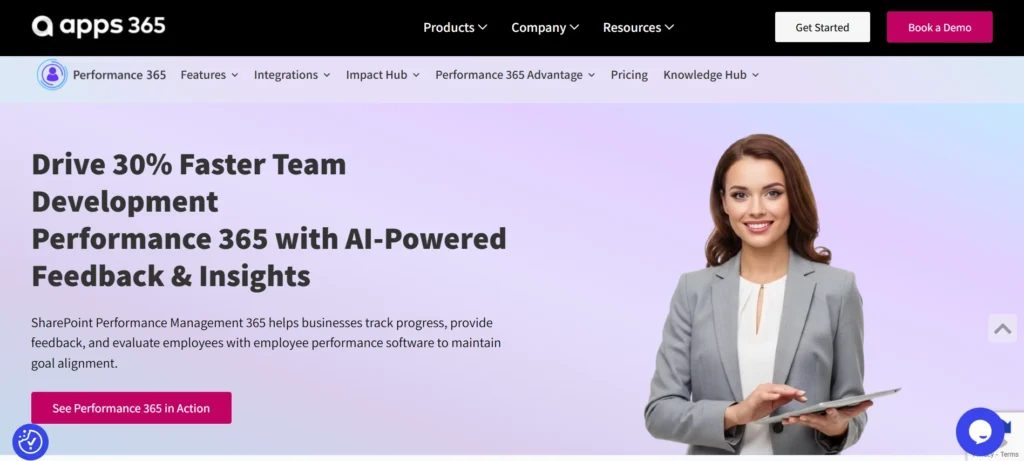
Performance 365 is built specifically for organizations that already live inside Microsoft 365. Instead of asking HR and managers to adopt a separate platform, it works inside the tools people already use every day — Teams, SharePoint, and Outlook.
Key AI Features
- AI Review Summaries — condenses manager, self, and peer feedback into a clear, structured summary
- AI-Driven KRAs — helps draft measurable Key Result Areas aligned to each role
- AI-Guided Improvement — highlights specific gaps and suggests development actions
- AI Copilot — assists managers and HR with review writing, goal drafting, and performance queries in natural language
Other Performance Features
- Structured performance reviews and 360° feedback
- Goal, KPI, and KRA management
- Guided 1:1 meeting workflows
- Continuous feedback capture
- Built-in performance reporting and dashboards
Best for: Organizations already using Microsoft Teams, SharePoint, and Outlook that want AI-assisted performance management without adding another disconnected platform to their HR stack.
2. Leapsome — Best for AI-Assisted Employee Development
Leapsome combines performance reviews, goal management, engagement surveys, and learning in one platform, with AI used to summarize feedback and support development conversations. It’s a strong fit for companies that want performance and learning tied together rather than managed separately.
Key AI Features: AI-assisted feedback summaries, skill and development suggestions, and review-writing support.
Other Features: 360° reviews, OKR/goal tracking, engagement surveys, and a learning module for closing skill gaps identified in reviews.
Best for: Mid-size to enterprise companies that want performance management and learning & development connected in one system.
3. 15Five — Best for AI-Assisted Manager Coaching
15Five is built around continuous performance management, with a strong focus on manager effectiveness. Its AI features are aimed at coaching managers — surfacing recommendations and talking points based on employee check-ins and review data.
Key AI Features: AI-generated coaching recommendations and performance summaries designed to help managers run better 1:1s.
Other Features: Weekly check-ins, goal tracking, engagement surveys, and manager effectiveness scoring.
Best for: Companies that want to invest specifically in making managers better coaches, not just tracking review scores.
4. Peoplebox.ai — Best for AI-Driven Performance and OKRs
Peoplebox.ai is built AI-first, with a strong emphasis on OKRs and Slack/Teams-native workflows. It uses AI heavily for summarizing feedback, supporting calibration sessions, and reducing the manual admin work around review cycles.
Key AI Features: AI-generated review summaries, calibration support, and performance insights surfaced directly in Slack or Teams.
Other Features: OKR and goal tracking, 360° reviews, and 1:1 meeting tools.
Best for: AI-forward HR teams that run performance management heavily through Slack or Teams and want OKRs at the center.
5. Lattice — Best for Growing Organizations
Lattice is one of the more established performance management platforms, covering reviews, goals, engagement, and compensation in one suite. Its AI features are increasingly focused on speeding up review writing and surfacing performance insights across teams.
Key AI Features: AI-assisted review drafting and performance insight summaries.
Other Features: Goal and OKR tracking, engagement surveys, compensation management, and career development tools.
Best for: Scaling companies that want one platform to grow into as HR needs expand beyond just reviews.
6. Culture Amp — Best for Performance and Employee Engagement Insights
Culture Amp is best known for employee engagement surveys, and it has extended that people-analytics strength into performance management. Its AI is used to connect engagement data with performance data for a fuller picture of team health.
Key AI Features: AI-driven people insights that link engagement trends to performance outcomes.
Other Features: Engagement and pulse surveys, performance reviews, and goal tracking.
Best for: Organizations that want performance management closely tied to engagement and culture data.
7. Betterworks — Best for Enterprise Goal Alignment
Betterworks focuses heavily on goal management at scale, making it a strong fit for large, complex organizations that need goals aligned across many teams and levels. Its AI features support goal writing and connect goal progress to performance reviews.
Key AI Features: AI-assisted goal drafting and performance-goal alignment insights.
Other Features: Enterprise-grade OKR and goal management, structured reviews, and manager dashboards.
Best for: Large enterprises that need consistent, AI-supported goal alignment across many teams.
8. Engagedly — Best for Employee Development and Engagement
Engagedly combines performance reviews, goal tracking, engagement, and learning in one platform, with an AI assistant built to support performance-related tasks and recommendations across the employee lifecycle.
Key AI Features: AI-assisted performance recommendations and review support.
Other Features: 360° reviews, goal management, engagement surveys, and learning tools.
Best for: Companies that want performance, engagement, and development managed together with AI assistance throughout.
Key Features to Look for in AI Performance Management Software
AI Performance Review Assistance
Look for AI that summarizes feedback and drafts review content — not just a chatbot that answers generic HR questions.
AI Goal, KPI, OKR, and KRA Generation
The AI should help draft measurable, role-relevant goals, saving managers from starting every cycle with a blank page.
Continuous Feedback
Feedback should be captured year-round, not just during a review window, so AI insights reflect real, current performance.
360-Degree Feedback
Multi-source feedback (manager, peers, self) gives the AI more context to work with and produces more balanced summaries.
Performance Analytics
Dashboards should surface trends — like slipping goal completion or recurring feedback themes — not just raw scores.
Employee Development Insights
The tool should connect performance data to specific, actionable development suggestions, not just flag “areas for improvement.”
Integration with Existing Workplace Tools
AI performance tools work best when they live inside tools your team already uses daily, like Microsoft 365, Slack, or your HRIS — this drives real adoption instead of a forgotten login.
Data Security and AI Governance
Check how employee data is used to train or run AI models, who can see AI-generated content, and whether the vendor is transparent about its AI governance practices.
Benefits of AI-Powered Performance Management Software
- Reduces performance review administration — AI handles first-draft writing and summarizing, cutting hours of manual work per cycle
- Makes feedback easier to summarize — long feedback threads become short, readable summaries
- Improves goal alignment — AI-drafted goals are more consistently tied to role and team objectives
- Supports continuous performance management — insights update year-round, not just at review time
- Helps identify employee development areas — patterns across reviews surface real skill gaps
- Gives managers better performance insights — trends are visible before they become bigger problems
- Improves consistency across review cycles — AI applies the same structure and criteria to every review
- Supports faster decision-making — HR and managers spend less time compiling data and more time acting on it
AI Performance Management: Risks and Limitations
AI-powered performance tools are genuinely useful, but they aren’t risk-free, and any credible vendor should say so plainly.
- AI-generated recommendations can contain errors — summaries and suggestions should always be reviewed by a manager before being acted on
- Employee data privacy — performance data is sensitive; know exactly how it’s stored, used, and whether it trains external AI models
- Algorithmic bias — AI trained on historical data can repeat past biases in language or ratings if it isn’t checked
- Transparency — employees and managers should be able to understand how an AI summary or score was generated
- Over-reliance on automated performance scores — a number or summary should inform a conversation, not replace it
- Need for manager and HR oversight — every AI output should pass through a human before it affects an employee’s record
Regulatory attention on AI use in employee evaluations is also increasing, with more guidance emerging around transparency and fairness in AI-assisted HR decisions.
AI should support performance decisions, not make employment decisions independently.
How to Choose the Right AI Performance Management Software
Define Your Performance Management Goals
Decide upfront whether you’re solving for faster reviews, better goal alignment, stronger manager coaching, or all three — this shapes which AI features actually matter to you.
Identify the AI Capabilities You Actually Need
Not every team needs AI Copilot-level assistance. Some need AI mainly for summarizing feedback; others want AI drafting goals and coaching managers too.
Check Integration With Existing Systems
A tool that lives inside Microsoft 365, Slack, or your HRIS will see far higher adoption than one requiring a separate login and workflow.
Review Security and Data Privacy
Ask directly how employee data is used in AI processing, where it’s stored, and who has access to AI-generated content.
Compare Pricing and Total Cost
Look beyond the sticker price to seat minimums, add-on AI features, and implementation costs.
Test Employee and Manager Usability
Run a trial with real managers and employees — AI features only add value if people actually use them.
Compare Performance Management 365 side-by-side with your current tool →
Conclusion
There is no single best AI performance management software for every organization. The right choice depends on company size, existing tools, and AI needs. Platforms like Leapsome, 15Five, Lattice, Peoplebox.ai, Culture Amp, Betterworks, and Engagedly serve different performance management priorities.
For Microsoft 365 users, Performance Management 365 brings AI-assisted reviews, KRAs, goals, development insights, and continuous feedback directly into Teams, SharePoint, and Outlook.
Join Our Creative Community
Frequently Asked Questions
What is the best AI-powered performance management software?
It depends on your setup. For organizations built on Microsoft 365, Performance Management 365 is a strong fit because it brings AI reviews, KRAs, and coaching support directly into Teams, SharePoint, and Outlook. For companies focused mainly on development or engagement, tools like Leapsome or Culture Amp may be a better match.
How is AI used in performance management?
AI is mainly used to summarize feedback, draft goals and KRAs, spot performance trends over time, and suggest coaching points for managers ahead of 1:1s. It supports the process — it doesn’t run it alone.
Can AI automate employee performance reviews?
AI can automate the drafting and summarizing parts of a review — pulling together feedback and generating a first-draft summary. It should not automate the final judgment; a manager still needs to review, adjust, and approve the content.
Can AI reduce bias in performance reviews?
AI can help by applying consistent language and criteria across reviews and flagging inconsistent or vague feedback. But it cannot guarantee bias-free evaluations — AI is trained on past data, which can carry its own biases, so human oversight is still essential.
What features should AI performance management software include?
At minimum: AI-assisted review summaries, goal/KRA generation, continuous feedback capture, performance analytics, development insights, and integration with the tools your team already uses.
What is the best AI performance management software for Microsoft 365?
Performance Management 365 is built specifically for Microsoft 365 environments, offering AI review summaries, AI-driven KRAs, AI-guided improvement plans, and an AI Copilot inside Teams, SharePoint, and Outlook — without requiring a separate platform.

_JiluXJRGNl.svg)























