


Corporate card management is now a core part of how modern businesses run their finances. It lets employees handle work-related expenses easily while giving finance teams the visibility and control they need over every dollar spent.
Struggling to track employee spending and keep expenses under control? Without proper corporate card management, businesses often face overspending, delayed reporting, and limited visibility. With the right approach, you gain real-time insights, stronger control over expenses, and faster financial decisions that keep your business on track.
But without the right structure, corporate card management leads to problems like Unauthorized transactions slip through, receipts going missing, and finance teams losing hours to manual reconciliation, all while trying to keep spending in check.
A well-managed corporate card management system helps eliminate these challenges. By setting clear policies, implementing strong controls and using the right tools.
What is Corporate Credit Card Expense Management ?
Corporate credit card and spend management is the process of handling company-issued credit cards that employees use for business expenses. It helps businesses control how money is spent, track every transaction, and keep records organized for accounting and reporting.
Key aspects include
- Issuing cards to employees based on their roles and needs
- Setting spending limits and usage rules
- Tracking all transactions in real time
- Collecting and managing receipts for every expense
- Approving or rejecting purchases based on company policy
- Ensuring employees follow company guidelines
- Integrating expense data into accounting systems
- Monitoring for unusual or unauthorized spending
Corporate cards are usually linked to a main company account. This allows businesses to control spending centrally while still giving employees the flexibility to make necessary payments.
When employees make work-related purchases, corporate cards can be used to handle those expenses directly. This reduces the need for reimbursement processes and keeps all spending under company control. It also improves transparency and makes it easier to follow company spending rules.
Benefits of Corporate Card Management
Corporate card management helps businesses take full control of their expenses while improving visibility, security, and financial planning. As more companies depend on cards for daily operations, having a structured management system turns every transaction into a valuable insight for growth.
1. Greater Control Over Company Spending
Corporate card management allows businesses to set clear rules for how cards are used across teams and departments. You can assign spending limits, restrict categories, and define usage based on roles. This level of control helps keep every expense aligned with business goals, reduces unnecessary spending, and supports better budget discipline across the organization.
2. Strong Protection with Virtual Cards
With corporate card management, businesses can easily use virtual cards for different payments like subscriptions, vendor payments, or one-time purchases. These cards offer advanced security features such as single-use numbers and controlled limits. As a result, virtual cards reduce fraud rates from 36% (physical cards) to 9% a 75% reduction, helping businesses protect their finances and reduce risk.
3. Real-Time Visibility into Business Expenses
Corporate card management systems provide a live view of all transactions as they happen. Finance teams can track spending instantly without waiting for reports or manual updates. This visibility helps identify spending patterns, monitor budgets closely, and make quick decisions when adjustments are needed.
4. Separate Business and Personal Expenses
Without proper corporate card management, many businesses rely on personal cards for work-related spending. Studies show that 79% of small employers use credit cards for business, while 49% also use personal cards. A well-managed corporate card system eliminates this dependency, keeping all business expenses in one place and improving accountability and record accuracy.
5. Better Financial Planning
Corporate card management brings all expense data into a single system, making it easier to review and analyze spending. Businesses can forecast future expenses, manage cash flow more effectively, and make informed financial decisions. With complete and organized data, companies can plan with clarity and stay in control of their finances.
20 Effective Strategies for Corporate Card Management
Strong corporate card management helps businesses gain better control over expenses, improve visibility, and make well-informed financial decisions. As companies handle more transactions through cards, a structured approach supports better tracking, reduces risk, and improves overall financial discipline.
1. Build Clear Card Policies
Start with a well-defined corporate card policy that explains who can use the card, what expenses are allowed, and any restrictions. Clear guidelines help employees follow the right process and keep spending aligned with business goals. Updating policies regularly keeps them relevant to changing needs.
2. Assign Spending Limits Based on Roles
In corporate card management, setting spending limits based on roles helps maintain strong financial discipline. Employees in different positions have different spending needs, so defining limits accordingly keeps expenses relevant and controlled. This approach also supports corporate credit card management by reducing unnecessary spending while still giving employees the flexibility to complete their tasks. Regular reviews of these limits help businesses stay aligned with changing responsibilities and budgets.
3. Review Transactions Frequently
Frequent transaction reviews play a key role in effective corporate card management. By checking transactions regularly, finance teams can quickly identify unusual activity, incorrect charges, or policy deviations. This practice strengthens corporate card expense management by keeping spending transparent and up to date, allowing businesses to take timely action when needed.
4. Use Smart Expense Management Tools
Modern tools are essential for efficient corporate card management. These tools connect directly with corporate cards and automatically capture transaction data, making expense tracking easier. In corporate credit card management, such tools provide real-time insights into spending patterns, helping finance teams monitor budgets and improve decision-making without relying heavily on manual processes.
5. Create Approval Structures for Better Control
Approval systems add an important layer to corporate card management. By requiring approvals for high-value or sensitive transactions, businesses can maintain better control over spending. This supports corporate card expense management by aligning expenses with company budgets and priorities, while also promoting accountability across departments.
6. Monitor Transactions for Fraud Signals
Monitoring transactions closely is a critical part of corporate card management. Alerts and tracking systems help detect unusual patterns or unauthorized activities early. In corporate credit card management, this proactive approach helps reduce financial risk and protects company funds from potential misuse.
7. Use Prepaid Cards for Fixed Budgets
Prepaid cards are a valuable tool in corporate card management, especially for teams or projects with fixed budgets. These cards allow businesses to load a specific amount, preventing overspending. This improves corporate card expense management by giving clear control over allocated funds and simplifying budget tracking.
8. Capture Receipts Digitally
Digital receipt capture supports smooth corporate card management by keeping all records organized in one place. Employees can upload receipts instantly, reducing the chances of missing documents. This strengthens corporate credit card management by improving record accuracy and making audits or reviews easier.
9. Reconcile Statements Regularly
Regular reconciliation is essential for accurate corporate card management. Matching card statements with internal records helps maintain financial clarity and prevents discrepancies. In corporate card expense management, timely reconciliation supports better cash flow tracking and keeps financial data reliable.
10. Promote Accountability Across Teams
Corporate card management works best when employees take responsibility for their spending. Encouraging regular expense reporting and adherence to policies helps build a culture of accountability. This improves corporate credit card management by keeping all transactions aligned with company guidelines.
11. Limit Card Usage to Specific Categories
Restricting card usage to defined categories is a smart approach in corporate card management. Whether it’s travel, subscriptions, or office supplies, category-based usage improves clarity and control. This also enhances corporate card expense management by making it easier to track and allocate budgets effectively.
12. Conduct Regular Financial Audits
Audits play a vital role in strengthening corporate card management. Regular reviews of transactions help identify gaps, highlight unusual patterns, and maintain accurate records. This supports corporate credit card management by reinforcing financial discipline and improving oversight.
13. Use Cards for Recurring Payments
Corporate cards are highly effective for managing recurring payments such as software subscriptions or service fees. In corporate card management, this keeps payments organized and reduces the risk of missed deadlines. It also supports corporate card expense management by centralizing recurring expenses.
14. Provide Employee Training and Awareness
Training is a key part of successful corporate card management. Educating employees on proper card usage, policies, and reporting methods helps improve compliance. In corporate credit card management, well-informed employees contribute to better spending practices and reduced misuse.
15. Encourage Timely Expense Reporting
Timely reporting improves the efficiency of corporate card management. When employees submit expenses quickly, financial data stays updated and accurate. This strengthens corporate card expense management by supporting faster reviews and better decision-making.
16. Use Virtual Cards for Better Security and Control
Virtual cards add strong value to corporate card management by offering better control over online and one-time transactions. They provide unique card details for each use, reducing risk and improving tracking. Mastercard’s B2B Payments Study found that 46% of large enterprises now use virtual cards for expense management, highlighting their growing role in corporate credit card management.
17. Define Clear Reimbursement Processes
Clear reimbursement guidelines are essential for effective corporate card management. When employees understand how expenses are handled, it improves transparency and consistency. This also supports corporate card expense management by keeping all financial records structured and easy to track.
18. Track Cardholder Spending Behavior
Monitoring how employees use corporate cards helps improve corporate card management. By analyzing spending patterns, businesses can identify trends, adjust limits, and guide better usage. This strengthens corporate credit card management by promoting responsible spending.
19. Make Use of Rewards and Benefits
Corporate cards often come with rewards, cashback, or loyalty programs. Using these benefits wisely adds value to corporate card management by reducing overall costs. It also enhances corporate card expense management by turning regular spending into savings opportunities.
20. Set Up Real-Time Alerts for Better Oversight
Real-time alerts are a powerful feature in corporate card management. Notifications for high-value or unusual transactions help businesses respond quickly and maintain strong oversight. Additionally, 38% of enterprises have adopted intelligent invoice reconciliation tools, showing how companies are improving corporate credit card management with smarter financial systems.
An expense management platform helps companies to manage the expenditure of employees in a transparent and organized way. These are some of the features to consider.
Why Choose Expense 365 to Manage Corporate Card?
Expense 365 is a smart expense management solution that helps businesses handle expenses and reimbursements with ease. Built to work with Microsoft 365, it allows companies to track spending, manage claims, and maintain clear financial records without relying on manual processes.
With Expense 365, employees can quickly submit expenses by uploading their statements. The system automatically captures key details such as category, amount, date, and other relevant information, reducing manual entry. Once submitted, the expense is automatically sent to the respective manager or department head for approval, making the reimbursement process faster and more organized. Users can integrate with Plaid and receive approval reminders.
The platform also uses AI-powered receipt scanning, allowing users to simply scan or upload receipts while the system extracts and records all necessary data.
This helps businesses save time, improve accuracy, and maintain well-structured expense records while making reimbursements smooth for both employees and finance teams.
Enabling Corporate Card Management in Expense 365
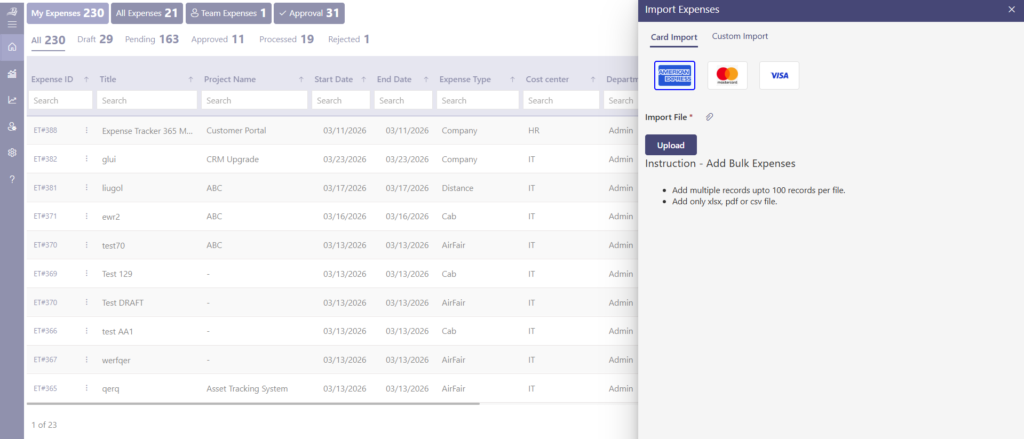
Expense 365 makes it easy to manage corporate card transactions by allowing users to import and view expense data in bulk. This feature helps businesses keep all card-related expenses organized in one place.
- How to Enable and Use the Import Option
- Enable the Import Cards option in settings to allow users to upload and access corporate card data
- Click on Add and choose the Upload option
- Attach the file that contains bulk expense details
- Click on Upload to proceed
Once the file is uploaded, Expense 365 will automatically capture and display important details such as transaction category, amount, date, and other relevant information.
This feature in corporate card management helps reduce manual work, improves accuracy, and makes it easier for finance teams to review and track expenses efficiently.
Conclusion
Corporate card management becomes more efficient with Expense 365. It allows businesses to monitor spending in real time, generate reports automatically, and keep all expenses aligned with company policies.
The platform also supports faster reconciliation and gives a clear view of every transaction, helping teams stay in control of their finances and manage spending with ease.
Upload, submit, and receive your reimbursements quickly with Expense 365.
Frequently Asked Questions
How to manage corporate credit cards effectively?
Corporate credit card management involves setting spending limits, defining usage policies, tracking transactions in real time, and using tools for automated reporting. Regular monitoring and reconciliation help maintain control, reduce risk, and improve financial visibility.
How to manage employee credit cards?
Assign cards based on roles, set individual limits, require receipt uploads, and use approval workflows. Tracking employee spending helps maintain accountability and keeps expenses aligned with company policies.
How corporate card programs help in expense management?
Corporate card programs improve expense management by enabling real-time tracking, automated reporting, better spending visibility, faster reconciliation, and stronger policy compliance. This helps businesses manage expenses efficiently and maintain financial control.
What are the key factors to consider when setting spending limits for corporate cards?
Spending limits should be based on the employee’s role, department budget, and past spending patterns. Businesses should also consider the type of expenses, such as travel or client costs, and follow company policies. Flexible limits with real-time tracking help control spending and avoid overspending.
What types of expenses can be paid using corporate cards?
Corporate cards are commonly used for business expenses such as travel, office supplies, software subscriptions, client meetings, and company events.
How can businesses control corporate card spending?
Businesses can control corporate card spending by setting clear limits, defining usage policies, and monitoring transactions in real time.


_JiluXJRGNl.svg)























