

_mVFFaHUZhS.webp)
The results of a recent study of the productivity of workers in the workplace indicate that workers spend 4.5 hours per week on administration, and manual time tracking takes a large share of the lost productivity. This is equivalent to almost 234 hours per year per employee — time that can be diverted to revenue generating activities.
The AI-Powered automatic time tracking software is an automatic work activity capturing software that eliminates manual timesheets and enhances productivity. Timesheet 365 will provide the right insights, smarter billing, and improved workforce planning in 2026 with the integration of Microsoft 365.
Timesheet 365 is one of the leading solutions in this category and is integrated with Microsoft 365 to deliver organizations intelligent and automated time tracking that fits into the existing workflow ecosystem. Removing the hassle of moving between platforms, Timesheet 365 allows the team to prioritize what is important and leave the tedious process of time capture and analysis to AI.
The Manual to Automatic Time Tracking Evolution
The old time tracking system meant that the employees had to start and stop timers manually, complete timesheets at the end of the day or week and the data was usually inaccurate because some entries were forgotten or estimated. The software of automatic time tracking makes this process a revolution as it works in the background, identifies what applications, documents, and projects the employees are working on, and automatically classifies time spent on different activities.
The move to automation tackles a number of pain points:
- Accuracy dependent on memory: Employees do not have to remember what they worked on hours or days ago.
- Red tape: Managers waste less time reviewing and correcting timesheets.
- Billing issues: Detailed time records are accurate and give unquestionable evidence of work done.
- Blind spots in productivity: Organizations can gain insight into the actual time spent and the perceived time spent.
Improvement of Automatic Time Tracking with AI
AI brings automatic time tracking to an even greater level by including intelligent pattern recognition, predictive analytics, and adaptive learning. AI-based systems such as Timesheet 365 are able to:
- Classify activities automatically according to the use of applications, document titles, and project contexts.
- Get to know personal work patterns to become more accurate with time.
- Identify anomalies like odd working hours or reduction in productivity that can be signs of burnout.
- Create foresight on project schedules and resource requirements.
- Intelligent recommendations on how time can be allocated.
The study of the International Journal of Project Management shows that companies that apply AI-enhanced time tracking experience a 23-%-point increase in the precision of project estimates and a 31-%-point decrease in the administrative expenses associated with time tracking.
The Major Characteristics of Automatic Time Tracking
Live Activity Tracking
Any efficient automatic time tracker tool is based on the fact that it is able to track the work activities in real time without interfering with the workflow. This includes:
- Application tracking: Tracking the use of which software applications and their length of use.
- Document-level tracking: Determining which files, emails, or web pages are being used.
- Project association: This is the automatic connection of activities to corresponding projects or clients.
- Idle time detection: The separation between active work and breaks or away-from-keyboard time.
The extensive integration of Timesheet 365 with Microsoft 365 allows tracking time in all Microsoft applications, such as Word, Excel, PowerPoint, Teams, Outlook, and SharePoint, and gives a full picture of how employees use the Microsoft ecosystem.
Integration with the Existing Tools Is Seamless
The best time tracking systems are those that will become part of the current work processes and do not demand the use of new systems by employees. This is especially important to organizations that rely on Microsoft 365, which Timesheet 365 can do by providing native integration with the entire Microsoft 365 suite, which allows:
- Outlook calendar synchronization: Automatic creation of time entries, which are made on the basis of calendar events and meetings.
- Teams integration: Monitoring the time spent in channels, chats, and video calls.
- SharePoint connection: Tracking the document collaboration and the time of editing.
- Project integration: Integrating with Microsoft Project to have an overall project management.
Such a degree of integration guarantees that time tracking occurs automatically in the tools that employees use on a daily basis, requiring no context switching and making the adoption less frictious.
Privacy and Compliance Feature
With the advancement of automatic time tracking, the issue of privacy has become a significant factor. Top solutions will respond to these issues by:
- Open monitoring policies: The clear communication of what is monitored and how the data are used.
- Employee access controls: Permitting employees to access their tracking information and correct.
- Privacy settings: The possibility to stop tracking during breaks or personal time.
- GDPR and compliance compliance: International data protection standards.
According to the findings of the Journal of Business Ethics, organizations that have clear time tracking policies have 42 percent higher rates of employee acceptance and 28 percent better quality data than organizations with opaque time monitoring practices.
The Business Case: Why Automatic Time Tracking is Beneficial
Increased Productivity and Responsibility
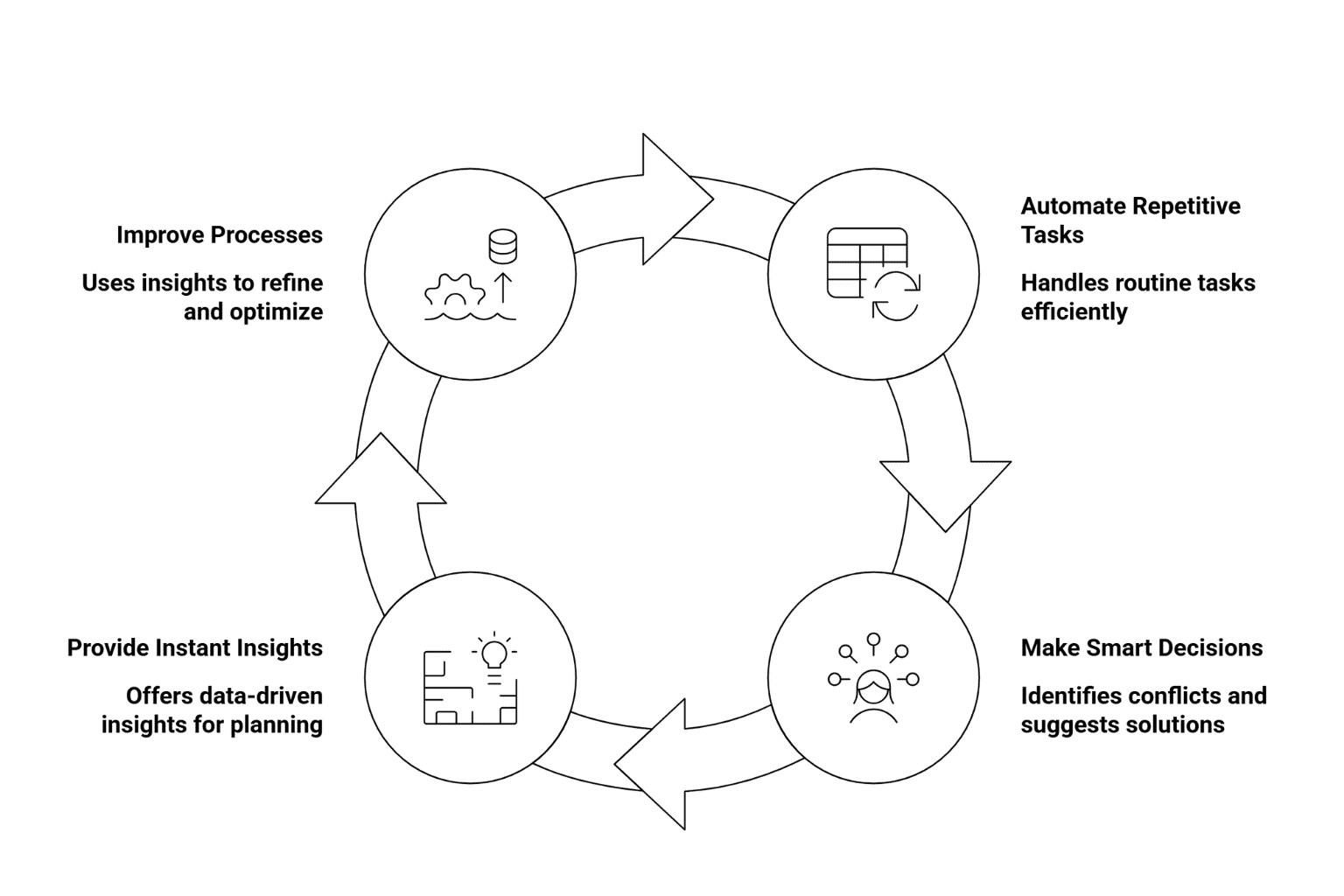
The productivity effect is one of the main factors that make the implementation of AI time tracking to teams a necessity. When the employees are aware that their time is being automatically monitored, a number of positive behaviors are observed:
- Less time wastage: Tracking awareness promotes more concentrated working patterns.
- Improved task priorities: Time allocation visibility assists employees to find low-value activities.
- Better meeting efficiency: Meeting time data is used to make organizations consider meeting necessity and duration.
- Responsibility without control: Data-driven performance appraisals are used instead of subjective ones.
In a thorough research article in the Academy of Management Journal, it was discovered that teams with automatic time tracking experienced a 17 percent improvement in the rate of task completion and a 22 percent improvement in deadline met within six months.
Proper Project Costing and Billing
In the case of professional services firms, consulting agencies and any organization that charges its clients on a time basis, accuracy is the most important. Automatic time tracking provides:
- Accurate billable hour capture: This is to ensure that there is no billable time that is not captured.
- Detailed activity logs: Documenting to justify invoices and settle disputes.
- Real-time project profitability: This allows managers to detect over or under-budgeted projects before it is too late.
- Better estimation: History data feeds better future project quotes.
According to industry statistics, organizations that have automated time tracking regain an average of 11% of the billable hours that would otherwise be lost to manual time tracking, and this directly translates into revenue.
Data-Driven Resource Allocation
Understanding how time is actually spent—rather than how it is planned to be spent—enables smarter resource allocation decisions:
Employee Burnout and Wellness
Though it may be ignored, automatic time tracking can be very helpful in safeguarding the wellbeing of employees:
- Detection of overtime: This is the detection of employees who always work overtime.
- Pattern of work analysis: Identifying unhealthy working patterns such as missed breaks, working on the weekend.
- Workload allocation: Provisions of even distribution of work among teams.
- Early intervention: Allowing managers to mitigate the risk factors of burnout.
In a longitudinal study published in the Journal of Occupational Health Psychology, the authors concluded that organizations that utilized time tracking information to assess the wellness of employees had a 29 percent lower turnover and 41 percent fewer absences due to burnout.
Pain Areas and Their Solutions Through Automatic Time Tracking
SaaS onboarding software offers a wide range of advantages that go beyond simple task onboarding automation, positively impacting internal culture, employee engagement, and overall team effectiveness:
- Streamlined Communication and Collaboration: By integrating seamlessly with popular communication tools like Slack, Microsoft Teams, and email platforms, SaaS onboarding software ensures that new hires can quickly connect with their teammates, managers, and mentors. This fosters immediate inclusion, encourages teamwork, and breaks down barriers that often slow down traditional onboarding processes.
1: I Forget to Keep Track of My Time
This is probably the biggest grievance of manual time tracking systems. Employees become engrossed in their work and fail to initiate timers, change projects or record activities. By the week-end, they are left to attempt to recreate their time based on memory, which makes the data inaccurate.
Solution:
Automatic time tracking would completely remove this issue since it would record activities in the background without the employee having to think about it. Timesheet 365 keeps a track of the usage of the Microsoft 365 application 24/7, so that each minute of work is properly tracked.
2: Time Tracking Is Too Time-Consuming
Employees are not lost in the irony of spending a lot of time to track time. Manual systems may take 15–30 minutes a day to time enter and categorize—time that could be spent on productive work.
Solution:
AI-based automatic categorization takes seconds instead of minutes to time enter and categorize. Employees are only expected to go through and sign automatically generated timesheets instead of making them manually. Research indicates that this saves 92 percent of time tracking overhead.
3: I Don’t Know Where My Time Goes
Most knowledge workers find it hard to track their time especially when they are working on numerous projects, ad-hoc requests, and in a number of meetings. This invisibility complicates productivity or workload justification.
Solution:
Detailed time breakdowns of projects, applications, and type of tasks can be achieved with comprehensive activity tracking. Patterns and time sinks that would have otherwise been hidden can be seen through visual dashboards and reports and employees can make informed decisions regarding time management.
4: Time Tracking Is Like Surveillance
Time tracking initiatives may be met with resistance by employees because of their privacy and micromanagement concerns. In situations where tracking seems punitive as opposed to supportive, it destroys trust and morale.
Solution:
The current generation of automatic time tracking systems such as Timesheet 365 prioritizes transparency, allows employees to see their own data, and is more about productivity insights than surveillance.
Automatic tracking is usually well-received when it is implemented with clear communication regarding purpose and privacy protection. Studies indicate that 78 percent of employees would rather use automatic tracking than manual tracking in the event that the privacy policies are well established.
5: Our Time Tracking Does Not Fit with Our Other Tools
Single time tracking systems that need to change contexts and enter data twice cause friction and decrease adoption. In the case of time tracking in isolation, it is hard to tie time data to project management, billing and HR systems.
Solution:
Native integration with Microsoft 365 implies that Timesheet 365 operates within the ecosystem where knowledge work is done. Time data is automatically exported to where it is required—project dashboards, billing systems, and performance reviews—without exporting and importing time data manually.
The Selection of the Optimal Automatic Time Tracking Software
Critical Evaluation Requirements
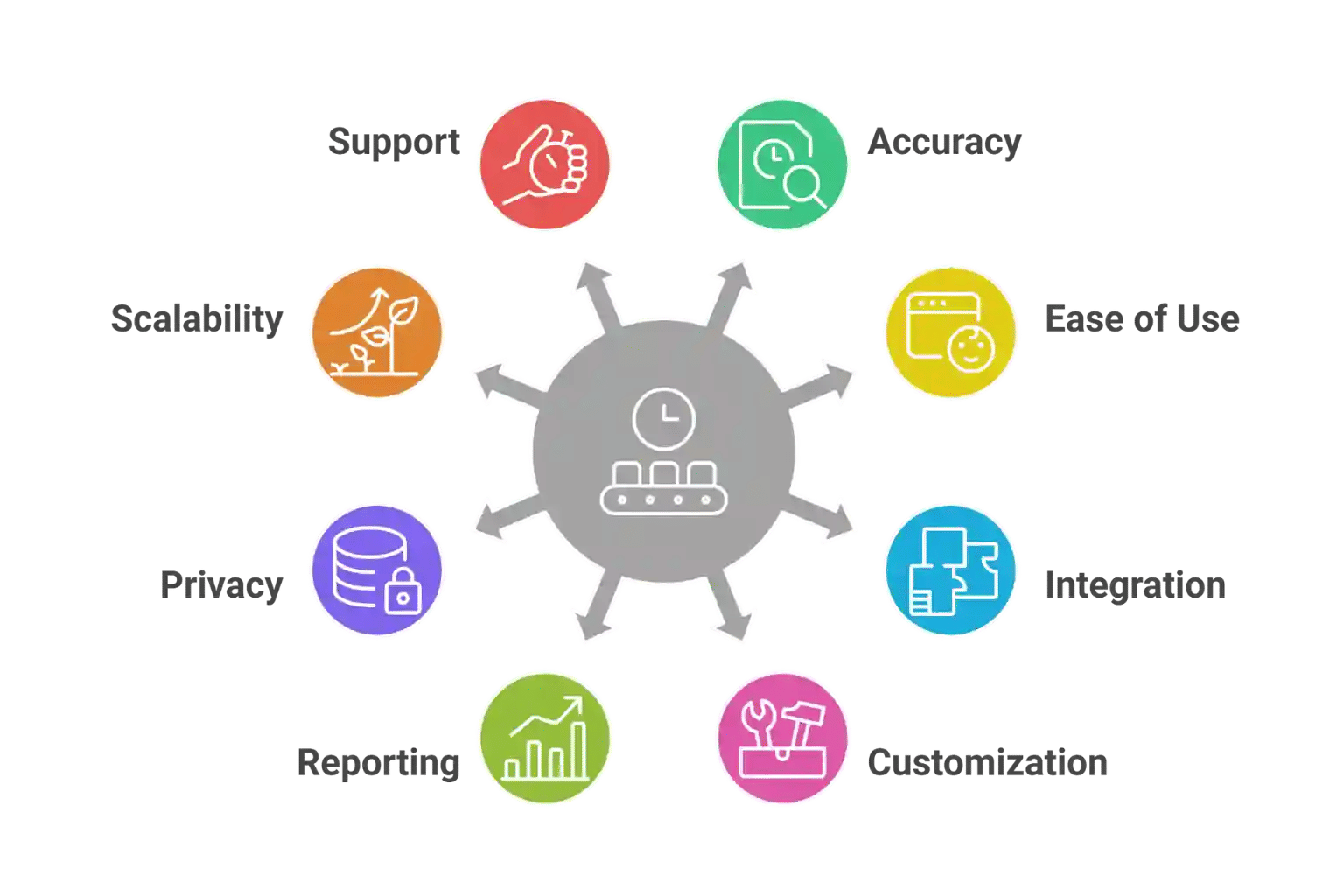
Organizations must consider candidates according to:
- Accuracy and reliability: Does the system record time in a consistent manner with no gaps or errors?
- Ease of use: Does it require little training to be used by employees?
- Integration: Does it integrate with your current technology stack?
- Customization features: Does it support your own workflow and classification requirements?
- Reporting and analytics: Does it give actionable information other than raw time data?
- Privacy and compliance: Does it comply with your regulatory requirements in the industry?
- Scalability: Does it expand with your organization?
- Support and training: Does the vendor offer sufficient implementation support?
The Importance of Microsoft 365 Integration
For the millions of organizations that are on Microsoft 365 as their productivity platform, integration with this ecosystem is not only convenient but essential. The reason is as follows:
- Unified data environment: When time tracking is connected to Microsoft 365, all work data will be in one connected environment. The time spent on Teams meetings, editing SharePoint files, or answering Outlook emails is automatically tracked and put in context.
- Less tool sprawl: The introduction of separate tools adds complexity, training needs, and subscription fees.
- Better integration: Native integration allows more accurate tracking since the system can access application-level data directly, instead of having to use screen monitoring or manual labeling.
- Easier administration: Timesheet 365 can be managed with familiar Microsoft administration centers, providing advanced integration and more sophisticated features than generic time tracking tools supporting multiple platforms.
Best Practices of Implementation
Setting Up for Success
The implementation of automatic time tracking does not only need the installation of the software to be successful. Organizations should:
- Communicate intent and value: Explain why time tracking is being introduced, how it will benefit the organization and employees, and what privacy measures exist. Openness generates confidence and adoption.
- Pilot program: Start with a small team or department to detect problems, optimize procedures, and build internal champions before wider implementation.
- Customize categorization rules: Set up project codes, client associations, and activity categories that reflect your organization’s structure. Generic defaults rarely meet business needs.
- Training and Support: Even with automatic systems, employees require guidance on reviewing timesheets, making corrections, and interpreting reports. Invest in comprehensive onboarding.
- Create explicit policies: Define expectations around time tracking, approvals, and data usage. Document policies and make them easily accessible.
Overcoming Resistance
Change management is often the largest obstacle in time tracking implementation. Address resistance by:
- Involvement of employees in the selection process: Participation increases engagement and interest in tool success.
- Emphasizing individual advantages: Highlight that automatic tracking reduces administrative load and provides insights into personal productivity.
- Direct response to privacy concerns: Clearly communicate what is tracked, who has access, and how it is protected.
- Beginning with voluntary adoption: Early adopters demonstrate value before making usage mandatory.
- Praising small wins: Publicize early success stories and positive outcomes.
According to research by the Change Management Institute, time tracking implementations with structured change management programs are 67% more likely to be adopted and achieve 54% faster time-to-value than purely technical rollouts.
High-Tech Features: The Future of Time Tracking
AI Insights and Predictive Analytics
The future of productivity tracking AI goes beyond simple time tracking and offers predictive insights:
- Project completion forecasting: Predict project completion using historical time data and current progress.
- Resource demand prediction: Forecast staffing requirements based on project pipelines and historical time data.
- Pattern recognition of productivity: Identify optimal working hours, fatigue trends, and efficiency patterns.
- Anomaly detection: Detect unusual patterns that may indicate problems or opportunities.
These features transform time tracking into a strategic resource rather than just a reporting tool.
Performance Management Integration
Progressive organizations link time tracking data with performance management systems to:
- Give objective performance reports: Complement subjective manager ratings with measurable productivity data.
- Reward good performers: Recognize employees who consistently deliver quality work efficiently.
- Support development discussions: Use time allocation data to discuss career growth and skill development.
- Inform compensation decisions: Base raises and bonuses on measurable productivity contributions.
When implemented carefully with privacy protections, this creates fairer, data-driven performance management processes.
Mobile and Remote Work Support
With remote and hybrid work becoming permanent, time tracking must adapt:
- Mobile apps: Allow employees to track time on smartphones and tablets.
- Location-independent tracking: Record work wherever it occurs.
- Support of flexible scheduling: Accommodate non-traditional work hours and asynchronous collaboration.
- Remote team visibility: Assist distributed teams in coordinating across time zones.
The cloud-based architecture of Timesheet 365 and its integration with Microsoft 365 make it ideally suited for remote work environments, tracking activities seamlessly across devices and locations.
Industry-Specific Applications
Professional Services and Consulting
Accurate time tracking directly impacts revenue for consulting firms, law offices, and other professional services organizations:
- Higher billable hour capture: Recover unbilled time.
- Detailed client reporting: Provide transparency on time spent per client.
- Matter-based tracking: Organize time by case, project, or engagement.
- Adherence to billing standards: Comply with client-mandated tracking requirements.
Industry benchmarks show 8–12% more hours billed annually compared to manual tracking.
Software Development and IT
Automatic time tracking helps technology teams with:
- Sprint and project tracking: Track actual vs. estimated time spent on development tasks.
- Code review and collaboration time: Capture peer review and knowledge-sharing time.
- Support and maintenance allocation: Differentiate new development from maintenance work.
- Analysis of tool usage: Identify tools and platforms consuming the most time.
Research from IEEE Transactions on Software Engineering shows 19% more accurate sprint planning and 24% improved resource allocation with time tracking.
Marketing and Creative Agencies
Creative professionals often resist time tracking, but automatic tracking solves key issues:
- Non-intrusive capture: Tracks work in the background without disrupting creative flow.
- Campaign-level insights: Analyze time spent across campaigns and clients.
- Analysis of creative process: Identify stages consuming the most time.
- Client profitability: Determine most profitable clients and projects.
Agencies using automatic time tracking report 31% improvement in project profitability and 27% better capacity planning.
Evaluating ROI: Time Tracking Value
Key Metrics to Track
Organizations must track the following to justify investment in automatic time tracking software:
- Compliance rate with time tracking: % of employees who always used the system.
- Recovery in billable hours: More time is captured in billable hours than in past approaches.
- Administrative time savings: Decrease in the number of hours devoted to timesheet management.
- Accuracy of project estimation: Enhancement in project schedule and budget estimates.
- Employee satisfaction: Alterations in employee attitude towards time tracking procedures.
Determining Financial Impact
An average ROI analysis of automatic time tracking will involve:
Cost savings:
- Less administrative overhead (manager time to review timesheets)
- Reduced payroll errors and corrections
- Reduced software expenses (no longer multiple point solutions)
Revenue gains:
- Higher capture of billable hours
- Better resource allocation leads to improved project profitability
- Less scope creep and project overruns
Productivity improvements:
- Manual time entry saved
- Increased concentration because of less administrative disruption
- Better decisions based on data-driven insights
The average ROI of an organization is positive in 3–6 months of automatic time tracking implementation, and the annual benefits continue to be 15–25 percent of the total labor costs.
Timesheet 365: Microsoft 365 Organizations
Why Timesheet 365 Stands Out
When other time tracking tools can be integrated with Microsoft 365 as an addition, Timesheet 365 is designed specifically to work with the Microsoft ecosystem. This specialized solution offers a number of benefits:
- Deep integration: Built on Microsoft Graph API and native Microsoft services to offer end-to-end tracking of time data across all Microsoft 365 applications.
- Familiar user experience: Designed to look and feel like Microsoft, requiring no additional training.
- Unified administration: Managed using existing identity, security, and compliance systems, ensuring time tracking data is protected like other business-critical data.
- Enterprise-grade security: Compliant with Microsoft’s security protocols and standards.
Key Capabilities
Timesheet 365 is a full-fledged automatic time tracker specially built for Microsoft 365 users:
- Cross-application tracking: Tracks time in Word, Excel, PowerPoint, Teams, Outlook, SharePoint, OneDrive, and other Microsoft 365 apps.
- AI-based categorization: Automatically allocates time to projects, clients, and tasks based on document names, email subjects, and meeting participants.
- Calendar integration: Adds time entries based on calendar events in Outlook.
- Teams collaboration tracking: Records time spent in channels, chats, and video meetings.
- SharePoint document tracking: Tracks time spent working on and collaborating on SharePoint documents.
- Configurable approval procedures: Allows multi-level timesheet approval aligned with hierarchical organizational structures.
- Detailed reporting: Provides dashboards and reports to individuals, managers, and executives.
- Mobile access: Review and approve timesheets on mobile devices.
- Compliance characteristics: Adheres to GDPR, SOC 2, and other regulatory standards via the Microsoft compliance framework.
Introduction to Timesheet 365
Timesheet 365 is implemented in a simplified manner:
- First consultation: Discuss organizational requirements, project structures, and customization needs.
- Configuration: Set up project codes, client associations, approval processes, and categorization rules.
- Pilot deployment: Introduce a small group to test configuration and gather feedback.
- Training: Train users and prepare reference documentation.
- Full implementation: Extend to the whole organization and provide support.
- Optimization: Keep categorization rules and reports optimized based on usage patterns.
Conclusion
In 2026, AI-based automatic time tracking software will help businesses enhance productivity, minimize administrative workload, and provide real-time, accurate insight into how work hours are spent on teams and projects.
Timesheet 365 is designed for Microsoft 365, providing smooth, AI-enhanced time tracking that does not interfere with daily workflows.
Get a demo to see how automated time tracking can simplify operations and enable smarter decisions.
Join Our Creative Community
Frequently Asked Questions
How does Timesheet 365 help streamline employee time tracking?
Timesheet 365 automatically captures work activities, eliminating manual timesheets and saving hours of administrative work. It provides accurate, real-time insights into employee productivity.
Can I customize reports to fit my project management needs with Timesheet 365?
Yes, Timesheet 365 allows fully customizable reports, so you can analyze time spent by projects, clients, or tasks for better decision-making.
Is Timesheet 365 compatible with other tools or software we already use in our business?
Absolutely, Timesheet 365 integrates seamlessly with Microsoft 365 apps, project management tools, and other software to fit your workflow.
What features does Timesheet 365 offer for managing multiple projects simultaneously?
It tracks time across all projects, auto-categorizes activities, and provides detailed dashboards for easy monitoring of multiple workloads.
How secure is the data stored in Timesheet 365, especially regarding sensitive employee information?
Timesheet 365 follows enterprise-grade security and compliance standards like GDPR and SOC 2, keeping all employee and project data fully protected.


_JiluXJRGNl.svg)























