


65% of employees say they don’t know how they’re performing at work. And most managers? They find out about a problem when it’s already too late to fix it.
That’s the gap quarterly performance reviews are built to close.
But here’s the thing most companies either skip them, rush them, or run them in a way that leaves both the manager and the employee more frustrated than when they started.
This guide changes that. You’ll get the full picture: what a quarterly review actually is, why it works better than annual reviews, how to run one step by step, what questions to ask, what to measure, real examples, a ready-to-use template, and the mistakes most managers don’t even know they’re making.
Whether you’re a first-time manager or you’ve been leading teams for years, this is the guide you’ll want to save.
✨
Key Takeaways
- Quarterly performance reviews help employees stay aligned, receive timely feedback, and adjust goals before small issues become bigger problems.
- The most effective reviews combine performance data, employee self-reflection, specific feedback, and clear goals for the next 90 days.
- Regular quarterly reviews create better accountability, stronger manager-employee relationships, and more meaningful development conversations than annual reviews alone.
- Success depends on consistent preparation, measurable goals, documented outcomes, and ongoing coaching between review cycles.
What Most Managers Get Wrong Before the Meeting Even Starts
Before we define what a quarterly review is, let’s talk about what kills it before it even begins.
Most managers walk into a review with good intentions but no real preparation. They have not pulled the data. They haven’t reviewed last quarter’s goals. They are going off memory and memory is unreliable, especially after 90 days.
Here’s what bad preparation looks like in practice:
- Giving feedback based only on the last two weeks (not the full quarter)
- Not having specific examples to support your observations
- Setting goals in the room, on the spot, without connecting them to team or company priorities
- Talking for 80% of the meeting and asking the employee to speak for the remaining 20%
The result? The employee leaves feeling evaluated, not supported. The manager leaves with a vague sense that something important was said, but nothing will actually change.
Good quarterly reviews do not happen by accident. They’re designed. And the design starts before you ever sit down with the employee.
What Is a Quarterly Performance Review?
Imagine finding out about a mistake you made at work six months after it happened. By then, you can’t fix it. Your manager can’t explain it clearly. The moment has passed. And nothing useful comes out of the conversation.
That’s what happens when feedback comes too late.
A quarterly performance review is a one-on-one meeting between a manager and an employee that happens four times a year once every three months.
In this meeting, both sides sit down and look at the same three things:
- What the employee worked on in the last 90 days
- How well they did against the goals that were set
- What they should focus on in the next quarter
It sounds simple because it is. But simple doesn’t mean easy, and it definitely doesn’t mean unimportant.
Think about what happens without it. Goals get set in January and forgotten by March. A struggling employee doesn’t hear anything until December. A high performer goes the whole year without knowing whether their work is actually making a difference.
Quarterly reviews fix all of that. They create a regular rhythm where feedback is fresh, goals stay relevant, and no one is left guessing where they stand.
For managers, it means fewer surprises at year end. For employees, it means they always know what’s expected and where they’re headed. For the company, it means the whole team is moving in the same direction not just once a year, but every single quarter.
Quarterly Reviews vs Annual Reviews: Which One Actually Works?
This is one of the most common questions managers ask and it’s worth answering early because the answer shapes everything else.
Here’s the honest comparison:
Factor | Quarterly Review | Annual Review |
Frequency | 4x per year | 1x per year |
Feedback freshness | High — based on recent events | Low — 12 months of blur |
Goal relevance | Updated every 90 days | Goals can become stale |
Employee anxiety level | Lower — routine check-in | Higher — high-stakes event |
Problem detection | Early — caught in 90-day windows | Late — may already be a crisis |
Manager workload | Spread across the year | Compressed into one intense period |
Best suited for | Fast-moving teams, SaaS, startups | Stable, traditional industries |
The truth is: they’re not really competitors. Most high-performing companies use both. Quarterly reviews handle ongoing feedback, goal-setting, and development. The annual review handles bigger decisions promotions, compensation, and career direction.
But if you’re choosing one, quarterly wins for most modern teams. The market moves too fast, priorities shift too often, and the feedback cycle in annual reviews is simply too slow to be useful.
Why Quarterly Reviews Matter
Here’s the core problem with waiting 12 months to give feedback: by the time the review happens, it doesn’t feel like feedback it feels like a verdict.
Quarterly reviews fix this by creating a rhythm. Feedback arrives when it’s still fresh, still specific, and still actionable.
Here’s why that matters for your team:
Feedback is more useful when it’s close to the event
If a customer success manager dropped the ball on three renewals in Q2, that conversation is 10 times more useful in July than in December. The context is still there. The patterns are still clear.
Goals stay connected to what actually matters
A goal set in January can be completely irrelevant by March if the business changes direction. Quarterly reviews let you realign goals before they become obsolete work.
Employees feel noticed not invisible
One of the top reasons people leave their jobs is feeling like their work doesn’t matter. Regular check-ins tell employees the opposite: their work is being seen, and someone is paying attention.
Problems get caught before they compound
Performance issues rarely appear overnight. They build slowly a pattern here, a missed deadline there. A quarterly review is a checkpoint to catch a problem at 20% before it reaches the point where it’s hard to fix.
For SaaS teams especially where metrics like ARR, NPS, churn, and pipeline can swing dramatically within a single quarter a 12-month feedback cycle is not just slow, it’s dangerous
Benefits of Quarterly Performance Reviews
Let’s get specific about what you actually get out of running these well.
For Managers
You get a clearer, more consistent picture of your team’s health. You know who’s thriving, who’s stuck, and who might be thinking about leaving before it becomes an emergency.
You also get documentation. Regular reviews create a record of what was discussed, what was agreed on, and what changed over time. That makes year-end compensation conversations, promotion decisions, and when needed performance improvement plans much easier to handle without dispute.
And perhaps most importantly: you build trust. Managers who give regular, honest feedback are more trusted than those who only show up for the big annual review. That trust translates directly into better team performance.
For Employees
When reviews happen four times a year, they stop feeling like a scary event and start feeling like a normal part of work. That shift in perception alone reduces anxiety and improves how open employees are during the conversation.
Employees who get regular feedback also grow faster. They know what’s working. They know what to change. They don’t spend 12 months reinforcing a bad habit before anyone tells them about it.
And regular goal-setting gives employees a clearer sense of ownership. When someone sets their own goals every quarter and reviews them with their manager they feel more invested in the outcome.
For the Company
Teams that run quarterly reviews see lower turnover. When people feel heard, challenged, and supported, they stay longer. That’s not a soft claim it’s a retention strategy.
Quarterly reviews also improve alignment. When individual goals connect directly to team and company OKRs, everyone is working toward the same things not just doing whatever feels urgent.
And over time, regular reviews build a performance culture. They signal that growth and accountability are taken seriously not just during peak performance season, but all year round.
How to Conduct a Quarterly Performance Review
Running a strong quarterly review isn’t complicated, but it does require a process. Here’s one that works.
Step 1: Prepare Before You Walk In
Pull the data first. Before the meeting, gather:
- The goals you set together last quarter
- Relevant performance metrics (quota attainment, NPS, project completion, tickets closed whatever applies to the role)
- Specific examples of strong work and areas where the employee struggled
- Notes from any 1:1s or informal conversations during the quarter
Send the employee a self-review form at least 3–5 days before the meeting. Give them real time to reflect not a form they’re filling out in the parking lot five minutes before the review starts.
Step 2: Start with the Employee’s Perspective
Open the meeting by asking the employee to share their own assessment. What went well? Where did they fall short? What got in the way?
Starting here does two important things. It shows the employee that their self-awareness matters. And it puts both of you on the same page before you share your observations which makes the whole conversation less one-sided.
Step 3: Review Last Quarter’s Goals
Go through each goal from last quarter one by one. For each one, ask:
- Was it completed? Partially? Not at all?
- What drove the result — positive or negative?
- What should we carry forward or change?
Be specific in your review. If a goal wasn’t met, don’t just note the miss look at why. Was it a priority issue? A resource issue? An execution issue? The reason matters as much as the result.
Step 4: Give Honest, Balanced Feedback
Strong feedback includes both what’s working and what needs to change. Skipping one side doesn’t help anyone.
A simple structure that works in practice: What went well → What could be stronger → What that improvement looks like in practice.
Specific feedback beats vague feedback every time. “You need to communicate better” is not feedback. “In the last three team syncs, your updates didn’t include next steps, which left the team unclear on ownership let’s fix that” is feedback.
Step 5: Set Clear Goals for the Next Quarter
Work with the employee not just for them to set 3–5 goals for the next 90 days. Goals that stick are:
- Specific: not “improve sales skills” but “increase discovery call-to-demo conversion rate from 30% to 40%”
- Measurable: include a number, percentage, or outcome that can be verified
- Realistic: achievable within 90 days without requiring perfect conditions
- Connected to company priorities: the employee should be able to see how their goal ties to a team or business objective
Step 6: Close by Asking What Support They Need
End every review with one simple question: “What do you need from me to hit these goals?”
This question changes the dynamic. It tells the employee that the review isn’t just about judging their past it’s about setting them up for what’s next. And it surfaces blockers, resource gaps, or management issues you might not have known about otherwise.
Quarterly Performance Review Questions to Ask
The quality of your questions determines the quality of your review. Here are the ones that actually open conversations.
Questions for Self-Reflection
- What accomplishment from this quarter are you most proud of?
- What’s one thing you wish you had done differently this quarter?
- What felt harder than it should have been?
Questions for Reviewing Goals
- How do you feel about the goals we set last quarter were they the right ones?
- What got in the way of goals you didn’t fully hit?
- Did any of your priorities shift mid-quarter? How did that affect your work?
Questions for High Performers
- Is there a bigger challenge you’d like to take on next quarter?
- What would help you do your best work even more consistently?
- Are there skills you want to develop that we haven’t talked about yet?
Questions for Employees Who Are Struggling
- What’s felt most difficult this quarter — workload, clarity, skills, or something else?
- Is there anything I can do differently to make it easier for you to succeed?
- What would “winning” look like for you next quarter?
Questions for Growth and Development
- What skills do you want to build in the next 90 days?
- Are there projects or responsibilities you’d like more ownership of?
- Is there a role or path you’re working toward?
Questions for the Manager Relationship
- Is there feedback you’ve wanted to share but haven’t?
- Do you feel like you have the tools and resources you need?
- Is there anything about how we work together that you’d want to change?
Don’t ask all of these in one meeting. Pick the 4–6 that fit where the employee is right now.
Key Metrics to Track During Quarterly Reviews
Metrics give the review structure. They move the conversation from opinions to observable facts and make it much harder for either side to be operating from a distorted view of what actually happened.
The right metrics depend on the role. Here are the most relevant ones across common SaaS team functions.
Sales Roles
- Quota attainment (% of target hit)
- Deals closed (number and total value)
- Pipeline generated
- Win rate and average deal size
- Sales cycle length
Customer Success Roles
- Net Promoter Score (NPS) team average and portfolio average
- Gross and net retention rates
- Expansion revenue generated
- Time to first value for new accounts
- Number of at-risk accounts proactively managed
Product and Engineering Roles
- Features shipped vs. planned
- Bug rate or defect count post-release
- Sprint completion rate
- System uptime and reliability metrics
- Cycle time (idea to production)
Marketing Roles
- Leads generated by channel
- Conversion rate from lead to opportunity
- Cost per lead
- Content performance (traffic, engagement, time on page)
- Campaign ROI
For All Roles
- Goal completion rate from last quarter
- Peer and cross-functional feedback (360 input)
- Growth in skills or responsibilities taken on
- Consistency of attendance, deadlines, and follow-through
One important note: metrics need context. A sales rep who hit 85% of quota during a market downturn may deserve more recognition than one who hit 115% during a record month. Always present the number with the story behind it.
Quarterly Performance Review Examples
Example 1: High Performer
Employee: Sara, Account Executive
Quarter: Q2
Goals set: Close 8 deals, generate $200K in pipeline, complete two product certifications
What happened:
- Closed 10 deals (125% of target)
- Generated $240K in pipeline
- Completed one certification (second was postponed due to a company-wide training freeze)
Feedback summary: Sara exceeded her core targets and demonstrated strong cross-functional collaboration with the customer success team on account handoffs. The missed certification wasn’t a performance issue — it was caused by a scheduling constraint outside her control. Acknowledge that clearly.
Q3 goals:
- Close 9 deals (slight increase reflecting elevated baseline)
- Complete the second certification before August
- Begin mentoring two junior reps — one hour per week
Support needed: Access to advanced product training, bi-weekly pipeline review with manager
Example 2: Middle Performer (Most Common, Most Underserved)
Employee: David, Product Manager
Quarter: Q2
Goals set: Ship two major features, complete 90% of sprint commitments, lead one cross-functional initiative
What happened:
- Shipped one major feature on time; second delayed by two weeks due to unclear requirements
- Sprint completion: 82%
- Cross-functional initiative launched but ownership was unclear mid-quarter
Feedback summary: David is doing solid work but is plateauing. He executes well within clear boundaries but hesitates to drive decisions when things are ambiguous. This isn’t a skill gap it’s a confidence gap. The Q3 plan should push him into situations where he has to lead without full clarity.
Q3 goals:
- Ship two features with self-authored requirements docs approved before sprint start
- Raise sprint completion rate to 88%
- Lead one cross-functional meeting per month with a prepared agenda and written follow-up
Support needed: Manager to provide feedback on two requirements docs before Q3 sprint planning
Example 3: Employee Needing Improvement
Employee: James, Customer Success Manager
Quarter: Q2
Goals set: Maintain portfolio NPS above 45, reduce churn by 5%, complete onboarding for 8 new accounts
What happened:
- NPS dropped from 46 to 38
- Churn increased by 2%
- 6 of 8 accounts onboarded (two delayed past the 30-day window)
Feedback summary: James is working hard but struggling with proactive portfolio management. Several at-risk accounts didn’t receive check-ins before churning. The pattern points to reactive vs. proactive work habits. This quarter needs a specific plan, clear milestones, and closer manager involvement.
Q3 goals:
- Restore NPS baseline to 42 or above by end of Q3
- Implement a weekly at-risk account review (shared in Slack every Monday)
- Complete all new account onboardings within 30 days of kickoff — no exceptions
Support needed: Manager joins two customer calls per month for real-time coaching. James attends the CS training workshop in July.
Common Mistakes Managers Should Avoid
Even experienced managers make these. Knowing them ahead of time is the difference between a review that helps and one that hurts.
Doing all the talking
If you’re speaking more than half the time, the employee isn’t getting a real chance to reflect or respond. Ask questions. Then listen fully, not just while waiting for your turn.
Being vague
“You need to communicate better” is not useful feedback. It gives the employee nothing to act on. Be specific: what happened, when it happened, and what better looks like.
Skipping the prep
Walking in without reviewing last quarter’s goals or pulling any performance data signals to the employee that the review doesn’t really matter. They notice. Prep is respect.
Recency bias
This is when you judge the whole quarter based on what happened in the last few weeks. Make sure you’re looking at the full 90 days both the high points and the low ones not just what’s fresh in your mind.
Avoiding hard conversations
If someone is underperforming, the review is exactly the right place to address it. Avoiding it doesn’t protect the employee it delays a conversation that will only get harder the longer you wait.
Treating the review as a one-way evaluation
A strong review includes both sides giving feedback. Ask the employee what you can do better as their manager. You’ll learn things you can’t find anywhere else.
Not documenting outcomes
If nothing gets written down, the review effectively didn’t happen. Send a short written summary within 24 hours: what was discussed, what goals were set, what support was agreed on.
Quarterly Review Template for Manager
Name: Sales Manager’s Template
Description: A streamlined template for evaluating Sales Manager performance across revenue targets, client acquisition, pipeline management, and team development on a quarterly basis.
Job Title(s): Sales Manager
Department: Sales
KRA(s) — Total Weightage: 40
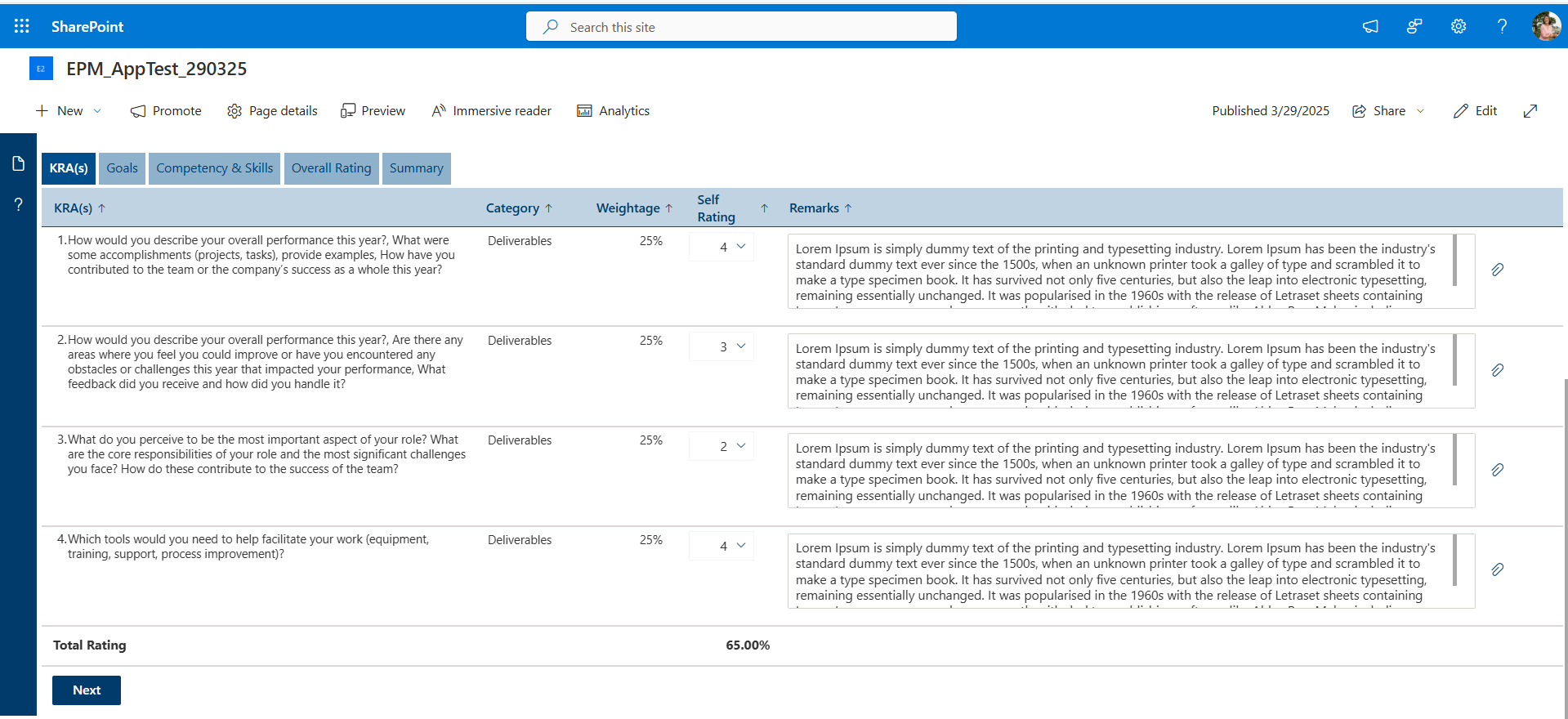
KRA | Category | Weightage |
Generate revenue through new client acquisitions | Deliverables | 9 |
Lead generation and pipeline development | Deliverables | 9 |
Achieve annual sales goals and revenue targets | Deliverables | 9 |
Achieve quarterly sales goals | Deliverables | 8 |
Achieve monthly sales goals | Deliverables | 5 |
Goals — Total Weightage: 40
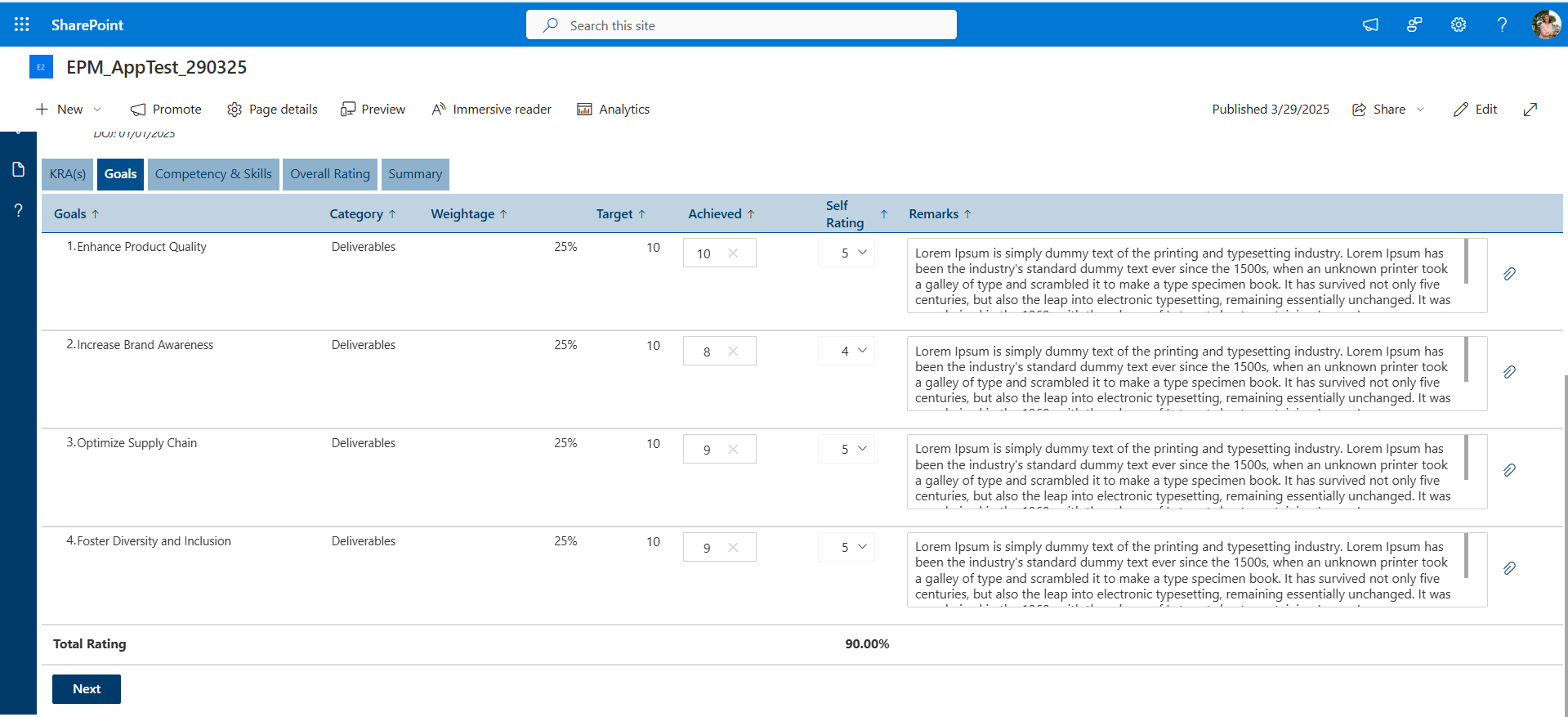
Goal | Type | Measurement | Weightage |
Close a minimum of 8 new deals this quarter | Quantitative | CRM deal report | 10 |
Generate $200,000 in new pipeline this quarter | Quantitative | Pipeline report | 8 |
Maintain a win rate of 25% or above | Quantitative | Win/loss report | 8 |
Complete all product knowledge certifications for the quarter | Qualitative | LMS records | 6 |
Update CRM records within 24 hours of every customer interaction | Behavioral | CRM audit log | 5 |
Conduct at least 2 joint sales calls with junior reps per month | Behavioral | Manager sign-off | 3 |
Competency & Skills — Total Weightage: 20
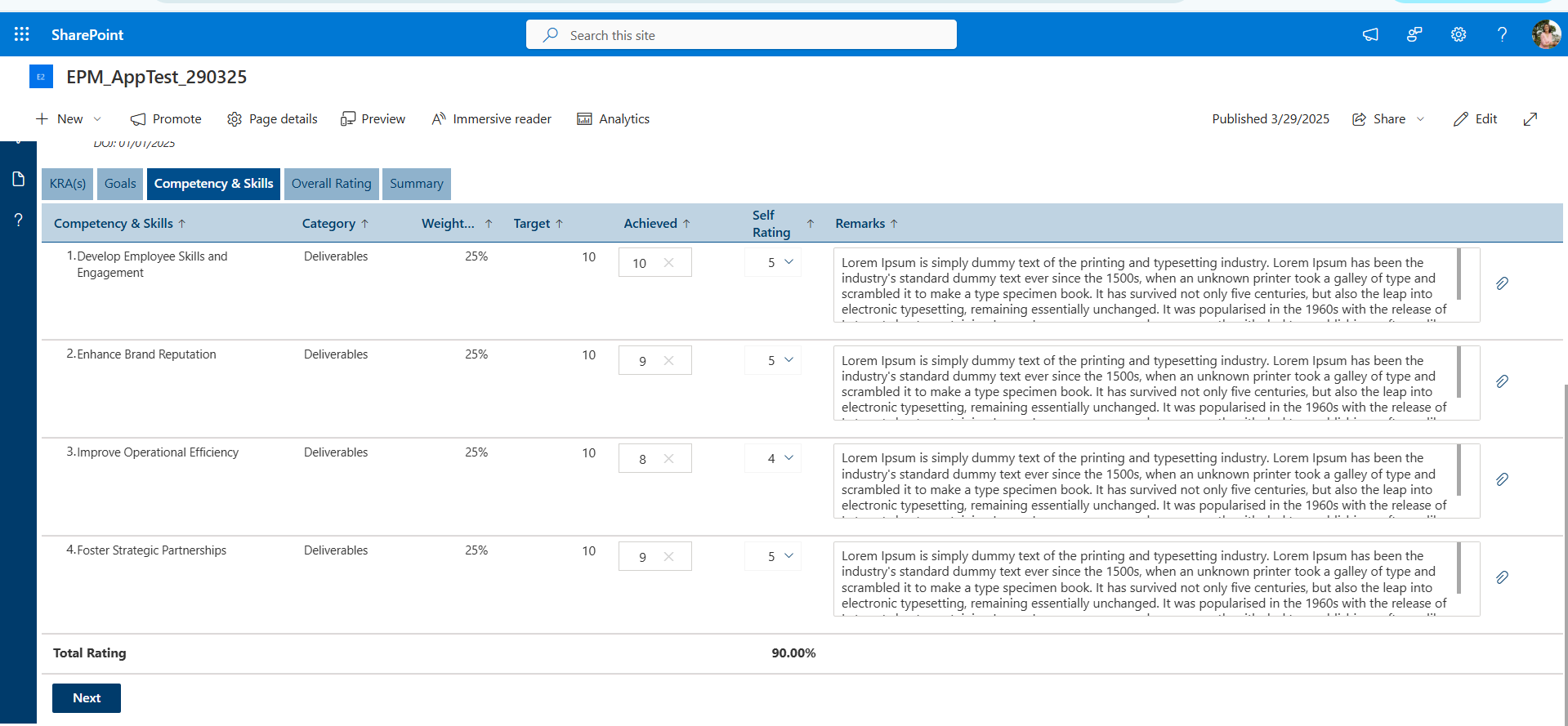
Competency | Description | Expected Level | Weightage |
Sales Acumen | Ability to identify opportunities, handle objections, and close deals consistently | Advanced (4/5) | 5 |
Customer Relationship Management | Builds and maintains strong, long-term client relationships that drive retention and growth | Advanced (4/5) | 5 |
Communication & Negotiation | Communicates clearly with clients and internal teams; negotiates effectively to close value-driven deals | Proficient (3/5) | 4 |
Pipeline & Forecast Management | Maintains an accurate, up-to-date pipeline and provides reliable revenue forecasts each quarter | Proficient (3/5) | 4 |
Team Collaboration & Coaching | Actively supports junior reps, shares knowledge, and contributes to a collaborative sales culture | Developing (2/5) | 2 |
Total Weightage Breakdown
Section | Weightage |
KRA(s) | 40 |
Goals | 40 |
Competency & Skills | 20 |
Total | 100 |
Best Practices for More Effective Reviews
These aren’t extras. Each one comes from teams that run reviews consistently and actually see results on the other side.
Protect the schedule
When quarterly reviews get rescheduled repeatedly, they stop being taken seriously. Block the time at the start of each quarter and treat it like a critical business meeting — not a nice-to-have.
Send a prep guide in advance
Share 4–6 questions with the employee at least three days before the meeting. People show up with far better answers when they’ve had time to think.
Use a consistent format every quarter
A repeatable template makes reviews faster to run and easier to compare over time. It also makes the experience feel fair and predictable for employees.
Document within 24 hours
Send a written summary to the employee the same day or the next morning. Include: key feedback shared, goals set, and any commitments made. This creates accountability on both sides.
Connect individual goals to company goals
Employees work harder when they can see how their role connects to something bigger. Always tie quarterly goals to team OKRs or company priorities. Make the link explicit.
Keep the conversation going between reviews
A quarterly review should not be the only performance-related conversation you have. Weekly or biweekly 1:1s are where coaching happens in real time. The quarterly review is where you formalize and assess.
Train managers to run reviews well
A poorly run review can do more damage than no review at all. Invest in manager training on giving specific feedback, having difficult conversations, setting useful goals, and listening actively.
Use data, not just impressions
Where possible, anchor your feedback in observable metrics. “Your close rate dropped from 24% to 16% this quarter” is cleaner and more actionable than “I feel like you could be closing more.”
Ask the employee to rate the review
At the end of each session, ask: “Was this review useful for you? What could we do better next time?” This creates a loop that improves your process each quarter.
Conclusion
A quarterly performance review is one of the most direct ways to improve team performance, reduce turnover, and build a culture where people actually grow.
When done well, it gives employees clear feedback they can act on, goals they helped create, and the support they need to succeed. It gives managers early visibility into what’s working and what isn’t before small problems become big ones.
The formula is not complicated: prepare before you walk in, listen more than you talk, give specific feedback, set goals together, and document what was agreed on. Then do it again in 90 days.
Companies that run quarterly reviews consistently and run them well don’t just see better individual performance. They build teams where accountability and growth are the norm, not the exception.
Start with one good review this quarter. Use the template. Ask the questions that open real conversations. Show up prepared. The rest follows from there.
Join Our Creative Community
Frequently Asked Questions
How long should a quarterly performance review take?
Most effective quarterly reviews run 45–60 minutes. Shorter than 30 minutes usually means the conversation stayed surface-level. Longer than 90 minutes often means there’s no clear structure. For new employees or employees going through a difficult quarter, plan for a full hour.
What should I say in a quarterly performance review?
Start with what went well specific examples, not general praise. Then move to what could be stronger again with specific examples and context, not vague critiques. Then set goals together for the next quarter. End by asking what support the employee needs from you.
How do you write a quarterly performance review?
Document what was accomplished vs. what was planned, note specific examples of strong work and areas to improve, record the goals set for the next quarter, and note any commitments made by the manager. Keep it factual and specific not general impressions.
Can a quarterly review replace an annual review?
Quarterly reviews handle ongoing feedback, goal-setting, and development. Annual reviews handle compensation adjustments, promotions, and longer-term career planning. Most companies use both. If you have to choose one, quarterly reviews are more immediately useful for most teams.
What if the employee disagrees with the feedback?
That’s a healthy sign. Listen to their perspective fully before responding. If new information changes your view, say so. If it doesn’t, explain your reasoning clearly and calmly. Document both perspectives in the review notes. Disagreement handled well builds trust handled poorly, it damages it.
How do I give feedback to a high performer without making it feel pointless?
Focus on growth, not just performance. Even strong performers want to be challenged. Ask them what they want to accomplish next, what stretch opportunities interest them, and how you can support their career trajectory. The goal is continued investment, not just validation.
What's the difference between a quarterly review and a 1:1?
A 1:1 is an ongoing check-in typically weekly or biweekly where you handle real-time issues, blockers, and short-term priorities. A quarterly review is a formal assessment of the past 90 days with structured goal-setting for the next 90. Both matter. Neither replaces the other.


_JiluXJRGNl.svg)























