
Using Employee Performance Analytics to Answer HR’s Most Critical Questions

Here is a situation most HR leaders know well.
Your organization runs annual performance reviews. You track goals. You send out engagement surveys. You have spreadsheets, reports, and maybe even a dashboard. You have more employee data than you’ve ever had before.
- Focus on performance metrics that drive better HR decisions, not just easier reporting.
- Track performance trends over time to identify growth, risks, and development opportunities early.
- Combine goals, feedback, engagement, and review data for a complete view of employee performance.
- Keep your analytics dashboard simple, actionable, and aligned with business goals.
- The real value of performance analytics comes from turning insights into action.
And yet when a senior leader asks “Who are our top performers? Which teams are at risk? Where are we losing good people?” the answer takes days to pull together. Or it’s incomplete. Or it’s based on whoever made the most noise in the last review cycle.
That’s not an analytics problem. That’s a wrong metrics problem.
Most HR teams measure what’s easy to collect attendance, review completion rates, training hours. But those numbers don’t tell you who is growing, who is disengaged, who is about to leave, or where your next generation of leaders is sitting right now.
Employee performance analytics fixes this but only when you’re tracking the right things.
This guide covers exactly that. The metrics that matter, the mistakes to avoid, how to build a dashboard that actually gets used, and how Performance 365 gives HR teams the tools to act on what the data is telling them.
What HR Leaders Actually Ask About Performance Analytics
These are real questions HR leaders ask when they start building a performance analytics strategy. If any of these sound familiar, you’re in the right place.
“We have performance review data but no one knows how to use it. Where do we start?”
Start with three questions your business leadership actually cares about: Are employees hitting their goals? Are high performers staying? Are managers having regular conversations with their teams? Build your analytics around answering those three questions first. Everything else comes after.
“Our managers give everyone a 3 out of 5. How do we fix rating inflation?”
Rating inflation happens when managers don’t have clear criteria, don’t have supporting data, or feel social pressure to avoid conflict. The fix is a combination of structured calibration sessions, visible rating distributions, and continuous feedback data that gives managers evidence to back up their ratings or challenge them.
“How do we know which employees are flight risks before they hand in their notice?”
Declining performance ratings, dropping feedback participation, disengagement survey scores trending down, and reduced goal activity are all early signals. None of them are obvious in isolation — but together, they paint a clear picture. That’s what performance analytics is built to surface.
“How do we identify high-potential employees fairly not just the loudest voices in the room?”
By looking at data across multiple dimensions over time not just one manager’s opinion from one review cycle. Consistent goal achievement, skill development trends, leadership competency scores, and peer recognition patterns together give a much more accurate picture than a single rating.
“Our HR team spends more time collecting data than using it. How do we change that?”
The answer is centralizing your data in one place instead of pulling it from five different systems. When goal data, review ratings, feedback activity, and engagement scores all live together, analysis takes minutes — not days.
📊 Still Pulling Performance Data From Spreadsheets?
Performance 365 gives HR leaders a centralized analytics dashboard goal completion, review ratings, feedback trends, engagement scores, and retention risk indicators all in one place, updated in real time.
What Is Employee Performance Analytics?
Employee performance analytics is the process of collecting, analyzing, and acting on data about how individuals, teams, and departments are performing over time, not just at a single point.
It pulls together information from multiple sources:
Performance review ratings
Goal tracking and completion data
Continuous feedback activity
Employee engagement survey scores
Skills and competency assessments
Learning and development participation
Recognition and appreciation data
Productivity and project outcomes
The purpose isn’t to generate reports. It’s to answer questions that improve decisions — about who to develop, who needs support, where turnover risk is building, and how well your performance management process is actually working.
Done right, employee performance analytics moves HR from a function that reacts to problems after they happen to one that spots them early and acts before they become expensive.
The 10 Performance Metrics That Actually Matter
1. Goal Achievement Rate
This is the clearest signal of whether employees are doing what they were hired to do.
Goal achievement rate measures the percentage of assigned goals an employee completes within a set period. Track it at the individual level, the team level, and the department level because the patterns look very different across each.
What to measure:
Percentage of goals completed on time
Goals completed vs. goals assigned
Goal completion trends over multiple review periods
Completion rate by department and manager
Why it matters: If goal achievement is consistently low in one team but high in another, that’s not a performance problem that’s a management or resource problem. Analytics helps you tell the difference.
Example: An employee who completes 9 out of 10 goals has a 90% goal achievement rate. Across a department of 50 people, that same metric tells you whether your goal-setting process is realistic or broken.
2. Performance Review Ratings Distribution
Individual ratings matter. But the distribution of ratings across your organization matters more.
If 80% of your employees are rated “meets expectations” every single year, you either have an extraordinarily average workforce or your managers aren’t differentiating performance. The latter is almost always the answer.
What to measure:
Rating distribution across all employees
Average ratings by department and manager
Rating trends over multiple review cycles
Gap between self ratings and manager ratings
Why it matters: Rating inflation hides your best people and protects your lowest performers. Tracking distribution forces the conversation about calibration and gives HR the data to drive it.
3. Continuous Feedback Activity
Annual reviews give you a snapshot. Continuous feedback gives you the film.
Feedback frequency, who gives it, who receives it, and how consistently managers are having conversations throughout the year all of this tells you far more about your culture and performance management health than any single review score.
What to measure:
Number of feedback conversations per employee per quarter
Manager-to-employee feedback frequency
Peer feedback participation rates
Feedback sentiment trends over time
Why it matters: Teams where managers give regular, specific feedback consistently outperform teams where feedback only happens at review time. This metric tells you which managers are coaching and which ones are coasting.
💬 Are Your Managers Actually Having Feedback Conversations?
Performance 365 tracks feedback frequency, participation, and sentiment across every team — so HR leaders can see exactly where coaching is happening and where it isn’t. → Start tracking feedback activity with Performance 365
💬 Are Your Managers Actually Having Feedback Conversations?
Performance 365 tracks feedback frequency, participation, and sentiment across every team so HR leaders can see exactly where coaching is happening and where it
4. Employee Productivity Metrics
Productivity looks different in every role so the right metric depends entirely on what the role is supposed to produce.
Examples by role:
Sales: Revenue generated, deals closed, pipeline conversion rate
Customer support: Tickets resolved, satisfaction scores, resolution time
Engineering: Features shipped, bugs resolved, sprint completion rate
Operations: Process cycle time, error rate, output volume
What to measure: Focus on outcomes what was produced not activity how busy someone looked. Hours worked is not a productivity metric. Results delivered is.
Why it matters: Productivity data, when combined with review ratings and feedback, helps identify employees who are delivering strong results that aren’t being recognized and employees whose ratings are high but whose output tells a different story.
5. Employee Engagement Scores
Engagement and performance are directly connected. Disengaged employees don’t suddenly become high performers. And high performers who become disengaged are your biggest flight risk.
What to measure:
Overall engagement survey scores
Engagement trends by team and department
Participation rates in surveys (low participation is itself a signal)
Correlation between engagement scores and performance ratings
Why it matters: When you overlay engagement data with performance data, patterns emerge that neither dataset shows alone. A team with strong performance ratings but falling engagement scores is a team that’s about to have a turnover problem. Analytics lets you see that before it happens.
6. Skills and Competency Development
Current performance tells you where someone is today. Skills development data tells you where they could be in 12 months.
What to measure:
Skill assessment scores over time
Competency ratings across key areas
Training and certification completion rates
Skills gap analysis at team and department level
Why it matters: Organizations that track skills development alongside performance can build targeted development plans, identify internal candidates for open roles, and make succession planning decisions based on evidence not assumptions.
7. Employee Recognition Trends
Recognition data is often overlooked in performance analytics. That’s a mistake.
Employees who consistently recognize others tend to be strong collaborators and cultural contributors qualities that don’t always show up in goal completion rates. Employees who never receive recognition may be doing valuable work that’s going unnoticed.
What to measure:
Recognition given and received per employee
Recognition participation rates by team
Correlation between recognition activity and engagement scores
Departments with low recognition activity
Why it matters: Recognition patterns often surface team dynamics that formal reviews miss. A department where recognition only flows downward from manager to employee, never peer-to-peer has a collaboration problem, even if the numbers look fine.
8. High-Potential Employee Indicators
Identifying future leaders is one of the most important and most difficult things HR teams do. Done on gut feel, it consistently favors people who are visible, vocal, and similar to the leaders making the decision. Done with data, it finds people who are actually ready.
What to measure:
Consistent high performance ratings across multiple cycles
Strong goal achievement trends over time
Leadership competency scores
Learning participation and skill development pace
Peer recognition patterns
Why it matters: Succession planning based on data not politics produces better leaders and fairer outcomes. Performance analytics gives HR the evidence to make the case for the right people, not just the most obvious ones.
9. Performance Improvement Trends
A single rating at a single point in time is not very useful. A trend over four review cycles tells you something real.
What to measure:
Rating changes over multiple review periods
Goal achievement growth quarter over quarter
Skill development progress over time
Coaching outcomes after performance improvement plans
Why it matters: An employee rated “needs improvement” two years ago who is now consistently hitting goals and receiving strong feedback is a very different situation from someone whose ratings have been declining for three cycles. Trend data captures that difference. Point-in-time data doesn’t.
10. Retention Risk Indicators
Your best employees have options. Tracking retention risk before people decide to leave is far less expensive than replacing them after they do.
What to measure:
High performer turnover rates by department
Declining performance ratings or feedback participation
Engagement score drops in previously strong employees
Internal mobility patterns — or lack of them
Time since last promotion or role change for high performers
Why it matters: The combination of declining engagement, stalled career progression, and reduced feedback activity is a pattern that appears months before a resignation letter. Performance analytics gives HR the visibility to intervene while there’s still time.
How to Build a Performance Analytics Dashboard
A performance analytics dashboard is only useful if it answers questions people are actually asking. Build yours around decisions, not data.
Start with three questions:
Are employees hitting their goals?
Are our best people staying?
Are managers coaching their teams?
Every metric on your dashboard should connect to at least one of those questions.
What a strong dashboard includes:
Metric | What It Answers |
Goal completion rate | Are employees delivering? |
Rating distribution | Are reviews fair and calibrated? |
Feedback frequency | Are managers coaching? |
Engagement score trends | Are people motivated? |
Skills development progress | Are people growing? |
Recognition activity | Is collaboration healthy? |
High-potential indicators | Who’s ready for more? |
Retention risk flags | Who might leave? |
Keep it actionable. A dashboard that shows 40 metrics is a dashboard nobody uses. Show the eight to ten numbers that drive decisions — and make sure every number has a clear “so what” attached to it.
Review it regularly. Performance data that’s only looked at once a year isn’t analytics — it’s record-keeping. The best HR teams review their dashboards monthly and use what they find to guide manager conversations, development planning, and resource decisions.
Common Mistakes HR Leaders Make With Analytics
Measuring what’s easy instead of what matters. Tracking training hours completed is easy. Tracking whether that training changed performance is hard. Do the hard thing.
Looking at ratings in isolation. A performance rating without context without feedback data, goal data, and engagement data alongside it is almost meaningless. Always look at the full picture.
Ignoring the trend and only seeing the snapshot. Where someone is today matters less than where they’re going. Always look at direction, not just position.
Collecting data but never acting on it. Analytics only creates value when it changes a decision. If your data isn’t influencing how managers coach, how HR intervenes, or how leaders plan — it’s just a report nobody reads.
Treating all metrics as equally important. Not all data points carry the same weight. Goal achievement and engagement trends tell you more than training completion rates. Know which metrics drive decisions and focus there.
Only looking at performance during review season. By the time annual reviews arrive, the patterns you needed to act on were visible months ago. Real analytics is continuous, not seasonal.
How Performance 365 Powers Your Analytics
Most HR teams struggle with performance analytics not because they lack ambition but because their data lives in too many places.
Review ratings are in one system. Goals are tracked in spreadsheets. Feedback happens in emails. Engagement survey results are in a separate tool. Pulling it all together for a meaningful picture takes days — and by the time you have it, decisions have already been made without it.
Performance 365 solves this by centralizing everything.
Goal tracking, continuous feedback, performance reviews, skills assessments, engagement data, and recognition activity all live in one platform. When a manager wants to understand their team’s performance, or an HR leader needs to identify retention risk across a department, the answer is available in seconds not after a week of spreadsheet work.
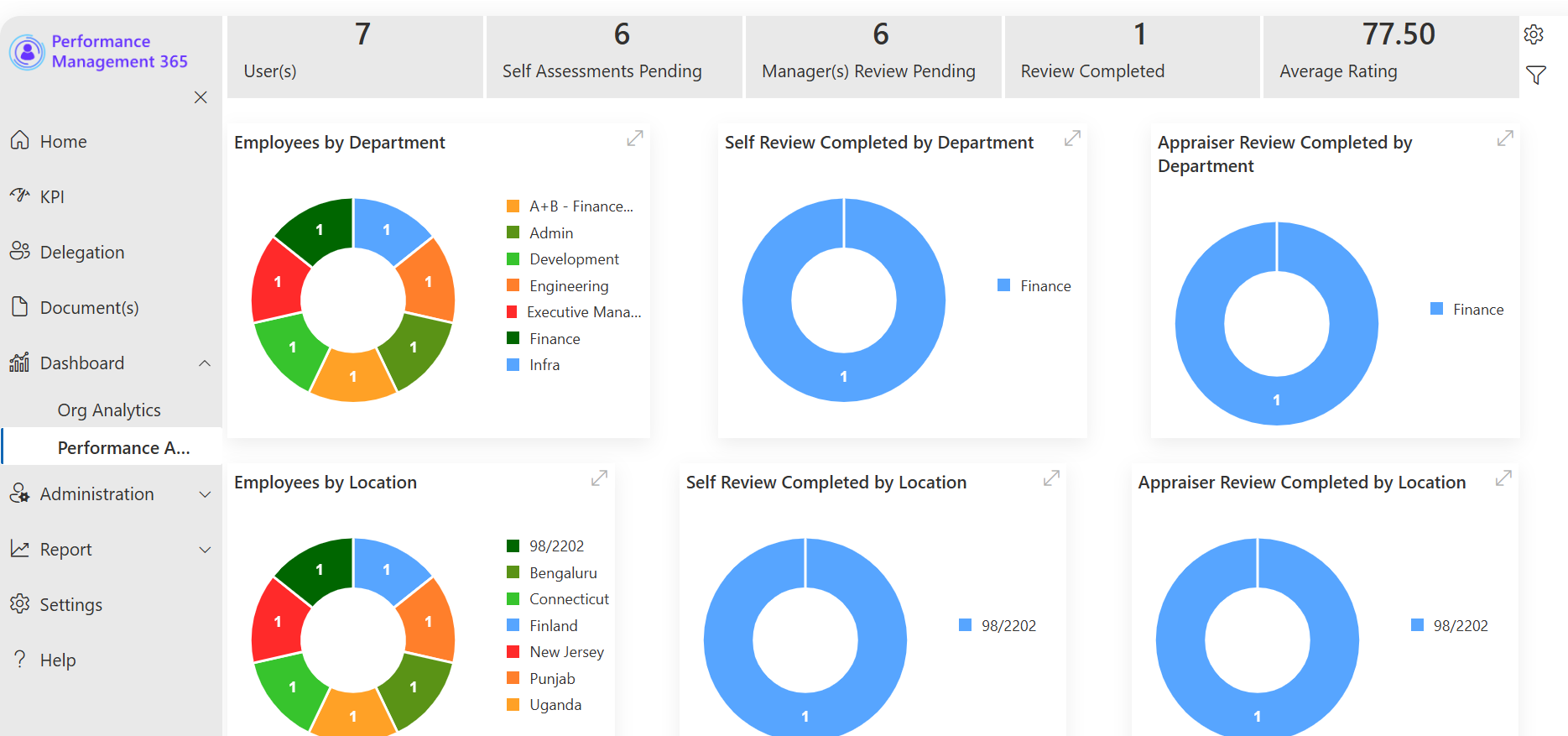
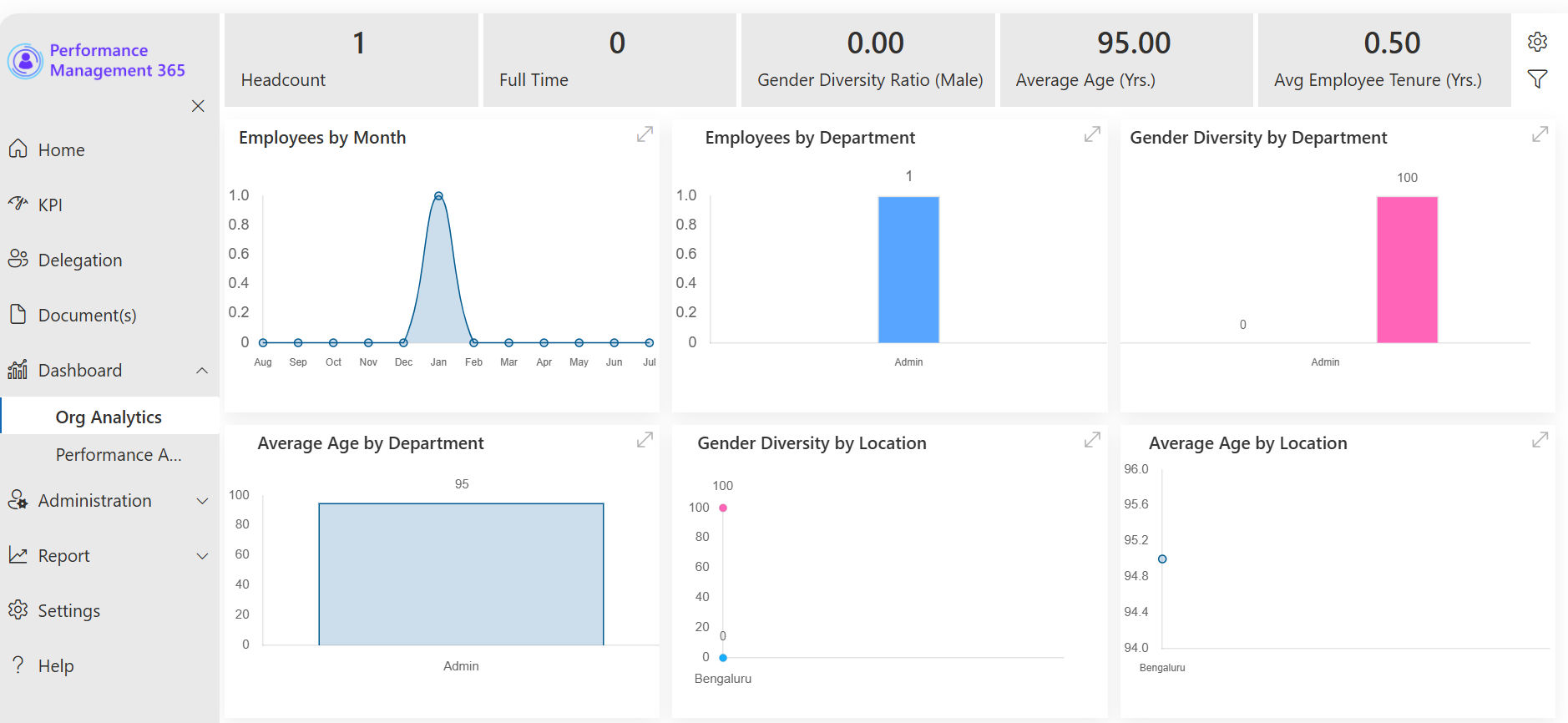
For HR leaders, Performance 365 provides a real-time analytics dashboard that surfaces the metrics that matter goal completion trends, rating distributions, feedback activity, high-potential indicators, and retention risk flags — all in one view.
For managers, it provides the data they need to have better coaching conversations. Instead of walking into a check-in with nothing but a vague sense of how someone is doing, managers can see goal progress, recent feedback, and engagement trends before the meeting starts.
For employees, it creates a clear picture of where they stand, what’s expected, and what they need to do to grow — which reduces the anxiety that comes from not knowing.
Performance analytics only works when the data is reliable, current, and accessible. Performance 365 makes all three possible without the manual work that makes most HR analytics projects collapse under their own weight.
Conclusion
📈 Ready to Turn Your Performance Data Into Decisions?
Performance 365 gives HR leaders the analytics infrastructure they need — centralized data, real-time dashboards, and actionable insights across goals, reviews, feedback, and retention risk. → Book your free Performance 365 demo today
Join Our Creative Community
Frequently Asked Questions
What is employee performance analytics?
Employee performance analytics is the process of collecting and analyzing data about how employees, teams, and departments are performing over time. It combines data from performance reviews, goal tracking, feedback, engagement surveys, and skills assessments to help HR leaders make better decisions about development, promotions, retention, and workforce planning.
What are the most important performance metrics for HR teams to track?
The most important metrics are goal achievement rate, performance rating distribution, continuous feedback frequency, employee engagement scores, skills development progress, recognition activity, high-potential indicators, and retention risk signals. Together these give HR a complete view of performance health — not just a snapshot of one review cycle.
How is employee performance analytics different from a regular performance review?
A performance review gives you a rating at one point in time. Employee performance analytics gives you trends, patterns, and comparisons across time, teams, and roles. Reviews are an input into analytics — but analytics goes much further by combining multiple data sources and showing you direction, not just position.
How do you identify high-potential employees using data?
Look for employees with consistent goal achievement across multiple review cycles, strong and improving competency ratings, active learning participation, positive peer recognition patterns, and leadership behaviors that show up in feedback. High potential is a trend — not a single review score.
What causes rating inflation and how does analytics help fix it?
Rating inflation happens when managers don’t have clear criteria, feel social pressure to avoid giving low ratings, or simply don’t have enough data to justify differentiating performance. Analytics helps by making rating distributions visible — when a manager sees that 90% of their team is rated “exceeds expectations” compared to a company average of 30%, that conversation becomes much easier to have.
How early can performance analytics detect retention risk?
In most cases, the signals appear three to six months before an employee decides to leave. Declining engagement scores, reduced feedback participation, stalled goal activity, and lack of career progression are all early indicators. The key is having systems that surface these signals in combination — not in isolation.
Do small HR teams need performance analytics?
Yes — arguably more than large ones. Small HR teams have fewer people to catch problems manually. Analytics surfaces issues early and helps small teams prioritize where to spend their limited time and resources. The tools don’t need to be complex — even tracking five or six key metrics consistently will give a small HR team a significant advantage.
How does Performance 365 support employee performance analytics?
Performance 365 centralizes all performance data — goals, review ratings, feedback, engagement scores, skills development, and recognition — in one platform. It provides HR leaders with a real-time analytics dashboard that surfaces trends, flags retention risk, identifies high performers, and tracks progress over time. Instead of spending days compiling reports from multiple systems, HR leaders can access the insights they need in minutes and use them to make faster, fairer workforce decisions.
What's the difference between performance analytics and workforce analytics?
Performance analytics focuses specifically on how employees are doing their jobs — goal achievement, review ratings, feedback, skills development. Workforce analytics is broader and includes headcount planning, hiring data, compensation analysis, and organizational structure. Performance analytics is a subset of workforce analytics, and it’s usually the best place for HR teams to start.


_JiluXJRGNl.svg)























