


A vendor once told a client, “we’ll handle the redesign.” Three months and $40,000 later, nobody agreed on what “redesign” meant.
- A scope of work (SOW) is the document that defines exactly what work will happen, who does it, when it’s due, and how success gets measured.
- Projects without a written scope of work are far more likely to suffer scope creep, missed deadlines, and budget overruns.
- A scope of work is not the same as a statement of work, even though people use the terms interchangeably.
- Strong contract management, including how you track renewals and obligations tied to your SOW, protects revenue long after the ink dries.
The vendor assumed the job covered equipment setup and basic testing. The manufacturer expected site preparation, electrical connections, operator training, and final commissioning to be included.
The problem wasn’t the work itself. It was that nobody had clearly defined what the project covered before work began.
That’s where a well-written scope of work makes a difference. It clearly defines the contract deliverables, specifications, responsibilities, timelines, and what falls outside the project.
What Is a Scope of Work?
A scope of work is a written document that spells out the tasks, deliverables, timeline, and responsibilities for a specific project. It answers one question in plain terms: what, exactly, did everyone agree to?
Think of it as the rulebook for a project. It names the deliverables. It sets due dates. It lists who’s responsible for what. It defines what “done” looks like, so nobody has to guess later.
A scope of work usually lives inside a larger contract or gets attached to one as an exhibit. It can be one page for a small freelance job or run dozens of pages for a construction build-out. The length changes. The purpose doesn’t: remove ambiguity before work starts, not after.
A Common Scenario
A manufacturer hires a vendor for “equipment installation,” but the phrase means different things to both sides. The vendor expects to install and test the equipment, while the manufacturer expects site preparation, electrical connections, and operator training too.
Since none of this was documented, the project stalls as both sides argue over what was included.
A clear scope of work defining the deliverables, contractual obligations, and exclusions could have prevented the dispute.
Why Do Contracts Need a Scope of Work?
Contracts need a clear scope of work because broad promises and verbal agreements can quickly lead to different interpretations. A contract may state that a vendor will “provide installation services,” but without defining exactly what that includes, both parties can walk away with different expectations.
A scope of work removes that ambiguity by documenting the specific deliverables, contract deadlines, specifications, timelines, and exclusions agreed upon by both parties.
It also gives the parties a clear reference point when questions or disagreements arise. If a customer asks for work that falls outside the agreed scope, the contract can establish whether it requires a change order, additional fees, or a separate agreement.
In this way, a scope of work does more than describe the work. It helps define contractual obligations, control unexpected changes, and reduce the risk of disputes.
Is a Scope of Work the Same as a Statement of Work?
A scope of work is narrower, it’s the section that defines tasks and deliverables. A statement of work is the broader contract document, and the scope of work usually sits inside it as one part.
Aspect | Scope of Work (SOW) | Statement of Work (also SOW) |
What it covers | Tasks, deliverables, timeline, responsibilities | The full working agreement: scope, payment terms, legal clauses, governance |
Legal weight on its own | Often an attachment or exhibit, not always independently enforceable | Typically the binding contract itself, or incorporated by reference into one |
Who writes it | Project managers, contract managers, or the delivery team | Legal, procurement, or contract management teams, often with input from delivery |
Typical use case | Defining “what work happens” for a specific engagement or phase | Formalizing the full commercial relationship, especially for larger vendor deals |
The naming can be confusing. Some businesses use “scope of work” to mean the entire agreement, but larger or complex contracts often use both: a Statement of Work (SOW) to define the overall engagement and a Scope of Work to detail the specific tasks and deliverables.
What Should a Scope of Work Include?
A scope of work is only useful if it’s specific. Vague language is where disputes live. Here’s what belongs in it.
- Project overview: A short summary of the business problem and the goal, so anyone reading it later understands the “why.”
- Deliverables: The exact things being produced: a report, a build, a set of assets. Name formats, quantities, and specs.
- Timeline and milestones: Start date, key checkpoints, and the final deadline. Milestones matter more than a single end date because they catch delays early.
- Roles and responsibilities: Who approves what, who delivers what, and who the point of contact is on each side.
- Acceptance criteria: How “done” gets measured. Without this, delivery becomes a matter of opinion.
- Assumptions and exclusions: What’s explicitly not included. This one line prevents more arguments than any other section.
- Pricing and payment schedule: Tied to milestones where possible, not just a lump sum at the end.
- Change management process: How new requests get evaluated, priced, and approved, instead of silently absorbed.
Skip any of these and you’ve left a door open for a contract dispute. The exclusions section, in particular, gets left out constantly, and it’s the one section that saves the most arguments.
Keep your contract obligations on track.
CLM 365 helps you manage obligations, deadlines, renewals, and approvals in one place, so nothing important gets missed.
How to Create a Scope of Work Step by Step?
A good scope of work clearly defines what the contract covers, contract governance, and what falls outside the agreement. Here’s how to create one step by step.
Step 1: Start with the problem, not the deliverable.
Briefly explain the business problem the contract is meant to solve. This gives both parties a clear understanding of the agreement’s purpose.
Step 2: Define deliverables clearly.
Avoid vague terms like “marketing materials” or “installation services.” Specify exactly what will be delivered, including relevant requirements, quantities, formats, or standards.
Step 3: Set dates for key milestones.
Include deadlines for important deliverables, not just the final completion date. Clear milestones help both parties track performance.
Step 4: Define what is excluded.
State what is outside the agreed scope and explain what happens when additional work is requested.
Step 5: Assign clear approval responsibilities.
Name who can approve deliverables or changes on each side. This avoids delays and confusion over who has authority.
Step 6: Review the SOW with the right people.
Have both delivery and contract teams review the document before it is finalized. They can identify practical and contractual gaps.
Step 7: Define the change order process.
Explain how changes will be requested, priced, approved, and documented before additional work begins.
Step 8: Keep the SOW accessible.
Store the signed SOW with the related contract so teams can easily find the agreed scope, obligations, and important dates.
What Common Mistakes Should You Avoid When Writing a Scope of Work?
Even a well-planned scope of work can create problems when key contract milestones are unclear or missing. Avoiding common drafting mistakes helps prevent confusion, extra costs, and contract disputes.
Vague Language: Terms like “regular updates,” “reasonable effort,” or “as needed” can mean different things to different parties. Define clear timelines, quantities, service levels, and conditions wherever possible.
Untracked Changes: New contract requests can quickly go beyond the original agreement. Record additional work through a change request or change order, including any impact on fees, timelines, and responsibilities.
Outdated Templates: Reusing an old template without reviewing its assumptions can carry forward incorrect requirements, technical details, team information, or regulatory references. Update the document for each contract.
Unclear Acceptance: Don’t assume both parties will agree on when a deliverable is complete. Set clear acceptance criteria, review periods, and contract approval requirements before work begins.
Static Documents: Treat the scope as an ongoing reference throughout the contract lifecycle. Review it at key milestones to ensure deliverables, obligations, and agreed terms remain aligned.
What are the Legal Implications of a Scope of Work?
A scope of work can have legal significance when it forms part of a signed contract, helping define what each party has agreed to deliver, when, and under what conditions.
- It can become part of the contract: When a scope of work is attached to a signed contract or clearly included by reference, its terms can become binding requirements for both parties.
- Vague wording can create problems: If the scope is unclear, it can be difficult to determine what each party agreed to deliver. In some cases, unclear language may also be interpreted against the party that drafted it.
- Clear details help resolve disputes: A well-defined scope provides written evidence of what was agreed, especially when disagreements involve deliverables, timelines, responsibilities, or payment.
- Poor contract management adds risk: One industry analysis found that 71% of businesses cannot locate at least 10% of their contracts. When agreements cannot be found, important obligations can easily be missed.
- Exclusions can protect both parties: Clearly stating what is not included helps prevent disagreements over additional work and shows what both parties understood to be outside the agreed scope.
- It can help establish a breach: If one party fails to deliver something clearly required by the agreement, the documented scope can help show what was promised and what was not delivered.
How Can a Scope of Work Protect Your Business?
A well-written scope of work is a business asset, not paperwork. Here’s how it protects you.
- It limits liability. If a deliverable was never included in the agreement, you can’t be held to producing it, and you have a document to prove it.
- It protects revenue. Every change request outside the original scope becomes a legitimate opportunity to bill more, instead of quietly absorbed labor. One industry report found organizations waste nearly 9.9% of every project dollar to unmanaged scope changes, money a clear scope helps you recover through proper change orders instead of losing.
- It protects relationships. Disputes over “what we agreed to” are some of the most damaging to a working relationship. A specific scope removes the argument entirely because there’s less room for conflicting interpretations.
- It creates an audit trail. When contract obligations, deliverables, and deadlines are documented, you can prove compliance, defend against a claim, or demonstrate performance history if the relationship comes up for renewal or renegotiation.
- It reduces the human error factor. Loose verbal understandings depend on memory. Written scopes don’t. Given that a large share of contract management failures trace back to human error in tracking and communication, a specific scope removes one of the biggest points of failure before it happens.
How Do Scope of Work Requirements Differ by Industry?
A scope of work isn’t one-size-fits-all. What belongs in it changes based on the field.
- Construction: SOWs need extreme physical specificity, materials, quantities, safety codes, permits, and site conditions. A missing measurement or code reference can halt a project or trigger a compliance violation.
- Software and IT: The agreement lean on defined sprints, acceptance testing criteria, and integration requirements. Because requirements are abstract until something is built, exclusions and change control matter more here than almost anywhere else.
- Professional services (legal, consulting, marketing): Scope of work focus on deliverables, review cycles, and revision limits, since the “product” is often knowledge work rather than a physical output.
- Healthcare and regulated industries: Healthcare contracts must reference compliance standards, data privacy requirements, and audit rights, because a scope gap here can trigger regulatory exposure, not just a billing dispute.
- Government contracting: Federal contracts is often the most rigid of all, following strict templates with defined performance metrics, because public funds require documented accountability at every stage.
The common thread across every industry, the more regulated or physically complex the work, the more specific the scope needs to be, and the more consequences follow from getting it wrong.
Role of CLM 365 in Managing Obligation and Deadlines
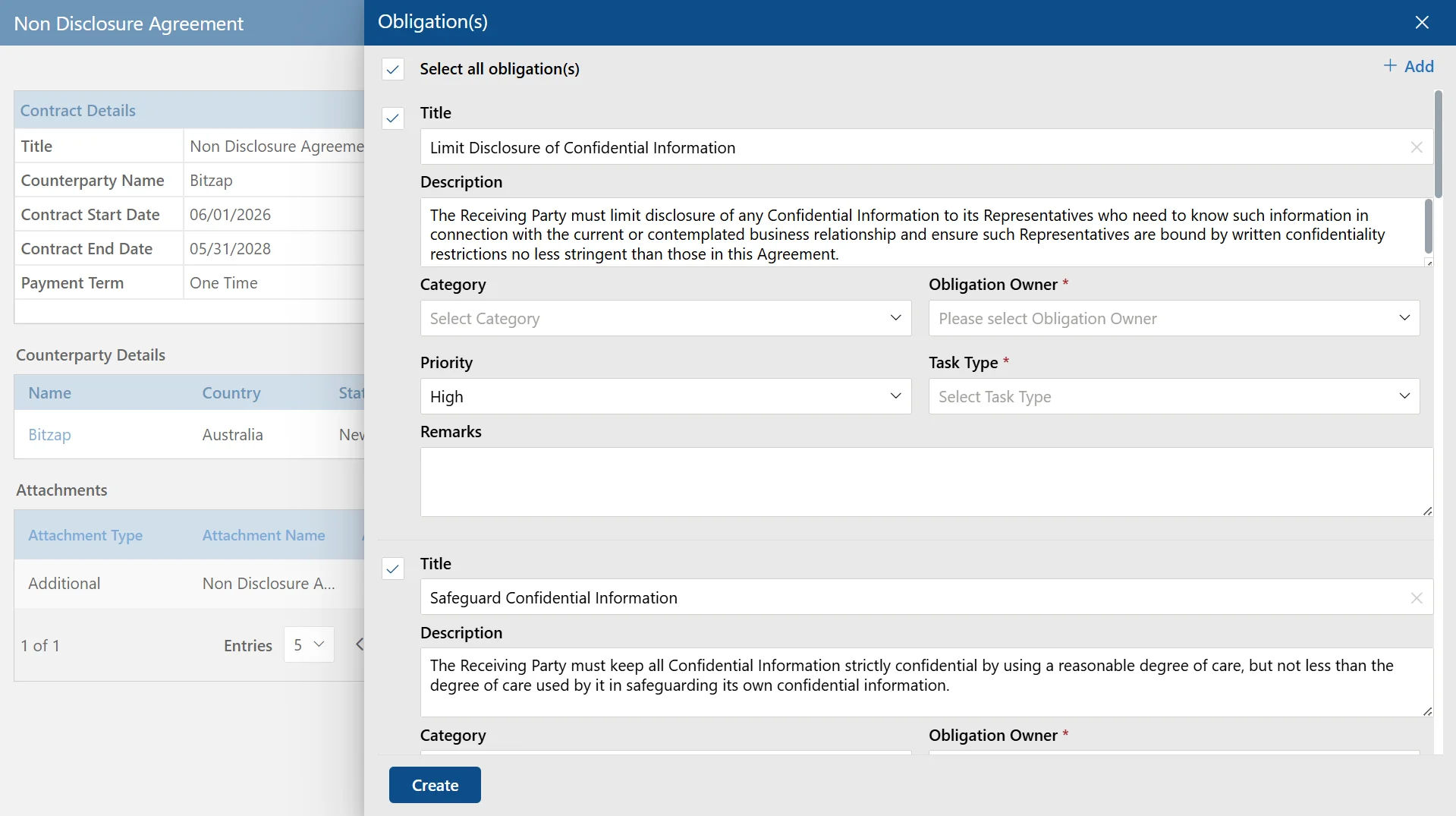
CLM 365 helps teams manage contracts, renewals, and obligations in one place while working with the tools they already use. It integrates with Microsoft 365 apps, Adobe Acrobat Sign, and DocuSign, making it easier to create, review, sign, and manage agreements.
With AI, CLM 365 can highlight important deadlines, contract obligations, and risky clauses, helping teams identify which agreements need attention first. Internal teams can quickly see high-priority contracts and take action before deadlines or obligations are missed.
Built with enterprise-grade security and a user-friendly interface, CLM 365 makes contract management easier for growing businesses and large enterprises.
The platform is backed by SOC 2 compliance, Microsoft certification, and Microsoft Solutions Partner status, providing a trusted environment for managing sensitive contract data.
CLM 365 also supports GCC and GCC High environments, helping highly regulated organizations meet strict security and data protection requirements.
Conclusion
A clear scope of work helps prevent disputes by defining deliverables, timelines, responsibilities, and exclusions from the start. But documenting the agreement is only the first step. Teams also need to track deadlines, obligations, renewals, and changes after signing.
CLM 365 helps you do both. With AI-powered insights, Microsoft 365 integrations, and centralized contract management, your team can identify important obligations and prioritize contracts that need attention.
Make every contract easier to manage. Explore CLM 365 today.
Frequently Asked Questions
Can I assign contract obligations to specific team members?
Yes. Assigning responsibility makes it clear who needs to complete or monitor each obligation and reduces the chance that an important commitment is overlooked.
Can we track obligations for different departments?
Yes. obligations can be assigned to the relevant departments or individuals, helping legal, procurement, finance, sales, and operations understand what they need to do.
Does AI identify risky clauses related to our obligations?
Yes. AI identifies and highlights potentially risky clauses, important obligations, and key contract terms, helping teams quickly spot contracts that need closer attention.
How can we prevent important renewals from being missed?
The system sends alerts for upcoming renewal dates, giving teams enough time to review the contract and take action before it renews or expires.
Can we track whether a deliverable has been completed?
Yes. Teams can track the status of deliverables and obligations, including completed, pending, and overdue items.


_JiluXJRGNl.svg)























