
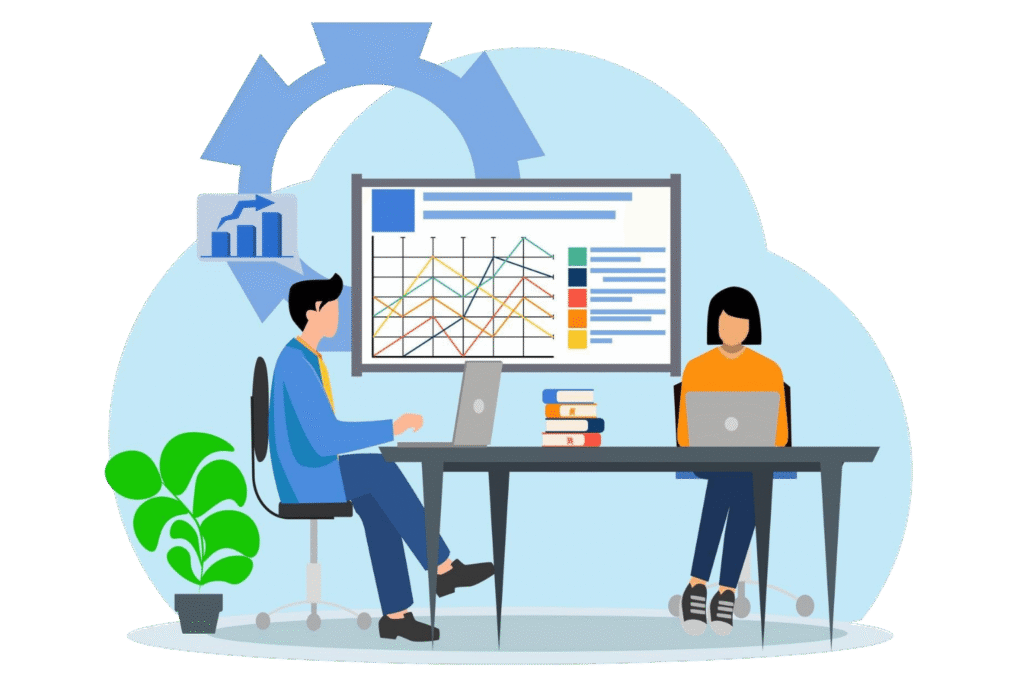
How Performance Evaluation Software Improves Employee Development
_eH2jDg7dZ.png)
Performance evaluation software is a system that helps HR teams and managers plan, run, and document structured assessments of employee performance — replacing paper forms, spreadsheets, or disconnected survey tools with a single platform for goal tracking, feedback, ratings, and development planning.
Used well, it does more than produce a score at the end of the year. It turns scattered feedback into a continuous record that managers and employees can actually act on — which is the real mechanism by which it improves employee development, not just performance measurement.
- Performance evaluation software formalizes goal-setting, feedback, and ratings into a system of record — reducing recency bias and rating inflation compared to manual annual reviews.
- Performance evaluation software and performance management software are often used interchangeably, but evaluation software is narrower, focused on the appraisal cycle itself, while management software adds continuous check-ins, engagement, and OKR tracking.
- Calibration tools and structured rating scales are the single biggest lever for reducing manager bias, more important than which review format (annual, 360, continuous) a company chooses.
- Integration with payroll, and learning systems determines whether evaluation data actually drives promotions, comp decisions, and training — disconnected tools rarely do.
Research on workplace performance management consistently finds that a large share of employees don’t feel traditional annual reviews help them grow — one widely cited Gallup finding puts the number who strongly agree their review inspires them to improve at roughly 1 in 7. That gap between “we evaluate people” and “people actually develop” is the problem this category of software exists to close.
This guide covers what performance evaluation software is, how it differs from broader performance management platforms, the features that actually drive development (not just documentation), how to choose a system, and the governance issues most vendors gloss over.
What Is Performance Evaluation Software?
Performance evaluation software is a digital system used to plan, conduct, score, and document structured assessments of employee performance, typically covering goal progress, competencies, manager and peer feedback, and self-assessments within a defined review cycle.
It replaces three things most HR teams still patch together manually:
- Paper or PDF review forms routed by email
- Spreadsheets used to track ratings, calibration, and completion status
- Standalone survey tools used for 360-degree feedback that don’t connect back to the review record
Core users are HR/People Ops teams (who own the process), managers (who conduct reviews), and employees (who complete self-assessments and receive feedback). Most platforms also expose analytics to leadership — completion rates, rating distributions, and promotion-readiness signals.
Why Traditional Performance Reviews Fall Short
Before looking at software, it’s worth being specific about the problem it solves — “improves employee development” is a vague claim unless you know what’s actually broken in the manual process.
Three well-documented failure modes in unstructured or infrequent reviews:
- Recency bias. Managers rate based on the last few weeks, not the full period, because there’s no running record of feedback.
- Rating inflation and central tendency. Without calibration, most employees cluster around “meets expectations,” making ratings nearly useless for identifying who needs development support versus who’s ready for more responsibility.
- Feedback too infrequent to act on. Annual-only cycles mean an employee can carry a skill gap for eleven months before anyone documents it formally.
Multiple HR-research organizations (Deloitte and Gartner/CEB-affiliated studies are the ones most often cited) have reported that a majority of HR executives don’t believe their current performance review process actually drives engagement or high performance. The specific percentage varies by survey year and should be sourced and dated before this goes live.
Core Features of Performance Evaluation Software
Not every platform ships every feature below, and feature-count isn’t the same as fit — but this is the set worth evaluating against, organized by what each feature is actually for.
Feature | What It Does | Development Impact |
Goal & OKR tracking | Ties individual goals to team/company objectives, tracks progress over the cycle | Gives employees a concrete target to develop against, not just a rating |
Continuous check-ins | Lightweight, recurring 1:1 or weekly feedback logs | Catches skill gaps in weeks, not months |
360-degree feedback | Collects input from peers, direct reports, and cross-functional partners | Surfaces blind spots a single manager wouldn’t see |
Competency & skill frameworks | Defines what “good” looks like at each level/role | Turns subjective ratings into comparable, coachable criteria |
Calibration tools | Lets managers compare and adjust ratings across teams before finalizing | Reduces rating inflation and manager-to-manager bias |
Individual Development Plans (IDPs) | Auto-generates or templates a growth plan from review outcomes | The direct link between “evaluation” and “development” |
People analytics dashboards | Visualizes completion rates, rating distribution, trends over time | Lets HR spot systemic gaps (e.g., one team consistently under-trained) |
AI-assisted drafting & bias flagging | Suggests review language, flags loaded or vague phrasing | Saves manager time and can catch some (not all) biased language patterns |
How Performance Evaluation Software Improves Employee Development
This is the mechanism most competitor content skips — they list features but don’t explain how those features actually produce development outcomes. Here’s the causal chain:
- Clarifies expectations through goal alignment. Employees can’t develop toward a target they don’t understand. Linking individual goals to team OKRs inside the tool removes ambiguity about what “good performance” means.
- Increases feedback frequency. Shifting from a once-a-year event to continuous check-ins means skill gaps get flagged in weeks, not months — while there’s still time in the cycle to close them.
- Surfaces skill gaps objectively. 360-degree and competency-framework data gives a fuller picture than one manager’s opinion, especially useful for skills a direct manager doesn’t directly observe (cross-functional collaboration, for example).
- Converts evaluation data into an actual development plan. This is the step manual processes almost always skip. A rating without a follow-up IDP is just a record; a rating that auto-populates a development plan with recommended actions, courses, or stretch assignments is a growth mechanism.
- Reduces bias through calibration and structured scales, which matters for development specifically because biased ratings systematically under-invest in the development of employees rated unfairly low.
- Connects performance data to learning content. Platforms that integrate with an LMS (or expose data to BI tools like Power BI) can route a flagged skill gap directly to relevant training. [INTERNAL LINK: /blog/lms-reporting-software-with-power-bi “see how LMS analytics platforms structure this data”]
- Surfaces promotion and succession readiness. Tools that support 9-box grid mapping (performance × potential) give both employee and manager a shared, visual answer to “what’s next for me,” which is itself a development conversation.
Illustrative example (not a real company): A 200-person software company moves from an annual paper review to a platform with quarterly check-ins and calibration. Over the first two cycles, manager rating variance across teams drops noticeably after calibration sessions, and the share of employees with a documented IDP goes from near-zero to full coverage — because the plan is generated as part of closing out the review, not as a separate manual step.
Performance Evaluation Software vs. Performance Management Software
These terms get used interchangeably in marketing copy, but they describe different scopes — and buyers searching “performance evaluation software” are often actually deciding between the two.
| Performance Evaluation Software | Performance Management Software |
Core focus | The appraisal cycle: ratings, forms, calibration | Continuous performance: goals, check-ins, engagement, evaluation |
Typical cadence | Annual, semi-annual, or quarterly cycles | Ongoing — weekly/biweekly check-ins plus formal cycles |
Primary output | A completed, documented review | Development plans, engagement data, and reviews |
Best fit | Companies formalizing a first structured review process | Companies wanting continuous feedback plus formal evaluation |
Feature overlap | Ratings, 360 feedback, calibration | Everything evaluation software has, plus OKRs, pulse surveys, recognition |
In practice, most modern platforms sold as “performance evaluation software” have absorbed continuous-feedback features and function as performance management software — so the distinction matters more for search intent than for actual product selection.
Common Performance Evaluation Methods These Tools Support
Method | Frequency | Best For | Watch-Outs |
Annual review | Once/year | Compliance-driven documentation | Recency bias, low development value alone |
360-degree feedback | 1–2x/year | Roles with cross-functional impact | Needs anonymity safeguards to stay honest |
Continuous check-ins | Weekly/biweekly | Fast-moving teams, coaching culture | Requires manager discipline to sustain |
OKR-based evaluation | Quarterly | Goal-driven, outcome-focused teams | Can undervalue non-measurable contributions |
Self-assessment | Paired with any cycle | Employee voice, self-awareness calibration | Should never be the sole input |
Peer review | Paired with 360 or standalone | Team-based or matrixed org structures | Risk of “favor trading” without structure |
9-box grid (performance × potential) | Annual, tied to succession planning | Promotion and succession decisions | Can feel opaque to employees if not explained |
How to Choose Performance Evaluation Software
By company size:
- Under ~50 employees: Prioritize simplicity and fast setup over deep customization. A lightweight tool — or even a well-structured spreadsheet — may be enough until review volume justifies software.
- 50–500 employees: This is where most buyers evaluate dedicated evaluation software — the manual process starts breaking down, and calibration/analytics start to matter.
- 500+ employees: Prioritize HRIS/SSO integration, role-based permissions, and audit trails — at this scale, process consistency and compliance matter as much as features.
Build vs. buy vs. spreadsheet:
- Spreadsheet/manual: Free, but doesn’t scale past a few dozen employees and has no audit trail or calibration support.
- Buy a dedicated platform: Fastest to deploy, with purpose-built calibration and analytics — the right default for most teams.
- Build internally: Rarely worth it outside very large enterprises with unusual compliance requirements; the ongoing maintenance cost of a homegrown review system is easy to underestimate.
Integration checklist:
- Does it sync with your HRIS (employee records, org chart, role changes)?
- Does it support SSO for security and adoption?
- Does it connect to payroll/comp systems if ratings feed merit increases?
- Does it expose data to (or integrate with) your learning system, so flagged skill gaps can route to training?
Compare against your current process and bring your existing review template — most vendors will map it into the platform live.
Data, Bias, and Legal Considerations
This is the section most competitor content skips entirely, and it matters for both trust and, in some jurisdictions, real legal exposure.
- Calibration reduces bias, but doesn’t eliminate it. Structured rating scales and cross-manager calibration sessions catch obvious inflation and deflation, but they require someone to actually run the session — software provides the mechanism, not the discipline.
- Documentation matters for defensibility. Consistent, dated, structured evaluation records are generally more defensible in employment disputes than ad hoc notes — this reflects general HR practice, not legal advice, and organizations should confirm requirements with employment counsel for their jurisdiction.
- Data privacy. Performance data is sensitive personal data. If you operate in the EU/UK, GDPR-relevant considerations include data minimization, retention limits, and employee access rights to their own review data. Role-based access control — so peer feedback isn’t visible to the wrong people — is a baseline requirement, not a nice-to-have.
- AI-assisted drafting has limits. AI features that suggest review language or flag biased phrasing can help catch some patterns (vague language, loaded adjectives), but they don’t replace calibration — a well-written biased review is still biased.
Common Implementation Pitfalls
- Rolling out software without changing the process. Digitizing a broken annual review just makes the broken process faster, not better.
- Skipping calibration training. The tool can support calibration; it can’t run the meeting for you.
- Not connecting evaluation data to development action. If ratings dead-end at a PDF, the “development” half of the promise never happens — this is the single most common gap.
- Ignoring manager adoption. A platform with low manager engagement produces worse data than a well-run spreadsheet.
- Treating 360 feedback as fully anonymous when it isn’t. Small teams or unusual phrasing can make feedback identifiable — set expectations honestly.
Conclusion
Performance evaluation software earns its place in an HR stack when it does more than digitize a form — when it turns goal-setting, feedback, and ratings into a continuous record that actually feeds development plans, flags skill gaps early, and reduces the bias that undermines fair growth opportunities. The features matter less than whether the platform closes the loop from “here’s your rating” to “here’s your plan and the resources to act on it.
Join Our Creative Community
Frequently Asked Questions
What is performance evaluation software?
Performance evaluation software is a platform for planning, conducting, scoring, and documenting structured employee performance assessments — replacing manual forms and spreadsheets with a system that tracks goals, feedback, ratings, and (in more complete platforms) development plans.
How is performance evaluation software different from performance management software?
Evaluation software focuses narrowly on the appraisal cycle itself (ratings, forms, calibration). Performance management software is broader, adding continuous check-ins, OKR tracking, and engagement features alongside evaluation. Most modern platforms blend both.
Do small businesses need performance evaluation software?
Not always immediately. Companies under roughly 50 employees can often manage with a structured spreadsheet or lightweight tool; dedicated software tends to pay off once review volume and calibration needs outgrow manual tracking — typically in the 50–500 employee range.
Does performance evaluation software eliminate manager bias?
No single tool eliminates bias. Structured rating scales, calibration sessions, and 360-degree input reduce common bias patterns (recency bias, rating inflation), but they require managers to actually use the calibration process — the software provides the mechanism, not the discipline.
How much does performance evaluation software typically cost?
Pricing is usually per-employee-per-month, with small-business tiers and enterprise contracts varying widely. Exact figures should be confirmed against current vendor pricing pages rather than quoted from memory.
Can performance evaluation software integrate with our HRIS and payroll systems?
Most established platforms support HRIS sync (for employee records and org structure), and many integrate with payroll or compensation systems so ratings can feed merit-increase workflows — confirm specific integrations during evaluation, as depth varies significantly by vendor.
Is 360-degree feedback necessary, or is manager-only review enough?
Manager-only review is faster to run but misses input on cross-functional and peer-visible behaviors. 360-degree feedback is most valuable for roles with significant cross-team collaboration; for narrowly scoped individual-contributor roles, manager-plus-self-assessment may be sufficient.
Can AI-generated review drafts replace manager judgment?
No. AI drafting tools can speed up writing and flag some biased or vague language, but the underlying judgment about performance — and the calibration conversation — still require a human manager. AI assistance reduces effort, not accountability.
Table of Contents
- Core Features of Performance Evaluation Software
- Performance Evaluation Software Improves Employee Development
- Performance Evaluation Software vs. Performance Management Software
- Common Performance Evaluation Methods These Tools Support
- How to Choose Performance Evaluation Software
- Common Implementation Pitfalls


_JiluXJRGNl.svg)























