
_3Md7mlgYD.webp)

The contracts are the heart of business operations, and most companies continue to use manual approaches to contract analysis.
Every contract is subject to various terms and conditions, whether that is sales agreements and vendor clauses, offer letters and non-disclosure documents.
In this blog, we explore how contract analysis software helps businesses manage contracts more effectively while improving the productivity of internal teams. We also look at how AI-driven insights reduce manual effort, improve visibility, and support faster decision-making across departments.
This growing complexity has prompted companies to use contract analysis software. These tools are AI-driven, reviewing legal documents, surfacing key terms, monitoring key dates, and eliminating manual work.
According to Thomson Reuters, 53% of organizations report seeing at least one clear benefit after adopting AI, highlighting how rapidly intelligent technology is reshaping business operations.
What Is Contract Analysis Software?
Contract analysis software uses AI to scan and interprets contract documents. It assists companies to summarize contracts, find potential risks and verify that the contracts are in line with the company rules and legal regulations. It assists teams to save time and work more efficiently by eliminating the necessity to go through each line of the contract.
Why Is Contract Analysis Important
- Companies deal with numerous contracts and unless they are reviewed properly, they might overlook some important information. Contract analysis software sheds helps analyze contracts, increasing the number of deals.
- Contracts tend to be lengthy and full of legal terminology. With the increase in the number of contract numbers, teams require a faster way to analyse contracts.
- Businesses are bound by the law, regulations and industry regulations. Contract analysis software assists in the identification of missing clauses or obligations.
- Certain terms of the contract can be unclear or open to interpretation, thereby raising the risk of business. Contract analysis software assist teams in having a clear vision of roles and responsibilities.
- Most contracts have some business information that is disregarded. Good analysis is useful in revealing useful information that lies in clauses, dates, and conditions.
- Delays in approvals and decisions may be caused by slow review of contracts in fast-paced industries. Contract analysis helps in faster reviews to enable teams to proceed with work without undue delays.
Supporting this shift, a Gartner survey found that 30% of law firms reported higher productivity after adopting AI, highlighting the growing role of intelligent tools in contract-related work.
How Does Contract Analysis Software Works?
AI Contract analysis software uses AI to break down complex contracts into clear, easy-to-manage actions. Here’s a detailed look at how it works:
Step 1: Upload the Contract
The process starts with the uploading of the contract document which is normally in PDF format. The contract analysis software scans the file and makes it ready to be analysed without altering the original file.
Step 2: Scan and Understand the Contract
After uploading, the AI summarizes the whole contract through the whole document and gets to know the context of every clause. It recognizes key areas like obligations, deadlines, renewal terms and responsibilities.
Step 3: Extraction of Key Obligations and Terms
The contract analysis software extracts obligations and significant information in the contract automatically and presents them in a formatted format. This simplifies the process of observing what is to be done and when it should be done.
Step 4: Review and Ownership
The contract can be reviewed by teams to ensure that it is accurate. The obligations can then be allocated to the relevant owner with a priority level attached to it so that everybody knows who is to do what.
Step 5: Determine Type of Task and Schedules
The users are allowed to indicate tasks as recurring or one-time. In case of recurring obligations, it is possible to set start dates, frequency and end dates to aid in dealing with recurring responsibilities over time.
Step 6: Publication of the Contract to be Tracked
Once reviewed, the contract is signed and made public. This enables tracking and enables the system to track obligations in the contract lifecycle.
Step 7: Track the Progress using a Dashboard
All the duties and responsibilities are displayed on a central dashboard. The teams can monitor the progress, check updates and approve or reject completion of tasks.
Key Features of Contract Analysis Software
These are the main characteristics that make the contract analysis software a valuable tool to the contemporary business that deals with complex agreements.
1) AI-Powered Clause Summarization
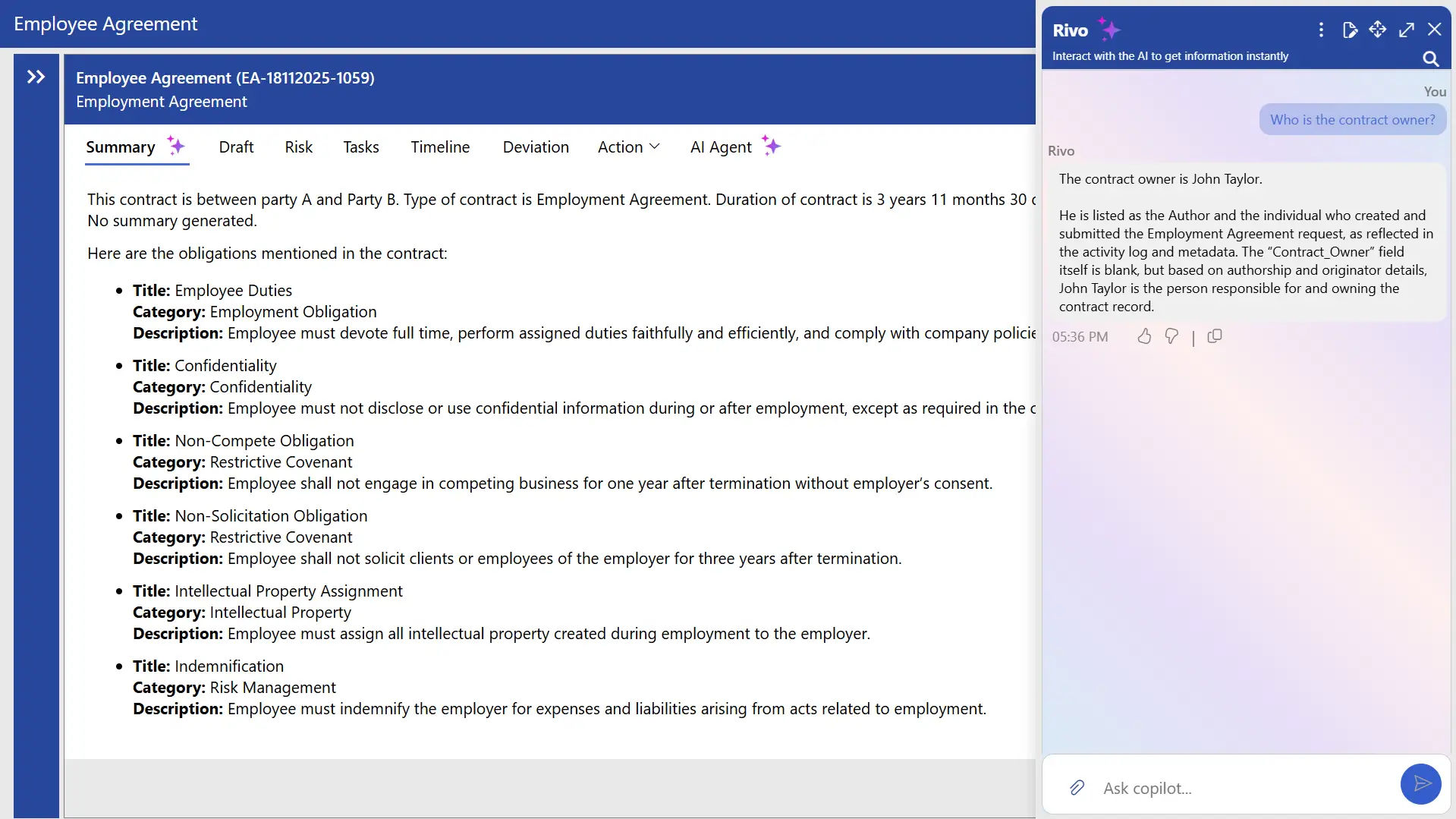
Legal contracts are lengthy and not easily comprehensible particularly by non-legal teams. Clause summarization AI-powered contract lifecycle management summarizes legal language into simple explanations and assists teams to grasp clauses swiftly. According to a Thomson Reuters study, survey respondents estimate that AI can save up to five hours per week, which adds up to around 240 hours per year, delivering an average annual value of $19,000 per professional.
This highlights how automated summaries reduce reading time and help teams focus on more meaningful work.
2) Advanced Risk Detection
Certain terms of the contract can subject businesses to financial, legal or operational risks. The contract analysis software checks every clause and points out the wording that can result in possible problems. Teams can benefit by spotting risky terms early, and then have time to consider, or renegotiate agreements.
3) Alternative Clause Suggestions
Not every business situation fits into all the clauses of a contract. In addition to the identification of risks, contract analysis software also proposes more balanced and practical alternative clauses. Where one of the clauses is found to be unfavourable, the system suggests alternatives that are legally sound clauses.
4) Industry-Relevant Clause Identification
Various industries have various standards and regulations. Contract analysis software is aware of this and highlights automatically the clauses that are industry specific. Regardless of the sphere of your business healthcare, finance, technology, or manufacturing, the software recognizes the most valuable terms.
5) Obligation Management
Some of the common responsibilities that are contained in contracts are delivery schedules, payment schedules, and renewal schedules. Contract obligation management capabilities monitor such requirements and alert teams before significant dates. This keeps the teams on track of what is ahead and minimizes the risk of failing to deliver on important commitments.
6) Searchable Contract Repository
Handling large volumes of contracts can be challenging without a structured system. A searchable contract repository stores all agreements in one secure location. With advanced search options, users can quickly locate specific contracts, clauses, or keywords, saving time and improving access to important information.
7) Version Control and Audit Trails
It is necessary to track the changes in the contract to ensure transparency and accountability. Audit trails and contract version control keep a record of all edits, comments, and approvals. Teams can see past versions, compare changes, and see who made changes at any given time.
Benefits of Using Contract Analysis Software
These are some of the main advantages of contract analysis software that can be used to enhance workflows, minimize legal risks, and contribute to better business results.
1. Time Savings
Companies are also investing more in AI to enhance productivity. The value that businesses place on intelligent automation is expected to increase as corporations are projected to increase their AI expenditure by 2026 to about 0.8 percent to almost 1.7 percent of the total revenue.
Contract analysis software significantly reduces the time spent reviewing agreements. Legal and procurement teams do not have to read contracts line by line, but automated contract summary software can scan the documents, extract the essential information, and highlight the important parts in a short period of time. Tasks that previously required several days can now be completed within hours, making it easier to handle high contract volumes without slowing operations.
2. Improved Accuracy
Reviewing of contracts manually may fail to identify significant clauses, absent terms, or inconsistencies. Contract analysis software checks all sections of the contract and breaks down legal language into straightforward and organized data. The system underlines the absence of clauses, signals suspicious wording, and identifies possible risks.
3. Smarter Business Decisions
Contracts also hold important information regarding the price, renewal duration, responsibilities, schedules, and risk exposure. Contract analysis software records this information and displays it in the form of reports and contract dashboard. Having access to structured contract data, leadership teams will be able to determine the general patterns of negotiation, assess the and assess the performance of contracts.
4. Cost Reduction
Large amounts of contracts tend to raise the cost of legal review, particularly in cases where external legal assistance is required. The contract analysis software saves time on the manual reviews, which results in lower legal costs and lower operational costs. The contract analysis software enables legal professionals to focus on the more complex cases that need their expert.
5. Faster Revenue Recognition
The delay in contract review can postpone the project kickoffs and revenue schedule. Contract analysis software accelerates the contract reviews and approval, assisting deals in a faster process. The sales teams can speed up going through the proposal to signed agreement and the finance teams records the revenue sooner and enhance financial planning.
6. Consistency and Compliance
It is significant to keep the same language of contracts in all teams to safeguard the business interests and to comply with the regulations. Contract analysis software uses clause library terms and structure. This assists businesses to have consistent contract standards, less variation of clauses and remain consistent.
7. Better Team Collaboration
Contracts often involve multiple departments such as legal, sales, finance, and operations. Contract analysis software provides a shared platform where all teams can access contract details, obligations, and updates.
This shared visibility helps teams stay aligned, track responsibilities clearly, and work together more effectively throughout the contract lifecycle.
When Should a Business Adopt Contract Analysis Software?
Growing contract volumes begin to slow down manual reviews and increase workload for legal or procurement teams.
- Critical dates like renewals, expirations and deliverables are hard to keep track of in several agreements
- Various departments deal with contracts, which leads to a necessity to have a common view of the conditions and obligations
- Law firms waste time in going through routine contracts rather than doing any complicated or strategic work
- Regulatory or industry requirements are also operations that require more attention to the contract clauses
- The language and structure of contracts differ extensively, and it is more difficult to ensure uniformity in contracts
- Contract data is needed to give leadership a clearer insight to aid in planning and performance reviews
- Slow contract reviews begin to impact deal closure, project schedule or revenue budget
Things to Consider Before Selecting Contract Analysis Software
The choice of the appropriate contract analysis software contributes significantly to the effectiveness with which a business handles the agreements, risks, and obligations. Here are points to evaluate.
1. Accuracy of AI Analysis
The main advantage of the contract analysis software is the ability to read and analyse contracts with the highest level of accuracy. It must be able to recognize contract clauses, obligations, key dates, and possible areas of risks in various contract-based formats with reliability. High accuracy eliminates the reliance on repeated manual reviews and enables teams to operate on extract information effectively.
2. Ease of Use for Business Teams
Legal teams do not deal with contracts independently. An easy and user-friendly interface allows non-legal users to view agreements, follow-up on delegated tasks, and retrieve significant details. The ease of use facilitates quicker adoption and enables the teams within different departments to work more efficiently with contracts.
3. Customization for Your Contract Types
Some types of contracts that businesses are involved with include sales contracts, vendor agreements, employment letters, and NDAs. The software must enable the customization of clause libraries, workflows and review rules to enable to exact contract arrangements that your organization employs. This flexibility will make the system more applicable to everyday operations.
4. Scalability as Contract Volume Grows
The more organizations grow, the more contracts they have. Higher contract volumes should be supported with contract analysis software without any performance problems. It facilitates businesses to remain on the same platform as their contract requirements increase as time goes by.
5. Reporting and Analytics Capabilities
Contracts hold useful information concerning commitments, schedules, costs, and risks. Reporting and analytics capabilities assist in transforming this information into clear dashboards and summaries. These are insights that help in tracking, planning, and continuous review of performance of the contract.
6. Integration With Existing Business Systems
Contract data may be required to integrate with other and existing business systems. Integration features enable the flow of contract information between systems to enhance visibility and minimize manual data processing.
7. Security and Access Controls
Contracts include sensitive legal and business information. Strong security measures such as role-based access, permission controls, and data protection features help safeguard documents while allowing teams to access only the information relevant to their role.
Challenges Faced During Contract Analysis Process
Here are some common challenges faced during the contract analysis process, along with practical ways to address them and improve the overall review experience.
Contract Analysis Challenges | Best Practices to Address Them |
Manual review overload | Prioritize contracts based on business impact and urgency |
Complex legal language | Align legal and business teams on shared interpretations |
Review process delays | Break reviews into sections with defined focus areas |
Multiple reviewer inputs | Assign a lead reviewer to consolidate feedback |
Unclear review scope | Define review objectives before starting analysis |
Inconsistent review approach | Set internal deadlines aligned with deal timelines |
Limited review bandwidth | Batch similar contracts for structured review cycles |
Missed review insights | Use standard review guidelines across teams |
Future of AI in Contract Management
AI is set to play an increasingly important role in how organizations manage contracts, from review and analysis to long-term oversight. Legal teams are beginning to see AI not as a replacement, but as a practical support that improves speed, visibility, and decision-making.
Thomson Reuters research reflects this shift clearly. Around 72% of legal professionals believe AI is having a positive impact on their work, showing growing acceptance of AI across legal functions. This supports more efficient contract processes.
As AI adoption grows, integration is becoming a key focus. According to the Federal Bar Association, 43% of respondents said integration with trusted software was the top factor when investing in legal-focused generative AI tools. This highlights the demand for AI solutions that work smoothly within existing legal and business systems.
Looking ahead, AI-driven contract management will continue to evolve toward deeper insights, better collaboration across teams, and stronger alignment with business goals. As organizations invest further in legal technology, AI will become a core part of managing contracts at scale while supporting accuracy, transparency, and long-term value.
How CLM 365 Helps in Analysing Contracts
CLM 365 is certified and built within the Microsoft ecosystem. It integrates with SharePoint, Microsoft Teams, Word, PowerPoint, Power Automate, and Microsoft Copilot. With AI built into the platform, it helps analyse contract clauses, track risks and obligations, and enables non-legal teams to understand clauses faster through AI-driven assistance.
Conclusion
Contract analysis software has become essential for businesses that want to control legal risk and manage agreements better. With AI-based insights, improved compliance, and quicker reviews, the right solution helps teams take informed actions and move deals forward without delays.
See how CLM 365 makes a real impact. Book a free demo today and learn how intelligent contract tools can support your daily business operations.
Join Our Creative Community
Frequently Asked Questions
What types of contracts can it review?
The platform can review a wide range of contracts, including NDAs, supplier and vendor agreements, master service agreements, employment contracts, lease documents, and more.
Can AI automatically summarize an entire contract document into key points?
Yes. AI can quickly read a full contract and turn it into short, clear key points. It highlights important clauses like payment terms, duration, obligations, penalties, renewal dates, and termination conditions. This helps users understand the contract without reading every page.
How does risk assessment in contracts work with AI contract analysis tools?
AI scans the contract and looks for risky or unusual clauses. It compares terms against standard or preferred language and flags issues such as high liability, missing clauses, strict penalties, or unclear obligations.
Does AI contract analysis software help non-legal teams?
Yes. AI agents allow users to select any clause in a contract and instantly get a clear explanation. This helps sales, HR, finance, and operations teams understand contracts quickly without legal expertise, reducing reliance on legal teams for routine reviews.
How does contract analysis software help improve team productivity?
Contract analysis software saves time by automating contract review tasks. Teams spend less time reading documents manually and more time making decisions.
Power Productivity—Start Today
All Your Work, One Smart Platform
Your Team's New Favorite Workspace
Organize, Collaborate, and Thrive—For Free

Trusted by the Best

_JiluXJRGNl.svg)























